

Daily Devotional
Friday, August 4, 2028 (NS), July 22, 2028 (OS)
Fast Day, but Wine and Olive Oil Allowed.
Friday of the Ninth Week
The commemoration of the holy Myrrh-bearer and Equal-to-the-apostles Mary Magdalene, and Hieromartyr Phokas of Sinope (commemorated on some Gk. calendars on either the 21st or 23rd of July), and the Virgin-martyr Markella of Chios.
Scripture Readings
Paschalion — Movable Calendar
Friday of the Ninth Week
Epistle
The Reading is from the First Epistle of Saint Paul to the Corinthians [§ 157]. Brethren:
14 26Whenever ye come together, each one of you hath a psalm, hath a teaching, hath a tongue, hath a revelation, hath an interpretation. Let all things be done with a view to edify. 27If anyone speak in a tongue, let it be by two or at the most three, and in turn, and let one interpret. 28But if there be no interpreter, let him keep silent in church; and let him speak to himself and to God. 29And let two or three prophets speak, and let the others discern. 30But if anything should be revealed to another sitting by, let the first keep silent. 31For ye can all prophesy one by one, that all may learn and all may be comforted. 32And the spirits of prophets are subject to prophets. 33For God is not a God of confusion, but of peace, as in all the churches of the saints.
34Let your women keep silent in the churches; for it hath not been permitted to them to speak, but to be subordinate, even as also saith the law. 35And if they wish to learn anything, let them inquire of their own husbands at home; for it is shameful for women to speak in church. 36Or did the word of God come forth from you? Or did it come down only to you? 37If anyone think to be a prophet or spiritual, let him acknowledge what I write to you, that they are commandments of the Lord. 38But if any be ignorant, let him be ignorant. 39Therefore, brethren, keep on being zealous to prophesy, and cease forbidding to speak in tongues. 40Let all things be done decently and according to order.
Gospel
The Reading is from the Holy Gospel according to Saint Matthew [§ 83]. At that time:
21 12Jesus entered into the temple of God and cast out all those who sold and bought in the temple, and overthrew the tables of the money changers, and the seats of those who sold the doves. 13And He saith to them, “It hath been written: ‘My house shall be called a house of prayer [Is. 56:7]’; but ye made it ‘a den of robbers [Jer. 7:11].’” 14And the blind and lame came to Him in the temple; and He cured them. 15But after the chief priests and the scribes saw the wonders which He did, and the children crying out in the temple and saying, “Hosanna, to the Son of David,” they were indignant, 16and said to Him, “Hearest Thou what these say?” And Jesus saith to them, “Yes; did ye never read, ‘Out of the mouth of babes and sucklings Thou hast perfected praise for Thyself [Ps. 8:2]’?” 17And He left them behind and went out of the city to Bethany, and He lodged there.
18Now in the morning as He returned into the city, He hungered. 19And having seen a single fig tree in the way, He came to it and found nothing on it, except leaves only, and said to it, “Let there be no more fruit from thee forever.” And forthwith the tree was withered. 20And after the disciples saw it, they wondered, saying, “How was the fig tree withered forthwith?”
Menaion — Fixed Calendar
The commemoration of the holy Myrrh-bearer and Equal-to-the-apostles Mary Magdalene, and Hieromartyr Phokas of Sinope (commemorated on some Gk. calendars on either the 21st or 23rd of July), and the Virgin-martyr Markella of Chios.
Epistle
For the Equal-to-the-apostles:
The Reading is from the First Epistle of Saint Paul to the Corinthians [§ 141]. Brethren:
9 2Ye are the seal of mine apostleship in the Lord. 3My defense to those who examine me is this: 4We do not have authority to eat and to drink, do we? 5We do not have authority to lead about a wife who is a sister in the Lord, as also the rest of the apostles, and the brethren of the Lord, and Kephas, do we? 6Or do only I and Barnabas have no authority not to be working? 7Who at any time serveth as a soldier at his own pay? Who planteth a vineyard, and eateth not of its fruit? Or who shepherdeth a flock, and eateth not of the milk of the flock? 8I am not saying these things after the manner of man, am I? Or saith not the law these things also? 9For in the law of Moses it hath been written: “Thou shalt not muzzle the ox that treadeth the corn [Deut. 25:4].” It is not the care of the oxen that matters with God, is it? 10Or saith He it altogether for our sakes? For our sakes it was written, that the one who ploweth ought to plow in hope, and the one who thresheth in hope ought to partake of his hope. 11If we did sow to you spiritual things, is it a great thing if we shall reap of your carnal things? 12If others partake of this authority over you, should not rather we? Nevertheless we did not use this authority; but we bear up against all things, lest we should give any hindrance to the Gospel of Christ.
Gospel
For the Equal-to-the-apostles:
The Reading is from the Holy Gospel according to Saint Luke [§ 34]. At that time:
8 1Jesus was traveling through, city by city and village by village, preaching and proclaiming the good tidings of the kingdom of God. And the twelve were with Him, 2and certain women who had been cured of diseases and scourges and evil spirits and infirmities—Mary who is called Magdalene, from whom seven demons had gone out, 3and Joanna the wife of Chuza, a steward of Herod, and Susanna, and many other women who were ministering to Him from their possessions.
for Sl. usage, see [Jn. 20:11-18].
Lives of the Saints (Prologue)
August 4th – Civil Calendar
July 22nd – Church Calendar
1. St. Mary Magdalene.
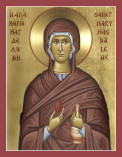 One of the myrrh-bearing women, and equal to the apostles, she was born
in Magdala by the Lake of Gennesaret, of the tribe of Issachar. She was tormented by seven evil
spirits, of which she was freed and healed by the Lord Jesus. Now she was tormented by these
spirits not because she was a sinful woman, but rather, because she was a very virtuous woman,
and the devil thought that she was going to be the one to bear our Savior. Isn’t it ironic
that she came to be close to our Virgin Mary, the Theotokos? She was a faithful follower and
servant of the Lord during His earthly life, and also stood beneath the Cross on Golgotha and
lamented bitterly with the most holy Mother of God. After the Lord’s death, she visited His
tomb three times; and when He rose again, she saw Him twice, once alone and the other time with
the other myrrh-bearing women. She travelled to Rome, went before Tiberias Caesar and presented
him with a red egg, greeting him with the words: ‘Christ is risen!’ At the same time,
she denounced Pilate to Caesar for his unjust condemnation of the Lord Jesus. Caesar listened to
her, and moved Pilate from Jerusalem to Gaul, where this unjust judge died under imperial
displeasure after a terrible illness. After that, she returned from Rome to Ephesus, to St. John
the Theologian, whom she helped in his task of preaching the Gospel. With great love for the
risen Lord and with great zeal, she proclaimed the holy Gospel as a true apostle of Christ. She
died peacefully in Ephesus and was buried, according to tradition, in the same cave in which the
seven young men (see August 4th) had been in a charmed sleep for a hundred years. They came to
life, and then died. St. Magdalene’s relics were then taken to Constantinople. Near the
Garden of Gethsemane, there is a beautiful Russian church dedicated to St. Mary Magdalene.
One of the myrrh-bearing women, and equal to the apostles, she was born
in Magdala by the Lake of Gennesaret, of the tribe of Issachar. She was tormented by seven evil
spirits, of which she was freed and healed by the Lord Jesus. Now she was tormented by these
spirits not because she was a sinful woman, but rather, because she was a very virtuous woman,
and the devil thought that she was going to be the one to bear our Savior. Isn’t it ironic
that she came to be close to our Virgin Mary, the Theotokos? She was a faithful follower and
servant of the Lord during His earthly life, and also stood beneath the Cross on Golgotha and
lamented bitterly with the most holy Mother of God. After the Lord’s death, she visited His
tomb three times; and when He rose again, she saw Him twice, once alone and the other time with
the other myrrh-bearing women. She travelled to Rome, went before Tiberias Caesar and presented
him with a red egg, greeting him with the words: ‘Christ is risen!’ At the same time,
she denounced Pilate to Caesar for his unjust condemnation of the Lord Jesus. Caesar listened to
her, and moved Pilate from Jerusalem to Gaul, where this unjust judge died under imperial
displeasure after a terrible illness. After that, she returned from Rome to Ephesus, to St. John
the Theologian, whom she helped in his task of preaching the Gospel. With great love for the
risen Lord and with great zeal, she proclaimed the holy Gospel as a true apostle of Christ. She
died peacefully in Ephesus and was buried, according to tradition, in the same cave in which the
seven young men (see August 4th) had been in a charmed sleep for a hundred years. They came to
life, and then died. St. Magdalene’s relics were then taken to Constantinople. Near the
Garden of Gethsemane, there is a beautiful Russian church dedicated to St. Mary Magdalene.
2. The Hieromartyr Phokas.
Today we commemorate the translation of his relics from Pontus to Constantinople in about 404. The chief commemoration of this saint is on September 22nd, where an account of his life and sufferings is set down. Today, a particular miracle by this saint is also commemorated. A man, Pontinus, was taken by Arabs, who fettered him, tied his hands behind his back and left him to die. Lying on his face on the ground and being incapable of movement, Pontinus cried out: ‘Holy Martyr Phokas, have mercy on me and save me!’ Thus saying, he fell asleep, and saw Phokas in a dream, coming to him, taking him by the hand and saying: ‘The Lord Jesus Christ forgives thee!’ When the man awoke, he found himself free from all his bonds. He got up and went home, and took St. Phokas as his family patron.
3. Our Holy Father Cornelius of Pereyaslavl.
Made a monk at the age of fifteen by an elder called Paul, he later withdrew to the desert in quest of silence. He spent thirty years in silence, never speaking a word to anyone, so that many thought that he was dumb. He was so emaciated from fasting that he looked like a skeleton. He received the Great Habit just before his death, and entered into rest on July 22nd, 1693.
4. The Holy Martyr Markella.
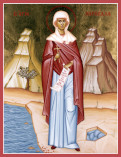 This saint is greatly venerated on the island of Chios. In
her church, miracles are performed throughout the years. Markella was a young girl who was
left motherless very young. Her pagan and bestial father desired to live with his daughter
as though she were his wife. Markella fled from her father, but he, infuriated like a wild
beast, found her and cut her to pieces. Near her church there are several rocks which on
her feast day become saturated with blood. The people take these rocks to the church, pray
to St. Markella and then touch the sick with them, and they are healed. This saint is greatly venerated on the island of Chios. In
her church, miracles are performed throughout the years. Markella was a young girl who was
left motherless very young. Her pagan and bestial father desired to live with his daughter
as though she were his wife. Markella fled from her father, but he, infuriated like a wild
beast, found her and cut her to pieces. Near her church there are several rocks which on
her feast day become saturated with blood. The people take these rocks to the church, pray
to St. Markella and then touch the sick with them, and they are healed.
|
FOR CONSIDERATION
‘Blessed are they that weep,’ said the Lord. Blessed are they who weep, seeking the kingdom of God. Blessed are they who weep, suffering for the Christian Faith. Blessed are they who weep, repenting of their sins. There is no true repentance without tears. With what shall we be able to wash away our sin, save by tears or by blood (the blood of martyrdom)? The monks of Nitria begged great Makarios to come to them, so that they would not all have to go to him. Makarios went in obedience. The monks sat round him and asked him for a word of instruction. Makarios burst into tears, and through his tears, said: ‘My brethren, may your eyes flow with tears before you go to that place where our tears would scald our bodies.’ Then all the brethren began to weep.
Daily Scripture Readings taken from The Orthodox New Testament, translated and published by Holy Apostles Convent, Buena Vista, Colorado, copyright © 2000, used with permission, all rights reserved.
Daily Prologue Readings taken from The Prologue of Ochrid, by Bishop Nikolai Velimirovic, translated by Mother Maria, published by Lazarica Press, Birmingham, England, copyright © 1985, all rights reserved. Edited by Dormition Skete.