

Daily Devotional
Saturday, August 5, 2028 (NS), July 23, 2028 (OS)
No Fasting.
Saturday of the Ninth Week
The commemoration of the translation of the relics of Hieromartyr Phokas of Sinope (commemorated on Sl. calendar on the 22nd of July), the holy Prophet Ezekiel (commemorated on Sl. calendar on the 21st of July), and the Martyrs Trophimos, Theophilos, and 13 others in Lycia (Sl. calendar), and the Icon of the Theotokos, The Joy of All Who Sorrow, and the Icon of the Theotokos of Pochaev.
Scripture Readings
Paschalion — Movable Calendar
Saturday of the Ninth Week
Epistle
The Reading is from the Epistle of Saint Paul to the Romans [§ 113]. Brethren:
14 6The one who mindeth the day, mindeth it to the Lord; and the one who mindeth not the day, mindeth it not to the Lord. The one who eateth, eateth to the Lord, for he giveth thanks to God; and the one who eateth not, to the Lord he eateth not, and giveth thanks to God. 7For none of us liveth to himself, and no one dieth to himself. 8For if we live, we live to the Lord; and if we die, we die to the Lord. Therefore, whether we live or die, we are the Lord’s. 9For to this purpose Christ both died and rose and came to life again, in order that He might become Lord both of the dead and the living.
Gospel
The Reading is from the Holy Gospel according to Saint Matthew [§ 64]. At that time:
15 32Jesus called to Himself His disciples and said, “I am moved with compassion toward the crowd, because they continue with Me now three days, and have nothing that they might eat. And I am not willing to dismiss them fasting, lest they should be faint in the way.” 33And His disciples say to Him, “From what place should come so many loaves in a wilderness, as to fill so great a crowd?” 34And Jesus saith to them, “How many loaves have ye?” And they said, “Seven, and a few small fish.” 35And He commanded the crowds to recline on the ground. 36And having taken the seven loaves and the fish, He gave thanks and broke them and gave to His disciples, and the disciples to the crowd. 37And they did all eat, and were filled; and they took up of the fragments that which was over and above—seven large provision baskets full. 38And they who ate were four thousand men, apart from women and children. 39And He dismissed the crowds, and embarked into the ship, and came to the borders of Magdala.
Menaion — Fixed Calendar
The commemoration of the translation of the relics of Hieromartyr Phokas of Sinope (commemorated on Sl. calendar on the 22nd of July), the holy Prophet Ezekiel (commemorated on Sl. calendar on the 21st of July), and the Martyrs Trophimos, Theophilos, and 13 others in Lycia (Sl. calendar), and the Icon of the Theotokos, The Joy of All Who Sorrow, and the Icon of the Theotokos of Pochaev.
Epistle
For the Icon:
The Reading is from the Epistle of Saint Paul to the Philippians [§ 240]. Brethren:
2 5Let this mind be in you which was also in Christ Jesus, 6Who, existing in the form of God, deemed it not a prize to be seized to be equal with God; 7but He emptied Himself and took the form of a slave, and came to be in the likeness of men. 8And having been found in fashion as a man, He humbled Himself and became obedient even to death—indeed, the death of a cross. 9Wherefore God also exalted Him exceedingly, and freely gave to Him a name that is above every name, 10that in the name of Jesus every knee should bow, of those in heaven and on earth and under the earth; 11and every tongue should confess for itself that Jesus Christ is Lord, to the glory of God the Father.
Or for the Pochaev Icon:
The Reading is from the Epistle of Saint Paul to the Hebrews [§ 320]. Brethren:
9 1The first tabernacle also used to have both ordinances of worship and the sanctuary of this world. 2For a tabernacle was furnished: the first in which were both the lampstand and the table, and the laying forth of the loaves, which is called Holy; 3and after the second veil, a tabernacle which is called Holy of Holies, 4which hath a golden censer, and the ark of the covenant which hath been covered all around from every side with gold, in which was the golden jar having the manna, and the rod of Aaron that budded, and the tablets of the covenant; 5and above it were the cherubim of glory overshadowing the mercy seat, concerning which now is not the time to speak severally. 6Now after these things were thus furnished, the priests, on the one hand, enter into the first tabernacle, performing worship services; 7on the other hand, into the second, the high priest entereth alone once for all every year, not without blood, which he offereth on behalf of himself and the faults of ignorance of the people.
Gospel
For the Icon:
The Reading is from the Holy Gospel according to Saint Luke [§ 54]. At that time:
10 38 Jesus entered into a certain village. And a certain woman, by name Martha, received Him into her house. 39And she had a sister called Mary, who also sat down beside the feet of Jesus, and was listening to His word. 40But Martha was distracted about much serving, and she came up to Him and said, “Lord, is it no concern to Thee that my sister left me to serve alone? Speak to her therefore that she should help me.” 41And Jesus answered and said to her, “Martha, Martha, thou art anxious and troubled about many things. 42“But there is need of one thing, and Mary chose the good part, which shall not be taken away from her.”...
11 27And it came to pass, as He was speaking these things, a certain woman out of the crowd lifted up her voice and said to Him, “Blessed is the womb that bore Thee, and the breasts which Thou didst suck.” 28But He said, “Yea rather, blessed are they who hear the word of God and keep it.”
Lives of the Saints (Prologue)
August 5th – Civil Calendar
July 23rd – Church Calendar
1. The Holy Martyrs Trophimus and Theophilus and thirteen others with them.
They suffered in Lycia, in the time of the Emperor Diocletian. Because they would in no way deny Christ nor offer sacrifice to idols, they were put to manifold tortures: they were stoned, flayed with iron flails, their knees were broken, and thus tortured and more dead than alive, they were thrown into the flames, in which the power of God kept them unharmed. They were then taken from the fire and beheaded. The Lord glorified them both on earth and in His heavenly kingdom. They suffered with honor in Lycia at the beginning of the fourth century.
2. The Hieromartyr Apollinarius.
He was a disciple of the Apostle Peter and was born in the city of Antioch. St. Peter took him with him from Antioch to Rome, and in Rome, consecrated him Bishop of Ravenna. Arriving in Ravenna, Apollinarius went into the house of a soldier, Irenaeus, whose blind son he healed and by this brought the whole family to the Christian Faith. He also healed the wife of the military governor of Ravenna of a grave infirmity, and baptized his whole household. At the governor’s request, Apollinarius remained in his house as his guest. Here he formed a house-church, and lived in that house for twelve years, preaching the Gospel and baptising unbelievers. He was grievously tormented in various ways by the pagan elders, but the strong right hand of God upheld him and preserved him. He was finally condemned to exile in Illyria in the Balkans. But the boat in which he was sailing capsized in a storm, and from among all the travellers, only St. Apollinarius, together with two soldiers and three of his priests, was saved. Saved so miraculously, the soldiers came to believe in the power of Apollinarius’ God and were baptized. Then Apollinarius began preaching the Gospel throughout the Balkans, travelling as far as the Danube. He then went to Thrace, where he spread the Gospel against great opposition. After three years of working in the Balkans, he was driven back to Italy. He went to Ravenna, where the faithful welcomed him with great joy. Hearing of this, the pagan elders wrote to Emperor Vespasian about Apollinarius, calling him a magician and asking if he should be put to death as an opponent of their gods. The emperor replied that it was not necessary to kill him, but that he should be made to sacrifice to idols or driven from the city, for, he said: ‘It is not seemly to take revenge on someone on behalf of the gods, for they can themselves be revenged on their enemies if they are angered.’ But, in spite of this imperial decree, the pagans assaulted Apollinarius and stabbed him with daggers. This servant of God died of his wounds and went to the kingdom of God. His relics are preserved in Ravenna, in the church dedicated to him.
3. The Pochaev Icon of the Theotokos.
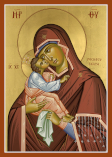 In the summer of 1675 during the time of the Zbarazhsk
War with the Turks, during the reign of the Polish king Jan Sobesski (1674-1696), regiments
composed of Tatars under the command of Khan Nurredin via Vishnevets fell upon the Pochaev
monastery, surrounding it on three sides. The weak monastery walls, just like some of the stone
buildings of the monastery, did not offer much defense against a siege. The hegumen, Iosif
(Dobromirsky), urged the brethren and laypeople to turn themselves to heavenly intercessors: to
the most holy Mother of God and the Monk Job of Pochaev (Oct. 28). The monks and the laypeople
prayed fervently, prostrating themselves before the wonderworking image of the Mother of God and
the reliquary with the relics of the Monk Job. On the morning of July 23, with the rising of the
sun, as the Tatars were holding a final meeting about an assault on the monastery, the hegumen
ordered the singing of an Akathist to the Mother of God. With the first words, “O Queen of
the Heavenly Hosts”, suddenly there appeared over the church the most holy Mother of God
herself, in “an unfurled gleaming-white omophorion”, with heavenly angels holding
unsheathed swords. The Abbot Job was beside the Mother of God, bowing to her and beseeching for
the defense of the monastery. The Tatars took the heavenly army for an apparition, and in
confusion they began to shoot arrows at the Theotokos and the Monk Job, but the arrows fell
backwards and wounded those who shot them. Terror seized the enemy. In a flight of panic and
without looking, they trampled upon and killed each other. The defenders of the monastery pursued
them and took many prisoner. Some of the prisoners afterwards accepted the Christian Faith and
remained at the monastery thereafter.
In the summer of 1675 during the time of the Zbarazhsk
War with the Turks, during the reign of the Polish king Jan Sobesski (1674-1696), regiments
composed of Tatars under the command of Khan Nurredin via Vishnevets fell upon the Pochaev
monastery, surrounding it on three sides. The weak monastery walls, just like some of the stone
buildings of the monastery, did not offer much defense against a siege. The hegumen, Iosif
(Dobromirsky), urged the brethren and laypeople to turn themselves to heavenly intercessors: to
the most holy Mother of God and the Monk Job of Pochaev (Oct. 28). The monks and the laypeople
prayed fervently, prostrating themselves before the wonderworking image of the Mother of God and
the reliquary with the relics of the Monk Job. On the morning of July 23, with the rising of the
sun, as the Tatars were holding a final meeting about an assault on the monastery, the hegumen
ordered the singing of an Akathist to the Mother of God. With the first words, “O Queen of
the Heavenly Hosts”, suddenly there appeared over the church the most holy Mother of God
herself, in “an unfurled gleaming-white omophorion”, with heavenly angels holding
unsheathed swords. The Abbot Job was beside the Mother of God, bowing to her and beseeching for
the defense of the monastery. The Tatars took the heavenly army for an apparition, and in
confusion they began to shoot arrows at the Theotokos and the Monk Job, but the arrows fell
backwards and wounded those who shot them. Terror seized the enemy. In a flight of panic and
without looking, they trampled upon and killed each other. The defenders of the monastery pursued
them and took many prisoner. Some of the prisoners afterwards accepted the Christian Faith and
remained at the monastery thereafter.
FOR CONSIDERATION
The greatest teachers of the Church endeavored to teach great truths to men not only by words, but also by visual examples. Thus Abba Isaias, in order to teach the monks that no one would receive a reward from God Who did not toil in this life for Him, led his disciples to a threshing floor, where a laborer was gathering the threshed wheat. ‘Give me some of that wheat!’ Isaias said to the laborer. ‘Have you been reaping as well, father?’ ‘I haven’t,’ replied the elder. ‘Then you’ve got a hope of some wheat, if you’ve not gathered it!’ To this, the elder said: ‘There’s no wheat for him who has not gathered it?’ ‘No,’ replied the laborer. Hearing this reply, the elder went away in silence. When his disciples asked him to explain his actions to them, he said: ‘I did that deliberately, in order to show you that no one will receive the reward from God who has not labored in asceticism.’
Daily Scripture Readings taken from The Orthodox New Testament, translated and published by Holy Apostles Convent, Buena Vista, Colorado, copyright © 2000, used with permission, all rights reserved.
Daily Prologue Readings taken from The Prologue of Ochrid, by Bishop Nikolai Velimirovic, translated by Mother Maria, published by Lazarica Press, Birmingham, England, copyright © 1985, all rights reserved. Edited by Dormition Skete.