

Daily Devotional
Monday, December 21, 2026 (NS), December 8, 2026 (OS)
Fast Day, but Fish, Wine and Olive Oil Allowed.
Monday of the Thirtieth Week
The commemoration of our holy Father Patapios of Thebes.
Scripture Readings
Paschalion — Movable Calendar
Monday of the Thirtieth Week
Epistle
The Reading is from the Epistle of Saint Paul to the Hebrews [§ 319]. Brethren:
8 7If that first covenant were blameless, a place for a second would not be sought. 8For finding fault with them, He saith, “‘Behold, days are coming,’ saith the Lord, ‘and I will consummate a new covenant with the house of Israel and with the house of Juda [cf. Jer. 38(31):31]; 9“‘not according to the covenant which I made with their fathers, in the day when I took hold of their hand to lead them out of the land of Egypt; because they did not continue in My covenant, and I cared not for them,’ saith the Lord [cf. Jer. 38(31):32]. 10“‘For this is the covenant which I will make with the house of Israel after those days,’ saith the Lord: ‘I will give My laws into their mind, and write them upon their hearts; and I will be to them for a God and they shall be to Me for a people [cf. Jer. 38(31):33]. 11“‘And in no wise shall they teach each his neighbor, and each his brother, saying, “Know the Lord”; for all shall know Me, from the least of them unto the greatest of them [cf. Jer. 38(31):34]. 12“‘For I will be merciful to their unrighteousness, and their sins and their lawlessnesses in no wise will I remember any more [cf. Jer. 38(31):34].’” 13In the saying, “new,” He hath made the first old. Now that which is becoming obsolete and growing old is near to disappearing.
Gospel
The Reading is from the Holy Gospel according to Saint Luke [§ 102]. At that time:
20 27Some of the Sadducees, those who contradict that there is any resurrection, came to Jesus and questioned Him, 28saying, “Teacher, Moses wrote to us: ‘If anyone’s brother should die, having a wife, and this man should die childless, that his brother should take the wife and raise up seed to his brother [cf. Gen. 38:8; Deut. 25:5].’ 29“There were then seven brothers; and the first took a wife, and died childless. 30“And the second took the woman, and this man died childless. 31“And the third took her in like manner. And likewise also the seven, they left behind no children, and they died. 32“And last of all the woman died also. 33“Therefore, in the resurrection, of which of them doth she become wife? For the seven had her to wife.” 34And Jesus answered and said to them, “The sons of this age marry and are given in marriage; 35“but those having been counted worthy to attain to that age, and the resurrection which is from the dead, neither marry nor are given in marriage, 36“for neither are they able to die any more, for they are equal to the angels and are sons of God, being sons of the resurrection. 37“But that the dead are raised, even Moses indicated in the passage concerning the bush where the Lord saith, ‘I am the God of Abraham, and the God of Isaac, and the God of Jacob [Ex. 3:6].’ 38“Now He is not the God of the dead, but of the living; for all live to Him.” 39And some of the scribes answered and said, “Teacher, Thou didst speak well.” 40And no longer were they daring to ask Him anything.
41And He said to them, “How do they say the Christ is David’s Son? 42“And David himself saith in the book of Psalms, ‘The Lord said to my Lord, “Sit Thou on My right, 43“‘“until I should place Thine enemies as a footstool of Thy feet [Ps. 109(110):1].”’ 44“David then calleth Him Lord; and yet how is He his Son?”
Menaion — Fixed Calendar
The commemoration of our holy Father Patapios of Thebes.
Epistle
The Reading is from the Second Epistle of Saint Paul to the Thessalonians [§ 276]. Brethren:
2 13We are bound to give thanks to God always concerning you, brethren beloved by the Lord, because God chose you for Himself from the beginning to salvation in sanctification of the Spirit and belief of the truth, 14to which He called you through our Gospel, to acquisition of the glory of our Lord Jesus Christ. 15So then, brethren, be standing firm and holding fast the traditions which ye were taught, whether by word or by our epistle. 16Now may our Lord Jesus Christ Himself, and our God and Father, the One Who loved us and gave everlasting consolation and good hope by grace, 17comfort your hearts and establish you in every good word and work.
3 1For the rest, brethren, be praying for us, that the word of the Lord may run and be glorified, even as also it is with you, 2and that we might be delivered from wayward and evil men; for not all have the faith. 3But faithful is the Lord, Who shall establish you and guard you from the evil one. 4And we trust in the Lord as to you, that ye both do and will do what we command you. 5And may the Lord direct your hearts into the love of God, and into the patience of the Christ.
Gospel
No reading given.
Lives of the Saints (Prologue)
December 21st – Civil Calendar
December 8th – Church Calendar
1. Our Holy Father Patapios.
Born and brought up in the Faith and in the fear of God by pious parents in the Egyptian city of Thebes, he early perceived and rejected the empty vanity of the world and went into the Egyptian desert, where he devoted himself to cleansing his heart from every worldly thought and desire for the sake of divine love. When his virtues became known among the people, they began to come to him and seek relief from their troubles. Afraid of human glory, which darkens a man’s mind and separates it from God, Patapios fled from the desert to Constantinople, for this wonderful saint thought that he could more easily hide himself from men in the heart of a city than in the desert. He built himself a hut close to the Vlachernai church and there, enclosed and unknown, took up again his interrupted life of asceticism. But the light cannot be hidden. A child, blind from birth, was led by divine providence to St. Patapios and begged him to offer a prayer that he might be given his sight and look upon God’s creation, and praise God all the more. Patapios had pity on the suffering child and prayed to God, and the child saw. Through this miracle, Patapios’ godly life became known throughout the entire capital, and people began to turn to him for healing, comfort and teaching. Patapios healed one eminent man of dropsy after blessing him with a cross and anointing him with oil. Making the sign of the Cross in the air, he freed a youth from an unclean spirit which had cruelly tormented him, and the evil spirit went out of God’s creature like smoke, uttering a great cry. He made the sign of the Cross over a woman who had sores on her breasts all filled with worms, and she was healed. St. Patapios worked many other miracles, all through prayer in the name of Christ and by the power of the Cross. He entered into rest in great old age, going to the kingdom of God in the seventh century.
2. The Holy Apostles Sosthenes, Apollos, Tychicus, Epaphroditus, Onesiphorus, Cephas and Caesar.
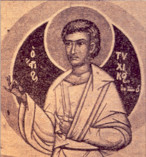 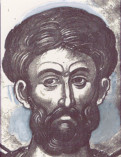 All these are
commemorated on January 4th with the other lesser apostles. St. Apollos is also
commemorated on September 10th, St. Onesiphorus on September 7th, and Cephas and Caesar on
March 30th. St. Sosthenes was Bishop of Caesarea and Tychicus succeeded him in the same
city. Epaphroditus was bishop in Colophon in Pamphylia, Cephas in Iconium and Caesar in the
Peloponnese. They all preached the Gospel of Christ with burning love, and endured
suffering for His name’s sake before they entered into the kingdom of eternal joy. All these are
commemorated on January 4th with the other lesser apostles. St. Apollos is also
commemorated on September 10th, St. Onesiphorus on September 7th, and Cephas and Caesar on
March 30th. St. Sosthenes was Bishop of Caesarea and Tychicus succeeded him in the same
city. Epaphroditus was bishop in Colophon in Pamphylia, Cephas in Iconium and Caesar in the
Peloponnese. They all preached the Gospel of Christ with burning love, and endured
suffering for His name’s sake before they entered into the kingdom of eternal joy.
|
FOR CONSIDERATION
He who entrusts himself completely to God is led by Him towards salvation, and is used by Him for the good of many others. St. Nicholas, entrusting himself to the will of God, fled from human vanity, from his town of Patara, and came to the city of Myra in Lycia, where he knew no one and was known by none. With no means at all of supporting himself (for, although he had been rich, he had abandoned everything), without acquaintance and without any plan, he went unnoticed about the city, waiting for God to direct his footsteps. At that time, John, the archbishop of the city, died and the synod that was assembled for the election of a new archbishop could not agree on any one candidate. Finally, the members of the synod decided to fast and pray that God would show them who was most worthy of the position. God heard the prayers of His servants, and disclosed to them who was the most worthy. While the presiding bishop was standing at prayer, a man appeared to him, clothed in white, and told him to go out early and stand in front of the church, awaiting the first man to arrive for morning prayer. ‘Make him archbishop; he is called Nicholas,’ he said. The bishop informed the others of what he had heard and seen, and he went to the church early the next morning and waited. St. Nicholas, who was accustomed to rising early to pray, came to the church. Seeing him, the bishop asked: ‘What is your name, my son?’ Nicholas was silent. The bishop asked him again, and this time he answered: ‘I am called Nicholas, and am your lordship’s servant.’ Then the bishop took him by the hand, and leading him into the synod, said: ‘Receive, my brethren, your pastor, whom the Holy Spirit has anointed and who has been elected not by a human synod, but by divine providence.’
Daily Scripture Readings taken from The Orthodox New Testament, translated and published by Holy Apostles Convent, Buena Vista, Colorado, copyright © 2000, used with permission, all rights reserved.
Daily Prologue Readings taken from The Prologue of Ochrid, by Bishop Nikolai Velimirovic, translated by Mother Maria, published by Lazarica Press, Birmingham, England, copyright © 1985, all rights reserved. Edited by Dormition Skete.