

Daily Devotional
Tuesday, December 22, 2026 (NS), December 9, 2026 (OS)
Fast Day, but Fish, Wine and Olive Oil Allowed.
Tuesday of the Thirtieth Week
9. The commemoration of the Conception of the Virgin Mary by St. Anna, the Foremother of God, and the miraculous Icon of the Theotokos known as "Unexpected Joy."
Scripture Readings
Paschalion — Movable Calendar
Tuesday of the Thirtieth Week
Epistle
The Reading is from the Epistle of Saint Paul to the Hebrews [§ 321]. Brethren:
For Gk. usage, see Heb. 9:8-23; for Sl. usage, see Heb. 9:8-10, 15-23.
9 8The Holy Spirit signifieth that the way into the Holies hath not yet been made manifest while the first tabernacle still hath a standing, 9which was a type for the time then present, according to which both gifts and sacrifices are being offered, which is not able to perfect the one who worshippeth, as concerning conscience, 10only in foods and drinks, and diverse ablutions, and ordinances of the flesh being imposed on them, until the time of setting things straight. 11But Christ, Who came as High Priest of the coming good things, by means of the greater and more perfect tabernacle—not made by hand, that is, not of this creation, 12nor by blood of goats and of calves, but by His own blood—entered once for all into the Holies, having Himself obtained eternal redemption. 13For if the blood of bulls and of goats and ashes of a heifer, sprinkling those who have been defiled, sanctifieth to the purity of the flesh, 14how much more shall the blood of the Christ, Who through the eternal Spirit offered Himself without blemish to God, purify your conscience from dead works in order to worship the living God? 15And for this cause He is Mediator of a new testament, so that by means of a death which took place for redemption from the transgressions under the first testament, they who have been called might receive the promise of the eternal inheritance. 16For where a testament is, it is necessary for the death of the one who made a disposition for himself to be brought forward. 17For a testament is confirmed over those dead, since it never hath strength when the one who maketh the disposition liveth. 18Wherefore neither hath the first been inaugurated without blood. 19For after Moses spoke every command to all the people according to the law, he took the blood of the calves and goats, with water, and scarlet wool, and hyssop, and sprinkled both the book itself and all the people, 20saying, “This is the blood of the testament which God enjoined concerning you [cf. Exod. 24:8].” 21And in like manner he sprinkled with blood both the tabernacle and all the vessels of the service. 22And I may almost say all things are being purified with blood according to the law, and without shedding of blood no remission taketh place. 23It was therefore necessary on the one hand that the patterns of the things in the heavens be purified with these, but on the other hand the heavenly things themselves with better sacrifices than these.
Gospel
The Reading is from the Holy Gospel according to Saint Luke [§ 106]. The Lord said to His disciples, “Be taking heed of men:
21 12“For they shall lay their hands upon you and persecute you, delivering you up to synagogues and prisons, bringing you before kings and governors on account of My name; 13“but it shall prove to be a testimony for you. 14“Therefore settle it for yourselves in your hearts not to premeditate to make a defense; 15“for I will give you a mouth and wisdom, which all those who oppose you shall not be able to contradict nor withstand. 16“And ye shall be delivered up also by parents, and kinfolk, and friends, and brethren; and they shall put some of you to death. 17“And ye shall be hated by all for My name’s sake. 18“But a hair of your head in no wise shall perish. 19“In your patience win your souls.”
Menaion — Fixed Calendar
9. The commemoration of the Conception of the Virgin Mary by St. Anna, the Foremother of God, and the miraculous Icon of the Theotokos known as "Unexpected Joy."
Epistle
For the Conception:
The Reading is from the Epistle of Saint Paul to the Galatians. Brethren:
For Gk. usage, see Gal. 4:22-27 [§ mid 210]; for Sl. usage, see Gal. 4:22-31 [§§ mid 210, 211].
4 22Abraham had two sons: one by the maidservant, and one by the free woman. 23But on the one hand, the one of the maidservant hath been born according to the flesh; and on the other hand, the one of the free woman through the promise, 24which things are allegorized. For these are the two covenants: one indeed from Mount Sinai which bringeth forth to slavery, which is Agar— 25for the Agar is Mount Sinai in Arabia, and correspondeth to the present Jerusalem, and she doth slave with her children— 26but the Jerusalem above is free, which is Mother of us all. 27For it hath been written: “Rejoice, thou barren, who bearest not; break forth and cry thou who travailest not; for many are the children of the desolate more than of her who hath the husband [Is. 54:1].” 28Now we, brethren, after the manner of Isaac, are children of promise. 29But as then he who was born according to the flesh persecuted him who was born according to the Spirit, even so it is now. 30But what saith the Scripture? “Cast out the maidservant and her son; for in no wise shall the son of the maidservant inherit with the son of the free woman [cf. Gen. 21:10].” 31So then, brethren, we are not children of a maidservant, but of the free woman.
For the Icon:
The Reading is from the Epistle of Saint Paul to the Hebrews [§ 320]. Brethren:
9 1The first tabernacle also used to have both ordinances of worship and the sanctuary of this world. 2For a tabernacle was furnished: the first in which were both the lampstand and the table, and the laying forth of the loaves, which is called Holy; 3and after the second veil, a tabernacle which is called Holy of Holies, 4which hath a golden censer, and the ark of the covenant which hath been covered all around from every side with gold, in which was the golden jar having the manna, and the rod of Aaron that budded, and the tablets of the covenant; 5and above it were the cherubim of glory overshadowing the mercy seat, concerning which now is not the time to speak severally. 6Now after these things were thus furnished, the priests, on the one hand, enter into the first tabernacle, performing worship services; 7on the other hand, into the second, the high priest entereth alone once for all every year, not without blood, which he offereth on behalf of himself and the faults of ignorance of the people.
Gospel
For the Conception:
The Reading is from the Holy Gospel according to Saint Luke [§ 36]. The Lord said:
8 16“No one, having lit a lamp, covereth it with a vessel or putteth it underneath a bed, but placeth it upon a lampstand, that they who enter in may see the light. 17“For nothing is secret which shall not become manifest, nor hidden that shall not be known and come to light. 18“Be taking heed then how ye hear: for whosoever hath, it shall be given to him; and whosoever hath not, even what he seemeth to have shall be taken away from him.”
19And His Mother and brethren came to Him, and were not able to meet with Him on account of the crowd. 20And it was reported to Him by some who said, “Thy Mother and Thy brethren are standing outside, wishing to see Thee.” 21And He answered and said to them, “My mother and My brethren are these who hear the word of God and do it.”
For the Icon:
The Reading is from the Holy Gospel according to Saint Luke [§ 54]. At that time:
10 38Jesus entered into a certain village. And a certain woman, by name Martha, received Him into her house. 39And she had a sister called Mary, who also sat down beside the feet of Jesus, and was listening to His word. 40But Martha was distracted about much serving, and she came up to Him and said, “Lord, is it no concern to Thee that my sister left me to serve alone? Speak to her therefore that she should help me.” 41And Jesus answered and said to her, “Martha, Martha, thou art anxious and troubled about many things. 42“But there is need of one thing, and Mary chose the good part, which shall not be taken away from her.”...
11 27And it came to pass, as He was speaking these things, a certain woman out of the crowd lifted up her voice and said to Him, “Blessed is the womb that bore Thee, and the breasts which Thou didst suck.” 28But He said, “Yea rather, blessed are they who hear the word of God and keep it.”
Lives of the Saints (Prologue)
December 22nd – Civil Calendar
December 9th – Church Calendar
1. The Conception by St. Anna of the Most Holy Mother of God.
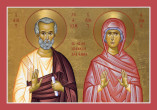 Righteous Joachim and Anna were childless for fifty years
of their married life. In their old age, the Archangel Gabriel appeared to them, to each
one separately, and told them that God had heard their prayer and that a daughter would be
born to them. Then St. Anna conceived by her husband, and after nine months, bore a
daughter blessed by God and all generations of men: the most holy Virgin Mary and Mother of
God. There is a fuller account of all this on September 9th. Righteous Joachim and Anna were childless for fifty years
of their married life. In their old age, the Archangel Gabriel appeared to them, to each
one separately, and told them that God had heard their prayer and that a daughter would be
born to them. Then St. Anna conceived by her husband, and after nine months, bore a
daughter blessed by God and all generations of men: the most holy Virgin Mary and Mother of
God. There is a fuller account of all this on September 9th.
|
2. St. Hannah, Mother of the Prophet Samuel.
Hannah was the wife of Elkanah from Ramathaim-Zophim, or Arimathea (I Kgs. [I Sam.] 1). She had had no child, being barren, and she wept and grieved bitterly for this. But God in His mercy took pity on her, and removed her barrenness in response to her ceaseless prayers and sighs. Hannah bore a son, Samuel, and dedicated him to God from his childhood. Samuel was a great leader of the nation of Israel, and a prophet who anointed two kings, Saul and David. St. Hannah sang a hymn of thanksgiving to God, a hymn wonderful in its wisdom and beauty, which is used to this day in church services (I Kgs. [I Sam.] 2:1).
3. Our Holy Father Stephen the New Light.
This godly man was born and brought up in Constantinople in the house of his parents Zacharias and Theophano, his father being a priest at the Great Church in the time of Patriarch Methodius. When she was carrying him in her womb, his mother fed only on bread and water, and when the child was born, a cross of light shone on his breast. Because of this, and because of his pure and godly way of life, he is named ‘the New Light’. At the age of eighteen, Stephen shut himself up in a cell attached to the church of St. Peter the Apostle, and devoted himself to prayer and fasting. Once St. Peter appeared to him, and said: ‘Peace be to thee, my child; thou hast made a good beginning. May the Lord strengthen thee.’ After that, he spent many years in a cell by the church of the holy martyr Antipas. This saint also appeared to him, encouraging him: ‘Know that I will not abandon thee.’ Stephen took greater and greater labors upon himself. He ate only twice a week, and that unsalted cabbage. In all, this holy man spent fifty-five years in asceticism for the sake of the kingdom of Christ, and went to his rest in the Lord in 879, at the age of seventy-three.
4. St. Sophronios, Archbishop of Cyprus.
He was born and brought up in Cyprus. Because of his great spiritual erudition and his many virtues, in particular his compassion, he was made archbishop after St. Damian. Having faithfully served the Church and led a life pleasing to God, he died peacefully in the sixth century.
FOR CONSIDERATION
God repays a hundred-fold that which is loaned to Him through the poor. There was once a Christian woman married to a pagan, and they lived together in love and poverty. When the husband had put by fifty pieces of silver, he remarked to his wife that they should lend the money out on interest, because their savings would otherwise be frittered away coin by coin, and they would be left with nothing. His wife replied: ‘If you want to lend the money, lend it to the Christian God.’ ‘And where is this Christian God?’ he asked. His wife took him to the church and told him to distribute all the money to the beggars in front of it, saying: ‘The God of the Christians will accept it from them, for they all belong to Him.’ So, giving every single one of the fifty coins of silver to the poor, they went home. After a while, they were left without bread in the house, and the woman told her husband to go to the church for the money that he had lent to God. Off the husband went to the church, but he saw only beggars there, and in doubt about who would give him the money, he paced around the church building. Suddenly, he saw a silver coin lying before him. He picked it up, bought a fish with it and took it home, where he complained to his wife that he had not seen anybody, and nobody had given him anything at all, but that he had come upon a single coin on the ground quite by chance. His wife replied: ‘God is invisible, and works in an unseen way.’ When she opened the fish, she found a glittering stone in it. She gave it to her husband, who took it to a merchant to see what he could get for it. The merchant offered him five silver pieces, and the man began to laugh, thinking the merchant was joking in offering so high a price. However, the merchant thought that the man was laughing on account of the meanness of his offer, and offered him first ten, then fifteen, thirty and finally fifty silver pieces. The man then realized that it was a precious stone, and began to demur. The merchant raised his price higher and higher, until he reached three hundred pieces of silver. Then the man accepted the three hundred pieces and went off home full of joy. ‘Do you see how good the Christian God is?’ asked his wife. The amazed husband was baptized straight away, and lived to glorify God together with his wife.
Daily Scripture Readings taken from The Orthodox New Testament, translated and published by Holy Apostles Convent, Buena Vista, Colorado, copyright © 2000, used with permission, all rights reserved.
Daily Prologue Readings taken from The Prologue of Ochrid, by Bishop Nikolai Velimirovic, translated by Mother Maria, published by Lazarica Press, Birmingham, England, copyright © 1985, all rights reserved. Edited by Dormition Skete.