

Daily Devotional
Sunday, December 20, 2026 (NS), December 7, 2026 (OS)
Fast Day, but Fish, Wine and Olive Oil Allowed.
Sunday of the Twenty-Ninth Week
Mode Four — Seventh Eothinon
The commemoration of our father among the saints, Ambrose, Bishop of Milan.
Scripture Readings
Paschalion — Movable Calendar
Sunday of the Twenty-Ninth Week
Mode Four — Seventh Eothinon
Epistle
The Reading is from the Epistle of Saint Paul to the Colossians [§ 258]. Brethren:
3 12Put on for yourselves, as elect of God, holy and beloved, compassion from your inward parts, kindness, humbleness of mind, meekness, long-suffering, 13bearing with one another, and graciously forgiving one another, if anyone hath a complaint against someone; even as the Christ graciously forgave you, thus also do ye. 14And over all these things, put on love, which is the bond of perfection. 15And let the peace of God be presiding in your hearts, to which also ye were called in one body; and keep on becoming thankful. 16Let the word of Christ dwell in you richly, in all wisdom, teaching and admonishing one another in psalms and hymns and spiritual odes, singing with grace in your heart to the Lord.
Gospel
The Reading is from the Holy Gospel according to Saint Luke [§ 71]. At that time:
13 10Jesus was teaching in one of the synagogues on the sabbath days. 11And behold, there was a woman who had a spirit of infirmity eighteen years, and was bowed together, and was utterly unable to lift herself up. 12And having seen her, Jesus called to her and said to her, “Woman, thou hast been loosed from thine infirmity.” 13And He laid His hands upon her, and immediately she was set straight again, and was glorifying God. 14But the ruler of the synagogue, being indignant because Jesus cured on the sabbath, answered and was saying to the crowd, “There are six days in which is it fitting to work; within these therefore come and be cured, but not on the day of the sabbath.” 15The Lord then answered him and said, “Hypocrite, doth not each of you on the sabbath loose his ox or ass from the manger, and lead it away and give it drink? 16“And ought not this woman, being a daughter of Abraham, whom Satan bound, lo, eighteen years, to be loosed from this bond on the day of the sabbath?” 17And when He said these things, all those who opposed Him were put to shame; but the whole crowd was rejoicing over all the glorious things which were being done by Him.
Menaion — Fixed Calendar
The commemoration of our father among the saints, Ambrose, Bishop of Milan.
Epistle
The Reading is from the Second Epistle of Saint Paul to the Thessalonians [§ 276]. Brethren:
2 13We are bound to give thanks to God always concerning you, brethren beloved by the Lord, because God chose you for Himself from the beginning to salvation in sanctification of the Spirit and belief of the truth, 14to which He called you through our Gospel, to acquisition of the glory of our Lord Jesus Christ. 15So then, brethren, be standing firm and holding fast the traditions which ye were taught, whether by word or by our epistle. 16Now may our Lord Jesus Christ Himself, and our God and Father, the One Who loved us and gave everlasting consolation and good hope by grace, 17comfort your hearts and establish you in every good word and work.
3 1For the rest, brethren, be praying for us, that the word of the Lord may run and be glorified, even as also it is with you, 2and that we might be delivered from wayward and evil men; for not all have the faith. 3But faithful is the Lord, Who shall establish you and guard you from the evil one. 4And we trust in the Lord as to you, that ye both do and will do what we command you. 5And may the Lord direct your hearts into the love of God, and into the patience of the Christ.
Gospel
No reading given.
Lives of the Saints (Prologue)
December 20th – Civil Calendar
December 7th – Church Calendar
1. St. Ambrose, Bishop of Milan (Mediolanum).
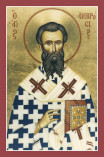 This great father of the Orthodox Church was of
eminent parentage. His father was the imperial governor of Gaul and Spain, and a pagan, while his
mother was a Christian. While he was still in his cradle, a swarm of bees once settled on him,
left some honey on his lips and flew off; and while still a child, he thrust out his hand and
said prophetically: ‘Kiss it, for I shall be a bishop!’ On the death of his father,
the emperor made him governor of Liguria, of which province Milan was the chief city. When the
bishop of Milan died, there was great dissension between the Orthodox Christians and the
heretical Arians about the choice of a new bishop. Ambrose went into the church to keep order,
this being his responsibility. Thereupon, a child at its mother’s breast cried out:
‘Ambrose for bishop!’ All the people took this to be the voice of God, and
unanimously elected Ambrose as their bishop, although it was against his will. Ambrose was
baptized, and passed through all the necessary ranks in one week, and was consecrated bishop. In
this capacity, he strengthened the faith of the Orthodox, restrained heretics, adorned churches,
spread the Faith among the pagans, wrote many instructive books and was an example of a true
Christian and a true shepherd. He also composed the Te Deum, the great hymn of thanksgiving. This
renowned hierarch, who was visited by people from distant lands for his wisdom and gracious
words, was very austere in his personal life, being no stranger to toil and full of good works.
He slept little, worked and prayed constantly and fasted every day except Saturday and Sunday.
God therefore permitted him to witness many of His wonders, and to perform many himself. He
discovered the relics of Ss. Protasius, Gervasius, Nazarius and Celsus (see Oct. 14th). Humble
before lesser men, he was fearless before the great. He reproached the Empress Justina for
heresy, cursed Maximus for tyranny and murder and forbade the Emperor Theodosios to enter a
church until he had repented of his sin. He refused to meet the powerful Eugenius, the
self-styled emperor. God granted this man, who was so pleasing to Him, such grace that he could
raise the dead, drive demons from men, heal the sick of every ailment and see into the future. He
died peacefully at daybreak on the day of Pascha in the year 397.
This great father of the Orthodox Church was of
eminent parentage. His father was the imperial governor of Gaul and Spain, and a pagan, while his
mother was a Christian. While he was still in his cradle, a swarm of bees once settled on him,
left some honey on his lips and flew off; and while still a child, he thrust out his hand and
said prophetically: ‘Kiss it, for I shall be a bishop!’ On the death of his father,
the emperor made him governor of Liguria, of which province Milan was the chief city. When the
bishop of Milan died, there was great dissension between the Orthodox Christians and the
heretical Arians about the choice of a new bishop. Ambrose went into the church to keep order,
this being his responsibility. Thereupon, a child at its mother’s breast cried out:
‘Ambrose for bishop!’ All the people took this to be the voice of God, and
unanimously elected Ambrose as their bishop, although it was against his will. Ambrose was
baptized, and passed through all the necessary ranks in one week, and was consecrated bishop. In
this capacity, he strengthened the faith of the Orthodox, restrained heretics, adorned churches,
spread the Faith among the pagans, wrote many instructive books and was an example of a true
Christian and a true shepherd. He also composed the Te Deum, the great hymn of thanksgiving. This
renowned hierarch, who was visited by people from distant lands for his wisdom and gracious
words, was very austere in his personal life, being no stranger to toil and full of good works.
He slept little, worked and prayed constantly and fasted every day except Saturday and Sunday.
God therefore permitted him to witness many of His wonders, and to perform many himself. He
discovered the relics of Ss. Protasius, Gervasius, Nazarius and Celsus (see Oct. 14th). Humble
before lesser men, he was fearless before the great. He reproached the Empress Justina for
heresy, cursed Maximus for tyranny and murder and forbade the Emperor Theodosios to enter a
church until he had repented of his sin. He refused to meet the powerful Eugenius, the
self-styled emperor. God granted this man, who was so pleasing to Him, such grace that he could
raise the dead, drive demons from men, heal the sick of every ailment and see into the future. He
died peacefully at daybreak on the day of Pascha in the year 397.
2. The Holy Martyrs in Africa.
They suffered for the truth of Orthodoxy in the reign of Gunerik of the Vandals (477-484), at the hands of the heretical Arians. Two priests were burned, sixty had their tongues torn out and three hundred laymen were beheaded. All of them suffered terribly, but they overcame falsehood by their deaths, and Orthodoxy was strengthened and was handed down to us pure and untarnished. The Lord crowned them with crowns of glory in His immortal kingdom.
3. Our Holy Father Gregory the Hesychast.
A Serb by birth, he was the founder of the monastery of St. Nicholas on the Holy Mountain, which is known by the name of Grigoriou after him. He built himself a cell about four hours’ journey from the monastery, where he wept over his sins and prayed. In 1761, a serious fire broke out in the monastery, and at that time some of the monks took his relics to Serbia. This man of God entered into eternal rest in 1406.
4. Our Holy Father Nilus of Stolobnoye.
A worker on the land, born in Novgorod, he went off into a lonely place and survived on plants and gleanings. He was instructed by a voice from on high to move to the island of Stolobnoye (Table Island). Once, some robbers burst into his cell, and were immediately blinded. He dug his own grave close to his cell, and wept over it every day. He entered into eternal rest in the kingdom of Christ in 1554, and his wonder-working relics are preserved in the place where he led his life of fasting.
FOR CONSIDERATION
Fear of God drives all fear of men from the heart. In all the great hierarchs of the Orthodox Church, we notice a wonderful combination of humility and fearlessness. St. Nicholas seized the sword of an executioner so that he could not execute innocent men. St. John Chrysostom castigated the Empress Evdoxia for her misdeeds, with no consideration for the unpleasantness and danger to his life to which he exposed himself in consequence. There are many other similar examples: when the Emperor Valentinian the Elder had listened to the stern criticism of St. Ambrose, he said to him: ‘I knew of your fearlessness when I helped in your election as bishop. Correct our faults, teach the law of God and cure our unrighteousness.’ When Valentinian the Younger, at the instigation of his mother Justina (who was an Arian), ordered that the cathedral in Milan be opened for heretics, Ambrose shut himself in the church with the faithful, and would not come out for three days. He sent word to the emperor and empress that, if they desired his death, he was prepared at any time ‘here in the church to be run through, either by a sword or a spear’. Hearing this, the emperor and empress rescinded their order. When a quarrel broke out in Thessalonica, and the Emperor Theodosios the Great had more than seven thousand people beheaded, Ambrose was so furious with the emperor that, when he visited Milan and wished to enter the church, the saint forbade him to do so. The emperor said to St. Ambrose: ‘David sinned, and yet was not deprived of God’s mercy.’ The bishop replied: ‘As you have imitated David in sin, so now imitate him in repentance also.’ The emperor was ashamed and turned back, and repented bitterly of the sin he had committed.
Daily Scripture Readings taken from The Orthodox New Testament, translated and published by Holy Apostles Convent, Buena Vista, Colorado, copyright © 2000, used with permission, all rights reserved.
Daily Prologue Readings taken from The Prologue of Ochrid, by Bishop Nikolai Velimirovic, translated by Mother Maria, published by Lazarica Press, Birmingham, England, copyright © 1985, all rights reserved. Edited by Dormition Skete.