

Daily Devotional
Sunday, December 6, 2026 (NS), November 23, 2026 (OS)
Fast Day, but Fish, Wine and Olive Oil Allowed.
Sunday of the Twenty-Seventh Week
Mode Two — Fifth Eothinon
The commemoration of the Afterfeast of the Entrance of the Virgin, and our fathers among the saints, Amphilochios, Bishop of Iconium, and Gregory, Bishop of Agrigentum, and the repose of St. Alexander Nevsky, and Metrophanes, Wonder-worker and first Bishop of Voronezh.
Scripture Readings
Paschalion — Movable Calendar
Sunday of the Twenty-Seventh Week
Mode Two — Fifth Eothinon
Epistle
The Reading is from the Epistle of Saint Paul to the Ephesians [§ 233].
6 10Brethren, keep on being empowered in the Lord and in the strength of His might. 11Put on the full armor of God, for you to be able to stand against the wiles of the devil; 12because for us the wrestling is not against blood and flesh, but against the principalities, against the powers, against the cosmic rulers of the darkness of this age, against spiritual hosts of evil on account of the heavenly things. 13For this cause take up the full armor of God, in order that ye might be able to withstand in the evil day, and having counteracted all things, to stand. 14Stand therefore, having girt your loins with truth, and having put on for yourselves the breastplate of righteousness, 15and having shod your feet in readiness of the Gospel of peace; 16on the whole, take up the shield of faith, with which ye shall be able to quench all the fiery darts of the evil one. 17And take the helmet of salvation, and the sword of the Spirit, which is the word of God.
Gospel
The Reading is from the Holy Gospel according to Saint Luke [§ 66]. The Lord said this parable:
12 16“The land of a certain rich man produced well. 17“And he was considering within himself, saying, ‘What shall I do, because I have no room where I shall gather together my fruit?’ 18“And he said, ‘This will I do: I will take down my storehouses and build greater ones; and there will I gather together all my produce and my good things. 19“‘And I will say to my soul, “Soul, thou hast many good things being laid up for many years; be taking thy rest; eat, drink, and be merry.”’ 20“But God said to him, ‘Fool, this night they demand thy soul from thee; and what thou didst prepare, for whom shall it be?’ 21“Thus is the one who treasureth up for himself, and is not rich toward God.”
After He said these things, He said aloud, “The one who hath ears to hear, let him hear.”
Menaion — Fixed Calendar
The commemoration of the Afterfeast of the Entrance of the Virgin, and our fathers among the saints, Amphilochios, Bishop of Iconium, and Gregory, Bishop of Agrigentum, and the repose of St. Alexander Nevsky, and Metrophanes, Wonder-worker and first Bishop of Voronezh.
Epistle
For Hierarchs Amphilochios and Gregory:
The Reading is from the Epistle of Saint Paul to the Hebrews [§ 334]. Brethren:
13 7Be remembering those who lead you, who spoke to you the word of God, whose faith keep on imitating, observing attentively the end of their conduct: 8Jesus Christ, the same yesterday and today and to the ages. 9Cease being carried about by various and strange teachings. For it is good for the heart to be confirmed by grace, not by foods, in which those walking therein were not profited. 10We have an altar from which those serving the tabernacle have no authority to eat; 11for the bodies of those animals, “whose blood is being brought into the holies for sins” by the high priest, “are being burned outside of the encampment [cf. Lev. 16:27].” 12Wherefore Jesus also, that He might sanctify the people by His own blood, suffered outside of the gate. 13Let us be going forth therefore to Him outside of the encampment, bearing His reproach; 14for we have no abiding city here, but we seek the coming one. 15Through Him, then, let us be offering up a “sacrifice of praise [Lev. 7:2(12)]” continually to God, that is, “the fruit of the lips [cf. Hos. 14:3(2); Is. 57:19],” giving thanks to His name. 16But cease being forgetful of doing good and of contributing; for God is well pleased with such sacrifices.
For St. Alexander Nevsky:
The Reading is from the Epistle of Saint Paul to the Galatians [§ 213]. Brethren:
5 22The fruit of the Spirit is love, joy, peace, long-suffering, kindness, goodness, faith, 23meekness, self-control; against such things there is no law. 24But they who are of the Christ crucified the flesh with the passions and the lusts. 25If we live by the Spirit, let us also be walking by the Spirit. 26Let us not become vainglorious, provoking one another, envying one another.
6 1Brethren, even if a man should be overtaken in some transgression, ye, the spiritual ones, be restoring such a one in the spirit of meekness, looking out for thyself, lest thou also be tempted. 2Keep on bearing one another’s burdens, and thus fill up the law of the Christ.
For Hierarch Metrophanes:
The Reading is from the Epistle of Saint Paul to the Hebrews [§ 318]. Brethren:
7 26Such a High Priest was fitting for us: holy, guileless, undefiled, Who hath been separated from the sinners and hath become higher than the heavens, 27Who hath no need daily, even as the high priests, to offer up sacrifices, first for his own sins, then for those of the people; for this He did once for all after He offered up Himself. 28For the law appointeth men high priests who have weakness; but the word of the oath, which is after the law, appointeth the Son, Who hath been perfected forever.
8 1Now in reference to the things being spoken of, the chief point is: We have such a High Priest, Who sat down on the right of the throne of the majesty in the heavens, 2a Liturgist of the holies and of the tabernacle, the true one, which the Lord pitched, and not man.
Gospel
For Hierarchs Amphilochios and Gregory:
The Reading is from the Holy Gospel according to Saint Matthew [§ 103]. The Lord said to His disciples:
24 42“Be watching then, for ye know not in what hour your Lord cometh. 43“But know ye this, that if the master of the house had known in what watch the thief was coming, he would have watched and not let his house be broken into. 44“On this account, ye also keep on becoming ready, for in what hour ye think not, the Son of Man cometh. 45“Who then is the faithful and prudent slave, whom his lord appointeth over his household, to give them food in due season? 46“Happy is that slave whom his lord, after he cometh, shall find so doing. 47“Verily I say to you, that he shall appoint him over all his possessions.”
For St. Alexander Nevsky:
The Reading is from the Holy Gospel according to Saint Matthew [§ 43]. The Lord said to His disciples:
11 27“All things were delivered to Me by My Father. And no one doth fully know the Son, except the Father; nor doth anyone fully know the Father, except the Son, and he to whomsoever the Son is willing to reveal Him. 28“Come to Me, all ye who labor and are burdened, and I will give you rest. 29“Take up My yoke upon you and learn from Me, for I am meek and humble in heart; and ye shall find rest to your souls. 30“For My yoke is good and My burden is light.”
For Hierarch Metrophanes:
The Reading is from the Holy Gospel according to Saint Luke [§ 24]. At that time:
6 17Jesus stood upon a level place. And there was a crowd of
His disciples, and a great multitude of the people from all of Judæa and Jerusalem and the
seacoast of Tyre and Sidon, who came to hear Him, and to be healed of their diseases—
18even those who were troubled by unclean spirits; and they were cured.
19And all the crowd was seeking to touch Him, for power was coming forth from Him and
healing all. 20And He lifted up His eyes to His disciples, and began to say:
“Blessed are the poor, for yours is the kingdom of God.
21“Blessed are ye who hunger now, for ye shall be
filled.
Blessed are ye who weep now, for ye shall laugh.
22“Blessed are ye whenever men hate you, and whenever they
separate you, and reproach you, and cast out your name as evil, on account of the Son of
Man.
23“Rejoice in that day and leap for joy, for behold, your
reward is great in the heavens.”
Lives of the Saints (Prologue)
December 6th – Civil Calendar
November 23rd – Church Calendar
1. St. Amphilochius, Bishop of Iconium.
A fellow-countryman and friend of St. Basil the Great and other great saints of the fourth century, Amphilochius early forsook the bustle of the world and withdrew to a cave where, as a solitary, he lived in asceticism for forty years. The episcopal throne in Iconium then fell empty, and Amphilochius was chosen in a wonderful way and consecrated as Bishop of Iconium. He was a marvelous shepherd and a great defender of the purity of the Orthodox Faith, and took part in the Second Ecumenical Council in 381. He fought zealously against Macedonius (Makedonios), and against the Arians and the Evnomians. He personally begged Theodosios the Great to drive the Arians out of every city in the empire, but the emperor did not comply with his request. After a few days, Amphilochius came before the emperor again. When the bishop was taken into the presence-chamber, the emperor was sitting on his throne with his son Arkadios, whom he had taken as co-emperor, sitting at his right hand. Entering the room, Amphilochius did reverence to Theodosios, but ignored Arkadios as though he were not there. Infuriated by this, the Emperor Theodosios commanded that Amphilochius be instantly driven from court. The saint then said to the Emperor: ‘Do you see, O emperor, how you do not tolerate a slight paid to your son? In the same way, God the Father does not tolerate dishonor paid to His Son, turning with loathing from those who blaspheme against Him, and being angered at that accursed Arian heresy.’ Hearing this, the emperor understood the reason for Amphilochius’ seeming disrespect towards his son, and marveled at his wisdom and daring. Among many other works, Amphilochius wrote several books on the Faith. He entered into rest in 395 in great old age, and went to immortal life.
2. St. Gregory, Bishop of Agrigentum.
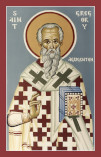 He was born in Sicily, near the town of Agrigentum
(where he was later bishop), of his devout parents Chariton and Theodota. His whole life
was woven through with God’s wonders. He went to Jerusalem, was chosen as bishop, and
was saved from slander in a miraculous way. He himself was a great wonder-worker, for he
was greatly pleasing to God, and was a great spiritual guide and ascetic. He took part in
the Fifth Ecumenical Council in Constantinople in 553. After severe temptations, he entered
peacefully into rest at the end of the sixth century or the beginning of the seventh. He was born in Sicily, near the town of Agrigentum
(where he was later bishop), of his devout parents Chariton and Theodota. His whole life
was woven through with God’s wonders. He went to Jerusalem, was chosen as bishop, and
was saved from slander in a miraculous way. He himself was a great wonder-worker, for he
was greatly pleasing to God, and was a great spiritual guide and ascetic. He took part in
the Fifth Ecumenical Council in Constantinople in 553. After severe temptations, he entered
peacefully into rest at the end of the sixth century or the beginning of the seventh.
|
3. St. Alexander of the Neva (Nevsky).
The son of Prince Yaroslav, his heart was drawn to God from his youth. He overcame the Swedes on the River Neva on July 15th, 1240, whence he took the name ‘of the Neva’. On that occasion, Ss. Boris and Gleb appeared to one of Alexander’s generals and promised their aid to the great prince, their kinsman. Among the Golden Horde of the Tartars (Cossacks), he refused to sacrifice to idols or pass through fire. The Tartar khan valued him for his wisdom, and his physical strength and beauty. He built many churches, and performed innumerable works of mercy. He entered into rest at the age of forty-three, on November 14th, 1263, today being the commemoration of the translation of his relics to the city of Vladimir.
4. St. Mitrophan, Bishop of Voronezh.
A famous Russian hierarch, ascetic and patriot, he was first a friend and then a strong critic of Peter I. He entered into rest on November 23rd, 1703. His wonder-working relics were discovered in 1832.
FOR CONSIDERATION
God permits misfortune to come upon the righteous, to their greater glorification; for misfortune overcome reveals both the glory of God and the glory of the righteous. Holy Gregory of Agrigentum was in all things righteous and pleasing to God. God let misfortune come upon him, a like misfortune to that which overtook St. Athanasius and St. Makarios: two priests, Sabinus and Crescens, to whom Gregory had done much good, could not abide his virtue (for such is the nature of guilt, that it cannot abide virtue). Sabinus and Crescens, then, found a notorious harlot and bribed her to slander Gregory, saying that he had had immoral relations with her. Once, when Gregory was in church, the woman hid in his bedroom, and when he came out of church with the people, this woman appeared from his room. These two priests then began to revile Gregory as an immoral man. Gregory was calm, and prepared for whatever suffering might come. They shut him up in prison, and then took him under escort to Rome. The pope believed his slanderers, and kept Gregory in prison for two years without trial. A council was then summoned to look into the affair, but before judgement was given by men, God gave His. The woman became mad, and was brought before the council as one demented. As a madwoman, she was not able to testify. Gregory the wonder-worker prayed to God for her and she was healed, the evil spirit leaving her forthwith. She testified through her tears that she had been bribed to slander the man of God and that, after this slander, an evil spirit had taken up residence in her and put her in its power. Sabinus and Crescens, along with the other slanderers—more than a hundred of them—suddenly found their faces turned coal-black, and they were punished with exile. Holy Gregory was returned to his diocese, and received with great exultation by his people.
Daily Scripture Readings taken from The Orthodox New Testament, translated and published by Holy Apostles Convent, Buena Vista, Colorado, copyright © 2000, used with permission, all rights reserved.
Daily Prologue Readings taken from The Prologue of Ochrid, by Bishop Nikolai Velimirovic, translated by Mother Maria, published by Lazarica Press, Birmingham, England, copyright © 1985, all rights reserved. Edited by Dormition Skete.