

Daily Devotional
Monday, December 7, 2026 (NS), November 24, 2026 (OS)
Fast Day, but Fish, Wine and Olive Oil Allowed.
Monday of the Twenty-Eighth Week
The commemoration of the Afterfeast of the Entrance of the Virgin into the Temple, and our fathers among the saints, Hieromartyrs Clement, Pope of Rome, and Peter, Patriarch of Alexandria. The commemoration of the Great-martyr Katherine and the Great-martyr Mercurios (see the 25th of November when commemorated on Gk. calendar).
Scripture Readings
Paschalion — Movable Calendar
Monday of the Twenty-Eighth Week
Epistle
The Reading is from the Second Epistle of Saint Paul to Saint Timothy [§ 294]. Child Timothy:
2 20In a great house there are not only golden and silver vessels, but also wooden and earthen, and some indeed to honor, but some to dishonor. 21If therefore one should cleanse himself from these, he shall be a vessel to honor, which hath been sanctified, and made useful to the master, having been prepared for every good work. 22Now keep on fleeing youthful lusts, but be pursuing righteousness, faith, love, peace, with those who call on the Lord out of a pure heart. 23But keep on rejecting foolish and undisciplined inquiries, knowing that they engender fights. 24And there is no need for a slave of the Lord to fight, but to be gentle toward all, apt to teach, forbearing, 25in meekness instructing those who oppose themselves, if perhaps God might give them repentance to a full knowledge of the truth, 26and that they might recover from out of the snare of the devil, having been taken captive by Him, in order to do the will of that One.
Gospel
The Reading is from the Holy Gospel according to Saint Luke [§ 86]. At that time:
17 20Jesus, having been questioned by the Pharisees when the kingdom of God is coming, answered them and said, “The kingdom of God cometh not with observation; 21“nor shall they say, ‘Behold, here!’ or ‘Behold, there!’ For behold, the kingdom of God is within you.” 22And He said to the disciples, “The days will come when ye shall desire to see one of the days of the Son of Man, and ye shall not see it. 23“And they shall say to you, ‘Behold, here!’ or ‘Behold, there!’ Do not begin to go forth nor follow. 24“For even as the lightning, which lighteneth out of one part under the heaven and shineth to the other part under the heaven, so also the Son of Man shall be in His day. 25“But first there is need for Him to suffer many things and to be rejected by this generation.”
Menaion — Fixed Calendar
The commemoration of the Afterfeast of the Entrance of the Virgin into the Temple, and our fathers among the saints, Hieromartyrs Clement, Pope of Rome, and Peter, Patriarch of Alexandria. The commemoration of the Great-martyr Katherine and the Great-martyr Mercurios (see the 25th of November when commemorated on Gk. calendar).
Epistle
The Reading is from the Epistle of Saint Paul to the Philippians [§ 246]. Brethren:
3 20Our citizenship existeth in the heavens, from where we also patiently await the Savior, the Lord Jesus Christ, 21Who shall transform the body of our humiliation, that it may become conformed to the body of His glory, according to the energy of Him Who is able even to subject all things to Himself.
4 1Therefore, my brethren, beloved and longed for, my joy and crown, thus be standing in the Lord, beloved ones. 2I beseech Evodia and I beseech Syntyche to be of the same mind in the Lord; 3yea, I ask thee also, genuine yoke-fellow, keep on assisting those women who struggled together with me in the Gospel, and Clement also, and the rest of my fellow workers, whose names are in the book of life.
Gospel
[Sl. usage] For the Feast:
The Reading is from the Holy Gospel according to Saint Luke [§ 54]. At that time:
10 38Jesus entered into a certain village. And a certain woman, by name Martha, received Him into her house. 39And she had a sister called Mary, who also sat down beside the feet of Jesus, and was listening to His word. 40But Martha was distracted about much serving, and she came up to Him and said, “Lord, is it no concern to Thee that my sister left me to serve alone? Speak to her therefore that she should help me.” 41And Jesus answered and said to her, “Martha, Martha, thou art anxious and troubled about many things. 42“But there is need of one thing, and Mary chose the good part, which shall not be taken away from her.”...
11 27And it came to pass, as He was speaking these things, a certain woman out of the crowd lifted up her voice and said to Him, “Blessed is the womb that bore Thee, and the breasts which Thou didst suck.” 28But He said, “Yea rather, blessed are they who hear the word of God and keep it.”
For the Hieromartyrs:
The Reading is from the Holy Gospel according to Saint John [§ 52]. The Lord said to His disciples:
15 17“These things I command you, that ye be loving one another.
18“If the world hate you, ye know that it hath hated Me before it hath hated you. 19“If ye were of the world, the world would love its own; but because ye are not of the world—but I chose you for Myself out of the world—therefore the world hateth you. 20“Keep on remembering the word which I said to you, ‘A slave is not greater than his lord.’ If they persecuted Me, they will also persecute you; if they kept My word, they will keep yours also. 21“But all these things they will do to you for My name’s sake, because they know not the One Who sent Me. 22“If I had not come and spoken to them, they would not have sin, but now they have no pretext for their sin. 23“The one who hateth Me hateth My Father also. 24“If I did not do the works among them which no other one hath done, they would not have sin; but now they have both seen and hated both Me and My Father. 25“But this cometh to pass that the word might be fulfilled which hath been written in their law: ‘They hated Me without a cause [cf. Ps. 34(35):22, 68(69):5(4)].’ 26“But whenever the Paraclete should come, Whom I shall send to you from the Father, the Spirit of the truth Who proceedeth from the Father, that One shall bear witness concerning Me. 27“And ye also are bearing witness, because ye have been with Me from the beginning.
16 1“These things I have spoken to you, in order that ye should not be made to stumble. 2“They shall put you out of the synagogues; yea moreover, there cometh an hour that everyone who killeth you should think that he offereth God a service.”
for Sl. usage, see [Mt. 5:14-19]
Lives of the Saints (Prologue)
December 7th – Civil Calendar
November 24th – Church Calendar
1. The Holy and Great Martyr Mercurios.
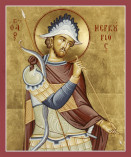 When the Emperor Decius was once making war on the
barbarians, there was in the army the commander of an Armenian regiment called the Martesians.
This commander was called Mercurios. In the battle, an angel of God appeared to Mercurios, put a
sword in his hand and told him that he would overcome the enemy. Mercurius displayed a wonderful
courage, mowing the enemy down like grass with his sword. After this glorious victory, the
emperor made him supreme commander of his army, but some jealous men denounced him to the emperor
as a Christian. Mercurios did not deny this before the emperor, but openly acknowledged it. He
was most terribly tortured: cut with knives in strips and burned in a furnace, but an angel of
God appeared in the prison and healed him. Finally the emperor pronounced the sentence that
General Mercurios be beheaded with the sword in Cappadocia. When they beheaded him, his body
became as white as snow, and from it there arose a wonderful, incense-like fragrance. Many of the
sick were healed by his wonder-working relics. This glorious soldier of Christ suffered for the
Faith some time between 251 and 259.
When the Emperor Decius was once making war on the
barbarians, there was in the army the commander of an Armenian regiment called the Martesians.
This commander was called Mercurios. In the battle, an angel of God appeared to Mercurios, put a
sword in his hand and told him that he would overcome the enemy. Mercurius displayed a wonderful
courage, mowing the enemy down like grass with his sword. After this glorious victory, the
emperor made him supreme commander of his army, but some jealous men denounced him to the emperor
as a Christian. Mercurios did not deny this before the emperor, but openly acknowledged it. He
was most terribly tortured: cut with knives in strips and burned in a furnace, but an angel of
God appeared in the prison and healed him. Finally the emperor pronounced the sentence that
General Mercurios be beheaded with the sword in Cappadocia. When they beheaded him, his body
became as white as snow, and from it there arose a wonderful, incense-like fragrance. Many of the
sick were healed by his wonder-working relics. This glorious soldier of Christ suffered for the
Faith some time between 251 and 259.
2. The Hieromartyr Clement, Bishop of Rome.
Born in Rome and of royal blood, he was a contemporary of the apostles. His mother and two brothers were caught by a storm on a voyage and driven to different places. His father then went off to find his wife and sons, and himself disappeared. Clement, being then twenty-four years old, set off eastwards to look for his parents and brothers. In Alexandria, he made the acquaintance of the Apostle Barnabas, and afterwards became a friend of the Apostle Peter, who was already being followed by Clement’s two brothers, Faustinus and Faustinian. By God’s providence, the Apostle Peter found Clement’s aged mother, who was living as a beggar-woman, and then his father also. Thus the whole family was reunited, and they all returned to Rome as Christians. Clement remained linked with the great apostles, who made him bishop before their death. Linus was bishop in Rome, then Cletus—both of them only for a short time—and then Clement. He governed the Church of God with burning zeal, and from day to day, brought large numbers of unbelievers to the Faith. He set seven scribes to record the lives of the Christian martyrs who were at that time suffering for their Lord. The Emperor Trajan drove him out to Cherson, where Clement found about two thousand exiled Christians, who were all put to the hard toil of cutting stone in an arid region. The Christians welcomed Clement with great joy, and he was to them a living source of comfort. By his prayers, he brought water from the dry ground and converted so many of the pagan inhabitants to Christianity that there were seventy-five churches built in that place in one year. To prevent the further spreading of the Christian Faith, Clement was condemned to death, and drowned in the sea with a stone round his neck in the year 101. His wonder-working relics were taken out of the sea only in the time of Ss. Kyril and Methodius.
3. The Hieromartyr Peter, Archbishop of Alexandria.
He was the disciple and successor of St. Theonas, Archbishop of Alexandria, and was for a time a teacher at Origen’s famous school of philosophy. He came to the archiepiscopal throne in 299, and died a martyr by the grave of the holy Apostle Mark in 311. He governed the Church in an acutely difficult period, when unbelievers were attacking the faithful from without and heretics from within. Six hundred and seventy Christians suffered in Alexandria in his time, whole families often perishing on the scaffold. At this time, Arius was troubling the faithful with his false teaching. St. Peter drove him from the Church and anathematized him in both this world and the next. The Lord Himself appeared to this great and wonderful saint in prison.
4. The Holy Maiden Mastridia.
She lived in Alexandria and led a solitary life of prayer and handwork. A young man became consumed with lustful passion towards her, and pestered her incessantly. Determined not to sin against God, and seeing that it would not be easy to shake off this dissolute youth, St. Mastridia once asked him what it was in her that most attracted him. He replied: ‘Your eyes!’ and Mastridia took the needle with which she was sewing and put out her eyes. Thus she preserved her own peace and the young man’s soul, who repented deeply and became a monk.
Author’s note: This Mastridia is apparently not the same as the one who is commemorated on February 7th. The latter is from Jerusalem, while this one is from Alexandria. The latter fled from scandal to the desert, and this one put out her eyes.
FOR CONSIDERATION
It is related of St. Peter of Alexandria that he never sat on the patriarchal throne, but sat at the foot of the steps up to it. When the faithful expressed their disapproval of the fact that their hierarch never sat in his own place, he replied: ‘Whenever I come up to the throne, I see a heavenly light upon it, and so I do not dare to go up and sit on it.’ Besides this vision, St. Peter had another, yet more wonderful. While he was lying in prison, the infamous heretic Arius pretended that he had repented of his heresy and sent word to the captive Peter that he had rejected his errors and asked to be received back into the Church. Arius did this solely because he counted on Peter’s being killed and himself inheriting the patriarchal throne, thereby giving him the opportunity of spreading and confirming his heresy. Before giving him any answer, Peter prayed to God in the prison. While he was praying, a strange light illumined the prison, and the Lord Jesus appeared to him as a twelve-year-old boy, in light more resplendent than the sun, so brilliant that He could not be gazed upon. The Lord was clad in a white garment that was torn down the front from neck to hem. He was clutching the garment round Himself, as though to hide His nakedness. Seeing this, St. Peter was greatly troubled and horrified, and cried out: ‘My Savior, who has torn Thy garment?’ The Lord replied: ‘That madman Arius. He has torn it, because he is turning My people from Me, the people whom I bought with My blood. Be careful not to receive him into communion with the Church, for his thoughts are evil and devilish about Me and My people.’ Hearing this, St. Peter replied to his priests Achilles and Alexander that they should not accede to Arius’ request, for he was false and evil, and the saint anathematized Arius in both worlds. He also prophesied that first Achilles and then Alexander would follow him as patriarch, and this came to pass.
Daily Scripture Readings taken from The Orthodox New Testament, translated and published by Holy Apostles Convent, Buena Vista, Colorado, copyright © 2000, used with permission, all rights reserved.
Daily Prologue Readings taken from The Prologue of Ochrid, by Bishop Nikolai Velimirovic, translated by Mother Maria, published by Lazarica Press, Birmingham, England, copyright © 1985, all rights reserved. Edited by Dormition Skete.