

Daily Devotional
Saturday, December 5, 2026 (NS), November 22, 2026 (OS)
Fast Day, but Fish, Wine and Olive Oil Allowed.
Saturday of the Twenty-Seventh Week
The commemoration of the Afterfeast of the Entrance of the Virgin into the Temple, and the holy Apostles Philemon, Archippos, Apfia, and Onesimos, the disciples of Paul the Apostle.
Scripture Readings
Paschalion — Movable Calendar
Saturday of the Twenty-Seventh Week
Epistle
The Reading is from the Epistle of Saint Paul to the Galatians [§ 213]. Brethren:
5 22The fruit of the Spirit is love, joy, peace, long-suffering, kindness, goodness, faith, 23meekness, self-control; against such things there is no law. 24But they who are of the Christ crucified the flesh with the passions and the lusts. 25If we live by the Spirit, let us also be walking by the Spirit. 26Let us not become vainglorious, provoking one another, envying one another.
6 1Brethren, even if a man should be overtaken in some transgression, ye, the spiritual ones, be restoring such a one in the spirit of meekness, looking out for thyself, lest thou also be tempted. 2Keep on bearing one another’s burdens, and thus fill up the law of the Christ.
Gospel
The Reading is from the Holy Gospel according to Saint Luke [§ 49]. At that time:
9 57As Jesus went in the way, someone said to Him, “I will follow Thee wheresoever Thou goest, Lord.” 58And Jesus said to him, “The foxes have holes and the birds of the heaven have nests, but the Son of Man hath nowhere that He may lay His head.” 59And He said to another, “Follow thou Me.” But he said, “Lord, permit me to go away first to bury my father.” 60But Jesus said to him, “Leave the dead to bury their own dead; but do thou go forth and be proclaiming the kingdom of God.” 61And another also said, “I will follow Thee, Lord, but first permit me to bid farewell to those in my house.” 62But Jesus said to him, “No one, having put his hand upon the plow, and looking to the things behind, is fit for the kingdom of God.”
Menaion — Fixed Calendar
The commemoration of the Afterfeast of the Entrance of the Virgin into the Temple, and the holy Apostles Philemon, Archippos, Apfia, and Onesimos, the disciples of Paul the Apostle.
Epistle
The Reading is from the Epistle of Saint Paul to Saint Philemon [§ mid 302 B].
1Paul, a prisoner of Christ Jesus, and Timothy our brother, to Philemon the beloved and our fellow worker, 2and to Apfia the beloved, and to Archippos our fellow soldier, and to the church in thy house. 3Grace to you and peace from God our Father and the Lord Jesus Christ.
4I thank my God, making mention of thee always in the time of my prayers, 5hearing of thy love and the faith which thou hast toward the Lord Jesus and in regard to all the saints, 6that the communion of thy faith might become energized in full knowledge of every good which is in you in regard to Christ Jesus. 7For we have much joy and consolation over thy love, because the hearts of the saints have been refreshed through thee, brother. 8Wherefore, though I have much boldness in Christ to enjoin thee to that which is becoming, 9yet for the sake of love I rather beseech, being such a one as Paul, an elder, and now also a prisoner of Jesus Christ, 10I beseech thee concerning my child, Onesimos, whom I begot in my bonds— 11the one who was once useless to thee, but is now useful to thee and to me—whom I am sending back. 12Now receive thou him, that is, mine own heart, 13whom I was wishing to hold for myself, that he may minister to me in the bonds of the Gospel; 14but without thine opinion I wished to do nothing, that thy good may not be as according to necessity, but according to willingness. 15For perhaps on this account he was separated from thee for a season, in order that thou mayest receive him in full forever, 16no longer as a slave, but above a slave, a brother beloved, especially to me, and how much more to thee, both in the flesh and in the Lord! 17If then thou holdest me a partner, take him to thyself as thou wouldest me. 18But if he wronged thee in anything or oweth thee, be reckoning this to me; 19I, Paul, am writing it with mine own hand, I will repay it; not that I may mention that to me thou owest even thyself. 20Yes, brother, may I benefit from thee in the Lord; refresh thou my heart in the Lord.
21Having trusted to thine obedience, I am writing to thee, knowing that even beyond what I may say thou wilt do. 22And at the same time also, be preparing a lodging for me, for I hope that through your prayers I shall be graciously given to you. 23There greeteth thee Epaphras, my fellow captive in Christ Jesus, 24Mark, Aristarchos, Demas, Luke, my fellow workers.
25The grace of our Lord Jesus Christ be with your spirit. Amen.
Gospel
The Reading is from the Holy Gospel according to Saint Luke [§ 50]. At that time:
10 1The Lord appointed seventy others also, and sent them forth two by two before His face into every city and place where He Himself was about to go. 2Therefore He was saying to them, “The harvest indeed is great, but the workers are few. Entreat therefore the Lord of the harvest that He would send out workers into His harvest. 3“Go; behold, I send you forth as lambs in the midst of wolves. 4“Cease carrying a purse, neither a leathern pouch, nor sandals; and do not begin to greet anyone along the way. 5“And into whatsoever house ye enter, first say, ‘Peace be to this house.’ 6“And if, indeed, there be there a son of peace, your peace shall come to rest upon it; but if not so, it shall return to you. 7“And in that very house keep on remaining, eating and drinking the things given by them, for the worker is worthy of his hire. Do not have the habit of moving from house to house. 8“And into whatsoever city ye enter, and they receive you, go on eating the things which are set before you; 9“and keep on curing the sick in it, and saying to them, ‘The kingdom of God hath drawn near to you.’ 10“But into whatsoever city ye enter, and they receive you not, go out into its broad streets, and say, 11“‘Even the dust of your city, which cleaveth to us, we wipe off ourselves against you; but know this, that the kingdom of God hath drawn near to you.’ 12“But I say to you that it shall be more tolerable in that day for Sodom than for that city. 13“Woe to thee, Chorazin! Woe to thee, Bethsaida! For if the works of power which took place in you took place in Tyre and Sidon, they would have repented long ago, sitting in sackcloth and ashes. 14“But it shall be more tolerable for Tyre and Sidon in the judgment than for you. 15“And thou, Capernaum, which hath been lifted high unto the heaven, shall be brought down as far as Hades.”
Lives of the Saints (Prologue)
December 5th – Civil Calendar
November 22nd – Church Calendar
1. The Holy Martyr Cecilia.
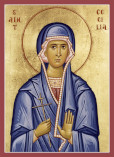 Born in Rome of rich and eminent parents, she had a firm faith in
Christ the Lord and a great zeal for the Faith. Vowing life-long virginity to God, holy Cecilia
wore a rough hair-shirt underneath the costly raiment that her parents gave her. When they forced
her into marriage with a pagan, Valerian, she spent the first night urging her newly-wedded
bridegroom to go to Bishop Urban for Baptism, and then himself to live a life of virginity.
Embracing the Christian Faith, Valerian also brought his brother Tibertius to it. Both brothers
were very soon condemned to death for their faith, but their zeal did not falter in the face of
death itself. Taken to the scaffold, these two brothers succeeded in bringing the captain of the
guard, Maximus, to the Faith, and they all three suffered together for Christ the Lord. St.
Cecilia buried their bodies together and was then herself taken for trial, having unwearyingly
won over many pagans to the Christian Faith. In one evening, she had won over four hundred souls.
When the judge asked her whence came her daring, she answered: ‘From a pure conscience and
an unquestioning faith.’ After harsh torture, she was condemned to death. The executioner
wounded her three times with a dagger, and the blood ran down from her wounds, being caught in
kerchiefs and bowls by the faithful to use for healing. Although left for dead, Cecilia remained
alive. Three days later, after making her house a church, Christ’s martyr and virgin gave
her spirit into the hands of her Lord, to rejoice with Him in eternity. St. Cecilia suffered with
the others in about the year 230. Her relics are preserved in the church dedicated to her name in
Rome.
Born in Rome of rich and eminent parents, she had a firm faith in
Christ the Lord and a great zeal for the Faith. Vowing life-long virginity to God, holy Cecilia
wore a rough hair-shirt underneath the costly raiment that her parents gave her. When they forced
her into marriage with a pagan, Valerian, she spent the first night urging her newly-wedded
bridegroom to go to Bishop Urban for Baptism, and then himself to live a life of virginity.
Embracing the Christian Faith, Valerian also brought his brother Tibertius to it. Both brothers
were very soon condemned to death for their faith, but their zeal did not falter in the face of
death itself. Taken to the scaffold, these two brothers succeeded in bringing the captain of the
guard, Maximus, to the Faith, and they all three suffered together for Christ the Lord. St.
Cecilia buried their bodies together and was then herself taken for trial, having unwearyingly
won over many pagans to the Christian Faith. In one evening, she had won over four hundred souls.
When the judge asked her whence came her daring, she answered: ‘From a pure conscience and
an unquestioning faith.’ After harsh torture, she was condemned to death. The executioner
wounded her three times with a dagger, and the blood ran down from her wounds, being caught in
kerchiefs and bowls by the faithful to use for healing. Although left for dead, Cecilia remained
alive. Three days later, after making her house a church, Christ’s martyr and virgin gave
her spirit into the hands of her Lord, to rejoice with Him in eternity. St. Cecilia suffered with
the others in about the year 230. Her relics are preserved in the church dedicated to her name in
Rome.
In the Orthodox Church, St. Cecilia is regarded as the patron of Church music because, during those three days that she suffered for Christ, she sang praises to the Lord.
2. St. Kallistos, Patriarch of Constantinople.
He was named ‘Xanthopoulos’ after the cell of that name on Mount Athos, where he lived for a long time in asceticism with his friend Ignatius. Together with this Ignatius, St. Kallistos wrote of his personal experience of a life of silence in a book containing a hundred chapters. This book holds a very important place in ascetic literature. Kallistos was greatly influenced by his teacher, St. Gregory the Sinaite, whose life he recorded.
3. The Holy Martyr Menignos.
Born on the Hellespont, he worked as a linen-bleacher, and so was called ‘the Bleacher’. In the time of the Emperor Decius (249-251), he tore up the imperial decree on the persecution of Christians, and was consequently thrown into prison. There, the Lord Himself appeared to him and encouraged him, saying: ‘Fear not; I am with thee.’ At that moment, his shackles melted like wax, the prison opened of itself and he went out. He was again seized and brought to trial. He was inhumanly tortured: his fingers and toes were cut off, and then he was beheaded. His severed head glowed at night like a lamp.
4. Holy and Righteous Michael the Soldier.
He was a Bulgarian by birth. With his friends, he went into the Greek army to fight against the Hagarenes in Ethiopia, there displaying an extraordinary fearlessness. He killed a poisonous snake and freed a maiden. Very soon after that, this righteous man entered into eternal life. He was first buried somewhere in Thrace, but in 1206 the Emperor Kalo-John translated his relics to Trnovo. He lived and died in the ninth century.
FOR CONSIDERATION
In vain does one strive to learn if one does not strive for purity of faith and life. The heavenly world is revealed not to the learned, but to the pure. When St. Cecilia had been led to the bridal chamber with her newly-wedded husband on the first night, she said to him: ‘I want to show you a mystery. There is standing here an angel of God, the guardian of my virginity, whom you cannot see. He is standing here ready to defend me, his handmaid, from assault. If you only touch me, he will kill you.’ Hearing this, Valerian begged Cecilia to show him the angel, that he too might see it. The maiden replied: ‘You are a man that does not know the true God, and you cannot see His angel until you are cleansed of the foulness of your unbelief.’ When Valerian had been baptized, he saw the angel in great light and unspeakable beauty. So also Tibertius, Valerian’s brother, when he had been baptized and had changed his way of life from impurity to purity, saw holy angels and spoke with them. Maximus also, their fellow-sufferer, at the time that these two brothers were beheaded, called down imprecations on himself from the executioner and the assembled people, saying: ‘I see angels of God bathed in light like the sun, taking their souls from the bodies of the martyrs, like beautiful maidens from the bridal chamber, and carrying them to heaven with great glory.’ But that which he saw was invisible to the unbelievers and the impure.
Daily Scripture Readings taken from The Orthodox New Testament, translated and published by Holy Apostles Convent, Buena Vista, Colorado, copyright © 2000, used with permission, all rights reserved.
Daily Prologue Readings taken from The Prologue of Ochrid, by Bishop Nikolai Velimirovic, translated by Mother Maria, published by Lazarica Press, Birmingham, England, copyright © 1985, all rights reserved. Edited by Dormition Skete.