

Daily Devotional
Tuesday, November 24, 2026 (NS), November 11, 2026 (OS)
No Fasting.
Tuesday of the Twenty-Sixth Week
11. The commemoration of the holy Martyrs Menas of Egypt, Victor at Damascus, and Vincent of Spain, and our venerable father and confessor, Theodore of the Studite Monastery.
Scripture Readings
Paschalion — Movable Calendar
Tuesday of the Twenty-Sixth Week
Epistle
The Reading is from the First Epistle of Saint Paul to Saint Timothy [§ 279]. Child Timothy:
1 8We know that the law is good, if one use it lawfully, 9knowing this, that the law is not laid down for the righteous, but for the lawless and insubordinate, for the impious and sinful, for the unholy and profane, for smiters of fathers and smiters of mothers, for manslayers, 10for fornicators, for sodomites, for man-stealers, for liars, for perjurers, and if there is any other which opposeth sound teaching, 11according to the Gospel of the glory of the blessed God with which I was entrusted. 12I have gratitude toward the One Who empowereth me, Christ Jesus our Lord, because He deemed me faithful, Who Himself put me into service, 13who before was a blasphemer and persecutor and an insolent man; but I was shown mercy, because being ignorant I did it in unbelief. 14And the grace of our Lord abounded exceedingly with faith and love which is in Christ Jesus.
Gospel
The Reading is from the Holy Gospel according to Saint Luke [§ 68].
12 42The Lord said, “Who then is the faithful and prudent steward, whom his lord shall appoint over his household servants, to give them their measure of food in due season? 43“Happy is that slave whom after his lord cometh shall find him so doing. 44“Truly I say to you that he will appoint him over all his possessions. 45“But if that slave should say in his heart, ‘My lord taketh time to come,’ and should begin to strike the menservants and the maidservants, and to eat and to drink and be drunken, 46“the lord of that slave shall come in a day in which he expecteth not, and in an hour in which he knoweth not, and will cut him in twain, and will place his portion with the unfaithful. 47“And that slave who knew the will of his lord, and prepared not, nor did according to his will, shall be beaten much. 48“But he who knew not, and did things worthy of blows, shall be beaten a little. And everyone to whom much was given, much shall be required from him; and to whom much was committed, the more they will ask of him.”
Menaion — Fixed Calendar
11. The commemoration of the holy Martyrs Menas of Egypt, Victor at Damascus, and Vincent of Spain, and our venerable father and confessor, Theodore of the Studite Monastery.
Epistle
For the Martyrs:
The Reading is from the Second Epistle of Saint Paul to the Corinthians [§§ 176, 177]. Brethren:
4 6It is God Who said, “Let there be light [cf. Gen. 1:3]” to shine out of darkness, Who shined in our hearts, for the illumination of the knowledge of the glory of God in the face of Jesus Christ.
7But we have this treasure in earthen vessels, that the preeminence of the power may be of God, and not from us. 8In every way we are afflicted, but not straitened; we are at a loss, but not utterly at a loss; 9persecuted, but not abandoned; cast down, but not destroyed— 10always bearing about in the body the dying of the Lord Jesus, that the life also of Jesus might be made manifest in our body. 11For we, the living, are always being delivered to death on account of Jesus, that also the life of Jesus might be made manifest in our mortal flesh. 12So that indeed death energizeth itself in us, but life in you. 13But having the same spirit of faith, according to that which hath been written: “I believed, wherefore I spoke [Ps. 115(116):1(10)],” we also believe, and therefore speak, 14knowing that the One Who raised up the Lord Jesus shall raise up us also through Jesus, and shall present us with you. 15For all things are for your sakes, that the grace, which abounded through the majority, might cause the giving of thanks to abound more to the glory of God.
for Sl. usage, see [Eph. 6:10-17].
For the venerable Father:
The Reading is from the Epistle of Saint Paul to the Hebrews [§ 335]. Brethren:
13 17Be obedient to those who lead you, and keep on submitting, for they are watchful for your souls, as those about to render an account, that they may do this with joy, and not groaning; for this would be unprofitable for you. 18Keep on praying for us; for we trust that we have a good conscience, in all things wishing to conduct ourselves well. 19But I beseech you more abundantly to do this, that I might be restored more quickly to you.
20Now the God of peace Who brought up from the dead our Lord Jesus, the Shepherd of the sheep, the great One, in the blood of an everlasting covenant, 21may He render you perfect in every good work, in order to do His will, doing in you that which is well-pleasing before His face, through Jesus Christ, to Whom be glory to the ages of the ages. Amen.
Gospel
For the Martyrs:
The Reading is from the Holy Gospel according to Saint Matthew [§§ 38, mid 79]. The Lord said tohis disciples:
10 32“Everyone who shall confess in Me before men, I also will confess in him before My Father Who is in the heavens. 33“But whosoever shall deny Me before men, him will I also deny before My Father Who is in the heavens.... 37“The one who loveth father or mother more than Me is not worthy of Me; and the one who loveth son or daughter more than Me is not worthy of Me. 38“And whosoever taketh not his cross and followeth after Me is not worthy of Me.”...
19 27Peter answered and said to Him, “Behold, we left all things and followed Thee; what then shall be for us?” 28And Jesus said to them, “Verily I say to you, that ye who followed Me, in the regeneration, whenever the Son of Man shall have taken His seat upon the throne of His glory, ye also shall sit upon twelve thrones, judging the twelve tribes of Israel. 29“And everyone who leaveth houses, or brothers, or sisters, or father, or mother, or wife, or children, or lands, on account of My name, shall receive a hundredfold, and shall inherit life everlasting. 30“But many who are first shall be last, and the last first.”
For the venerable Confessor:
The Reading is from the Holy Gospel according to Saint Matthew [§ 10]. At that time:
For Gk. usage, see Mt. 4:23-5:13; for Sl. usage, see Mt.4:25-5:13.
4 23Jesus was going around all Galilee, teaching in their synagogues, and proclaiming the Gospel of the kingdom, and curing every disease and every sickness among the people. 24And the report of Him went out into all Syria. And they brought to Him all those who were ill, constrained by various diseases and torments, and possessed by demons, and lunatics, and paralytics; and He cured them. 25And great crowds followed Him from Galilee, and Decapolis, and Jerusalem, and Judæa, and beyond the Jordan.
5 1And seeing the crowds, He went up into the
mountain; and after He sat down, His disciples came to Him. 2And He opened His mouth
and began to teach them, saying:
3“Blessed are the poor in spirit, for theirs is the
kingdom of the heavens.
4“Blessed are they who mourn, for they shall be
comforted.
5“Blessed are the meek, for they shall inherit the
earth.
6“Blessed are they who hunger and thirst after
righteousness, for they shall be filled.
7“Blessed are the merciful, for they shall find mercy.
8“Blessed are the pure in heart, for they shall see
God.
9“Blessed are the peacemakers, for they shall be called
sons of God.
10“Blessed are they who have been persecuted on account
of righteousness, for theirs is the kingdom of the heavens.
11“Blessed are ye whenever they reproach you and persecute
you, and say every evil word against you falsely on account of Me.
12“Be rejoicing and be exceedingly glad, for your reward
is great in the heavens. For so they persecuted the prophets who were before
you.
13“Ye are the salt of the earth; but if the salt should become insipid, with what shall it be salted? For it is no longer good for anything, except to be cast out and to be trampled underfoot by men.”
Lives of the Saints (Prologue)
November 24th – Civil Calendar
November 11th – Church Calendar
1. The Holy and Great Martyr Menas.
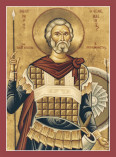 An Egyptian by birth and a soldier by profession, St.
Menas, as a true Christian, could not bear to look upon the foul offering of sacrifice to idols,
so he left the army and the town, the society of men and everything else, and went to a deserted
mountain. It was easier for Menas to live with the wild beasts than with pagans. One day, Menas
looked from afar in spirit at a pagan festival in the town of Cotyaeus, then went to the town,
and before them all, confessed his faith in Christ the living God, denouncing idolatry and
paganism as falsehood and darkness. The governor of that town, one Pyrrhus, asked who and what he
was. The saint replied: ‘My fatherland is Egypt; my name is Menas. I was an officer, but
seeing the worship of idols, I rejected your honors. I have come now to proclaim my Christ before
you all as the living God, that He may reveal me as His servant in the kingdom of God.’
Hearing this, Pyrrhus put holy Menas to harsh torture. He was flogged, flayed with iron flails,
burned with torches and tortured in many other ways, finally being beheaded. His body was burned
to prevent Christians taking it, but they did succeed in rescuing some bits from the flames. They
buried these remains with care, and they were later taken to Alexandria and buried there. A
church was built over them. St. Menas suffered in about 304, and entered into the kingdom of
Christ. He was and remains a great wonder-worker in both lives: both on earth and in heaven.
Whoever has glorified Menas or invoked his aid with faith in time of need has received help. He
has often appeared as a soldier on horseback, to help the faithful or to punish the
faithless.
An Egyptian by birth and a soldier by profession, St.
Menas, as a true Christian, could not bear to look upon the foul offering of sacrifice to idols,
so he left the army and the town, the society of men and everything else, and went to a deserted
mountain. It was easier for Menas to live with the wild beasts than with pagans. One day, Menas
looked from afar in spirit at a pagan festival in the town of Cotyaeus, then went to the town,
and before them all, confessed his faith in Christ the living God, denouncing idolatry and
paganism as falsehood and darkness. The governor of that town, one Pyrrhus, asked who and what he
was. The saint replied: ‘My fatherland is Egypt; my name is Menas. I was an officer, but
seeing the worship of idols, I rejected your honors. I have come now to proclaim my Christ before
you all as the living God, that He may reveal me as His servant in the kingdom of God.’
Hearing this, Pyrrhus put holy Menas to harsh torture. He was flogged, flayed with iron flails,
burned with torches and tortured in many other ways, finally being beheaded. His body was burned
to prevent Christians taking it, but they did succeed in rescuing some bits from the flames. They
buried these remains with care, and they were later taken to Alexandria and buried there. A
church was built over them. St. Menas suffered in about 304, and entered into the kingdom of
Christ. He was and remains a great wonder-worker in both lives: both on earth and in heaven.
Whoever has glorified Menas or invoked his aid with faith in time of need has received help. He
has often appeared as a soldier on horseback, to help the faithful or to punish the
faithless.
2. The Holy Martyr Stefan (Stephen) of Dečani, King of Serbia.
He was the son of King Milutin and father of King Dušan. At the command of his ill-informed father he was blinded, and at the command of his light-minded son was, in old age, drowned. At the time of his blinding, St. Nicholas appeared to him in the church at Ovče Polje (the Sheep-Pasture) and gestured towards his own eyes, saying: ‘Stefan, don’t be afraid; your eyes have been given to me and I will return them to you in due course.’ He spent five years in Constantinople, as an exile in the monastery of the Pantocrator. By his wisdom and ascesis, his meekness and devotion, his patience and greatness of soul, Stefan surpassed not only the monks in that monastery, but those in the whole of Constantinople. When five years had passed, St. Nicholas appeared to him again and said to him: ‘I have come to fulfill my promise.’ He then made the sign of the Cross over the blind king, and he received his sight. Out of gratitude to God, he built the monastery of Dečani, a rare example of the finest Byzantine work and one of the most famous memorials of Serbian devotion. The holy King Stefan, St. Sava and the holy Prince Lazar make a trio of holiness, nobility and self-sacrifice; the gift of the Serbian people. He lived his time on earth as a martyr, and died a martyr in 1336, receiving the wreath of immortal glory from the Almighty Whom he had served so faithfully.
3. The Holy Martyrs Victor and Stephanis.
Victor was a Roman soldier, and was tortured for Christ in the time of the Emperor Antoninus (138-161). During his torture, a young woman, Stephanis, revealed that she also was a Christian. Victor was beheaded and Stephanis was torn in half, being tied by the hands and feet to the tops of palm trees.
4. The Holy Martyr Vincent the Deacon.
From the diocese of Saragossa in Spain, he was terribly tortured for Christ the Lord, and finally burned on an iron grid. He gave his soul into God’s hands in 304. His body is preserved in Rome, in the church bearing his name.
5. Our Holy Father Theodore the Studite.
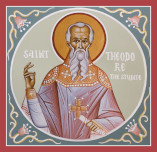 The famous abbot of Studium, he suffered greatly for the
sake of the icons. He was a wise organizer of the monastic life, an inspired teacher of
Orthodoxy and wonderful ascetic. He entered into rest in Constantinople in 826, at the age
of sixty-eight. The famous abbot of Studium, he suffered greatly for the
sake of the icons. He was a wise organizer of the monastic life, an inspired teacher of
Orthodoxy and wonderful ascetic. He entered into rest in Constantinople in 826, at the age
of sixty-eight.
|
6. St. Urošica, Prince of Serbia.
He was son of King Dragutin. He preserved his chastity and purity in marriage, and myrrh flowed from his tomb.
FOR CONSIDERATION
If ever there was a holy king on the throne of an earthly kingdom, that king was Stefan of Dečani. The Greeks, who regarded the Slavs as barbarians, marveled at the beauty of Stefan’s soul, as one of the rarest wonders of that age. When the Emperor John Cantacuzene sent the abbot of the Pantocrator monastery to King Milutin on business, the king, among other things, asked after his son Stefan. ‘Are you asking me about that second Job, your Majesty?’ the abbot replied. ‘Know that his godliness exceeds your royal majesty.’ The Greek emperor was at first very harsh towards Stefan, shutting him in an isolated palace and forbidding him any visitors, and then transferring him to the Pantocrator monastery in the hope that the strict asceticism would weaken and kill him. But God preserved blessed Stefan, and he bore the ascesis of fasting and prayer like a perfected monk. His wisdom began to be talked of throughout Constantinople, and the emperor began to value him and turn to him for advice. Thus, for example, St. Stefan contributed to the downfall of the notorious heresy of Barlaam, against which St. Gregory Palamas fought. Barlaam was in Constantinople at that time, and by skillful intrigues, had brought many of those eminent in the Church and the court to his way of thinking. In perplexity, the emperor summoned Stefan and asked him what was to be done with Barlaam. The wise Stefan answered in the words of the Psalmist: ‘I hated them, O Lord that hate Thee,’ and he added: ‘Dangerous men must be driven from our company.’ Hearing this, Emperor John Cantacuzene drove Barlaam with dishonor from the capital.
Daily Scripture Readings taken from The Orthodox New Testament, translated and published by Holy Apostles Convent, Buena Vista, Colorado, copyright © 2000, used with permission, all rights reserved.
Daily Prologue Readings taken from The Prologue of Ochrid, by Bishop Nikolai Velimirovic, translated by Mother Maria, published by Lazarica Press, Birmingham, England, copyright © 1985, all rights reserved. Edited by Dormition Skete.