

Daily Devotional
Sunday, November 22, 2026 (NS), November 9, 2026 (OS)
No Fasting.
Sunday of the Twenty-Fifth Week
Mode Plagal Four — Third Eothinon
The commemoration of the wonderworking Athonite Icon of the most holy Theotokos, "She Who is Quick to Hear," and the holy Martyrs Onesiphoros and Porphyrios of Ephesus, and our venerable Mothers Matrona the abbess at Constantinople and Theoktiste of Lesvos, and our holy father among the saints, Nectarios, Bishop of Pentapolis, Wonder-worker of Aegina.
Scripture Readings
Paschalion — Movable Calendar
Sunday of the Twenty-Fifth Week
Mode Plagal Four — Third Eothinon
Epistle
The Reading is from the Epistle of Saint Paul to the Ephesians [§ 224]. Brethren:
For Gk. usage, see Eph. 4:1-7; for Sl. usage, see Eph. 4:1-6.
4 1I, the prisoner in the Lord, beseech you to walk worthily of the calling in which ye were called, 2with all humility and meekness, with long-suffering, bearing with one another in love, 3giving diligence to keep the unity of the Spirit in the bond of peace. 4There is one body, and one Spirit, even as ye also were called in one hope of your calling; 5one Lord, one faith, one baptism; 6one God and Father of all, Who is over all, and through all, and in you all. 7But to each of us was given grace according to the measure of the gift of the Christ.
Gospel
The Reading is from the Holy Gospel according to Saint Luke [§ 39]. At that time:
8 41A certain man came to Jesus, whose name was Jairos, and he was a ruler of the synagogue. And he fell at the feet of Jesus and besought Him to come into his house, 42for he had an only daughter, about twelve years old, and she was dying. But as He was going, the crowds were pressing closely upon Him. 43And a woman, having a flow of blood for twelve years, who expended her whole living on physicians and could not be cured by anyone, 44came behind Him and touched the fringe of His garment. And immediately the flow of her blood stanched. 45And Jesus said, “Who is the one who touched Me?” But when all denied it, Peter said, and those with him, “Master, the crowds compass Thee and press Thee tightly, and sayest Thou, ‘Who is the one who touched Me?’” 46And Jesus said, “Someone touched Me; for I know that power went forth from Me.” 47And after the woman saw that she did not escape notice, she came trembling; and having fallen down before Him, she declared to Him before all the people for what cause she touched Him, and how she was healed immediately. 48And He said to her, “Daughter, be of good courage; thy faith hath made thee well. Go thou in peace.” 49While He is yet speaking, someone cometh from the ruler of the synagogue’s house, saying to him, “Thy daughter hath died; do not be troubling the Teacher.” 50But after Jesus heard it, He answered him, saying, “Cease being afraid; only keep on believing, and she shall be made well.” 51And after He entered into the house, He did not allow anyone to go in, except Peter and Iakovos and John, and the father and the mother of the girl. 52And all were weeping and beating their breasts. But He said, “Cease weeping; she did not die, but sleepeth.” 53And they kept on laughing scornfully at Him, knowing that she did die. 54But He put them all outside and took hold of her hand and called, saying, “Girl, arise.” 55And her spirit returned, and she arose immediately. And He commanded that something be given to her to eat. 56And her parents were amazed. And He gave orders to them to tell no one what took place.
Menaion — Fixed Calendar
The commemoration of the wonderworking Athonite Icon of the most holy Theotokos, "She Who is Quick to Hear," and the holy Martyrs Onesiphoros and Porphyrios of Ephesus, and our venerable Mothers Matrona the abbess at Constantinople and Theoktiste of Lesvos, and our holy father among the saints, Nectarios, Bishop of Pentapolis, Wonder-worker of Aegina.
Epistle
For the Icon:
The Reading is from the Epistle of Saint Paul to the Philippians [§ 240]. Brethren:
2 5Let this mind be in you which was also in Christ Jesus, 6Who, existing in the form of God, deemed it not a prize to be seized to be equal with God; 7but He emptied Himself and took the form of a slave, and came to be in the likeness of men. 8And having been found in fashion as a man, He humbled Himself and became obedient even to death—indeed, the death of a cross. 9Wherefore God also exalted Him exceedingly, and freely gave to Him a name that is above every name, 10that in the name of Jesus every knee should bow, of those in heaven and on earth and under the earth; 11and every tongue should confess for itself that Jesus Christ is Lord, to the glory of God the Father.
For the Martyrs and venerable Mothers:
The Reading is from the Epistle of Saint Paul to the Hebrews [§ 325]. Brethren:
10 32Remind yourselves of the former days in which, after ye were illuminated, ye endured a great contest of sufferings: 33partly, being made a show of both by reproaches and affliction; and partly, having become partners of those who conducted themselves thus. 34For ye also sympathized with those in bonds and ye yourselves accepted the seizure of your possessions with joy, knowing in yourselves that ye have in the heavens a better and abiding possession. 35Do not begin therefore to cast away your boldness which hath great recompense. 36For ye have need of patience, that, after ye do the will of God, ye might receive for yourselves the promise. 37“For yet a very little while, the One Who cometh will come, and will not delay [cf. Hab. 2:3]. 38“Now the just shall live by faith; and if one should draw himself back, My soul hath no pleasure in him [cf. Hab. 2:4].”
For the Hierarch:
The Reading is from the Epistle of Saint Paul to the Ephesians [§ 229]. Brethren:
5 8Be walking as children of light— 9for the fruit of the Spirit is in all goodness and righteousness and truth— 10proving what is well-pleasing to the Lord. 11And cease having fellowship with the unfruitful works of darkness, but rather even reprove them. 12For it is shameful even to speak of the things which are done by them in secret. 13But all things which are reproved are made manifest by the light; for all which is made manifest is light. 14Wherefore, He saith, “Rouse thyself, thou who sleepest, and arise from the dead, and the Christ shall shine on thee [cf. Is. 9:2, 26:19, 52:1, 60:1, 2].”
15Be taking heed then how exactly ye walk, not as unwise ones, but as wise ones, 16redeeming the time, because the days are evil. 17On this account cease becoming foolish, but become as ones understanding what the will of the Lord is. 18And cease being drunk with wine, in which is prodigality, but keep on being filled with the Spirit, 19speaking to one another in psalms and hymns and spiritual songs, singing and chanting in your heart to the Lord.
Gospel
For the Icon:
The Reading is from the Holy Gospel according to Saint Luke [§ 54]. At that time:
10 38Jesus entered into a certain village. And a certain woman, by name Martha, received Him into her house. 39And she had a sister called Mary, who also sat down beside the feet of Jesus, and was listening to His word. 40But Martha was distracted about much serving, and she came up to Him and said, “Lord, is it no concern to Thee that my sister left me to serve alone? Speak to her therefore that she should help me.”41And Jesus answered and said to her, “Martha, Martha, thou art anxious and troubled about many things. 42“But there is need of one thing, and Mary chose the good part, which shall not be taken away from her.”...
11 27And it came to pass, as He was speaking these things, a certain woman out of the crowd lifted up her voice and said to Him, “Blessed is the womb that bore Thee, and the breasts which Thou didst suck.” 28But He said, “Yea rather, blessed are they who hear the word of God and keep it.”
For the Hierarch:
The Reading is from the Holy Gospel according to Saint Matthew [§ 10]. At that time:
For Gk. usage, see Mt. 4:23-5:13; for Sl. usage, see Mt.4:25-5:13.
4 23Jesus was going around all Galilee, teaching in their synagogues, and proclaiming the Gospel of the kingdom, and curing every disease and every sickness among the people. 24And the report of Him went out into all Syria. And they brought to Him all those who were ill, constrained by various diseases and torments, and possessed by demons, and lunatics, and paralytics; and He cured them. 25And great crowds followed Him from Galilee, and Decapolis, and Jerusalem, and Judæa, and beyond the Jordan.
5 1And seeing the crowds, He went up into the
mountain; and after He sat down, His disciples came to Him. 2And He opened His mouth
and began to teach them, saying:
3“Blessed are the poor in spirit, for theirs is the
kingdom of the heavens.
4“Blessed are they who mourn, for they shall be
comforted.
5“Blessed are the meek, for they shall inherit the
earth.
6“Blessed are they who hunger and thirst after
righteousness, for they shall be filled.
7“Blessed are the merciful, for they shall find mercy.
8“Blessed are the pure in heart, for they shall see
God.
9“Blessed are the peacemakers, for they shall be called
sons of God.
10“Blessed are they who have been persecuted on account
of righteousness, for theirs is the kingdom of the heavens.
11“Blessed are ye whenever they reproach you and persecute
you, and say every evil word against you falsely on account of Me.
12“Be rejoicing and be exceedingly glad, for your reward
is great in the heavens. For so they persecuted the prophets who were before
you.
13“Ye are the salt of the earth; but if the salt should become insipid, with what shall it be salted? For it is no longer good for anything, except to be cast out and to be trampled underfoot by men.”
or
The Reading is from the Holy Gospel according to Saint John [§ 36]. The Lord said to the Jews who hadcome to Him:
10 9“I am the door; by Me if anyone should enter, he shall be saved, and shall go in and go out and find pasture. 10“The thief cometh not, except that he might steal, and slay, and destroy. I came that they may have life, and may have it abundantly. 11“I am the good shepherd. The good shepherd layeth down his life for the sheep. 12“But the hireling, who indeed is not a shepherd, whose own the sheep are not, seeth the wolf coming, and leaveth the sheep and fleeth; and the wolf seizeth them and scattereth the sheep. 13“Now the hireling fleeth, because he is a hireling and careth not about the sheep. 14“I am the good shepherd; and I know those that are Mine, and am known of those that are Mine. 15“Even as the Father knoweth Me, I also know the Father; and I lay down My life for the sheep. 16“And I have other sheep which are not of this fold; them also it is needful for Me to bring, and they shall hear My voice; and there shall be one flock and one Shepherd.”
Lives of the Saints (Prologue)
November 22nd – Civil Calendar
November 9th – Church Calendar
1. The Holy Martyrs Onesiphoros and Porphyrios.
These two wonderful men were martyred for the name of Christ in the time of the Emperor Diocletian (284-305). They were harshly beaten, and then burned in iron coffins, and after that tied to horses’ tails and dragged over stones and thistles. They were thus broken to pieces and gave their holy souls into God’s hands. Their relics were buried in Pentapolis.
2. Our Holy Father John Kolovos.
He is counted among the greatest of the Egyptian ascetics. ‘Kolovos’ means ‘short’ or ‘dwarf,’ for he was little of stature. He came to Sketis with his brother Daniel, and with surpassing zeal, gave himself to asceticism, such that his brother had to urge him to moderation. He was a disciple of St. Pambo, and later the teacher of St. Arsenius the Great. One of his fellow-disciples with St. Pambo was St. Paisius the Great. One day, when he was in conversation with St. Paisius about what sort of asceticism to adopt, an angel of God appeared to them, and ordered John to stay where he was and gather companions, and Paisius to go into the desert and live as a solitary. To test John’s obedience, Pambo ordered him to water a dry stick that he had stuck in the ground until it bore leaves. With no hesitation or doubt, John watered this dry stick for three whole years, from day to day, until, by God’s power, it put forth leaves and bore fruit. Then Pambo gathered the fruits from this tree, took them to the church and shared them out among the brethren, saying: ‘Come and taste of the fruits of obedience!’ John Kolovos had many disciples, and some of his wise sayings have been preserved. He entered peacefully into rest and the joy of his Lord early in the fifth century.
3. Our Holy Mother Matrona of Constantinople.
She was from Perga in Pamphylia. Quickly finding marriage to Dometian, a Constantinopolitan nobleman, unbearable, she fled, dressed herself in men’s clothing, and under the name of Babylas, went to the monastery of St. Bassian in Constantinople. As her husband searched for her unremittingly, she was forced to move constantly from place to place: Emesa, Sinai, Jerusalem, Beirut, finally returning to Constantinople. She received the monastic schema at the age of twenty-five, and lived in asceticism for seventy-five years. Living a hundred years in all, she died peacefully as abbess of a monastery in Constantinople, and entered into the joy of her Lord in the year 492.
4. Our Holy Father Efthymios of Docheiariou, and his disciple Neophytos.
They were Serbs by descent and kinsmen of high-ranking aristocrats in Byzantium. Efthymios was a friend of St. Athanasius and his steward Laurus, and later founded the monastery of Docheiariou. He entered peacefully into rest in 990. His nephew Neophytos succeeded his uncle as abbot of Docheiariou, increasing the number of brethren and building a great church. He entered into rest at the beginning of the eleventh century.
5. St. Simeon Metaphrastes.
A gifted Constantinopolitan, he had both worldly and spiritual learning. He became the emperor’s chief administrator, and the first among the nobles at court. But he lived a life pure and unstained as a true ascetic. He was distinguished by a rare military courage and diplomatic wisdom, and was for this greatly valued by the Emperor Leo the Wise, who once sent him to Crete to make peace terms with the Arabs, who had at that time seized the island. Succeeding in this mission, he returned to Constantinople and soon withdrew from the world and all secular occupation. He wrote lives of the saints, adding 122 new ‘biographies’ and correcting 539 others. He entered into rest in about 960, and a fragrant and healing myrrh flowed from his body.
6. Our Holy Mother Theoktista of Paros.
She was born on the island of Lesvos, and became a nun at the age of seventeen. Savage Saracens descended on the island and enslaved all who fell into their hands, including Theoktista and her sister. When the Saracens carried the slaves off to the bazaar on the island of Paros, Theoktista escaped from the crowd and hid herself. She hid in an abandoned church in the middle of the island, where she lived in asceticism for thirty-five years. She entered into rest in 881.
7. St. Nektarios the Wonder-worker of Aegina.
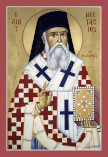 Born in Selyvria of Thrace in 1846, he put
himself through school in Constantinople with much hard labor and became a monk on Chios in 1876,
receiving the monastic name of Lazarus; because of his virtues, a year later he was ordained
deacon, receiving the new name of Nektarios. Under the patronage of Patriarch Sophronios of
Alexandria, Nektarios went to Athens to study. Completing his theological studies in 1885, he
went to Alexandria, where the patriarch ordained him priest. Father Nektarios showed much zeal
both for preaching the word of God and for the beauty of God’s house. He greatly beautified
the Church of Saint Nicholas in Cairo, and years later, when Nektarios was in Athens, Saint
Nicholas appeared to him in a dream, embracing him and telling him he was going to exalt him very
high.
Born in Selyvria of Thrace in 1846, he put
himself through school in Constantinople with much hard labor and became a monk on Chios in 1876,
receiving the monastic name of Lazarus; because of his virtues, a year later he was ordained
deacon, receiving the new name of Nektarios. Under the patronage of Patriarch Sophronios of
Alexandria, Nektarios went to Athens to study. Completing his theological studies in 1885, he
went to Alexandria, where the patriarch ordained him priest. Father Nektarios showed much zeal
both for preaching the word of God and for the beauty of God’s house. He greatly beautified
the Church of Saint Nicholas in Cairo, and years later, when Nektarios was in Athens, Saint
Nicholas appeared to him in a dream, embracing him and telling him he was going to exalt him very
high.
Shortly thereafter, Nektarios was consecrated Metropolitan of Pentapolis in eastern Libya, which was under the jurisdiction of Alexandria. Although Nektarios’ swift ascent through the degrees of ecclesiastical office did not affect his modesty and childlike innocence, it aroused the envy of lesser men, who convinced the elderly Sophronios that Nektarios had it in his heart to usurp the patriarch’s throne. Since the people loved Nektarios, the patriarch was troubled and believed the slanders. Sophronios uncanonically relieved Metropolitan Nektarios of his duties and banished him from Egypt.
Without seeking to avenge or even to defend himself, the innocent metropolitan left for Athens, where he found that accusations of immorality had arrived before him. Because his good name had been sullied, he was unable to find a position worthy of a bishop and could only get a position as a provincial preacher in Evia. In 1894, he was appointed dean of the Rizarios Ecclesiastical School in Athens. Through his eloquent sermons, his unwearying labors to educate fitting men for the priesthood, his generous almsgiving despite his own poverty, and the holiness, meekness, and fatherly love that were manifest in him, he became a shining light and a spiritual guide to many. At the request of certain pious women, he established a convent on the island of Aegina while yet dean of the Rizarios School. Finding later that his presence there was needed, he took up his residence on Aegina in 1908, where he spent the last years of his life, devoting himself to the direction of his convent and to very intense prayer. He was sometimes seen lifted above the ground while rapt in prayer. He became the protector of all Aegina, through his prayers delivering the island from drought, healing the sick, and casting out demons. Here also he endured wicked slanders with singular patience, forgiving his false accusers and not seeking to avenge himself. Although he had already worked wonders in life, an innumerable multitude of miracles have been wrought after his repose in 1920 through his holy relics, which for many years remained incorrupt. St. Nektarios is especially renowned for his healings of cancer for sufferers in all parts of the world.
FOR CONSIDERATION
After a long separation from his friend Paisius, St. John Kolovos visited him and talked with him. They asked each other what virtues they had, in the intervening time, brought to fruition. St. Paisius said: ‘The sun never sees me eat,’ and John Kolovos replied: ‘and it never sees me angry’. Teaching the brethren in Sketis, St. John used this story about the repentance of the human soul: ‘In one town, there lived a beautiful woman, a harlot who had many lovers. A prince suggested to this woman that he would take her to wife if she would promise to live honorably and faithfully in wedlock. She promised, and the prince took her to his court and married her. Discovering this, her former lovers plotted to bring her back to her old ways with them. They did not dare to confront the prince, but gathered behind the palace and began whistling. The woman heard the whistling and recognized it. She quickly blocked her ears and hid herself in an inner room of the palace, locking the door behind her, and was thus preserved from the new temptation.’ St. John explained this story thus: the harlot is the soul, her lovers are the passions, the prince is Christ, the inner room is the heavenly court and the lovers who whistle and entice her are the demons. If the soul is constantly turned from its passions and flees God-ward, the passions and demons will take flight and flee from it.
Daily Scripture Readings taken from The Orthodox New Testament, translated and published by Holy Apostles Convent, Buena Vista, Colorado, copyright © 2000, used with permission, all rights reserved.
Daily Prologue Readings taken from The Prologue of Ochrid, by Bishop Nikolai Velimirovic, translated by Mother Maria, published by Lazarica Press, Birmingham, England, copyright © 1985, all rights reserved. Edited by Dormition Skete.