

Daily Devotional
Saturday, November 21, 2026 (NS), November 8, 2026 (OS)
No Fasting.
Saturday of the Twenty-Fifth Week
The commemoration of the Synaxis of the Archangel Michael and the other bodiless powers: Archangels Gabriel, Raphael, Uriel, Salaphiel, Jegudiel, and Barachiel.
Scripture Readings
Paschalion — Movable Calendar
Saturday of the Twenty-Fifth Week
Epistle
The Reading is from the Epistle of Saint Paul to the Galatians [§ 199]. Brethren:
1 3Grace to you and peace from God the Father and our Lord Jesus Christ, 4Who gave Himself for our sins, so that He might deliver us out of the present evil age, according to the will of our God and Father, 5to Whom be the glory to the ages of the ages. Amen.
6I marvel that ye are so quickly transferring yourselves from the One Who called you in the grace of Christ to a different gospel, 7which is not another Gospel, only there are some who trouble you and wish to turn around the Gospel of the Christ. 8But even if we, or an angel from out of heaven, should preach a gospel to you besides what Gospel we preached to you, let such a one be anathema. 9As we have said before, and now again I say, if anyone preach a gospel to you besides what ye received, let such a one be anathema. 10For do I now persuade men, or God? Or do I seek to please men? For if I were yet trying to please men, I should not be a slave of Christ.
Gospel
The Reading is from the Holy Gospel according to Saint Luke [§ 40]. At that time:
9 1After Jesus called together to Himself His twelve disciples, He gave them power and authority over all the demons, and to cure diseases. 2And He sent them forth to proclaim the kingdom of God and to heal those who were sick. 3And He said to them, “Cease taking anything for the way, neither staves, nor leathern pouch, nor bread, nor money, nor having two tunics apiece. 4“And into whatsoever house ye enter, be lodging there, and from that place be going forth. 5“And as many as will not receive you, when ye go forth from the city, shake off even the dust from your feet for a testimony against them.” 6And as they went forth, they were passing through village by village, preaching the Gospel, and curing everywhere.
Menaion — Fixed Calendar
The commemoration of the Synaxis of the Archangel Michael and the other bodiless powers: Archangels Gabriel, Raphael, Uriel, Salaphiel, Jegudiel, and Barachiel.
Epistle
The Reading is from the Epistle of Saint Paul to the Hebrews [§ 305]. Brethren:
2 2If the word spoken by angels was confirmed, and every transgression and disobedience received a just recompense, 3how shall we escape, if we neglect so great a salvation, which received a beginning to be spoken of by the Lord, and was confirmed to us by those who heard, 4God also bearing them witness with both signs and wonders, and various works of power, and by distributions of the Holy Spirit, according to His will?
5For not to angels did He subject the coming inhabited world about which we speak; 6but one bore witness somewhere, saying, “What is man that Thou art mindful of him or the Son of Man that Thou visitest Him [Ps. 8:4]? 7“Thou didst make Him for a short time less than the angels; Thou didst crown Him with glory and honor [Ps. 8:5], 8“Thou didst subject all things under His feet [Ps. 8:6].” For in subjecting all things to Him, He left nothing not subject to Him. But now we see not yet all things subjected to Him. 9But we see Jesus, Who for a short time was made less than the angels on account of the suffering of death, crowned with glory and honor, so that He, by the grace of God, should taste death for everyone. 10For it was becoming to Him, because of Whom are all things and by means of Whom are all things, bringing many sons to glory, to have perfected the originator of their salvation through sufferings.
Gospel
In the Orthros
For Gk. usage, see [Mt. 18:10-20]; for Sl. usage, see [Mt. 13:24-30, 36-43] hereunder.
The Reading is from the Holy Gospel according to Saint Matthew [§ 52]. The Lord said a parable:
13 24“The kingdom of the heavens is likened to a man sowing good seed in his field; 25“but while the men were sleeping, his enemy came and sowed darnel in the midst of the wheat, and went away. 26“But when the crop sprouted and produced fruit, then the darnel appeared also. 27“And the slaves of the master of the house said to him, ‘Sir, thou didst sow good seed in thy field, didst thou not? From what place then hath it the darnel?’ 28“And he said to them, ‘An enemy, a man, did this.’ And the slaves said to him, ‘Dost thou wish then that we go forth and gather them together?’ 29“But he said, ‘No, lest while ye gather together the darnel, ye should root out the wheat with them. 30“‘Let both grow together until the harvest; and in the time of the harvest I will say to the reapers, “Gather together first the darnel and bind them into bundles in order to completely burn them; but bring together the wheat into my storehouse.”.”...
36Then Jesus sent the crowds away and went into the house. And His disciples came to Him, saying, “Declare to us the parable of the darnel of the field.” 37And He answered and said to them, “The One Who soweth the good seed is the Son of Man. 38“And the field is the world, and the good seed, these are the sons of the kingdom; but the darnel are the sons of the evil one. 39“And the enemy who sowed them is the devil, and the harvest is the consummation of the age, and the reapers are the angels. 40“Therefore even as the darnel is gathered together and burned completely, thus it shall be in the consummation of this age. 41“The Son of Man shall send forth His angels, and they shall gather together out of His kingdom all the stumbling blocks, and those doing lawlessness; 42“and they shall cast them into the furnace of the fire. There shall be there the weeping and the gnashing of the teeth. 43“Then the righteous shall shine forth as the sun in the kingdom of their Father. The one who hath ears to hear, let him hear.”
In the Liturgy
The Reading is from the Holy Gospel according to Saint Luke [§ 51]. The Lord said to His disciples:
10 16“The one who heareth you heareth Me, and the one who rejecteth you rejecteth Me, and the one who rejecteth Me rejecteth the One Who sent Me forth.”
17And the seventy returned with joy, saying, “Lord, even the demons are being made subject to us in Thy name.” 18And He said to them, “I was beholding Satan as lightning having fallen out of the heaven. 19“Behold, I give you the authority to tread upon serpents and scorpions, and upon all the power of the enemy; and nothing in anywise shall injure you. 20“However cease rejoicing in this, that the spirits are being made subject to you; but be rejoicing that your names were written in the heavens.” 21In the same hour Jesus rejoiced in the Spirit, and said, “I give thanks to Thee, O Father, Lord of the heaven and of the earth, that Thou didst hide these things from the wise and intelligent, and didst reveal them to babes. Yea, Father, for thus it was well-pleasing before Thee.”
Lives of the Saints (Prologue)
November 21st – Civil Calendar
November 8th – Church Calendar
1. The Holy Archangel Michael and all the Bodiless Powers of Heaven.
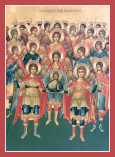 The angels of God have
been commemorated by men from the earliest times, but this commemoration often degenerates into
the divinization of angels (IV Kings 23:5). Heretics always wove fantasies round the angels. Some
of them saw the angels as gods and others, if they did not so regard them, took them to be the
creators of the whole visible world. The local council in Laodicea, that was held in the fourth
century, rejected in its 35th Canon the worship of angels as gods, and established the proper
veneration of them. In the time of Pope Sylvester of Rome and the Alexandrian Patriarch
Alexander, in the fourth century, this Feast of the Archangel Michael and the other heavenly
powers was instituted, to be celebrated in November. Why in November? Because November is the
ninth month after March, and it is thought that the world was created in the month of March. The
ninth month after March was chosen because of the nine orders of angels that were the first
created beings. St. Dionysius the Areopagite, a disciple of the Apostle Paul (that apostle who
was caught up to the third heaven), writes of these nine orders in his book: ‘Celestial
Hierarchies’. These orders are as follows: six-winged seraphim, many-eyed cherubim, godly
thrones, dominions, virtues, powers, principalities, archangels and angels. The leader of the
whole angelic army is the Archangel Michael. When Satan, Lucifer, fell away from God, and carried
half the angels with him to destruction, then Michael arose and cried to the unfallen angels:
‘Let us give heed! Let us stand aright; let us stand with fear!’ and the whole
angelic army sang aloud: ‘Holy, holy, holy Lord God of Sabaoth; heaven and earth are full
of Thy glory!’ (See on the Archangel Michael: Joshua 5:13-15 and Jude v. 9). Among the
angels there rules a perfect unity of mind, of soul and of love; of total obedience of the lesser
powers to the greater and of all to the holy will of God. Each nation has its guardian angel, as
does each individual Christian. We must keep in mind that, whatever we do, openly or in secret,
we do in the presence of our guardian angel and that, on the Day of Judgement, a great multitude
of the holy angels of heaven will be gathered around the throne of Christ, and the thoughts,
words and deeds of every man will be laid bare before them. May God have mercy on us and save us
at the prayers of the holy Archangel Michael and all the bodiless powers of heaven. Amen.
The angels of God have
been commemorated by men from the earliest times, but this commemoration often degenerates into
the divinization of angels (IV Kings 23:5). Heretics always wove fantasies round the angels. Some
of them saw the angels as gods and others, if they did not so regard them, took them to be the
creators of the whole visible world. The local council in Laodicea, that was held in the fourth
century, rejected in its 35th Canon the worship of angels as gods, and established the proper
veneration of them. In the time of Pope Sylvester of Rome and the Alexandrian Patriarch
Alexander, in the fourth century, this Feast of the Archangel Michael and the other heavenly
powers was instituted, to be celebrated in November. Why in November? Because November is the
ninth month after March, and it is thought that the world was created in the month of March. The
ninth month after March was chosen because of the nine orders of angels that were the first
created beings. St. Dionysius the Areopagite, a disciple of the Apostle Paul (that apostle who
was caught up to the third heaven), writes of these nine orders in his book: ‘Celestial
Hierarchies’. These orders are as follows: six-winged seraphim, many-eyed cherubim, godly
thrones, dominions, virtues, powers, principalities, archangels and angels. The leader of the
whole angelic army is the Archangel Michael. When Satan, Lucifer, fell away from God, and carried
half the angels with him to destruction, then Michael arose and cried to the unfallen angels:
‘Let us give heed! Let us stand aright; let us stand with fear!’ and the whole
angelic army sang aloud: ‘Holy, holy, holy Lord God of Sabaoth; heaven and earth are full
of Thy glory!’ (See on the Archangel Michael: Joshua 5:13-15 and Jude v. 9). Among the
angels there rules a perfect unity of mind, of soul and of love; of total obedience of the lesser
powers to the greater and of all to the holy will of God. Each nation has its guardian angel, as
does each individual Christian. We must keep in mind that, whatever we do, openly or in secret,
we do in the presence of our guardian angel and that, on the Day of Judgement, a great multitude
of the holy angels of heaven will be gathered around the throne of Christ, and the thoughts,
words and deeds of every man will be laid bare before them. May God have mercy on us and save us
at the prayers of the holy Archangel Michael and all the bodiless powers of heaven. Amen.
2. Our Holy Father Philaret the Confessor of New York.
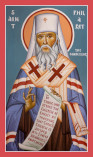 Originally named George, he was born
in 1903 in the city of Kursk and later moved with his family to the Far East while still a young
child. Fleeing the Bolshevik Revolution, the family fled into Manchuria, settling in Harbin,
where George finished his education, training as an electrical engineer and mechanic. The young
man’s heart, however, was set on the monastic life, and he took theological courses at the
institute in Harbin. In 1931, George was ordained a priest and soon tonsured a monk with the new
name of Philaret. Father Philaret became a teacher of the New Testament, pastoral theology, and
homiletics and was beloved by his pupils. Thousands of people came to his community church at the
House of Mercy to listen to the young archimandrite’s sermons and to share with him their woes.
People from all over came and lined up outside his cell in order to have an opportunity to speak
with the holy priest. In those days, Father Philaret corresponded with the holy First Hierarch of
the Russian Church Abroad, Metropolitan Anthony, who taught and advised the young archimandrite.
Philaret was generous in almsgiving, lived a strict ascetic life, and was a fearless confessor of
the Faith. In 1944, the Japanese who were occupying Manchuria tortured the saint so that he would
reverence one of their idols, but St. Philaret would not submit, even as they burned his flesh,
and God miraculously delivered him. He always denounced the communists in his sermons and warned
everyone against the deception of Stalin’s Soviet Church. The communists retaliated by trying to
kill him, and in 1960 they set his house on fire during the night; Philaret survived, although he
was burned and suffered a permanent disfigurement. After another assassination attempt, Father
Philaret finally succeeded in emigrating to Australia in 1962, where he was reunited with the
Russian Orthodox Church Abroad (ROCOR) under Metropolitan Anastassy. The following year, the
illustrious and renowned archimandrite was consecrated Bishop of Brisbane. Only a year later, in
1964, Philaret was chosen to be the head and First Hierarch of ROCOR and soon faced the greatest
heresy to attack the Orthodox Church in our times. On December 7th, 1965, Pope Paul VI and
Patriarch Athenagoras of Constantinople “lifted the anathemas” of 1054 and officially
ushered in the heresy of Ecumenism and the Great Apostasy. All of the Orthodox patriarchates and
autocephalous churches followed on this path of apostasy. Only the Russian Church Abroad under
Metropolitan Philaret and the Greek Old Calendarists refused to accept this heresy and broke
communion with the World Orthodox. Alone among all Orthodox bishops, the saint wrote a series of
“sorrowful epistles,” open letters protesting the action of Athenagoras and calling the
World Orthodox to repentance, starting just eight days after the “lifting of anathemas.”
St. Philaret said, “You know what Ecumenism is: it is the heresy of heresies. It wants to
completely wipe out the concept of the Orthodox Church as the guardian of the truth, and to
create some kind of new, strange church.” In his sorrowful epistles, he also said that the
Orthodox should not participate in the World Council of Churches, since its declarations were
blasphemous and its aims were incompatible with the true Faith. But all of these warnings and
exhortations were ignored. Nevertheless, a minority from World Orthodoxy, those laity who were
fervent and rejected Ecumenism, joined the ROCOR out of a desire for true Orthodoxy. The synod
abroad also stipulated that Roman Catholics and Protestants who join the Church must be baptized
with triple immersion, which decision increased the prestige of the ROCOR, and many who were
seeking the truth flocked to her for refuge. The Church continued to grow and flourish in many
countries around the world under Metropolitan Philaret’s wise leadership, yet within the synod
itself, the saint was being undermined by “false brethren,” unworthy bishops who plotted
against him. St. Philaret consistently taught that the Moscow Patriarchate was graceless because
of its Sergianist heresy. Furthermore, in 1983, he convoked a council that definitively
anathematized Ecumenism, also condemning therein those “who do not distinguish the
priesthood and mysteries of the Church from those of the heretics.” “The distinguishing
characteristic of our time,” he used to say, “is that people are now more and more
possessed by indifference to the divine truth.... Our Lord Jesus Christ in the Apocalypse clearly
indicates to us how terrible indifference to the truth is. There He turns to the angel standing
at the head of the Laodicean Church and says: ‘I know thy works, that thou art neither cold nor
hot. Oh if only thou wast hot or cold! But since thou art neither cold nor hot (but
lukewarm—neither the one nor the other, for the truth is not dear to thee), I will spew thee out
of My mouth!’ (Rev. 3:15, 16)... Let us remember that this indifference to the truth is one of
the main woes of our age of apostasies. Value the truth, O man! Be a fighter for the truth....
Place the truth higher than all else in life, O man, and never allow yourself to decline in any
way from the true path!” St. Philaret the Confessor reposed in the Lord in 1985 on the feast of
all the bodiless hosts. In 1998, his relics were transferred to a different tomb within Holy
Trinity Monastery in Jordanville, New York. When the coffin was opened, the body of Metropolitan
Philaret was seen to be completely incorrupt. Then the wicked apostate Archbishop Laurus ordered
the coffin to be closed and refused to let the people kiss the relics. He forbade anyone to
reproduce the photographs that had already been taken of the incorrupt body of the saint. Laurus
later covered the tomb of the saint with concrete so that no one could ever access the relics
again. St. Philaret has worked many miracles for those who call upon him in prayer. He was
glorified as a saint in 2001.
Originally named George, he was born
in 1903 in the city of Kursk and later moved with his family to the Far East while still a young
child. Fleeing the Bolshevik Revolution, the family fled into Manchuria, settling in Harbin,
where George finished his education, training as an electrical engineer and mechanic. The young
man’s heart, however, was set on the monastic life, and he took theological courses at the
institute in Harbin. In 1931, George was ordained a priest and soon tonsured a monk with the new
name of Philaret. Father Philaret became a teacher of the New Testament, pastoral theology, and
homiletics and was beloved by his pupils. Thousands of people came to his community church at the
House of Mercy to listen to the young archimandrite’s sermons and to share with him their woes.
People from all over came and lined up outside his cell in order to have an opportunity to speak
with the holy priest. In those days, Father Philaret corresponded with the holy First Hierarch of
the Russian Church Abroad, Metropolitan Anthony, who taught and advised the young archimandrite.
Philaret was generous in almsgiving, lived a strict ascetic life, and was a fearless confessor of
the Faith. In 1944, the Japanese who were occupying Manchuria tortured the saint so that he would
reverence one of their idols, but St. Philaret would not submit, even as they burned his flesh,
and God miraculously delivered him. He always denounced the communists in his sermons and warned
everyone against the deception of Stalin’s Soviet Church. The communists retaliated by trying to
kill him, and in 1960 they set his house on fire during the night; Philaret survived, although he
was burned and suffered a permanent disfigurement. After another assassination attempt, Father
Philaret finally succeeded in emigrating to Australia in 1962, where he was reunited with the
Russian Orthodox Church Abroad (ROCOR) under Metropolitan Anastassy. The following year, the
illustrious and renowned archimandrite was consecrated Bishop of Brisbane. Only a year later, in
1964, Philaret was chosen to be the head and First Hierarch of ROCOR and soon faced the greatest
heresy to attack the Orthodox Church in our times. On December 7th, 1965, Pope Paul VI and
Patriarch Athenagoras of Constantinople “lifted the anathemas” of 1054 and officially
ushered in the heresy of Ecumenism and the Great Apostasy. All of the Orthodox patriarchates and
autocephalous churches followed on this path of apostasy. Only the Russian Church Abroad under
Metropolitan Philaret and the Greek Old Calendarists refused to accept this heresy and broke
communion with the World Orthodox. Alone among all Orthodox bishops, the saint wrote a series of
“sorrowful epistles,” open letters protesting the action of Athenagoras and calling the
World Orthodox to repentance, starting just eight days after the “lifting of anathemas.”
St. Philaret said, “You know what Ecumenism is: it is the heresy of heresies. It wants to
completely wipe out the concept of the Orthodox Church as the guardian of the truth, and to
create some kind of new, strange church.” In his sorrowful epistles, he also said that the
Orthodox should not participate in the World Council of Churches, since its declarations were
blasphemous and its aims were incompatible with the true Faith. But all of these warnings and
exhortations were ignored. Nevertheless, a minority from World Orthodoxy, those laity who were
fervent and rejected Ecumenism, joined the ROCOR out of a desire for true Orthodoxy. The synod
abroad also stipulated that Roman Catholics and Protestants who join the Church must be baptized
with triple immersion, which decision increased the prestige of the ROCOR, and many who were
seeking the truth flocked to her for refuge. The Church continued to grow and flourish in many
countries around the world under Metropolitan Philaret’s wise leadership, yet within the synod
itself, the saint was being undermined by “false brethren,” unworthy bishops who plotted
against him. St. Philaret consistently taught that the Moscow Patriarchate was graceless because
of its Sergianist heresy. Furthermore, in 1983, he convoked a council that definitively
anathematized Ecumenism, also condemning therein those “who do not distinguish the
priesthood and mysteries of the Church from those of the heretics.” “The distinguishing
characteristic of our time,” he used to say, “is that people are now more and more
possessed by indifference to the divine truth.... Our Lord Jesus Christ in the Apocalypse clearly
indicates to us how terrible indifference to the truth is. There He turns to the angel standing
at the head of the Laodicean Church and says: ‘I know thy works, that thou art neither cold nor
hot. Oh if only thou wast hot or cold! But since thou art neither cold nor hot (but
lukewarm—neither the one nor the other, for the truth is not dear to thee), I will spew thee out
of My mouth!’ (Rev. 3:15, 16)... Let us remember that this indifference to the truth is one of
the main woes of our age of apostasies. Value the truth, O man! Be a fighter for the truth....
Place the truth higher than all else in life, O man, and never allow yourself to decline in any
way from the true path!” St. Philaret the Confessor reposed in the Lord in 1985 on the feast of
all the bodiless hosts. In 1998, his relics were transferred to a different tomb within Holy
Trinity Monastery in Jordanville, New York. When the coffin was opened, the body of Metropolitan
Philaret was seen to be completely incorrupt. Then the wicked apostate Archbishop Laurus ordered
the coffin to be closed and refused to let the people kiss the relics. He forbade anyone to
reproduce the photographs that had already been taken of the incorrupt body of the saint. Laurus
later covered the tomb of the saint with concrete so that no one could ever access the relics
again. St. Philaret has worked many miracles for those who call upon him in prayer. He was
glorified as a saint in 2001.
FOR CONSIDERATION
Saint Philaret of New York offers to us a great example of courage in the face of betrayal, and steadfastness in defense of the truth. In a sermon, he said, “O how often we do not have enough of such zeal when it is really necessary to speak for the insulted and trampled-on truth!... How often does it happen to us all now that we do not have the zeal to stand up, when necessary, in defense of our holy things! The Orthodox clergyman must zealously stand up against blasphemy, just as the holy Hierarch Nicholas stopped the mouth of the heretic [Arius].... But now, unfortunately, we have become, as the saying goes, ‘shamefully indifferent to both the evil and the good.’ And it is precisely in the soil of this indifference, of a kind of feeling of self-preservation, that the heresy of Ecumenism has established itself.... Let us remember, brethren, that Christian love embraces all in itself, is compassionate to all, wishes that all be saved and is sorry for, and merciful to, and loves every creature of God; but where it sees a conscious assault on the truth it turns into fiery zeal which cannot bear any such blasphemy.... And so must it always be, because every Orthodox Christian must always be zealous for God.” The saint also writes in a letter concerning schism: “I am accused of excessive strictness and of ‘fanaticism.’ But I have sufficient basis for holding my point of view, for behind me stand great authorities, both ancient and contemporary.... What do the clear and categorical words of the holy father [John Chrysostom] signify? They indicate nothing other than that schism is graceless! Christ was not divided, and His grace is one. If one is to believe in the ‘state of grace’ of schism, then one must either admit that we do not have grace, those who broke away having taken it with them; or else admit that there are two graces and obviously two true Churches, for grace is given only in the true Church.... There is no such thing as ‘different jurisdictions’; but there is only the Orthodox Church Abroad, and outside of her are schisms and heresies.”
Daily Scripture Readings taken from The Orthodox New Testament, translated and published by Holy Apostles Convent, Buena Vista, Colorado, copyright © 2000, used with permission, all rights reserved.
Daily Prologue Readings taken from The Prologue of Ochrid, by Bishop Nikolai Velimirovic, translated by Mother Maria, published by Lazarica Press, Birmingham, England, copyright © 1985, all rights reserved. Edited by Dormition Skete.