

Daily Devotional
Monday, October 26, 2026 (NS), October 13, 2026 (OS)
No Fasting.
Monday of the Twenty-Second Week
The commemoration of the holy Martyrs Karpos, Papylos, Agathodoros, and Agathonike.
Scripture Readings
Paschalion — Movable Calendar
Monday of the Twenty-Second Week
Epistle
The Reading is from the Epistle of Saint Paul to the Colossians [§ 255]. Brethren:
2 13You, being dead in the transgressions and the uncircumcision of your flesh, did Christ make alive together with Him, having forgiven us all the transgressions, 14having blotted out the bond written against us, in the ordinances, which was contrary to us. And He hath taken it away out of the midst, having nailed it to the Cross. 15And having put off from Himself the principalities and the powers, He made an example of them openly, triumphing over them in it.
16Let no one therefore judge you in food, or in drink, or in part of a feast, or a new moon, or sabbath days, 17which are a shadow of things to come, but the body is of Christ. 18Let no one deprive you of the prize, delighting in humility of mind and religious worship of the angels, intruding into things which he hath not seen, in vain being puffed up by the mind of his flesh,19and not holding the head, from Whom all the body, by the joints and ligaments being supplied and knit together, increaseth with the increase of God.
20If then ye died with the Christ from the elements of the world, why, as if living in the world, do ye subject yourselves to regulations?
Gospel
The Reading is from the Holy Gospel according to Saint Luke [§ 33]. At that time:
7 36A certain one of the Pharisees was asking Jesus that He would eat with him. And He entered into the house of the Pharisee, and reclined at table. 37And behold, a woman in the city who was a sinner, when she found out that He was reclining at table in the house of the Pharisee, brought an alabaster flask of perfumed ointment, 38and she stood beside His feet behind Him, weeping; and she began to wet His feet with tears, and was wiping them off with the hairs of her head; and she was kissing His feet ardently and anointing them with the perfumed ointment. 39Now when the Pharisee who invited Him saw it, he spoke within himself, saying, “This One, if He were a prophet, would know who and of what sort the woman is who toucheth Him, for she is a sinner.” 40And Jesus answered and said to him, “Simon, I have something to say to thee.” And he saith, “Teacher, say it.” 41“There were two debtors to a certain creditor: the one was owing five hundred denarii, and the other fifty. 42“But when they had nothing to pay back the debt, he showed himself gracious to both. Say which of them then will love him more?” 43Simon answered and said, “I suppose that he, to whom he showed himself the more gracious.” And He said to him, “Rightly thou didst judge.” 44And He turned to the woman, and said to Simon, “Seest thou this woman? I entered into thy house; water thou gavest Me not for My feet, but she with tears did wet My feet, and with the hairs of her head wiped them off. 45“A kiss thou gavest Me not, but she from the time that I entered did not cease from ardently kissing My feet. 46“With oil thou didst not anoint My head, but she anointed My feet with perfumed ointment. 47“For which reason I say to thee, her sins, which are many, have been forgiven, for she loved much. But to whom little is forgiven, the same loveth little.” 48And He said to her, “Thy sins have been forgiven.” 49And those reclining at table with Him began to say among themselves, “Who is this Who even forgiveth sins?” 50And He said to the woman, “Thy faith hath saved thee; go thy way in peace.”
Menaion — Fixed Calendar
The commemoration of the holy Martyrs Karpos, Papylos, Agathodoros, and Agathonike.
Epistle
The Reading is from the Epistle of Saint Paul to the Ephesians [§ 233].
6 10Brethren, keep on being empowered in the Lord and in the strength of His might. 11Put on the full armor of God, for you to be able to stand against the wiles of the devil; 12because for us the wrestling is not against blood and flesh, but against the principalities, against the powers, against the cosmic rulers of the darkness of this age, against spiritual hosts of evil on account of the heavenly things. 13For this cause take up the full armor of God, in order that ye might be able to withstand in the evil day, and having counteracted all things, to stand. 14Stand therefore, having girt your loins with truth, and having put on for yourselves the breastplate of righteousness, 15and having shod your feet in readiness of the Gospel of peace; 16on the whole, take up the shield of faith, with which ye shall be able to quench all the fiery darts of the evil one. 17And take the helmet of salvation, and the sword of the Spirit, which is the word of God.
Gospel
The Reading is from the Holy Gospel according to Saint Matthew [§ 21]. The Lord said:
7 12“All things whatsoever ye wish that men be doing to you, so also be ye doing to them; for this is the law and the prophets.
13“Enter through the narrow gate; for wide is the gate and broad is the way that leadeth away to destruction, and many are they who enter through it. 14“For narrow is the gate and straitened is the way that leadeth away to life, and few are they who find it. 15“But be on guard against the false prophets, who come to you in sheep’s clothing, but within they are rapacious wolves. 16“From their fruits ye shall fully know them. They do not gather a bunch of grapes from thorns, or figs from thistles, do they? 17“Thus, every good tree produceth good fruits, but the rotten tree produceth bad fruits. 18“A good tree is not able to produce bad fruits, nor is a rotten tree able to produce good fruits. 19“Every tree which produceth not good fruit is cut off and cast into the fire. 20“Then surely by their fruits ye shall fully know them.
21“Not everyone who saith to Me, ‘Lord, Lord,’ shall enter into the kingdom of the heavens, but the one who doeth the will of My Father in the heavens.”
Lives of the Saints (Prologue)
October 26th – Civil Calendar
October 13th – Church Calendar
1. The Holy Martyrs Karpos and Papylos.
Karpos was Bishop of Thyateira and Papylos was a deacon. They were born in Pergamum, where they finally suffered for the Christian Faith at the hands of the wicked governor, Valerius, in Decius’ reign. Valerius bound them behind horses and dragged them off to Sardis, where he put them to harsh torture; but an angel of God appeared to them, healed them of their wounds and strengthened them. Karpos’ servant, Agathodoros, followed his master with great sorrow until he also was taken for torture. After that, Valerius again bound them behind horses and dragged them from Sardis to Pergamum. When holy Karpos was tied to a tree and so terribly flogged that his whole body was laid open and his blood streamed down onto the ground, he smiled in the midst of these tortures. When they asked him why he smiled, the holy martyr replied that he saw the heavens open and the Lord sitting on His throne, surrounded by cherubim and seraphim. At the time of Papylos’ martyrdom, this holy martyr healed a man, blind in one eye, by his prayers. Many, seeing this, came to believe in Christ the Lord. Thrown before wild beasts, the martyrs remained unhurt. When they were thrown into a fiery furnace, Agathonika, Papylos’ sister, saw this and leapt into the flames. But the flames did not burn them. Finally, they were all beheaded with the sword in 251. Thus, after great spiritual endeavor, they received the wreath of glory in the kingdom of Christ.
2. The Hieromartyr Benjamin the Deacon.
This soldier of Christ was a Persian, and zealously preaching the Gospel, brought many pagans, both Persians and Greeks, to the Christian Faith. He suffered in the time of the Persian King Yazdgird, in about 412. When he was thrown into prison, one of the king’s nobles pleaded for him to the king. The king was willing to let him go free, on condition that he kept silent and spoke no more to the people about Christ. To this, Benjamin replied: ‘I cannot possibly do that. Those who hide the talent they have received will be given over to greater suffering,’ and he continued to spread the Christian Faith. The king then ordered that thorns be driven under his nails, and had him tortured until he gave his soul into God’s hands.
3. The Holy Martyr Zlata of Meglin (Bulgaria).
Born in the village of Slatina in the Meglin region, of poor peasants who had three other daughters, St. Zlata was a meek and devout girl, wise with Christ’s wisdom and golden (‘zlata’ means ‘gold’) not only in name but also in her God-fearing heart. When Zlata went out one day to get water, some shameless Turks seized her and carried her off to their house. When one of them urged her to embrace Islam and become his wife, Zlata answered fearlessly: ‘I believe in Christ, and know Him alone as my Bridegroom; I shall never deny Him even if you put me to a thousand tortures and cut me into pieces.’ Her parents and sisters then arrived, and said to her: ‘O our daughter, have mercy on yourself and us. Deny Christ publicly, that we can all be happy. Christ is merciful: He will forgive your sin, committed under the pressure of life.’ Her poor parents and kinsfolk wept bitterly. But Zlata’s heroic soul would not be overcome by devilish seduction. She replied to her parents: ‘When you urge me to deny Christ, the true God, you are no longer parents or sisters to me; I have the Lord Jesus Christ as Father, the Mother of God as mother, and for brothers and sisters, the saints.’ Then the Turks threw her into prison, where she lay for three months, and they took her out every day and flogged her until her blood flowed onto the ground. Finally, they hanged her upside-down and made a fire to choke her to death with the smoke. But God was with Zlata, and gave her strength in her suffering. At the very end, they hanged her from a tree and cut her into small pieces. Thus this martyr-maiden gave her soul into God’s hands, and entered into the realm of Paradise, in 1796. Pieces of her relics were taken by Christians to their homes, that they might bring a blessing to them.
4. The Translation to Moscow of the Iveron Icon of the Most Holy Theotokos.
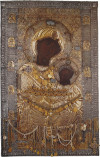 In 1648, Patriarch Nikon of Moscow, while he was
still Archimandrite of Novospassky Monastery, commissioned an exact copy of the Iveron Icon
to be made and sent to Russia. Almost immediately upon its arrival on October 13, the icon
was glorified with numerous miracles attributed to it by the faithful. The Iverskaya Chapel
was built in 1669 to enshrine the icon next to the Kremlin walls in Moscow. In 1648, Patriarch Nikon of Moscow, while he was
still Archimandrite of Novospassky Monastery, commissioned an exact copy of the Iveron Icon
to be made and sent to Russia. Almost immediately upon its arrival on October 13, the icon
was glorified with numerous miracles attributed to it by the faithful. The Iverskaya Chapel
was built in 1669 to enshrine the icon next to the Kremlin walls in Moscow.
|
FOR CONSIDERATION
There is nothing more wretched than a man who, in the hour of need, abandons hope in God and flees to a means of safety contrary to God’s law. Such a man not only cannot put right his outward circumstances, but also loses his soul. This is what happened to the Emperor Michael Palaiologos, the apostate to the Latins. In order to safeguard his kingdom, terrorized by the Bulgarians and Serbs, he sought help from the pope and made a Union with him in 1274. What did this gain? The kingdom was not saved and he did innumerable evil deeds, coming rapidly to an unhappy end in a campaign against Prince John Doukas of Epirus in 1282. The Orthodox people were so resentful towards him that his son Andronikos dared not bury him openly, but put him in the ground at night without funeral or prayers. He was rejected by the Orthodox Church and not received by the Roman, and Michael died outside the Church of God. His wife the empress, after his death, issued the following statement: ‘My Majesty hates and regards as loathsome this action (the Union) that has recently come about in the Church and has caused such discord.... As the holy Church of God has determined not to sanction any official commemoration of my departed spouse, our lord and king, on account of his aforementioned actions and intrigues, my Majesty also, bowing in all things to the fear of God and submitting to the holy Church, approves and accepts her decree, and will never presume to commemorate the soul of my lord and spouse in any way.’
Daily Scripture Readings taken from The Orthodox New Testament, translated and published by Holy Apostles Convent, Buena Vista, Colorado, copyright © 2000, used with permission, all rights reserved.
Daily Prologue Readings taken from The Prologue of Ochrid, by Bishop Nikolai Velimirovic, translated by Mother Maria, published by Lazarica Press, Birmingham, England, copyright © 1985, all rights reserved. Edited by Dormition Skete.