

Daily Devotional
Sunday, October 25, 2026 (NS), October 12, 2026 (OS)
No Fasting.
The Sunday of the Holy Fathers
According to Gk. usage, if the 11th of October should fall on Sunday, we commemorate the service of The Holy Fathers of the Seventh Œcumenical Synod. If not, we commemorate the service on the following Sunday. According Sl. usage, if the 11th of October should fall on Wednesday or earlier, the service is commemorated on the preceding Sunday. If the 11th should fall on Thursday or later, then the service is commemorated on the following Sunday.
Sunday of the Twenty-First Week
Mode Four — Tenth Eothinon
The commemoration of the holy Martyrs Probos, Tarachos and Andronikos, and our holy father among the saints, Martin, Bishop of Tours (commemorated on Gk. calendar on the 12th of November).
Scripture Readings
Special Commemorations
The Sunday of the Holy Fathers
According to Gk. usage, if the 11th of October should fall on Sunday, we commemorate the service of The Holy Fathers of the Seventh Œcumenical Synod. If not, we commemorate the service on the following Sunday. According Sl. usage, if the 11th of October should fall on Wednesday or earlier, the service is commemorated on the preceding Sunday. If the 11th should fall on Thursday or later, then the service is commemorated on the following Sunday.
Epistle
The Reading is from the Epistle of Saint Paul to Saint Titus [§ mid 302 A]: Child Titus:
3 8Faithful is the word. And concerning these things I desire thee to be affirming, in order that they who have believed God may give heed to set before themselves good works. These things are good and profitable to men. 9But be shunning foolish inquiries, and genealogies, and strifes, and contentions relating to points of the law; for they are unprofitable and vain. 10A heretical man, after a first and second admonition, be rejecting, 11knowing that such a one hath been perverted, and sinneth, being self-condemned.
12Whenever I should send Artemas to thee, or Tychikos, hasten to come to me in Nicopolis, for I have decided to winter there. 13Send forth with haste Zenas the lawyer and Apollos, in order that nothing may be lacking to them. 14And let ours also be learning to set before themselves good works for necessary uses, that they may not be unfruitful.
15All those with me salute thee. Greet those who love us in faith.
Grace be with you all. Amen.
For Sl. usage, see [Heb. 13:7-16].
Gospel
The Reading is from the Holy Gospel according to Saint Matthew [§ 11]. The Lord said to His disciples:
5 14“Ye are the light of the world. A city situated on the top of a mountain cannot be hid. 15“Nor do they light a lamp and put it under the bushel, but upon the lampstand, and it giveth light to all those in the house. 16“Thus, let your light shine before men, that they might see your good works, and might glorify your Father Who is in the heavens.
17“Do not begin to think that I came to abolish the law or the prophets; I came not to abolish, but to fulfill. 18“For verily I say to you, until the heaven and the earth shall have passed away, one iota or one tittle in no wise shall pass away from the law, until all shall have taken place. 19“Whosoever then shall break one of the least of these commandments, and shall teach men so, he shall be called least in the kingdom of the heavens; but whosoever shall do and teach them, this one shall be called great in the kingdom of the heavens.”
for Sl. usage, see [Jn. 17:1-13].
Paschalion — Movable Calendar
Sunday of the Twenty-First Week
Mode Four — Tenth Eothinon
Epistle
The Reading is from the Epistle of Saint Paul to the Galatians [§ 203]. Brethren:
2 16Knowing then that a man is not being justified by the works of the law, except through faith in Jesus Christ, even we believed in Christ Jesus, in order that we might be justified by faith in Christ and not by the works of the law; because by the works of the law shall no flesh be justified. 17But if, while we sought to be justified in Christ, we ourselves also were found sinners, is then Christ a minister of sin? May it not be! 18For if I build again these things which I destroyed, I constitute myself a transgressor. 19For I through the law died to the law, in order that I might live to God. 20I have been crucified with Christ; and I no longer live, but Christ liveth in me; and the life that I now live in the flesh I live in faith, in that of the Son of God, Who loved me and gave Himself for me.
Gospel
The Reading is from the Holy Gospel according to Saint Luke [§ 35]. The Lord said this parable:
8 5“The one who soweth went out to sow his seed. And as he was sowing, some seed indeed fell by the wayside; and it was trampled down, and the birds of the heaven devoured it. 6“And other seed fell upon the rock; and having sprung up, it was dried up, because it had no moisture. 7“And other seed fell in the midst of the thorns; and the thorns, having sprung up together, choked it. 8“And other seed fell upon the good ground; and having sprung up, it produced fruit a hundredfold.” And after He said these things, He cried, “The one who hath ears to hear, let him hear.” 9And His disciples were asking Him, saying, “What may this parable be?” 10And He said, “To you it hath been given to know the mysteries of the kingdom of God, but to the rest in parables, that ‘seeing they see not, and hearing they understand not [cf. Is. 6:9].’ 11“Now the parable is this: The seed is the word of God. 12“And those by the wayside are the ones who hear; then the devil cometh and taketh away the word from their heart, lest after they believe they should be saved. 13“And those upon the rock are the ones who, whenever they hear, receive the word with joy; and yet these, who for a time believe, have no root, and in time of temptation withdraw. 14“And that which fell into the thorns, these are the ones who heard, and while they are going on their way, they are being choked by cares and wealth and pleasures of life, and do not bring fruit to perfection. 15“But that in the good ground, these are they who, after they hear the word with a noble and good heart, held fast and bore fruit in patience.”
Menaion — Fixed Calendar
The commemoration of the holy Martyrs Probos, Tarachos and Andronikos, and our holy father among the saints, Martin, Bishop of Tours (commemorated on Gk. calendar on the 12th of November).
Epistle
For the Martyrs:
The Reading is from the Epistle of Saint Paul to the Ephesians [§ 233].
6 10Brethren, keep on being empowered in the Lord and in the strength of His might. 11Put on the full armor of God, for you to be able to stand against the wiles of the devil; 12because for us the wrestling is not against blood and flesh, but against the principalities, against the powers, against the cosmic rulers of the darkness of this age, against spiritual hosts of evil on account of the heavenly things. 13For this cause take up the full armor of God, in order that ye might be able to withstand in the evil day, and having counteracted all things, to stand. 14Stand therefore, having girt your loins with truth, and having put on for yourselves the breastplate of righteousness, 15and having shod your feet in readiness of the Gospel of peace; 16on the whole, take up the shield of faith, with which ye shall be able to quench all the fiery darts of the evil one. 17And take the helmet of salvation, and the sword of the Spirit, which is the word of God.
For the Hierarch:
The Reading is from the First Epistle of Saint Paul to the Corinthians [§ 151]. Brethren:
12 7To each one the manifestation of the Spirit is given to the profit of all: 8for to one is given by the Spirit a word of wisdom; and to another a word of knowledge according to the same Spirit; 9and to another faith in the same Spirit; and to another free gifts of healings in the same Spirit; 10and to another operations of works of power; and to another prophecy; and to another discerning of spirits; and to another kinds of tongues; and to another interpretation of tongues; 11but the one and the same Spirit energizeth all these things, distributing to each separately as He will.
Gospel
For the Martyrs:
The Reading is from the Holy Gospel according to Saint Luke [§ 106]. The Lord said to His disciples, “Be taking heed of men:
21 12“For they shall lay their hands upon you and persecute you, delivering you up to synagogues and prisons, bringing you before kings and governors on account of My name; 13“but it shall prove to be a testimony for you. 14“Therefore settle it for yourselves in your hearts not to premeditate to make a defense; 15“for I will give you a mouth and wisdom, which all those who oppose you shall not be able to contradict nor withstand. 16“And ye shall be delivered up also by parents, and kinfolk, and friends, and brethren; and they shall put some of you to death. 17“And ye shall be hated by all for My name’s sake. 18“But a hair of your head in no wise shall perish. 19“In your patience win your souls.”
For the Hierarch:
The Reading is from the Holy Gospel according to Saint John [§ 36]. The Lord said to the Jews who had come to Him:
10 9“I am the door; by Me if anyone should enter, he shall be saved, and shall go in and go out and find pasture. 10“The thief cometh not, except that he might steal, and slay, and destroy. I came that they may have life, and may have it abundantly. 11“I am the good shepherd. The good shepherd layeth down his life for the sheep. 12“But the hireling, who indeed is not a shepherd, whose own the sheep are not, seeth the wolf coming, and leaveth the sheep and fleeth; and the wolf seizeth them and scattereth the sheep. 13“Now the hireling fleeth, because he is a hireling and careth not about the sheep. 14“I am the good shepherd; and I know those that are Mine, and am known of those that are Mine. 15“Even as the Father knoweth Me, I also know the Father; and I lay down My life for the sheep. 16“And I have other sheep which are not of this fold; them also it is needful for Me to bring, and they shall hear My voice; and there shall be one flock and one Shepherd.”
Lives of the Saints (Prologue)
Special Commemorations
Commemoration of the Seventh Ecumenical Council.
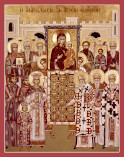 This Council was held in 787 in Nicaea. in the reign of the
devout Empress Irene and her son Constantine, and in the time of Patriarch Tarasius. This Council
finally upheld the veneration of icons, expounding it from Holy Scripture, the witness of the
holy fathers and the examples of miracles in connection with the holy icons. Among other examples
cited, the Cypriot bishop, Constantine, brought forward this one: A herdsman from the city of
Constantia, driving his flock out to pasture one day, saw an icon of the Mother of God adorned
with flowers by the devout. ‘Why give so much honour to a rock?’, said the herdsman,
obviously brought up in iconoclasm, and threw his iron stave at the icon, damaging the right eye
of the Mother of God. As soon as he had left that spot, he stumbled over the same stave and put
out his own right eye. Returning blinded to the city, he cried out tearfully that it was a
punishment from the Mother of God.
This Council was held in 787 in Nicaea. in the reign of the
devout Empress Irene and her son Constantine, and in the time of Patriarch Tarasius. This Council
finally upheld the veneration of icons, expounding it from Holy Scripture, the witness of the
holy fathers and the examples of miracles in connection with the holy icons. Among other examples
cited, the Cypriot bishop, Constantine, brought forward this one: A herdsman from the city of
Constantia, driving his flock out to pasture one day, saw an icon of the Mother of God adorned
with flowers by the devout. ‘Why give so much honour to a rock?’, said the herdsman,
obviously brought up in iconoclasm, and threw his iron stave at the icon, damaging the right eye
of the Mother of God. As soon as he had left that spot, he stumbled over the same stave and put
out his own right eye. Returning blinded to the city, he cried out tearfully that it was a
punishment from the Mother of God.
This Council also decided that the relics of the martyrs be placed in the antimins.* Three hundred and sixty-seven fathers took part in the Council. May the Lord have mercy on us and save us by their prayers.
*Antimins: A cloth containing relics of the saints that is spread on the Holy Table for the celebration of the Divine Liturgy—Tr.
Menaion — Fixed Calendar
October 25th – Civil Calendar
October 12th – Church Calendar
The Holy Martyrs Tarachos, Provos and Andronikos.
Tarachos was born in Syrian Claudiopolis, Provos in Pamphylian Side, and Andronikos was the son of an eminent citizen of Ephesus. They were all three martyred together by the proconsul, Hymerius Maximus, in the time of the Emperor Diocletian (284-305). Tarachos was sixty-five years old when he was martyred. When the proconsul asked him three times for his name, he answered all three times: ‘I am a Christian.’ They were first beaten with rods, then, all bloody and wounded, thrown into prison. After that, they were brought out again for further torture. When the proconsul urged Provos to deny Christ, promising him honors from the emperor and his own friendship, holy Provos replied: ‘I neither desire imperial honors nor seek your friendship.’ When he put St. Andronikos to even greater physical torture, Christ’s young martyr replied: ‘My body is before you; do with it what you will.’ After long-drawn-out torture in various places, these three holy martyrs were thrown into the theater before the wild beasts. Before them, others were torn to pieces by the animals in this same theater, but the beasts would not touch the saints; both the bear and the ferocious lioness fawned around them. Seeing this, many people believed in Christ the Lord and cried out against the proconsul. Wild with anger, and more ferocious than the beasts, the proconsul ordered soldiers to go in and cut Christ’s soldiers to pieces, and their bodies lay mingled with the bodies of the others who had been slain. Three Christians: Makarios, Felix and Verianos, who witnessed the slaughter of the holy martyrs, came that night to take their bodies. All the bodies being mixed up and the night being very dark, they, in uncertainty about how to distinguish the martyrs’ bodies, prayed to God, and three lights suddenly appeared above the bodies of the saints. They then took them and gave them burial.
2. St. Martin, Bishop of Tours.
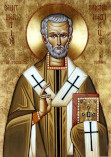 Born in 316 in Pannonia, in a town
called Sabaria, he was the son of pagan parents. His father was a Roman officer, and the young
Martin was therefore put, against his will, into the army. He was, however, already a catechumen
in the Christian Church, which he had loved with all his heart from his early youth. Travelling
one winter with his companions to the town of Amiens, he saw a beggar, almost naked and freezing
with cold, in front of the gates. Martin was distressed, and parting from his companions, took
off his soldier’s cloak, and with his saber, cut it in half. He gave half to the beggar and
wrapped himself in the other, and went on his way. That night, the Lord Jesus appeared to him in
a dream, clad in the other half of his cloak, and said to His angels: ‘Martin is only a
catechumen, and behold, he clothes Me in his garment!’ Leaving the army, Martin was
immediately baptized, and baptized his mother. After that, he became a monk in the diocese of St.
Hilary of Poitiers, and spent his life in true asceticism. He had a rare meekness, and for this
God gave him abundant wonder-working gifts, so that he could raise the dead and drive out evil
spirits. He was made Bishop of Tours against his will. After abundant toil in the Lord’s
vineyard and after a mighty struggle with both pagans and Arian heretics, St. Martin gave his
holy soul into the hands of his Lord in 397.
Born in 316 in Pannonia, in a town
called Sabaria, he was the son of pagan parents. His father was a Roman officer, and the young
Martin was therefore put, against his will, into the army. He was, however, already a catechumen
in the Christian Church, which he had loved with all his heart from his early youth. Travelling
one winter with his companions to the town of Amiens, he saw a beggar, almost naked and freezing
with cold, in front of the gates. Martin was distressed, and parting from his companions, took
off his soldier’s cloak, and with his saber, cut it in half. He gave half to the beggar and
wrapped himself in the other, and went on his way. That night, the Lord Jesus appeared to him in
a dream, clad in the other half of his cloak, and said to His angels: ‘Martin is only a
catechumen, and behold, he clothes Me in his garment!’ Leaving the army, Martin was
immediately baptized, and baptized his mother. After that, he became a monk in the diocese of St.
Hilary of Poitiers, and spent his life in true asceticism. He had a rare meekness, and for this
God gave him abundant wonder-working gifts, so that he could raise the dead and drive out evil
spirits. He was made Bishop of Tours against his will. After abundant toil in the Lord’s
vineyard and after a mighty struggle with both pagans and Arian heretics, St. Martin gave his
holy soul into the hands of his Lord in 397.
3. Our Holy Father Kosmas of Maiuma.
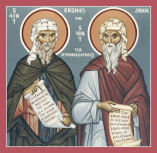 Born in Jerusalem, he was a friend of St. John Damascene, whose
parents took him in as an orphan and educated him. As a monk, he helped St. Damascene to
compile the Octoechos*, and he himself composed many canons to the saints. The especially
lovely canons for Lazarus Saturday, Palm Sunday and the Sunday of the Judgement are
ascribed to him. He was bishop of the town of Maiuma, near Gaza. He outlived St. Damascene
and died in great old age. Born in Jerusalem, he was a friend of St. John Damascene, whose
parents took him in as an orphan and educated him. As a monk, he helped St. Damascene to
compile the Octoechos*, and he himself composed many canons to the saints. The especially
lovely canons for Lazarus Saturday, Palm Sunday and the Sunday of the Judgement are
ascribed to him. He was bishop of the town of Maiuma, near Gaza. He outlived St. Damascene
and died in great old age. * The Octoechos: the book of the Eight Modes, which change weekly and comprise the basis of the Offices—Tr. |
FOR CONSIDERATION
In what have the saints been most exalted and glorified by heaven and by men? Chiefly in their humility and service. St. Martin, even as an officer before his Baptism, had one servant whom he regarded more as a brother than a servant. He often served his servant, feeling no shame at this, but rather joy. When St. Hilary wanted to make him a priest, he refused this honor with tears, and begged the bishop to let him be a monk in some remote place. St. Martin was once travelling from France to Pannonia, to see his parents. When he was crossing the Alps, brigands seized him and made to kill him. When one of the brigands took up a sword to behead him, Martin was unafraid and stayed motionless without asking for mercy, being utterly at peace as though nothing were happening. The brigand was astonished at such a reaction, put his sword away and asked Martin who he was. Martin said that he was a Christian, and that it was because of this that he was not afraid, knowing that God, in His great mercy, is near to men, and especially in the hour of danger. All the brigands were amazed at the rare virtues of this godly man, and he who had drawn his sword against Martin came to faith in Christ, was baptized and later became a monk. When the episcopal seat in Tours became vacant, everyone wanted to have St. Martin as bishop, but Martin was unwilling. Some citizens of Tours got him out of his monastery by craft, and took him off. This was how they did it: they came to the gate of Martin’s monastery and told the abbot that a sick man was waiting outside, asking that he come out and give him his blessing. When St. Martin came out, they seized him and carried him off to Tours, and made him bishop. Foreseeing his approaching death in old age, he told his brethren and they, with many tears, begged him not to leave them. The saint, to comfort them, prayed to God in their presence, saying: ‘Lord, if I am still needed by Thy people, I do not refuse the toil. May Thy holy will be done.’
Daily Scripture Readings taken from The Orthodox New Testament, translated and published by Holy Apostles Convent, Buena Vista, Colorado, copyright © 2000, used with permission, all rights reserved.
Daily Prologue Readings taken from The Prologue of Ochrid, by Bishop Nikolai Velimirovic, translated by Mother Maria, published by Lazarica Press, Birmingham, England, copyright © 1985, all rights reserved. Edited by Dormition Skete.