

Daily Devotional
Tuesday, October 27, 2026 (NS), October 14, 2026 (OS)
No Fasting.
Tuesday of the Twenty-Second Week
The commemoration of the holy Martyrs Nazarios, Gervasios, Protasios, and Kelsios, and our venerable mother among the saints, Paraskeva of Epivat, Protectress of Moldova.
Scripture Readings
Paschalion — Movable Calendar
Tuesday of the Twenty-Second Week
Epistle
The Reading is from the Epistle of Saint Paul to the Colossians [§ 256]. Brethren:
2 20If ye died with the Christ from the elements of the world, why, as if living in the world, do ye subject yourselves to regulations— 21“Do not touch, neither taste, nor handle,” 22which things are all for corruption in the using—according to the injunctions and teachings of men, 23which things indeed are having a reputation of wisdom in self-devised worship, and humility of mind, and unsparing treatment of the body, not showing any honor for gratification of the flesh?
3 1If ye then were raised with the Christ, be seeking the things above, where the Christ is seated at the right of God. 2Be minding the things above, not the things on the earth. 3For ye died, and your life hath been hidden with the Christ in God.
Gospel
The Reading is from the Holy Gospel according to Saint Luke [§ 34]. At that time:
8 1Jesus was traveling through, city by city and village by village, preaching and proclaiming the good tidings of the kingdom of God. And the twelve were with Him, 2and certain women who had been cured of diseases and scourges and evil spirits and infirmities—Mary who is called Magdalene, from whom seven demons had gone out, 3and Joanna the wife of Chuza, a steward of Herod, and Susanna, and many other women who were ministering to Him from their possessions.
Menaion — Fixed Calendar
The commemoration of the holy Martyrs Nazarios, Gervasios, Protasios, and Kelsios, and our venerable mother among the saints, Paraskeva of Epivat, Protectress of Moldova.
Epistle
For the holy Martyrs:
The Reading is from the Epistle of Saint Paul to the Ephesians [§ 233].
6 10Brethren, keep on being empowered in the Lord and in the strength of His might. 11Put on the full armor of God, for you to be able to stand against the wiles of the devil; 12because for us the wrestling is not against blood and flesh, but against the principalities, against the powers, against the cosmic rulers of the darkness of this age, against spiritual hosts of evil on account of the heavenly things. 13For this cause take up the full armor of God, in order that ye might be able to withstand in the evil day, and having counteracted all things, to stand. 14Stand therefore, having girt your loins with truth, and having put on for yourselves the breastplate of righteousness, 15and having shod your feet in readiness of the Gospel of peace; 16on the whole, take up the shield of faith, with which ye shall be able to quench all the fiery darts of the evil one. 17And take the helmet of salvation, and the sword of the Spirit, which is the word of God.
For the venerable Mother:
The Reading is from the Epistle of Saint Paul to the Galatians [§ 208]. Brethren:
3 23Before faith came, we were being guarded under the law, having been closed up to the faith about to be revealed. 24Therefore the law hath become our tutor until Christ, in order that we might be justified by faith. 25But faith having come, we are no longer under a tutor. 26For all are sons of God through faith in Christ Jesus. 27For as many as were baptized into Christ, ye put on Christ. 28There is neither Jew nor Greek, there is neither slave nor free, there is neither male and female; for ye are all one in Christ Jesus. 29And if ye are Christ’s, then are ye Abraham’s seed, and heirs according to promise.
Gospel
No reading given.
Lives of the Saints (Prologue)
October 27th – Civil Calendar
October 14th – Church Calendar
1. Our Holy Mother Petka (Paraskeva).
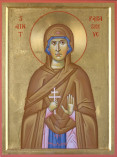 This glorious saint was of Bulgarian
birth, from the town of Epibata, between Silinaurius and Constantinople. St. Petka’s
parents were wealthy and devout Christians, and had one son, Evtimy (Euthymius), who became a
monk during his parents’ lifetime and later became Bishop of Madytos. After her
parents’ death, the maiden Petka, always desirous of the ascetic life for the sake of
Christ, left her home and went first to Constantinople and then to the Jordan wilderness, where
she lived to old age in asceticism. Who can describe all the labors, the sufferings, the
temptations from demons that Petka endured for many years? In her old age an angel of God
appeared to her and said: ‘Leave the wilderness and go back to your home.’ St. Petka
obeyed the voice from heaven, left her beloved wilderness and returned to Epibata. She lived a
further two years there, still in ceaseless fasting and prayer, and then gave her spirit into
God’s hands and went to join the company of Paradise. She entered into rest in the eleventh
century. Her wonder-working relics were, in the course of time, taken to Constantinople, Trnovo,
Constantinople again, and then Belgrade. They are now in Romania, in the town of Jassy. St.
Petka’s spring is to be found in Belgrade. The waters miraculously heal all the sick who,
with faith in God and love for this saint, hasten to ask her aid.
This glorious saint was of Bulgarian
birth, from the town of Epibata, between Silinaurius and Constantinople. St. Petka’s
parents were wealthy and devout Christians, and had one son, Evtimy (Euthymius), who became a
monk during his parents’ lifetime and later became Bishop of Madytos. After her
parents’ death, the maiden Petka, always desirous of the ascetic life for the sake of
Christ, left her home and went first to Constantinople and then to the Jordan wilderness, where
she lived to old age in asceticism. Who can describe all the labors, the sufferings, the
temptations from demons that Petka endured for many years? In her old age an angel of God
appeared to her and said: ‘Leave the wilderness and go back to your home.’ St. Petka
obeyed the voice from heaven, left her beloved wilderness and returned to Epibata. She lived a
further two years there, still in ceaseless fasting and prayer, and then gave her spirit into
God’s hands and went to join the company of Paradise. She entered into rest in the eleventh
century. Her wonder-working relics were, in the course of time, taken to Constantinople, Trnovo,
Constantinople again, and then Belgrade. They are now in Romania, in the town of Jassy. St.
Petka’s spring is to be found in Belgrade. The waters miraculously heal all the sick who,
with faith in God and love for this saint, hasten to ask her aid.
2. The Holy Martyrs Nazarius, Gervasius and Protasius.
Nazarius was born in Rome of a Jewish father and a Christian mother. His mother, Perpetua, was baptized by the Apostle Peter himself. Receiving his mother’s faith, Nazarius of his own volition gave himself to the fulfilling of all the Church’s precepts. Fearlessly preaching the Gospel, he went to Milan. There he found Gervasius and Protasius in prison, and ministered to them with great love. Discovering this, the local governor ordered that Nazarius be whipped and driven out of the city. His mother appeared to him in a vision and told him that he must go to Gaul (France) and preach the Gospel there, and Nazarius did so. After several years, Nazarius came again to Milan, now with the young Celsus, his disciple, whom he had baptized in Gaul. The brothers Gervasius and Protasius were still in prison, and Anulius the governor soon had Nazarius thrown in with them. Christ’s martyrs rejoiced greatly at the providence of God that had brought them together again. The Emperor Nero ordered that Nazarius be killed, and the governor took him and Celsus out of prison and beheaded them. Gervasius and Protasius were also beheaded very soon after that by a General Astacius, who was passing through Milan to wage war against the Moravians. The general heard that these two brothers would not offer sacrifice to idols, and being afraid that he might lose the war because of this, he ordered that they be beheaded at once. Gervasius and Protasius were twins, the sons of godly parents Vitalis and Valeria, who were also martyred for the Faith. The relics of St. Nazarius were taken from a garden outside the city to the Church of the Holy Apostles by St. Ambrose, and those of St. Gervasius and St. Protasius were revealed to him in a strange vision.
Author’s note: In the Greek Synaxarion, there is recorded this miraculous happening with the holy Martyr Paraskeve’s help on the island of Chios in 1442: A hieromonk, Ambrose, was celebrating Vespers in the church of St. Paraskeve (commemorated Oct. 28). No one else was in the church. At the end of the service, rain suddenly began to pour down in torrents with a great roar, and this continued all night. Ambrose was unable to leave the church. Thinking that the island would be completely flooded by the storm, he began to pray to St. Paraskeve to save his homeland and soothe God’s righteous anger. He had a dream at dawn and saw the church roofless, and in the heights, a cloud of light within which stood the form of a beautiful woman in prayer to God. After her prayer, she said to the priest: ‘Ambrose, don’t be afraid: your homeland is saved.’ And the rain stopped at once. From that time, the island of Chios has celebrated St. Paraskeve’s day with great solemnity.
FOR CONSIDERATION
Examples of how the saints themselves reveal their hidden relics to men are a justification of the respect that should be paid to these relics, not to mention their miraculous properties, which is a second justification. St. Petka’s grave was known by no one for a long time. It so happened that a sailor who had lived a wicked life died and his body was thrown near to the saint’s grave. When the body became carrion and began to give off an unbearable stench, a monk who lived in the vicinity called the villagers to bury the body. It came about that they buried it in St. Petka’s very grave. That night, St. Petka appeared in a dream to one of the villagers, George by name, who had buried the corpse. She appeared as a beautiful and resplendent queen, surrounded by many glorious warriors, and said: ‘George, dig up my relics at once and take them to some other place. I can’t bear the stench of that corpse!’ and St. Petka told him who and whence she was. The same night another villager, Ephemia, had the same vision. The following day, the villagers went and began digging, and indeed found the relics of St. Petka, retaining a rare fragrance, and which was quickly demonstrated, having wonder-working power.
About the relics of St. Gervasius and St. Protasius, St. Ambrose relates how, in a similar way, they were revealed to him. One night, two youths and an elderly man appeared to the wakeful Ambrose. He thought that the last was the Apostle Paul. While the young men kept silent, the elder told Bishop Ambrose that they were Christ’s martyrs, that their relics lay in the precise place in which St. Ambrose was at prayer, and that everything else about them could be learned from a little book that would be found in their grave. The next day, St. Ambrose recounted his vision, began to dig and indeed found the relics of two men, of whom it was learned from the discovered book that they were Gervasius and Protasius. In Bishop Ambrose’s presence, a blind man, Servirus, touched these holy relics and immediately received his sight.
Daily Scripture Readings taken from The Orthodox New Testament, translated and published by Holy Apostles Convent, Buena Vista, Colorado, copyright © 2000, used with permission, all rights reserved.
Daily Prologue Readings taken from The Prologue of Ochrid, by Bishop Nikolai Velimirovic, translated by Mother Maria, published by Lazarica Press, Birmingham, England, copyright © 1985, all rights reserved. Edited by Dormition Skete.