

Daily Devotional
Saturday, April 19, 2025 (NS), April 6, 2025 (OS)
Fast Day. Wine permitted, but not olive oil.
Holy Week
| Holy and Great Saturday |
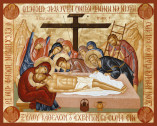
The commemoration of our holy father among the saints, Eftychios, Patriarch of Constantinople, and the venerable Methodios, Equal-to-the-apostles, Archbishop of Moravia and Enlightener of the Slavs.
Scripture Readings
Paschalion — Movable Calendar
Holy and Great Saturday
Epistle
In the Orthros
The Reading is from the First Epistle of Saint Paul to the Corinthians [§ 133]. Brethren:
Note two Readings, one from 1 Cor. 5:6-8 and Gal. 3:13, 14.
Begin with First Corinthians [§ 133]:
5 6A little leaven leaveneth the whole dough. 7Purge out therefore the old leaven, that ye may be a new dough, even as ye are unleavened. For also Christ, our Passover, was sacrificed for us; 8therefore let us be keeping festival, not with old leaven, nor with the leaven of malice and wickedness, but with the unleavened loaves of sincerity and of truth.
Conclude with Galatians [§ 206]:
3 13Christ redeemed us from the curse of the law, having become a curse for us (for it hath been written: “Cursed is everyone who hangeth on a tree [Deut. 21:23]”), 14that the blessing of Abraham might come to pass to the nations in Christ Jesus, in order that we might receive the promise of the Spirit through faith.
In the Divine Liturgy
The Reading is from the Epistle of Saint Paul to the Romans [§ 91]. Brethren:
6 3As many as were baptized into Christ Jesus were baptized into His death. 4Therefore we were buried with Him by the baptism into the death, that even as Christ was raised from the dead through the glory of the Father, thus also we should walk in newness of life. 5For if we have been planted together in the likeness of His death, certainly also we shall be of the resurrection, 6knowing this, that our old man was crucified with Him, that the body of sin might be rendered inactive, in order to no longer serve sin. 7For the one who died hath been justified from sin. 8Now if we died with Christ, we believe that we shall also live with Him, 9knowing that Christ Who was raised from the dead dieth no more; death no longer hath dominion over Him. 10For the death which He died, He died to sin once for all; but the life which He liveth, He liveth to God. 11Thus reckon ye also yourselves to be dead indeed to sin, but alive to God in Christ Jesus our Lord.
Gospel
In the Orthros
The Reading is from the Holy Gospel according to Saint Matthew [§ 114].
27 62On the morrow, which is after the preparation, the chief priests and the Pharisees were gathered together to Pilate, 63saying, “Sir, we were reminded that that deceiver said while He was yet alive, ‘I am being raised after three days.’ 64“Command therefore that the tomb be made secure until the third day, lest perchance His disciples come by night and steal Him, and say to the people, ‘He was raised from the dead’; and the last deceit shall be worse than the first.” 65And Pilate said to them, “Ye have a guard; go your way and make it as secure for yourselves as ye know how.” 66And they went and made the tomb secure, having sealed the stone with the guard being present.
In the Liturgy
The Reading is from the Holy Gospel according to Saint Matthew [§ 115].
28 1Late on the sabbath, at the dawning toward the first day of the week, there came Mary Magdalene and the other Mary to see the tomb. 2And behold, a great earthquake occurred; for an angel of the Lord descended out of heaven, and came and rolled away the stone from the door, and sat upon it. 3And his appearance was as lightning, and his garment white as snow. 4And those keeping guard, because of their fear of him, were shaken and became as dead men. 5And the angel answered and said to the women, “Cease being afraid, for I know that ye seek Jesus Who hath been crucified. 6“He is not here; for He was raised, even as He said. Come, see the place where the Lord was lying. 7“And go quickly and say to His disciples that He was raised from the dead. And behold, He goeth before you into Galilee; there shall ye see Him. Behold, I have told you.” 8And they went out quickly from the sepulcher with fear and great joy, and ran to bring tidings to His disciples. 9But as they were going to bring tidings to His disciples, then behold, Jesus met them, saying, “Rejoice ye.” And they approached and laid hold of His feet, and made obeisance to Him. 10Then Jesus saith to them, “Cease being frightened. Go and bring tidings to My brethren that they should go into Galilee, and there shall they see Me.” 11Now when they were going, behold, some of the guard came into the city and reported to the chief priests all the things that came to pass. 12And after they were gathered together with the elders and took counsel, they gave a considerable amount of money to the soldiers, 13saying, “Say, ‘His disciples came by night and stole Him while we were sleeping.’ 14“And if this should be heard before the governor, we will persuade him and make you free from care.” 15And they took the money and did as they were taught. And this report was spread abroad by the Jews until today.
16Now the eleven disciples went into Galilee, to the mountain where Jesus appointed them. 17And having seen Him, they made obeisance to Him; but some doubted. 18And Jesus approached and spoke to them, saying, “All authority is given to Me in heaven and on earth. 19“Go therefore and make disciples of all the nations, baptizing them in the name of the Father, and of the Son, and of the Holy Spirit, 20“teaching them to observe all things whatsoever I commanded you; and behold, I am with you all the days until the completion of the age.” Amen.
Menaion — Fixed Calendar
The commemoration of our holy father among the saints, Eftychios, Patriarch of Constantinople, and the venerable Methodios, Equal-to-the-apostles, Archbishop of Moravia and Enlightener of the Slavs.
Epistle
For the Equal-to-the-apostles:
The Reading is from the Epistle of Saint Paul to the Hebrews [§ 318]. Brethren:
7 26Such a High Priest was fitting for us: holy, guileless, undefiled, Who hath been separated from the sinners and hath become higher than the heavens, 27Who hath no need daily, even as the high priests, to offer up sacrifices, first for his own sins, then for those of the people; for this He did once for all after He offered up Himself. 28For the law appointeth men high priests who have weakness; but the word of the oath, which is after the law, appointeth the Son, Who hath been perfected forever.
8 1Now in reference to the things being spoken of, the chief point is: We have such a High Priest, Who sat down on the right of the throne of the majesty in the heavens, 2a Liturgist of the holies and of the tabernacle, the true one, which the Lord pitched, and not man.
Gospel
No reading given.
Lives of the Saints (Prologue)
April 19th – Civil Calendar
April 6th – Church Calendar
1. St. Eftychios, Patriarch of Constantinople.
He was born in Phrygia of devout parents, and was the son of an officer. Once, Eftychios was playing with some other children of his own age, their game being to write their names on a wall and put beside them the rank that they reckoned they would have in life. When Eftychios’ turn came, he wrote: ‘Eftychios—Patriarch!’ He became abbot of a monastery in Amaseia at the age of thirty, and ten years later the Metropolitan of Amaseia sent him to the Fifth Ecumenical Council in 553 as his representative. At the council, he shone like a bright star among the Church fathers, both for his learning and his devotion. When a quarrel arose about whether heretics could be anathematised after their deaths or not, he supported his belief that they could by citing III Kings (I Kings KJV) 13:1-8, and IV Kings (II Kings) 23:16. He became greatly liked by both Emperor Justinian and Patriarch Menas. The emperor very frequently turned to him for advice, and Menas (at that time very wealthy) designated him his heir and asked the emperor to ensure that this happened. And so it came to pass. Eftychios governed the Church in peace for twelve years. But then the devil raised a storm against him. This storm reached the Emperor Justinian himself. The emperor was deluded and fell into the Monophysite heresy of Aphthartodocetism, which taught the falsehood that the Lord Jesus, before the Resurrection, had a divine and incorrupting body, not feeling hunger or thirst or pain. Eftychios stood firmly against this heresy, for which the emperor sent him into exile to his first monastery. There Eftychios lived for twelve years and eight months, being shown to be a great wonder-worker, healing people of various diseases by his prayers and by anointing with holy oil. Justinian repented and died, and his successor, Justin II, called Eftychios back to the patriarchal throne, on which this saint remained till his death, governing the Church of God in peace. In 582, at the age of seventy, he went to the kingdom of Christ the Lord, the Lord Whom he had served so faithfully and courageously all his life.
2. The 120 Holy Martyrs in Persia.
When the Persian King Sapor plundered the Byzantine lands, he took 120 Christians into slavery. He put pressure on them to deny Christ and worship fire, but in vain. He then threw them into the fire and burned them alive. Among these martyrs were nine virgins, consecrated to God. They all suffered with honor between 344 and 347, and went to the courts of Christ the King.
FOR CONSIDERATION
Of a certain orator of olden times it is said that he strove day and night to perfect his oratory. Someone said to him: ‘Demosthenes will never permit you to be the chief orator!’ to which he at once replied: ‘Nor I him, to be the only!’ If you can’t be a first-class saint, like St. Anthony, don’t shrug your shoulders and say: ‘I can’t do anything,’ but apply your effort and double your talent. ‘In My Father’s house are many mansions,’ said the Lord. If you deserve only to find yourself in the smallest of these mansions, you will be more glorious and happier than any earthly monarch who has ever lived. To each according to his talent. You won’t be a St. Anthony—but the kingdom of God is not entirely populated by St. Anthonies!
Daily Scripture Readings taken from The Orthodox New Testament, translated and published by Holy Apostles Convent, Buena Vista, Colorado, copyright © 2000, used with permission, all rights reserved.
Daily Prologue Readings taken from The Prologue of Ochrid, by Bishop Nikolai Velimirovic, translated by Mother Maria, published by Lazarica Press, Birmingham, England, copyright © 1985, all rights reserved. Edited by Dormition Skete.