

Daily Devotional
Friday, April 18, 2025 (NS), April 5, 2025 (OS)
Fast Day. No Meat, Fish, Dairy, Eggs, Alcohol or Olive Oil Allowed.
Holy Week
STRICT FAST - No Food or Drink
From Thursday evening to Friday Evening.
| Holy and Great Friday The Great Hours of Holy and Great Friday |
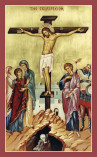
The commemoration of the holy Martyrs Claudius, Diodoros, Victor, Victorinos, Pappias, Nikephoros, and Serapion, and the holy Martyrs Theodoulos, Agathopodes, and those with them.
Scripture Readings
Paschalion — Movable Calendar
Holy and Great Friday
The Great Hours of Holy and Great Friday
Epistle
Epistle Reading of the First Hour
The Reading is from the Epistle of Saint Paul to the Galatians [§ mid 215]. Brethren:
6 14May it not be for me to boast, except in the Cross of our Lord Jesus Christ, through Whom the world hath been crucified to me, and I to the world. 15For in Christ Jesus neither circumcision hath any strength, nor uncircumcision, but a new creation. 16And as many as walk by this rule, peace be upon them and mercy, and upon the Israel of God.
17Henceforth, let no one be giving me troubles, for I bear in my body the marks of the Lord Jesus.
18The grace of our Lord Jesus Christ be with your spirit, brethren. Amen.
Epistle Reading of the Third Hour
The Reading is from the Epistle of Saint Paul to the Romans [§ mid 88]. Brethren:
For Gk. usage, see Rom. 5:6-10; for Sl. usage, see Rom. 5:6-11.
5 6When we were yet without strength, in due time Christ died for the ungodly. 7For scarcely for a righteous man will one die, yet perhaps for a good man someone would even dare to die. 8But God commendeth His own love to us, in that while we were yet sinners, Christ died for us. 9Much more then, having now been justified by His blood, we shall be saved from wrath through Him. 10For if, when we were enemies, we were reconciled to God through the death of His Son, much more, having been reconciled, we shall be saved by His life. 11And not only so, but we also boast in God through our Lord Jesus Christ, through Whom we now received the reconciliation.
Epistle Reading of the Sixth Hour
The Reading is from the Epistle of Saint Paul to the Hebrews [§ 306]. Brethren:
2 11Both He Who sanctifieth and they who are sanctified are all of one; for which cause He is not ashamed to call them brethren, 12saying, “I will announce Thy name to My brethren, in the midst of the church will I hymn Thee [cf. Ps. 21(22):22]”; 13and again, “I will trust in Him [cf. Is. 8:17]”; and again, “Behold, I and the children whom God gave Me [Is. 8:18].” 14Since then the children have partaken of flesh and blood, He also Himself in like manner partook of the same, in order that through death He might bring to nought the one who hath the power of death, that is, the devil, 15and might set free those who through fear of death were all their lifetime subject to bondage. 16For surely He taketh not hold of the nature of the angels, but He taketh hold of the seed of Abraham. 17Wherefore in all things it behooved Him to be made like His brethren, that He might become a merciful and faithful High Priest in things pertaining to God, in order to be made an expiation for the sins of the people. 18For having Himself been tempted in that which He suffered, He is able to help those who are tempted.
Epistle Reading of the Ninth Hour
The Reading is from the Epistle of Saint Paul to the Hebrews [§ 324].
10 19Brethren, having boldness for the entrance into the Holies by the blood of Jesus, 20which He inaugurated for us—a new and living way through the veil, that is, His flesh— 21and having a great Priest over the house of God, 22let us be drawing near with a true heart in full assurance of faith, our hearts having been sprinkled from an evil conscience, and our body having been washed with pure water. 23Let us be holding fast the confession of our hope unswerving, for He Who promised is faithful. 24And let us be considering one another to incitement of love and of good works, 25not forsaking the assembling of ourselves together, even as is the custom with some, but exhorting one another, and so much the more, as ye see the day approaching. 26For if we sin willingly after receiving the full knowledge of the truth, there remaineth no longer a sacrifice for sins, 27but a certain fearful expectation of judgment and indignation of fire, which is about to devour the adversaries. 28Anyone who set aside the law of Moses died without mercy “on the testimony of two or three witnesses [cf. Deut. 17:6]”; 29of how much worse punishment, do ye think that one shall be deemed worthy who trampled underfoot the Son of God, and deemed common the blood of the covenant, wherewith he was sanctified, and insulted the Spirit of grace? 30For we know the One Who said, “‘Vengeance belongeth to Me, I will recompense,’ saith the Lord [cf. Deut. 32:35]”; and again, “The Lord shall judge His people [cf. Deut. 32:36].” 31It is a fearful thing to fall into the hands of the living God.
In the Vespers
The Reading is from the First Epistle of Saint Paul to the Corinthians [§ 125]. Brethren:
1 18The word, that of the Cross, on the one hand, to those who are perishing is foolishness, but on the other hand, to us who are being saved, it is the power of God. 19For it hath been written: “I will destroy the wisdom of the wise, and will set at nought the comprehension of the intelligent [cf. Is. 29:14].” 20Where is the wise? Where is the scribe? Where is the disputer of this age? Did not God make foolish the wisdom of this world? 21For since, in the wisdom of God, the world knew not God through its wisdom, it pleased God through the foolishness of the preaching to save those who believe. 22For indeed, Jews ask for a sign, and Greeks seek wisdom; 23but we proclaim Christ Who hath been crucified, to Jews, on the one hand, a stumbling block, and to Greeks, on the other hand, foolishness, 24but to those who are called, both Jews and Greeks, Christ, God’s power and God’s wisdom. 25Because the foolish thing of God is wiser than man, and the weak thing of God is stronger than man. 26For ye see your calling, brethren, that there are not many wise according to the flesh, not many powerful, not many well-born. 27But God chose for Himself the foolish things of the world, that He may put to shame the wise; and God chose for Himself the weak things of the world, that He may put to shame the mighty things. 28And God chose for Himself the low-born of the world and the despised, and the things that are nothing, that He might make of no effect the things that are, 29so that no flesh should boast before Him. 30But of Him are ye in Christ Jesus, Who became for us wisdom from God, and righteousness and sanctification and redemption, 31in order that, even as it hath been written: “He that boasteth, in the Lord let him boast [cf. Jer. 9:23, 24].”
2 1And I, brethren, having come to you, came not according to excellency of speech or of wisdom, announcing to you the testimony of God. 2For I decided not to know anything among you, except Jesus Christ, even this One Who was crucified.
Gospel
Gospel Reading of the First Hour
The Reading is from the Holy Gospel according to Saint Matthew [§ 110]. At that time:
27 1It having become morning, all the chief priests and the elders of the people took counsel against Jesus, so as to put Him to death. 2And after they bound Him, they led Him away and delivered Him up to Pontius Pilate the governor.
3Then Judas, the one delivering Him up, after he saw that He was condemned, felt remorse and returned the thirty pieces of silver to the chief priests and the elders, 4saying, “I sinned, having delivered up innocent blood.” But they said, “What is that to us? Thou shalt see to that.” 5And having cast down the pieces of silver in the temple, he withdrew; and he went away and hanged himself. 6And the chief priests took the pieces of silver and said, “It is not lawful to put them into the treasury, since it is the price of blood.” 7And having taken counsel, they bought with them the potter’s field for a burial-place for the strangers. 8Wherefore that field was called Field of Blood until this day. 9Then was fulfilled that which was spoken by Jeremias the prophet, saying, “And they took the thirty pieces of silver [cf. Zach. 11:12], the price of Him Who was valued, Whom they of the sons of Israel valued for themselves, 10“and gave them for the potter’s field, according as the Lord prescribed to me [cf. Jer. 18:2, 39(32):6ff].”
11And Jesus stood before the governor. And the governor questioned Him, saying, “Thou art the King of the Jews?” And Jesus said to him, “Thou sayest.” 12And as He was being accused by the chief priests and the elders, He answered nothing. 13Then Pilate saith to Him, “Hearest Thou not how many things they bear witness against Thee?” 14And He gave no answer to him, not even to one word, so that the governor marvelled exceedingly. 15Now during the feast the governor was accustomed to releasing to the crowd one prisoner whom they were wanting. 16And they had then a notorious prisoner called Barabbas. 17Therefore when they were gathered together, Pilate said to them, “Whom do ye wish that I release to you? Barabbas, or Jesus Who is called Christ?” 18For he knew that by reason of envy they delivered Him up. 19But when he sat on the tribunal, his wife sent word to him, saying, “Let there be nothing between thee and that just One, for I suffered many things today in a dream because of Him.” 20But the chief priests and the elders persuaded the crowds that they should ask for themselves Barabbas, and utterly destroy Jesus. 21And the governor answered and said to them, “Which of the two do ye wish that I release to you?” And they said, “Barabbas.” 22Pilate saith to them, “What then shall I do with Jesus Who is called Christ?” They all say to him, “Let Him be crucified.” 23And the governor said, “Why, what evil did He do?” But they kept on crying out the more, saying, “Let Him be crucified.” 24And after Pilate saw that nothing was to be of use, but rather that an uproar was taking place, he took water and washed off his hands for himself before the crowd, saying, “I am innocent of the blood of this just One; ye shall see to it.” 25And all the people answered and said, “His blood be on us and on our children.” 26Then he released Barabbas to them; but after he scourged Jesus, he delivered Him up in order that He might be crucified.
27Then the soldiers of the governor took Jesus with them into the Prætorium, and gathered together the whole cohort against Him. 28And they stripped Him and put around Him a scarlet cloak. 29And after they plaited a crown of thorns, they put it upon His head, and a reed in His right hand. And having fallen on their knees before Him, they kept on mocking Him and saying, “Hail, King of the Jews!” 30And they spit upon Him, and took the reed and kept on striking Him on His head. 31And when they mocked Him, they took the cloak off Him and put His own garments on Him, and led Him away in order to crucify Him. 32And as they came out, they found a man, a Cyrenian, by name Simon. This one they impressed into service, in order that he might take up His Cross. 33And having come to a place called Golgotha, which is called Place of a Skull, 34they gave Him vinegar to drink mingled with gall. And after He tasted it, He would not drink. 35And having crucified Him, they parted His garments among themselves, casting a lot; 36and sitting down, they were watching over Him there. 37And they put over His head His accusation, it having been written: “This is Jesus the King of the Jews.” 38Then two robbers were crucified with Him, one on the right and one on the left. 39And those passing by were blaspheming Him, shaking their heads, 40and saying, “Thou Who destroyest the temple and buildest it in three days! Save Thyself; if Thou art God’s Son, come down from the Cross.” 41And in like manner also the chief priests, mocking with the scribes and elders and Pharisees, were saying, 42“Others He saved, Himself He is not able to save. If He is King of Israel, let Him come down now from the Cross, and let us believe on Him. 43“He hath trusted in God; let Him deliver Him now, if He taketh pleasure in Him; for He said, ‘I am God’s Son.’” 44And also the robbers who were crucified together with Him began to reproach Him with the same thing. 45Now from the sixth hour until the ninth hour there came to be a darkness over all the earth. 46And about the ninth hour Jesus cried out with a loud voice, saying, “Eli, Eli, lima sabachthani?” that is, “My God, My God, why didst Thou forsake Me?” 47And some of those who were standing there, after they heard that, were saying, “This One calleth Elias.” 48And straightway one of them ran, and took a sponge, and filled it with vinegar, and put it on a reed, and was attempting to give Him to drink. 49But the rest were saying, “Let be; let us see if Elias is coming to save Him.” 50And Jesus, having cried again with a loud voice, gave up the spirit. 51And behold, the veil of the temple was torn into two from top to bottom; and the earth was shaken, and the rocks were rent; 52and the sepulchers were opened, and many bodies of the saints who were asleep were raised, 53and came out of the sepulchers after His arising, and entered into the holy city and were manifested to many. 54Now after the centurion and those with him, who were watching over Jesus, saw the earthquake and the things which took place, they were exceedingly afraid, saying, “Truly this was God’s Son.”
Gospel Reading of the Third Hour
The Reading is from the holy Gospel according to Saint Mark [§ 67]. At that time:
15 16The soldiers led Jesus away inside the court, which is the Prætorium, and they called together all the cohort. 17And they clothed Him with purple. And having plaited a crown of thorns, they put it on Him, 18and began to salute Him, “Hail, King of the Jews!” 19And they kept on striking His head with a reed and spitting on Him; and bowing their knees, they were making obeisance to Him. 20And when they mocked Him, they took the purple off Him, and put His own garments on Him; and they lead Him out in order that they might crucify Him. 21And they impress into service one Simon a Cyrenian—the father of Alexander and Rufus—as he passed by coming from a field, in order that he might take up His Cross.
22And they bring Him to a place, Golgotha, which is, being interpreted, Place of a Skull. 23And they were attempting to give Him wine having been flavored with myrrh, but He did not take it. 24And having crucified Him, they were dividing among themselves His garments, casting a lot upon them, to determine who should take what. 25And it was the third hour, and they crucified Him. 26And the inscription of His accusation had been written above: “The King of the Jews.” 27And with Him they crucify two robbers, one on the right and one on His left. 28And the Scripture was fulfilled which saith, “And He was reckoned with the lawless [Is. 53:12].” 29And those passing by blasphemed Him, shaking their heads and saying, “Ha! Thou Who destroyest the temple and buildest it in three days! 30“Save Thyself, and come down from the Cross.” 31And in like manner also the chief priests, mocking with the scribes, were saying to one another, “Others He saved, Himself He is not able to save. 32“Let the Christ, the King of Israel, come down now from the Cross, in order that we might see and believe on Him.” And they who were crucified with Him were reproaching Him. 33And the sixth hour having come to pass, there came to be a darkness over all the earth until the ninth hour. 34And at the ninth hour Jesus cried with a loud voice, saying, “Eloi, Eloi, lima sabachthani?” which is, being interpreted, “My God, My God, why didst Thou forsake Me?” 35And some of those standing by, having heard that, were saying, “Behold, He calleth Elias.” 36And one of them ran and filled a sponge with vinegar, and put it on a reed, and was attempting to give Him to drink, saying, “Let be; let us see if Elias is coming to take Him down.” 37And Jesus let out a loud cry, and gave up the spirit. 38And the veil of the temple was torn into two from top to bottom. 39Now after the centurion who stood opposite Him saw that He thus cried out and gave up the spirit, he said, “Truly this Man was God’s Son.” 40And there were also women looking on from afar off, among whom was also Mary Magdalene, and Mary the Mother of Iakovos the younger and of Joses, and Salome— 41who also, when He was in Galilee, were following Him and ministering to Him—and many other women who came up with Him to Jerusalem.
Gospel Reading of the Sixth Hour
The Reading is from the Holy Gospel according to Saint Luke [§ 111]. At that time:
23 32With Jesus, two others, malefactors, were also being led with Him to be put to death.
33And when they came upon the place which is called Skull, there they crucified Him, and the malefactors, one on the right and the other one on the left. 34And Jesus was saying, “Father, forgive them, for they know not what they do.” And when they divided His garments among themselves, they cast a lot. 35And the people stood beholding. And the rulers also with them were deriding Him, saying, “He saved others; let Him save Himself, if this One is the Christ, the chosen of God.” 36And the soldiers also were mocking Him, approaching and offering vinegar to Him, 37and saying, “If Thou art the King of the Jews, save Thyself.” 38And an inscription also had been written over Him in Greek and Latin and Hebrew letters: “This is the King of the Jews.” 39And one of the malefactors who were hanged kept on blaspheming Him, saying, “If Thou art the Christ, save Thyself and us.” 40But the other, answering, rebuked him, saying, “Dost thou not even fear God, seeing that thou art in the same condemnation? 41“And we indeed justly, for we are receiving things deserving of what we did; but this Man did nothing out of place.” 42And he was saying to Jesus, “Remember me, O Lord, when Thou comest in Thy kingdom.” 43And Jesus said to him, “Verily I say to thee, today thou shalt be with Me in Paradise.” 44And it was about the sixth hour, and there came to be a darkness over all the earth until the ninth hour, 45while the sun failed, and the veil of the temple was torn in the midst. 46And Jesus, having cried out with a loud voice, said, “Father, into Thy hands I commend My spirit.” And having said these things, He gave up the spirit. 47Now after the centurion saw that which took place, he kept on glorifying God, saying, “Verily this Man was righteous.” 48And all the crowds that came together to see this sight, when they beheld the things which took place, beat their breasts and were turning back. 49And all His acquaintances, and the women who accompanied Him from Galilee, stood afar off, beholding these things.
Gospel Reading of the Ninth Hour
The Reading is from the Holy Gospel according to Saint John [§§ 59-61]. At that time:
For Gk. usage, see Jn. 19:23-37, hereunder; for Sl. usage, see Jn. 18:28-19:37, hereunder.
18 28They led Jesus from Caiaphas into the Prætorium; and it was early. And they themselves entered not into the Prætorium, in order that they should not be defiled, but that they might eat the passover. 29Pilate then went out to them, and said, “What accusation bring ye against this Man?” 30They answered and said to him, “If this One were not an evildoer, we would not have delivered Him up to thee.” 31Then Pilate said to them, “Take Him yourselves and judge Him according to your law.” The Jews therefore said to him, “It is not allowed for us to put anyone to death,” 32that the word of Jesus might be fulfilled which He spoke, signifying by what kind of death He was about to die. 33Then Pilate entered into the Prætorium again, and called Jesus, and said to Him, “Thou art the King of the Jews?” 34Jesus answered him, “Sayest thou this of thyself, or did others tell thee about Me?” 35Pilate answered, “I am not a Jew, am I? Thy nation and the chief priests delivered Thee up to me. What didst Thou?” 36Jesus answered, “My kingdom is not of this world. If My kingdom were of this world, My servants would be fighting, in order that I should not be delivered up to the Jews; but now My kingdom is not from this place.” 37Pilate therefore said to Him, “Thou art then a king, art Thou not?” Jesus answered, “Thou sayest it, for I am King. For this cause have I been born, and for this cause have I come into the world, that I should bear witness to the truth. Everyone who is of the truth heareth My voice.” 38Pilate saith to Him, “What is truth?” And having said this, he went out again to the Jews, and saith to them, “I do not find even one cause for accusation in Him. 39“But it is a custom with you that I should release to you one at the passover. Do ye then wish that I release to you the King of the Jews?” 40Then they all cried again, saying, “Not this One, but Barabbas.” Now Barabbas was a robber.
19 1Therefore Pilate then took Jesus and scourged Him. 2And the soldiers plaited a crown of thorns, and put it on His head, and threw around Him a purple outer garment, 3and kept on saying, “Hail, King of the Jews!” And they kept on giving Him slaps on the face with the palms of their hands. 4Pilate then went out again, and saith to them, “Behold, I bring Him out to you, in order that ye might know that I do not find even one cause for accusation in Him.” 5Then Jesus came out, wearing the thorny crown and the purple outer garment. And Pilate saith to them, “Behold, the Man.” 6Therefore, when the chief priests and the officers saw Him, they cried out, saying, “Crucify, crucify Him.” Pilate saith to them, “Ye take Him and crucify Him, for I find no cause for accusation in Him.” 7The Jews answered him, “We have a law, and according to our law He ought to die, because He made Himself Son of God.” 8Therefore, when Pilate heard this saying, he was the more afraid. 9And he entered into the Prætorium again, and saith to Jesus, “From what place art Thou?” But Jesus did not give him an answer. 10Then Pilate saith to Him, “Speakest Thou not to me? Knowest Thou not that I have authority to crucify Thee, and authority to release Thee?” 11Jesus answered, “Thou wouldest have no authority at all against Me, except it were given to thee from above. Therefore, the one delivering Me up to thee hath the greater sin.” 12From this time on Pilate was seeking to release Him; but the Jews were crying out, saying, “If thou shouldest release this One, thou art not a friend of the Cæsar. Everyone who maketh himself a king speaketh against the Cæsar.” 13Therefore Pilate, having heard this saying, brought out Jesus, and took his seat upon the tribunal in a place which is called Lithostrotos, but in Hebrew, Gabbatha. 14Now it was the preparation of the passover, and about the sixth hour. And he saith to the Jews, “Behold your King!” 15But they cried out, “Take Him away, take Him away, crucify Him.” Pilate saith to them, “Your King shall I crucify?” The chief priests answered, “We have no king except Cæsar.” 16Therefore he then delivered Him up to them, in order that He might be crucified.
And they took Jesus and led Him away. 17And bearing His Cross, He went out to the place called Place of a Skull, which is called in Hebrew, Golgotha, 18where they crucified Him, and two others with Him, on the one side and the other, and Jesus in the middle. 19And Pilate also wrote a title, and put it on the Cross. And it was written: “Jesus the Nazaræan, the King of the Jews.” 20Therefore many of the Jews read this title, for the place where Jesus was crucified was near the city; and it was written in Hebrew, in Greek, and in Latin. 21Then the chief priests of the Jews were saying to Pilate, “Write not, ‘The King of the Jews,’ but that ‘He said, “I am King of the Jews.”’” 22Pilate answered, “What I have written, I have written.”
For Sl. usage, continue hereunder.
For Greek usage, begin here Jn 19:23-37 [§§ mid 60, 61]. At that time: When they crucified Jesus, they took His garments....
19 23Then the soldiers, when they crucified Jesus, took His garments and made four parts, to each soldier a part, and also the tunic; but the tunic was seamless, woven from the top throughout. 24They said therefore to one another, “Let us not tear it, but let us obtain it by lot for whom it shall be,” that the Scripture might be fulfilled, which saith, “They parted My garments among themselves, and upon My clothing they cast a lot [Ps. 21(22):18].” These things therefore the soldiers did. 25Now there had stood by the Cross of Jesus His Mother, and His Mother’s sister, Mary the wife of Cleopas, and Mary Magdalene. 26Then Jesus, having seen His Mother and the disciple whom He loved standing by, saith to His Mother, “Woman, behold thy son.” 27Then He saith to the disciple, “Behold, thy Mother.” And from that hour the disciple took her into his own home. 28After this, Jesus, knowing that all things now have been accomplished, that the Scripture might be fulfilled, saith, “I thirst.” 29A vessel therefore full of vinegar was set; and they filled a sponge with vinegar and put around it hyssop, and brought it to His mouth. 30Then, when Jesus took the vinegar, He said, “It hath been finished.” And having bowed His head, He delivered up the spirit.
31The Jews therefore, since it was the preparation, in order that the bodies should not remain upon the cross on the sabbath—for great was the day of that sabbath—asked Pilate that their legs might be broken, and that they might be taken away. 32Then the soldiers came and indeed broke the legs of the first and of the other who was crucified with Him. 33But when they came to Jesus and saw that He was already dead, they did not break His legs. 34But one of the soldiers pierced His side with a spear, and straightway blood and water came out. 35And the one who hath seen it hath borne witness, and his testimony is true; and that one knoweth that he speaketh true things, that also ye might believe. 36For these things came to pass, in order that the Scripture should be fulfilled: “Not a bone of Him shall be broken [cf. Ex. 12:46; Num. 9:12; Ps. 33(34):20].” 37And again, another Scripture saith: “They shall look at Him Whom they pierced [cf. Zach. 12:10].”
In the Vespers
The Reading is from the Holy Gospel according to Saint Matthew [§ 110]. At that time:
27 1It having become morning, all the chief priests and the elders of the people took counsel against Jesus, so as to put Him to death. 2And after they bound Him, they led Him away and delivered Him up to Pontius Pilate the governor.
3Then Judas, the one delivering Him up, after he saw that He was condemned, felt remorse and returned the thirty pieces of silver to the chief priests and the elders, 4saying, “I sinned, having delivered up innocent blood.” But they said, “What is that to us? Thou shalt see to that.” 5And having cast down the pieces of silver in the temple, he withdrew; and he went away and hanged himself. 6And the chief priests took the pieces of silver and said, “It is not lawful to put them into the treasury, since it is the price of blood.” 7And having taken counsel, they bought with them the potter’s field for a burial-place for the strangers. 8Wherefore that field was called Field of Blood until this day. 9Then was fulfilled that which was spoken by Jeremias the prophet, saying, “And they took the thirty pieces of silver [cf. Zach. 11:12], the price of Him Who was valued, Whom they of the sons of Israel valued for themselves, 10“and gave them for the potter’s field, according as the Lord prescribed to me [cf. Jer. 18:2, 39(32):6ff].”
11And Jesus stood before the governor. And the governor questioned Him, saying, “Thou art the King of the Jews?” And Jesus said to him, “Thou sayest.” 12And as He was being accused by the chief priests and the elders, He answered nothing. 13Then Pilate saith to Him, “Hearest Thou not how many things they bear witness against Thee?” 14And He gave no answer to him, not even to one word, so that the governor marvelled exceedingly. 15Now during the feast the governor was accustomed to releasing to the crowd one prisoner whom they were wanting. 16And they had then a notorious prisoner called Barabbas. 17Therefore when they were gathered together, Pilate said to them, “Whom do ye wish that I release to you? Barabbas, or Jesus Who is called Christ?” 18For he knew that by reason of envy they delivered Him up. 19But when he sat on the tribunal, his wife sent word to him, saying, “Let there be nothing between thee and that just One, for I suffered many things today in a dream because of Him.” 20But the chief priests and the elders persuaded the crowds that they should ask for themselves Barabbas, and utterly destroy Jesus. 21And the governor answered and said to them, “Which of the two do ye wish that I release to you?” And they said, “Barabbas.” 22Pilate saith to them, “What then shall I do with Jesus Who is called Christ?” They all say to him, “Let Him be crucified.” 23And the governor said, “Why, what evil did He do?” But they kept on crying out the more, saying, “Let Him be crucified.” 24And after Pilate saw that nothing was to be of use, but rather that an uproar was taking place, he took water and washed off his hands for himself before the crowd, saying, “I am innocent of the blood of this just One; ye shall see to it.” 25And all the people answered and said, “His blood be on us and on our children.” 26Then he released Barabbas to them; but after he scourged Jesus, he delivered Him up in order that He might be crucified.
27Then the soldiers of the governor took Jesus with them into the Prætorium, and gathered together the whole cohort against Him. 28And they stripped Him and put around Him a scarlet cloak. 29And after they plaited a crown of thorns, they put it upon His head, and a reed in His right hand. And having fallen on their knees before Him, they kept on mocking Him and saying, “Hail, King of the Jews!” 30And they spit upon Him, and took the reed and kept on striking Him on His head. 31And when they mocked Him, they took the cloak off Him and put His own garments on Him, and led Him away in order to crucify Him. 32And as they came out, they found a man, a Cyrenian, by name Simon. This one they impressed into service, in order that he might take up His Cross. 33And having come to a place called Golgotha, which is called Place of a Skull, 34they gave Him vinegar to drink mingled with gall. And after He tasted it, He would not drink. 35And having crucified Him, they parted His garments among themselves, casting a lot; 36and sitting down, they were watching over Him there. 37And they put over His head His accusation, it having been written: “This is Jesus the King of the Jews.” 38Then two robbers were crucified with Him, one on the right and one on the left.
Continue hereunder with Lk. 23:39-43 [§ mid 111].
23 39And one of the malefactors who were hanged kept on blaspheming Him, saying, “If Thou art the Christ, save Thyself and us.” 40But the other, answering, rebuked him, saying, “Dost thou not even fear God, seeing that thou art in the same condemnation? 41“And we indeed justly, for we are receiving things deserving of what we did; but this Man did nothing out of place.” 42And he was saying to Jesus, “Remember me, O Lord, when Thou comest in Thy kingdom.” 43And Jesus said to him, “Verily I say to thee, today thou shalt be with Me in Paradise.”
Resume hereunder Mt. 27:39-54 [§ mid 113].
27 39And those passing by were blaspheming Him, shaking their heads, 40and saying, “Thou Who destroyest the temple and buildest it in three days! Save Thyself; if Thou art God’s Son, come down from the Cross.” 41And in like manner also the chief priests, mocking with the scribes and elders and Pharisees, were saying, 42“Others He saved, Himself He is not able to save. If He is King of Israel, let Him come down now from the Cross, and let us believe on Him. 43“He hath trusted in God; let Him deliver Him now, if He taketh pleasure in Him; for He said, ‘I am God’s Son.’” 44And also the robbers who were crucified together with Him began to reproach Him with the same thing. 45Now from the sixth hour until the ninth hour there came to be a darkness over all the earth. 46And about the ninth hour Jesus cried out with a loud voice, saying, “Eli, Eli, lima sabachthani?” that is, “My God, My God, why didst Thou forsake Me?” 47And some of those who were standing there, after they heard that, were saying, “This One calleth Elias.” 48And straightway one of them ran, and took a sponge, and filled it with vinegar, and put it on a reed, and was attempting to give Him to drink. 49But the rest were saying, “Let be; let us see if Elias is coming to save Him.” 50And Jesus, having cried again with a loud voice, gave up the spirit. 51And behold, the veil of the temple was torn into two from top to bottom; and the earth was shaken, and the rocks were rent; 52and the sepulchers were opened, and many bodies of the saints who were asleep were raised, 53and came out of the sepulchers after His arising, and entered into the holy city and were manifested to many. 54Now after the centurion and those with him, who were watching over Jesus, saw the earthquake and the things which took place, they were exceedingly afraid, saying, “Truly this was God’s Son.”
Continue hereunder with Jn. 19:31-37 [§ mid 61].
19 31The Jews therefore, since it was the preparation, in order that the bodies should not remain upon the cross on the sabbath—for great was the day of that sabbath—asked Pilate that their legs might be broken, and that they might be taken away. 32Then the soldiers came and indeed broke the legs of the first and of the other who was crucified with Him. 33But when they came to Jesus and saw that He was already dead, they did not break His legs. 34But one of the soldiers pierced His side with a spear, and straightway blood and water came out. 35And the one who hath seen it hath borne witness, and his testimony is true; and that one knoweth that he speaketh true things, that also ye might believe. 36For these things came to pass, in order that the Scripture should be fulfilled: “Not a bone of Him shall be broken [cf. Ex. 12:46; Num. 9:12; Ps. 33(34):20].” 37And again, another Scripture saith: “They shall look at Him Whom they pierced [cf. Zach. 12:10].”
Conclude hereunder with Mt. 27:55-61 [§ mid 113].
27 55And many women who followed Jesus from Galilee, ministering to Him, were there beholding from afar off, 56among whom was Mary Magdalene, and Mary the Mother of Iakovos and Joses, and the mother of the sons of Zebedee.
57And evening having come to pass, there came a rich man from Arimathæa, by name Joseph, who also himself became a disciple to Jesus. 58This man went to Pilate and asked for the body of Jesus for himself. Then Pilate commanded that the body be given up. 59And having taken the body, Joseph wrapped it in a clean linen cloth, 60and laid it in his new sepulcher which he hewed out in the rock; and he rolled a great stone to the door of the sepulcher, and departed. 61And Mary Magdalene was there, and the other Mary, sitting opposite the tomb.
Menaion — Fixed Calendar
The commemoration of the holy Martyrs Claudius, Diodoros, Victor, Victorinos, Pappias, Nikephoros, and Serapion, and the holy Martyrs Theodoulos, Agathopodes, and those with them.
No readings given.
Lives of the Saints (Prologue)
April 18th – Civil Calendar
April 5th – Church Calendar
1. The Holy Martyrs Agathopous and Theodulus.
Agathopous, adorned with the white hairs of age, was a deacon and Theodulus, with the chastity of youth, was a reader in the Church in Thessalonica. In the time of Diocletian’s hunting of Christians, these two were summoned for trial. They went there joyfully, and each holding the other by the hand, went in crying: ‘We are Christians!’ The whole court’s urging them to deny Christ and worship idols was in vain. After long imprisonment and starvation, they were condemned to death by drowning in the sea. Their hands were bound behind them and a large stone tied to their necks, and they were taken off to be drowned. When they went to throw Agathopous into the depths, he cried out: ‘Lo, by second Baptism we are washed from all our sins, and will go cleansed to Christ Jesus!’ The sea quickly threw their drowned bodies onto the shore, and Christians gave them burial. St. Theodulus appeared to his friends in the form of a shining angel in white raiment and commanded them to distribute all his remaining goods to the poor. These great soldiers of Christ suffered with honor under the Emperor Diocletian and Faustinus the governor of Thessalonica, in the year 303.
2. Our Holy Father Mark of Trache.
He is also known as ‘the Athenian’ because Athens was his birthplace. When he had finished his higher schooling in Athens, his parents died. He pondered within himself on the inevitability of death, and that one must prepare in good time for a holy departure from this world. He gave his goods away to the poor and seated himself on a plank in the sea, with profound faith in God’s help and the prayer that God would lead him wherever He desired. And, by the providence of God, he was kept safe and taken to Libya (or Ethiopia), to a mountain called Trache. Mark lived in asceticism on that mountain for ninety-five years, seeing neither man nor beast. For thirty whole years he had an intense struggle with evil sprits, and was tormented by hunger and thirst, cold and heat. He ate earth and drank sea-water. After thirty years of the most intense sufferings, the conquered demons fled from him and angels of God started bringing him food every day in the form of bread, fish and fruit. St. Serapion visited him just before his death, and later recorded the wonderful life of this saint. Mark was asking Serapion if there were in the world any Christians who could say to the mountain they were on: ‘Get up and cast yourself into the sea,’ and it would do so. At that moment the mountain began to move like a wave. But Mark raised a hand and quieted it, such being the miraculous power of this man of God. At the time of his death, he prayed for the salvation of all men and gave his soul into God’s hands. St. Serapion saw an angel bearing Mark’s soul, and a hand extended from heaven to receive it. St. Mark lived for a hundred and thirty years and entered into rest in about 400.
FOR CONSIDERATION
‘Live as though you were out of this world, and you will have peace.’ Thus St. Anthony spoke to his disciple. This is a strange teaching, but a true one. We experience the greatest trouble and unease in ourselves when we feel ourselves more and more to be in this world. But, the more a man withdraws from the world, the more often he contemplates this world as existing without him and the more strongly, in his thoughts, he ponders on the utter needlessness of his presence in this world, so much the closer will he stay to God and so much the deeper will be the spiritual peace that he will have. ‘I die daily’ (I Cor 15:31), says the Apostle Paul. That is, I feel every day that I am not in this world. But, because of this, he feels himself every day in spirit a citizen of heaven. When the torturer Faustinus asked St. Theodulus: ‘Isn’t life better than a harsh death?’ St. Theodulus replied: ‘Indeed, I bear in mind that life is better than death; and have therefore decided to scorn this mortal and transitory life on earth that I might be a partaker of life immortal.’
Daily Scripture Readings taken from The Orthodox New Testament, translated and published by Holy Apostles Convent, Buena Vista, Colorado, copyright © 2000, used with permission, all rights reserved.
Daily Prologue Readings taken from The Prologue of Ochrid, by Bishop Nikolai Velimirovic, translated by Mother Maria, published by Lazarica Press, Birmingham, England, copyright © 1985, all rights reserved. Edited by Dormition Skete.