

Daily Devotional
Sunday, April 20, 2025 (NS), April 7, 2025 (OS)
No Fasting.
| The Holy and Great Sunday of Pascha |
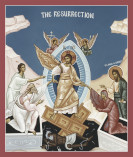
The commemoration of our holy father among the saints, George, Bishop of Mitylene, and the holy Martyr Kalliopios.
Scripture Readings
Paschalion — Movable Calendar
The Holy and Great Sunday of Pascha
Epistle
The Reading is from the Acts of the Apostles [§ 1].
1 1The first account indeed I made for myself concerning all which, O Theophilos, Jesus began both to do and teach, 2until the day in which He was taken up, after He gave command to the apostles whom He chose for Himself through the Holy Spirit, 3to whom also He presented Himself alive after He had suffered by many proofs, being seen by them during forty days and speaking the things concerning the kingdom of God. 4And being assembled together with them, He ordered them not to depart from Jerusalem, but to wait for the promise of the Father, “which,” He said, “ye heard of Me; 5“for John indeed baptized with water, but ye shall be baptized in the Holy Spirit not many days after these.” 6Indeed therefore, after they came together, they kept on questioning, saying, “Lord, dost Thou at this time restore the kingdom to Israel?” 7And He said to them, “It is not yours to know times or seasons which the Father Himself put in His own authority. 8“But ye shall receive power, after the Holy Spirit is come upon you; and ye shall be witnesses to Me both in Jerusalem, and in all Judæa and Samaria, and unto the ends of the earth.”
Gospel
In the Liturgy
The Reading is from the Holy Gospel according to Saint John [§ 1].
1 1In the beginning was the Logos, and the Logos was with God, and the Logos was God. 2This One was in the beginning with God. 3All things came into being through Him, and without Him not even one thing came into being that hath come to be. 4In Him was life, and the Life was the light of men. 5And the light shineth in the darkness, and the darkness overcame it not.
6There came to be a man who was sent forth from God, whose name was John. 7This same came for a witness, in order that he might bear witness concerning the Light, that all might believe through Him. 8He was not that One, the Light, but was sent that he might bear witness concerning the Light. 9That was the true Light, which giveth light to every man coming into the world. 10He was in the world, and the world came into being through Him, and the world knew Him not. 11He came to His own, and His own received Him not. 12But as many as received Him, to them He gave power to become children of God, to those who believe in His name: 13who were begotten not of blood, nor of the will of the flesh, nor of the will of man, but of God. 14And the Logos became flesh and tabernacled among us, and we beheld His glory, the glory as of an only-begotten from the Father, full of grace and truth. 15John beareth witness concerning Him, and hath cried out, saying, “This One was He of Whom I said, ‘The One Who cometh after me hath come to be before me, for He was before me.’” 16And of His fullness we all received, and grace for grace; 17for the law was given through Moses, but the grace and the truth came to be by Jesus Christ.
In Vespers
The Reading is from the Holy Gospel according to Saint John [§ 65].
20 19When it was evening on that day, the first of the week—and the doors were closed where the disciples were gathered together for fear of the Jews—Jesus came and stood in the midst, and saith to them, “Peace be to you.” 20And after He said this, He showed them His hands and His side. Then were the disciples glad, after they saw the Lord. 21Then Jesus said to them again, “Peace be to you; even as the Father hath sent Me forth, I also send you.” 22And after He said this, He breathed on them, and saith to them, “Receive ye the Holy Spirit: 23“if ye forgive the sins of any, they are forgiven to them; if ye retain the sins of any, they are retained.” 24But Thomas, one of the twelve, who is called Didymos, was not with them when Jesus came. 25The other disciples therefore were saying to him, “We have seen the Lord.” But he said to them, “Unless I should see in His hands the mark of the nails, and put my finger into the mark of the nails, and put my hand into His side, in no wise will I believe.”
Menaion — Fixed Calendar
The commemoration of our holy father among the saints, George, Bishop of Mitylene, and the holy Martyr Kalliopios.
No readings given.
Lives of the Saints (Prologue)
April 20th – Civil Calendar
April 7th – Church Calendar
1. St. George the Confessor.
For his great virtues, which he acquired through long asceticism, George was chosen and installed as Metropolitan of Mytilene. And this saint governed his flock with zeal and wisdom to old age. But when a persecution arose under Leo V, the Armenian, who destroyed the holy icons, this holy elder was summoned by the emperor to Constantinople, to the council of bishops which was summoned, at the emperor’s desire, to put a stop to the veneration of icons. But George not only refused to act according to the emperor’s desire; he, together with some other courageous bishops, stood up in defence of the holy icons. For this he was held in derision by the emperor and exiled to the region of Cherson, where, in physical pain and every sort of need, he spent the remainder of his earthly life. He died and went to immortal life in about 816. He was a wonder-worker both during his life and after his death, through his great righteousness and love for the Lord Jesus.
2. Our Holy Father Nil Sorsky.
One of the great fathers of the Russian Church, he was the founder of the monastic ‘skete’ way of life in Russia. He died peacefully in 1508, and his relics are preserved in the monastery at Sora. His rule of life in the sketes presents a spiritual and pragmatic work of the first order.
3. The Holy Martyr Calliopus (Kalliopios).
He was the only son, obtained from God with tears, of a senator of Perga in Pamphylia. His devout mother, Theoklea, taught him veneration of God and purity of life at an early age. Calliopus was still very young when a terrible persecution arose under the Emperor Maximian. To save him from death, his mother put him into a ship, gave him a sufficient sum of money and sent him off to the city of Pompeiopolis. But things turned out differently, by the providence of God. Disembarking at Pompeiopolis, Calliopus walked straight into some tumultuous pantheistic celebration. When he, in the press of the crazed mob, refused to take part in that senseless feast, he was brought to the commander, Maximus, to whom he confessed that he was a Christian. The commander ordered that he be beaten with iron staves, burned by fire and finally, wounded all over, thrown into prison. Hearing of the torture of her son, his mother, Theoklea, gave away all her goods to the poor and needy, and with a small sum of money, hurried to her son’s prison. Entering the prison, she bowed to her son and bound up his wounds. Finally, the commander pronounced the sentence that Calliopus be crucified. Joy and anguish were mingled together in his mother’s heart. When they led her son to the place of execution, she passed the executioner five gold pieces to crucify her son, not like the Lord, but upside-down. This she did from humility towards the Lord. Calliopus was crucified, upside-down, on Holy Thursday, and his mother stood below the cross giving thanks to God. When they took his dead body down from the cross the next day, she fell on it and breathed her last. Thus these two went to stand before the throne of the King of glory. They suffered with honor in 304.
4. Our Holy Father Daniel of Pereyaslavl.
He had as his special asceticism the care of the dead. Whenever he heard that someone had frozen to death or died in some other way, he hurried to give him burial and to pray to God for him. He died peacefully in 1540. His healing relics are preserved to this day.
5. Our Holy Father Gregory the Sinaite.
A great saint and ascetic of Sinai and Athos (see August 8th).
FOR CONSIDERATION
‘Those in spiritual authority must be careful to differentiate between themselves and those under them, as a shepherd must between himself and his sheep.’ So speaks St. Isidore of Pelusium, interpreting the First Epistle to St. Timothy. The life of a priest always serves as an example, whether for good or for ill. By a good life, a priest confirms the Gospel, and denies it by a bad one. No one else is in such a position to confirm or deny the Gospel as is a priest by his life. A good priest is differentiated by his actions from a bad priest, no less than a shepherd from a wolf. Therefore the portion of the good priest will be with the sons of God, and that of the bad with the wild beasts in darkness. Good shepherds of the Church, even at the moment of their last breath, were concerned for the flock that they were leaving behind them. On his deathbed, St. Joseph the Hymnographer prayed to God: ‘Defend Thy flock, O Son of God, and protect all the works of Thy hands to the end of time. Be Thou a helper of the beloved sons of Thy Church. Give to Thy Bride (the holy Church) eternal peace and stormless quiet.’ And St. Antipas, burning in a red-hot copper ox, prayed to God: ‘Not for myself alone, but for those who will, after me, become partakers of Thy mercy.’
Daily Scripture Readings taken from The Orthodox New Testament, translated and published by Holy Apostles Convent, Buena Vista, Colorado, copyright © 2000, used with permission, all rights reserved.
Daily Prologue Readings taken from The Prologue of Ochrid, by Bishop Nikolai Velimirovic, translated by Mother Maria, published by Lazarica Press, Birmingham, England, copyright © 1985, all rights reserved. Edited by Dormition Skete.