

Daily Devotional
Wednesday, January 15, 2025 (NS), January 2, 2025 (OS)
No Fasting.
Wednesday of the Thirtieth Week
The commemoration of the Forefeast of Theophany, and our father among the saints, Sylvester, Pope of Rome, and our venerable and God-bearing Father Seraphim, Wonder-worker of Sarov, and the holy and Righteous Juliana of Lazarevo.
Scripture Readings
Paschalion — Movable Calendar
Wednesday of the Thirtieth Week
Epistle
The Reading is from the Epistle of Saint Paul to the Hebrews [§ 323]. Brethren:
10 1The law, having a shadow of the coming good things, not the very image of the things, is never able to perfect those who approach with the same sacrifices, which they offer year by year in perpetuity. 2Otherwise would they not have ceased being offered, on account of those worshipping no longer having any consciousness of sins once they were purified? 3But in these sacrifices there is a remembrance of sins year by year. 4For it is impossible for the blood of bulls and of goats to take away sins. 5Wherefore, when He came into the world, He saith, “Sacrifice and offering Thou didst not wish, but Thou didst prepare for Thyself a body for Me [Ps. 39(40):9(6)]; 6“in whole burnt offerings also for sin Thou didst not take pleasure [cf. Ps. 39(40):10(6)]. 7“Then I said, ‘Behold, I come, in the roll of the book it hath been written concerning Me, to do Thy will, O God [cf. Ps. 39(40):11(7, 8)].’” 8Above when He saith, “Sacrifice and offering, and whole burnt offerings also for sin, Thou didst not wish, nor didst Thou take pleasure therein [cf. Ps. 39(40):9, 10(6)],” which are being offered according to the law, 9then He said, “Behold, I come to do Thy will, O God [cf. Ps. 39(40):11(7, 8)].” He taketh away the first, in order that He might establish the second: 10By which will we are sanctified through the offering of the body of Jesus Christ once for all. 11And indeed every priest standeth day by day ministering and offering often the same sacrifices, which are never able to take away sins. 12But He, having offered one sacrifice for sins in perpetuity, “sat down on the right of God [cf. Ps. 109(110):1],” 13henceforth waiting until His enemies should be placed as a footstool of His feet. 14For by one offering He hath perfected in perpetuity those being sanctified. 15And the Holy Spirit also beareth witness to us; for after having said before, 16“‘This is the covenant which I will covenant with them after those days,’ saith the Lord, ‘I will give My laws into their hearts, and write them upon their minds [cf. Jer. 38(31):33],’” 17and “‘Their sins and their lawlessnesses in no wise will I remember any more [cf. Jer. 38(31):34].’” 18Now where there is remission of these, there is no more offering for sin.
Gospel
The Reading is from the Holy Gospel according to Saint Mark [§ 56]. At that time:
12 28One of the scribes approached Jesus and heard the Sadducees disputing with Him; and perceiving that He answered them well, he questioned Him, “Which is the first commandment of all?” 29And Jesus answered him, “The first of all the commandments is: ‘Hear, O Israel, the Lord our God is one Lord [Deut. 6:4]; 30“‘and thou shalt love the Lord thy God with all thy heart, and with all thy soul, and with all thy mind, and with all thy strength [cf. Deut. 6:5, 10:12, 30:6].’ This is the first commandment. 31“And the second is like this: ‘Thou shalt love thy neighbor as thyself [Lev. 19:18].’ There is no other commandment greater than these.” 32And the scribe said to Him, “Well, Teacher! In truth didst Thou say that God is one and there is not another besides Him; 33“and to love Him with all the heart, and with all the understanding, and with all the soul, and with all the strength, and to love one’s neighbor as oneself, is more than all the whole burnt offerings and sacrifices.” 34And after Jesus saw that he answered discreetly, He said to him, “Thou art not far from the kingdom of God.” And no one dared to question Him any more.
35And Jesus answered and was saying, while He taught in the temple, “How say the scribes that the Christ is the Son of David? 36“For David himself said in the Holy Spirit, ‘The Lord saith to my Lord, “Sit Thou on My right, until I should place Thine enemies as a footstool of Thy feet [cf. Ps. 109 (110):1].”’ 37“David therefore himself calleth Him Lord; and whence is He his Son?” And the great crowd was hearing Him gladly.
Menaion — Fixed Calendar
The commemoration of the Forefeast of Theophany, and our father among the saints, Sylvester, Pope of Rome, and our venerable and God-bearing Father Seraphim, Wonder-worker of Sarov, and the holy and Righteous Juliana of Lazarevo.
Epistle
For the Hierarch:
The Reading is from the Epistle of Saint Paul to the Hebrews [§ mid 311]. Brethren:
5 4No one taketh the honor to himself, but he who is called by God, even as also Aaron. 5Thus also the Christ glorified not Himself to become a high priest, but the One Who said to Him, “Thou art My Son, today I have begotten Thee [Ps. 2:7].” 6Even as He saith also in another place, “Thou art a priest forever according to the order of Melchisedek [Ps. 109(110):4]”; 7Who, in the days of His flesh, having offered up both entreaties and supplications to the One Who was able to save Him from death, with strong crying and tears, and having been heard on account of the reverence, 8although being Son, He learned obedience from the things which He suffered; 9and having been made perfect, He became to all those who obey Him the cause of eternal salvation, 10having been called, by God, High Priest according to the order of Melchisedek.
For Sl. usage, see [Heb. 7:26-8:2].
For the Wonder-worker:
The Reading is from the Epistle of Saint Paul to the Galatians [§ 213]. Brethren:
5 22The fruit of the Spirit is love, joy, peace, long-suffering, kindness, goodness, faith, 23meekness, self-control; against such things there is no law. 24But they who are of the Christ crucified the flesh with the passions and the lusts. 25If we live by the Spirit, let us also be walking by the Spirit. 26Let us not become vainglorious, provoking one another, envying one another.
6 1Brethren, even if a man should be overtaken in some transgression, ye, the spiritual ones, be restoring such a one in the spirit of meekness, looking out for thyself, lest thou also be tempted. 2Keep on bearing one another’s burdens, and thus fill up the law of the Christ.
For St. Juliana:
The Reading is from the Epistle of Saint Paul to the Galatians [§ 208]. Brethren:
3 23Before faith came, we were being guarded under the law, having been closed up to the faith about to be revealed. 24Therefore the law hath become our tutor until Christ, in order that we might be justified by faith. 25But faith having come, we are no longer under a tutor. 26For all are sons of God through faith in Christ Jesus. 27For as many as were baptized into Christ, ye put on Christ. 28There is neither Jew nor Greek, there is neither slave nor free, there is neither male and female; for ye are all one in Christ Jesus. 29And if ye are Christ’s, then are ye Abraham’s seed, and heirs according to promise.
Gospel
For the Hierarch:
The Reading is from the Holy Gospel according to Saint John [§ 8]. At that time:
3 1There was a man of the Pharisees, named Nicodemos, a ruler of the Jews. 2This one came to Jesus by night, and said to Him, “Rabbi, we know that Thou hast come from God as a teacher; for no one is able to do these signs which Thou doest unless God be with him.” 3Jesus answered and said to him, “Verily, verily, I say to thee, except one should be born again, he is not able to see the kingdom of God.” 4Nicodemos saith to Him, “How is a man able to be born when he is old? He is not able to enter the womb of his mother a second time, and be born, is he?” 5Jesus answered, “Verily, verily, I say to thee, unless one should be born of water and of the Spirit, he is not able to enter into the kingdom of God. 6“That which hath been born of the flesh is flesh; and that which hath been born of the Spirit is spirit. 7“Do not begin to wonder that I said to thee, ‘It is needful for you to be born again.’ 8“The wind bloweth wheresoever it is naturally disposed, and thou hearest its sound, but thou knowest not from what place it cometh and where it goeth; thus is everyone who hath been born of the Spirit.” 9Nicodemos answered and said to Him, “How can these things be?” 10Jesus answered and said to him, “Thou art the teacher of Israel, and knowest not these things? 11“Verily, verily, I say to thee that We speak that which We know, and We bear witness of that which We have seen; and ye receive not Our testimony. 12“If I told you earthly things and ye believe not, how shall ye believe if I tell you heavenly things? 13“And no one hath gone up into the heavens, except the One Who came down from out of the heavens, the Son of Man, Who is in the heavens. 14“And even as Moses lifted up the serpent in the wilderness, thus it is needful for the Son of Man to be lifted up; 15“that everyone who believeth in Him should not perish, but may have everlasting life.”
for Sl. usage, see [Jn. 15:1-7].
For the Wonder-worker:
The Reading is from the Holy Gospel according to Saint Luke [§ 24]. At that time:
6 17Jesus stood upon a level place. And there was a crowd of
His disciples, and a great multitude of the people from all of Judæa and Jerusalem and the
seacoast of Tyre and Sidon, who came to hear Him, and to be healed of their diseases—
18even those who were troubled by unclean spirits; and they were cured.
19And all the crowd was seeking to touch Him, for power was coming forth from Him and
healing all. 20And He lifted up His eyes to His disciples, and began to say:
“Blessed are the poor, for yours is the kingdom of God.
21“Blessed are ye who hunger now, for ye shall be
filled.
Blessed are ye who weep now, for ye shall laugh.
22“Blessed are ye whenever men hate you, and whenever they
separate you, and reproach you, and cast out your name as evil, on account of the Son of
Man.
23“Rejoice in that day and leap for joy, for behold, your
reward is great in the heavens.”
For St. Juliana:
The Reading is from the Holy Gospel according to Saint Mark [§ 21]. At that time:
5 24A great crowd was following Jesus and pressing upon Him. 25And a certain woman who had a flow of blood for twelve years— 26and who suffered much under many physicians and spent all from her own means, and was not profited at all, but rather came to be the worse for it— 27after she heard about Jesus, came in the crowd behind, and touched His garment; 28for she was saying within herself, “If I might but touch His garments, I shall be made well.” 29And straightway the fountain of her blood was dried up; and she knew in her body that she had been healed from the scourge. 30And Jesus, straightway having fully known in Himself that the power from Him went forth, turned around in the crowd and was saying, “Who touched Me on My garments?” 31And His disciples were saying to Him, “Thou seest the crowd pressing on Thee, and sayest Thou, ‘Who touched Me?’” 32And He kept looking around Himself to see her who had done this. 33And the woman, fearing and trembling, knowing that which had been done for her, came and fell down before Him, and told Him all the truth. 34And He said to her, “Daughter, thy faith hath made thee well; go in peace, and be sound in body from thy scourge.”
Lives of the Saints (Prologue)
January 15th – Civil Calendar
January 2nd – Church Calendar
1. St. Sylvester, Bishop of Rome.
Born in Rome, he was skilled from his early years in secular learning and in Christian doctrine, and his life was always governed by the precepts of the Gospel. He made good use of the tuition of a priest, Timothy, whose death for the Faith he witnessed, and seeing the example of his teacher’s self-sacrifice, nourished himself in that same spirit for the rest of his life.
He became Bishop of Rome at the age of thirty, and reformed certain Christian customs; abolishing, for example, the Saturday fast that had up to that time been the rule among some Christians, and decreeing that only Great Saturday and those Saturdays that fall within fasting seasons should be so observed.
By his prayers and miracles, he was instrumental in the conversion and Baptism of the Emperor Constantine and his mother, Helena, and assisted Queen Helena in the finding of the Holy Cross. He governed the Church for twenty years, and finishing with honor his earthly life, entered into the heavenly kingdom in the year 335.
2. Our Holy Father Seraphim of Sarov.
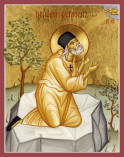 He was one of the greatest Russian ascetics and
wonder-workers, with profound spiritual discernment. Born in 1759, he departed this life in
1833. He was distinguished by great humility. Being praised by all the world, he referred
to himself as “humble Seraphim”. He was one of the greatest Russian ascetics and
wonder-workers, with profound spiritual discernment. Born in 1759, he departed this life in
1833. He was distinguished by great humility. Being praised by all the world, he referred
to himself as “humble Seraphim”.
|
3. St. Theodota.
The mother of the holy brothers Kosmas and Damian, the Unmercenaries and Wonder-workers, she lived a life pleasing to God, and brought up her sons to do the same.
4. Our Holy Father Ammon of Tabennisi.
He was a great ascetic of the fifth century and had charge of the Tabennisiot monastery in Upper Egypt, with about 3,000 monks living in asceticism under his direction. He had the blessed gifts of wonder-working and spiritual discernment. When one of his monks asked him for counsel, he said to him in reply: ‘Be as a transgressor in prison and ask repeatedly, as he would: “When will the Judge appear?” So thou also, ask thou this with fear.’
FOR CONSIDERATION
God looses ruin and debasement on man in his pride, when the latter thinks that his strength is eternally assured. When the wicked Roman governor Tarquinius had beheaded blessed Timothy, he summoned St. Sylvester and threatened him with death if he did not reveal the whereabouts of Timothy’s earthly possessions and if, furthermore, he did not immediately offer sacrifice to idols. The saint, gifted with foresight, answered fearlessly in the words of the Gospel: “Thou fool, thy soul shall be required of thee this night (Lk. 12:20), and that which thou art pleased to bring upon me (i.e. death) shall come upon thee!” The proud governor put Sylvester in chains and cast him into prison, with the intention of swiftly bringing about his death. Having done this, he sat down to his midday meal. As he ate, a fishbone stuck in his throat. From midday to midnight doctors strove to save his life, but all in vain. At midnight Tarquinius was deprived of his proud spirit in the greatest torment. And so the prophecy of St. Sylvester was fulfilled, as also the biblical words: “Pride goeth before destruction” (Prov. 16:18).
Daily Scripture Readings taken from The Orthodox New Testament, translated and published by Holy Apostles Convent, Buena Vista, Colorado, copyright © 2000, used with permission, all rights reserved.
Daily Prologue Readings taken from The Prologue of Ochrid, by Bishop Nikolai Velimirovic, translated by Mother Maria, published by Lazarica Press, Birmingham, England, copyright © 1985, all rights reserved. Edited by Dormition Skete.