

Daily Devotional
Thursday, January 16, 2025 (NS), January 3, 2025 (OS)
No Fasting.
Thursday of the Thirtieth Week
The commemoration of the Forefeast of Theophany, and the holy Prophet Malachias, and the holy Martyr Gordios at Cæsarea in Cappadocia.
Scripture Readings
Paschalion — Movable Calendar
Thursday of the Thirtieth Week
Epistle
The Reading is from the Epistle of Saint Paul to the Hebrews [§ 326]. Brethren:
10 35Do not begin to cast away your boldness which hath great recompense. 36For ye have need of patience, that, after ye do the will of God, ye might receive for yourselves the promise. 37“For yet a very little while, the One Who cometh will come, and will not delay [cf. Hab. 2:3]. 38“Now the just shall live by faith; and if one should draw himself back, My soul hath no pleasure in him [cf. Hab. 2:4].” 39But we are not of those who draw back to destruction, but of those who are of faith to the saving of the soul.
11 1Now faith is the subsistence of things hoped for, a proof of things not seen. 2For by this the elders were approved by testimony. 3By faith we perceive with the mind the ages to have been put in order by a word of God, so that the things which are seen have not come into being out of things which appear. 4By faith Abel offered to God a sacrifice greater in quality than Cain, by which he was borne witness to as being righteous, God bearing witness upon his gifts; and by it he being dead, yet speaketh. 5By faith Enoch was translated, so as not to see death, “and was not found, because God translated him [Gen. 5:24]”; for before his translation he hath been borne witness to have well pleased God. 6But without faith it is impossible to please Him, for it is needful for him who draweth near to God to have believed that He is, and that He becometh a rewarder to those who seek Him out. 7By faith Noah, after he was divinely warned concerning the things not yet seen, was moved to be wary and prepared an ark to the salvation of his house, by which he condemned the world, and became heir of the righteousness according to faith.
Gospel
The Reading is from the Holy Gospel according to Saint Mark [§ 57]. The Lord said:
12 38“Be wary of the scribes, who wish to walk about in full dress, and love salutations in the marketplaces, 39“and chief seats in the synagogues, and chief places at the dinners, 40“who devour the houses of the widows, and for a pretense offer long prayers! These shall receive greater judgment.”
41And Jesus sat down opposite the treasury and was beholding how the crowd cast money into the treasury. And many who were rich were casting in much. 42And one poor widow came and cast in two lepta, which is a quadrans. 43And He called to Himself His disciples, and saith to them, “Verily I say to you that this poor widow hath cast in more than all of those who cast into the treasury; 44“for all cast in out of that which is superfluous to them, but she, out of her need, cast in as much as she had, her whole means of living.”
Menaion — Fixed Calendar
The commemoration of the Forefeast of Theophany, and the holy Prophet Malachias, and the holy Martyr Gordios at Cæsarea in Cappadocia.
Epistle
The Reading is from the Second Epistle of Saint Paul to Saint Timothy [§ 292]. Child Timothy:
2 1Be thou empowered in the grace that is in Christ Jesus; 2and the things which thou heardest from me in the midst of many witnesses, commit thou these things to faithful men who shall be competent also to teach others. 3Thou therefore suffer hardship as a good soldier of Jesus Christ. 4No one serving as a soldier is entangled with the affairs of life, in order that he might please the one who enlisted him. 5And if anyone also contend as an athlete in the games, he is not crowned unless he contend lawfully. 6The farmer who laboreth must be first to partake of the fruits. 7Be considering what I say; O may the Lord give thee understanding in all things! 8Be remembering Jesus Christ, of the seed of David, Who hath been raised from the dead, according to my Gospel, 9in which I suffer hardship even to bonds as a malefactor, but the word of God hath not been bound. 10On this account I endure all things for the sake of the elect, that they might also attain salvation that is in Christ Jesus with eternal glory.
Gospel
The Reading is from the Holy Gospel according to Saint Matthew [§ 36]. The Lord said to His disciples:
10 16“Behold, I send you forth as sheep in the midst of wolves. Become therefore wise as the serpents and guileless as the doves. 17“But continue being on guard against men; for they will deliver you up to councils, and they will scourge you in their synagogues. 18“And also ye shall be brought before governors and kings on account of Me, for a testimony to them and to the nations. 19“But whenever they deliver you up, do not become anxious about how or what ye should speak; for it shall be given to you in that hour what ye shall speak. 20“For ye are not the ones who are speaking, but the Spirit of your Father Who is speaking in you. 21“Now a brother shall deliver up a brother to death, and a father a child; and children shall rise up against parents and shall put them to death. 22“And ye shall be hated by all for My name’s sake; but the one who endureth to the end, this one shall be saved.”
Lives of the Saints (Prologue)
January 16th – Civil Calendar
January 3rd – Church Calendar
1 The Prophet Malachi.
He was chronologically the last of the prophets, born after the return of the Jews from exile in Babylon in 538 B.C. He was unusually fair of face. According to folk-tradition, he was named ‘the angel,’ perhaps because of his outward fairness, or because of his purity of spirit, or, again, perhaps, because of his companionship with an angel, with whom he often spoke face to face. At these times, others also heard its voice but were not worthy to look on its face. The young prophet spoke forth that which the angel revealed to him. He cried out against the ingratitude of Israel and the sins of the priests. Five hundred years before Christ, he clearly foretold the coming and work of St. John the Baptist (3:7). But he was chiefly the prophet of the Day of Judgment (4:1-3). He went to God young in years, and after him there was no prophet in Israel until John the Baptist.
2. The Holy Martyr Gordios.
Born in Caesarea of Cappadocia, he was an officer in the Roman army under the Emperor Licinius. At the outbreak of a terrible persecution, he left the army and his former rank and went into the Sinai desert. Alone on Mount Horeb, Gordios spent his time in prayer and in pondering the mysteries of heaven and earth. In particular he pondered on vanity and on the worthlessness of all for which people struggle and strive so on earth. He came finally to the desire to die and so move into that life that is without transience or corruptibility. With this desire, he went down into a town where pagan games were held. He presented himself to the governor as a Christian. The governor attempted in vain to turn him from the Faith with flattery and threats. Gordios remained unyielding and firm as diamond, saying: “It would obviously be an act of the greatest folly to trade this brief life for eternal torment and spiritual peril.” Condemned to death, he hastened joyfully to the place of execution, speaking with the executioners on the way of the wonderful and sweet knowledge of Christ. With the name of Christ on his lips, he delivered his youthful body to the sword and his righteous soul to God in the year 320.
3. St. Geneviéve.
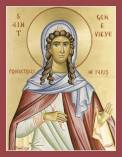 Protectress of Paris, she became worthy of the kingdom of God
by fasting, prayer and works of mercy. She entered into rest on January 3rd, 512, at the
age of 89. Protectress of Paris, she became worthy of the kingdom of God
by fasting, prayer and works of mercy. She entered into rest on January 3rd, 512, at the
age of 89.
|
FOR CONSIDERATION
God hearkens to the prayer of a righteous man. This is clearly seen in the lives of Moses and Elias and of many righteous men and prophets of the Old Testament, as also from the lives of the apostles and saints. When St. Genevieve was living the monastic life in Paris, Attila and his savage Huns laid siege to the city. Fear and horror took hold of all the inhabitants, who were in hourly expectation of its occupation by the enemy. St. Genevieve then called on the people to fast and pray, that the calamity might be averted. Many men and women responded to the saint’s call, and began to fast and to pray. Genevieve herself kept the strictest fast and made the most fervent prayer to God. After a very short time, the enemy withdrew from Paris, without any obvious reason, and went to some other place. That which cannot be accomplished by the swords of many sinners, the prayer of one righteous person can perform.
Daily Scripture Readings taken from The Orthodox New Testament, translated and published by Holy Apostles Convent, Buena Vista, Colorado, copyright © 2000, used with permission, all rights reserved.
Daily Prologue Readings taken from The Prologue of Ochrid, by Bishop Nikolai Velimirovic, translated by Mother Maria, published by Lazarica Press, Birmingham, England, copyright © 1985, all rights reserved. Edited by Dormition Skete.