

Daily Devotional
Tuesday, January 14, 2025 (NS), January 1, 2025 (OS)
No Fasting.
Tuesday of the Thirtieth Week
The commemoration of the Circumcision of our Lord Jesus Christ according to the flesh, and our holy father among the saints, Basil the Great.
Scripture Readings
Paschalion — Movable Calendar
Tuesday of the Thirtieth Week
Epistle
The Reading is from the Epistle of Saint Paul to the Hebrews [§ 321]. Brethren:
For Gk. usage, see Heb. 9:8-23; for Sl. usage, see Heb. 9:8-10, 15-23.
9 8The Holy Spirit signifieth that the way into the Holies hath not yet been made manifest while the first tabernacle still hath a standing, 9which was a type for the time then present, according to which both gifts and sacrifices are being offered, which is not able to perfect the one who worshippeth, as concerning conscience, 10only in foods and drinks, and diverse ablutions, and ordinances of the flesh being imposed on them, until the time of setting things straight. 11But Christ, Who came as High Priest of the coming good things, by means of the greater and more perfect tabernacle—not made by hand, that is, not of this creation, 12nor by blood of goats and of calves, but by His own blood—entered once for all into the Holies, having Himself obtained eternal redemption. 13For if the blood of bulls and of goats and ashes of a heifer, sprinkling those who have been defiled, sanctifieth to the purity of the flesh, 14how much more shall the blood of the Christ, Who through the eternal Spirit offered Himself without blemish to God, purify your conscience from dead works in order to worship the living God? 15And for this cause He is Mediator of a new testament, so that by means of a death which took place for redemption from the transgressions under the first testament, they who have been called might receive the promise of the eternal inheritance. 16For where a testament is, it is necessary for the death of the one who made a disposition for himself to be brought forward. 17For a testament is confirmed over those dead, since it never hath strength when the one who maketh the disposition liveth. 18Wherefore neither hath the first been inaugurated without blood. 19For after Moses spoke every command to all the people according to the law, he took the blood of the calves and goats, with water, and scarlet wool, and hyssop, and sprinkled both the book itself and all the people, 20saying, “This is the blood of the testament which God enjoined concerning you [cf. Exod. 24:8].” 21And in like manner he sprinkled with blood both the tabernacle and all the vessels of the service. 22And I may almost say all things are being purified with blood according to the law, and without shedding of blood no remission taketh place. 23It was therefore necessary on the one hand that the patterns of the things in the heavens be purified with these, but on the other hand the heavenly things themselves with better sacrifices than these.
Gospel
The Reading is from the Holy Gospel according to Saint Mark [§ 55]. At that time:
12 18Sadducees, who say there is no resurrection, came to Jesus; and they questioned Him, saying, 19“Teacher, Moses wrote to us that if anyone’s brother should die, and leave behind a wife, and leave no children, that his brother should take his wife, and raise up seed to his brother. 20“There were then seven brothers. And the first took a wife, and when he died, he left no seed. 21“And the second took her, and died, and neither did he leave seed. And the third in like manner. 22“And the seven took her, and left no seed. Last of all the woman died also. 23“Therefore, in the resurrection, whenever they rise, of which of them shall she be wife? For the seven had her to wife.” 24And Jesus answered and said to them, “Ye are led astray, are ye not, on this account, not knowing the Scriptures nor the power of God? 25“For whenever they rise from the dead, they neither marry nor are given in marriage, but are as the angels who are in the heavens. 26“But concerning the dead, that they are being raised, ye read, did ye not, in the book of Moses, in the passage concerning the bush, how God spoke to him, saying, ‘I am the God of Abraham, and the God of Isaac, and the God of Jacob [cf. Ex. 3:6]’? 27“He is not the God of the dead, but the God of the living. Ye therefore are greatly led astray.”
Menaion — Fixed Calendar
The commemoration of the Circumcision of our Lord Jesus Christ according to the flesh, and our holy father among the saints, Basil the Great.
Epistle
For the Feast:
The Reading is from the Epistle of Saint Paul to the Colossians [§ 254]. Brethren:
2 8Be wary lest there shall be anyone who leadeth you captive through philosophy and vain deceit, according to the tradition of men, according to the elements of the world, and not according to Christ. 9For in Him dwelleth all the fullness of the divinity bodily, 10and ye are made full in Him, Who is the head of all principality and authority, 11in Whom also ye were circumcised with a circumcision made without hands, in the putting off of the body of the sins of the flesh in the circumcision of the Christ, 12having been buried with Him in the baptism, in which also ye were raised with Him through faith in the energy of God, Who raised Him from the dead.
For the Hierarch:
For Sl. usage, see [Heb. 7:26-8:2].
Gospel
For the Feast:
The Reading is from the Holy Gospel according to Saint Luke [§§ 6, mid 8]. At that time:
2 20The shepherds returned, glorifying and praising God over all the things which they heard and saw, even as it was spoken to them.
21And when eight days were fulfilled to circumcise the little Child, then His name was called Jesus, which He was called by the angel before He was to be conceived in the womb....
40And the little Child was growing and showing Himself strong in spirit, being filled with wisdom; and the grace of God was upon Him.
41And His parents were going year by year to Jerusalem at the feast of the passover. 42And when He was twelve years old, they went up to Jerusalem, according to the custom of the feast. 43And after they fulfilled the days, as they were returning, the Child Jesus stayed behind in Jerusalem. And Joseph and His Mother did not know it. 44But they, supposing Him to be in the company, went a day’s journey; and they were searching for Him among their kinfolk and among their acquaintances. 45And not having found Him, they turned round about to Jerusalem seeking Him. 46And it came to pass, after three days, they found Him in the temple, sitting in the midst of the teachers, both hearing them and questioning them. 47And all those who heard Him were beside themselves at His comprehension and answers. 48And after they saw Him, they were amazed; and His Mother said to Him, “Child, why didst Thou do thus to us? Behold, Thy father and I were seeking Thee suffering distress.” 49And He said to them, “Why is it that ye were seeking Me? Ye know that it is necessary for Me to be in the things of My Father, do ye not?” 50And they understood not the saying which He spoke to them. 51And He went down with them and came to Nazareth, and was being subject to them. And His Mother was keeping all these sayings in her heart. 52And Jesus kept on advancing in wisdom and stature, and in grace in the presence of God and men.
For the Hierarch:
The Reading is from the Holy Gospel according to Saint Luke [§ 24]. At that time:
6 17Jesus stood upon a level place. And there was a crowd of
His disciples, and a great multitude of the people from all of Judæa and Jerusalem and the
seacoast of Tyre and Sidon, who came to hear Him, and to be healed of their diseases—
18even those who were troubled by unclean spirits; and they were cured.
19And all the crowd was seeking to touch Him, for power was coming forth from Him and
healing all. 20And He lifted up His eyes to His disciples, and began to say:
“Blessed are the poor, for yours is the kingdom of God.
21“Blessed are ye who hunger now, for ye shall be filled.
Blessed are ye who weep now, for ye shall laugh.
22“Blessed are ye whenever men hate you, and whenever they separate you, and
reproach you, and cast out your name as evil, on account of the Son of Man.
23“Rejoice in that day and leap for joy, for behold, your reward is great
in the heavens.”
Lives of the Saints (Prologue)
January 14th – Civil Calendar
January 1st – Church Calendar
1. The Circumcision of our Lord and God and Savior Jesus Christ.
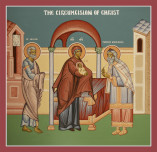 On the eighth day after His birth, the divine Child was taken to
the temple and duly circumcised according to the Jewish law that had been observed from the time
of Abraham. At this time He was given the name Jesus, the name announced to the most holy Virgin
by the Archangel Gabriel (Luke 1:31).
On the eighth day after His birth, the divine Child was taken to
the temple and duly circumcised according to the Jewish law that had been observed from the time
of Abraham. At this time He was given the name Jesus, the name announced to the most holy Virgin
by the Archangel Gabriel (Luke 1:31).
The Baptism of the New Covenant was prefigured in the Circumcision of the Old Covenant. The Lord’s Circumcision shows that He took true human flesh upon Himself, not its semblance as heretics later taught of Him. The Lord was truly circumcised, desiring thus to fulfill all the law, which He Himself had given through our forefathers and the prophets. Fulfilling all the ordinances of the law, He superseded them by Baptism in His Church, for, as the apostle declares: “In Christ Jesus neither circumcision availeth anything, nor uncircumcision, but a new creation” (Gal. 6:15). (In the Church Calendar, this feast of the Lord has neither forefeast nor after-feast.)
2. St. Basil the Great, Archbishop of Caesarea.
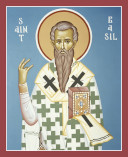 St. Basil was born in the reign of the Emperor
Constantine, in about 330. While still unbaptized, he spent fifteen years in Athens studying
philosophy, rhetoric, astronomy and other contemporary secular disciplines. Among his
fellow-students were Gregory the Theologian and Julian, later the apostate emperor. When already
of mature years, he was baptized in the Jordan together with his former tutor Evulios. He was
Bishop of Caesarea in Cappadocia for nearly ten years, and died at the age of fifty.
St. Basil was born in the reign of the Emperor
Constantine, in about 330. While still unbaptized, he spent fifteen years in Athens studying
philosophy, rhetoric, astronomy and other contemporary secular disciplines. Among his
fellow-students were Gregory the Theologian and Julian, later the apostate emperor. When already
of mature years, he was baptized in the Jordan together with his former tutor Evulios. He was
Bishop of Caesarea in Cappadocia for nearly ten years, and died at the age of fifty.
A great champion of Orthodoxy, a great torch of moral purity and zeal for the Faith, a great theological mind, a great builder and pillar of the Church of God, Basil fully deserved his title “the Great”. In the Office for his feast, he is referred to as a bee of the Church of Christ, bringing honey to the faithful but stinging those in heresy. Many of the writings of this father of the Church have survived—theological, apologetic, on asceticism and on the canons. There is also the Liturgy that bears his name. This Liturgy is celebrated ten times in the year: on January 1st, on the Eves of the Nativity of Christ and the Theophany, on every Sunday in the Great Fast with the exception of Palm Sunday, and on the Thursday and Saturday in Holy Week.
St. Basil departed this life peacefully on January 1st, 379, and entered into the kingdom of Christ.
FOR CONSIDERATION
Why must one obey the Church and not some man whose thinking is opposed to that of the Church, eminent or intellectually gifted though that man may be? Because the Church was founded by the Lord Jesus Christ and is guided by the inspiration of the Holy Spirit of God. Also because “the Church” signifies the community of the saints, an orchard of choice, fruit-bearing trees. If a man remains opposed to the community of the saints, that means that he is unholy. Why, therefore, listen to him? “The Church is an enclosure”, says the wise Chrysostom. “If you are within, the wolf cannot enter, but if you stray outside, the wild beasts will get you.... Do not wander from the Church; there is nothing more impregnable than the Church. She is your hope and your salvation. She is higher than the heavens, firmer than rock, wider than the world; she never grows old, but is forever renewing her youth.”
Daily Scripture Readings taken from The Orthodox New Testament, translated and published by Holy Apostles Convent, Buena Vista, Colorado, copyright © 2000, used with permission, all rights reserved.
Daily Prologue Readings taken from The Prologue of Ochrid, by Bishop Nikolai Velimirovic, translated by Mother Maria, published by Lazarica Press, Birmingham, England, copyright © 1985, all rights reserved. Edited by Dormition Skete.