

Daily Devotional
Saturday, July 29, 2028 (NS), July 16, 2028 (OS)
No Fasting.
Saturday of the Eighth Week
The commemoration of Hieromartyr Athenogenes, Bishop of Pedachtoe, and his ten disciples.
Scripture Readings
Paschalion — Movable Calendar
Saturday of the Eighth Week
Epistle
The Reading is from the Epistle of Saint Paul to the Romans [§ 111]. Brethren:
13 1Let every soul be subject to authorities which govern. For there is no authority except from God; and the existing authorities have been appointed by God. 2So that the one who sets himself against the authority hath withstood the ordinance of God; and they who have withstood shall receive judgment to themselves. 3For the rulers are not a terror to good works, but to bad ones. And dost thou wish not to be afraid of the authority? Be doing that which is good, and thou shalt have praise from the same. 4For he is a minister of God to thee for the good. But if thou be doing evil, be afraid; for not in vain doth he bear the sword, for he is a minister of God, an avenger for wrath to the one who practiseth that which is bad. 5Wherefore it is necessary to be subject, not only because of the wrath, but also because of the conscience. 6For on this account ye also pay tributes; for they are public workers of God, persevering for this same thing. 7Render then to all their dues: to whom the tribute is due, the tribute; to whom the customs duty, the toll; to whom the fear, the fear; to whom the honor, the honor. 8Cease owing even one person even one thing, except to be loving one another. For the one who loveth the other hath fulfilled the law; 9to wit, “Thou shalt not commit adultery; thou shalt not murder; thou shalt not steal; thou shalt not covet [Ex. 20:13-17]”; and if there is any other commandment, it is summed up in this phrase, namely, “Thou shalt love thy neighbor as thyself [Lev. 19:18].” 10Love worketh no ill to a neighbor; therefore love is the filling up of the law.
Gospel
The Reading is from the Holy Gospel according to Saint Matthew [§ 47]. The Lord said:
12 30“The one who is not with Me is against Me; and the one who gathereth not with Me scattereth. 31“On this account I say to you every sin and blasphemy shall be forgiven to men, but the blasphemy against the Spirit shall not be forgiven to men. 32“And whosoever shall speak a word against the Son of Man, it shall be forgiven him; but whosoever shall speak against the Holy Spirit, it shall not be forgiven him, neither in this age nor in the coming one. 33“Either make the tree good and the fruit of it good, or make the tree rotten and the fruit of it rotten; for the tree is known from the fruit. 34“O offspring of vipers, how are ye, being evil, able to speak good things? For out of the abundance of the heart the mouth speaketh. 35“The good man out of the good treasure of the heart bringeth forth good things; and the evil man out of the evil treasure bringeth forth evil things. 36“But I say to you, that every idle word, whatsoever men shall speak, they shall render an account concerning it in the day of judgment. 37“For by thy words thou shalt be justified, and by thy words thou shalt be condemned.”
Menaion — Fixed Calendar
The commemoration of Hieromartyr Athenogenes, Bishop of Pedachtoe, and his ten disciples.
No readings given.
Lives of the Saints (Prologue)
July 29th – Civil Calendar
July 16th – Church Calendar
1. The Hieromartyr Athenogenes, Bishop of Sebaste in Armenia.
He lived in a monastery near the town with ten of his disciples. In the time of Diocletian, a fierce persecutor of Christians called Philomarchus came to Sebaste. He arrested and killed many of the Christians in the town. When he saw Athenogenes and his disciples, he told the elder to sacrifice to idols, that they should not perish as had the other Christians. Athenogenes replied: ‘O torturer, those whom you describe as having perished have not perished, but are in heaven and make merry with the angels!’ There was a touching moment when a deer, which had been hand-fed by the compassionate Athenogenes, ran up to him, and seeing him in such straits, shed tears. Wild animals of the hills had more pity on the martyrs than did the pagans! After harsh torture, during which an angel of God comforted them, they were all beheaded, first the priests and fellow-workers of Athenogenes and then Athenogenes himself, and went to their heavenly home in the year 311.
2. The Holy Martyr Julia the Virgin.
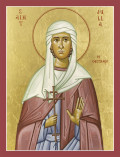 She was born in Carthage of noble parents. When the
Persians overran Carthage, many of the people were taken into slavery. St. Julia was one of
these, and was given to a Syrian merchant, who was a pagan. Seeing that Julia was a Christian, he
urged her many times to deny Christ and become of one faith with him, but Julia steadfastly
refused. As Julia was faithful and reliable in her work, the merchant left her in peace and spoke
no more about faith. One day, the merchant loaded his ship with goods, took Julia with him and
set off across the sea to a distant land to ply his trade. When they arrived at Corsica, there
was a pagan festival in progress, and the merchant took part in the foul idolatry while Julia
remained in the ship, weeping that so many people lived in foolish error, not knowing the truth.
The pagans somehow came to know about her, dragged her off the ship in spite of her owner’s
efforts to prevent them, and began to torture her in terrible ways. They cut off her breasts and
threw her onto the rock, then crucified her, at which Julia gave her soul to God. Her death was
revealed to some monks on the nearby island of Margarita (or Gorgona), and they went and buried
the martyr’s body. Many miracles were worked over St. Julia’s grave through the ages,
and she herself appeared to various people from the other world. She suffered with honor and went
to the kingdom of God in the sixth century.
She was born in Carthage of noble parents. When the
Persians overran Carthage, many of the people were taken into slavery. St. Julia was one of
these, and was given to a Syrian merchant, who was a pagan. Seeing that Julia was a Christian, he
urged her many times to deny Christ and become of one faith with him, but Julia steadfastly
refused. As Julia was faithful and reliable in her work, the merchant left her in peace and spoke
no more about faith. One day, the merchant loaded his ship with goods, took Julia with him and
set off across the sea to a distant land to ply his trade. When they arrived at Corsica, there
was a pagan festival in progress, and the merchant took part in the foul idolatry while Julia
remained in the ship, weeping that so many people lived in foolish error, not knowing the truth.
The pagans somehow came to know about her, dragged her off the ship in spite of her owner’s
efforts to prevent them, and began to torture her in terrible ways. They cut off her breasts and
threw her onto the rock, then crucified her, at which Julia gave her soul to God. Her death was
revealed to some monks on the nearby island of Margarita (or Gorgona), and they went and buried
the martyr’s body. Many miracles were worked over St. Julia’s grave through the ages,
and she herself appeared to various people from the other world. She suffered with honor and went
to the kingdom of God in the sixth century.
After many years had passed, the faithful wanted to build a new church in honor of St. Julia in another place, because the old church was small and dilapidated. They prepared the materials: the stone, bricks, sand and everything else that was needed, on the new site. But it happened that, at night, on the night before the day on which the foundations were to be laid, that the materials were carried by invisible hands back to the old church. In great perplexity, the people carried them to the new site again, but again the same thing happened: the materials were taken to the old site and left beside the church. The night watchman saw a maiden bathed in light, using white oxen to carry the materials to the old church. By this, they understood that St. Julia did not wish her church to be built in another place, so they pulled down the old church and built the new one on the same spot.
3. The Fifteen Thousand Holy Martyrs of Persia.
They were beheaded for the Christian Faith in Persia.
4. The Holy Martyr Athenogenes.
The composer of the Vespers hymn ‘O Joyous Light,’ he perished for Christ in the flames and was made worthy of eternal glory in the kingdom of God.
Daily Scripture Readings taken from The Orthodox New Testament, translated and published by Holy Apostles Convent, Buena Vista, Colorado, copyright © 2000, used with permission, all rights reserved.
Daily Prologue Readings taken from The Prologue of Ochrid, by Bishop Nikolai Velimirovic, translated by Mother Maria, published by Lazarica Press, Birmingham, England, copyright © 1985, all rights reserved. Edited by Dormition Skete.