

Daily Devotional
Saturday, June 3, 2028 (NS), May 21, 2028 (OS)
No Fasting.
Saturday of the Seventh Week or Saturday Before Pentecost or Saturday of Souls
The commemoration of the holy God-fearing emperor and empress and Equal-to-the-apostles, Constantine and Helen.
Scripture Readings
Paschalion — Movable Calendar
Saturday of the Seventh Week or Saturday Before Pentecost or Saturday of Souls
Epistle
The Reading is from the Acts of the Apostles [§ 51A]. In those days:
28 1After Paul and those with him were brought through safely, then they found out that the island was called Melita. 2And the barbarians were showing no common philanthropy to us; for they kindled a fire and took in all of us, because of the rain that came on and because of the cold. 3And after Paul gathered a great number of dry sticks and laid them on the fire, a viper came out because of the heat, and fastened on his hand. 4And when the barbarians saw the beast hang itself from his hand, they were saying to one another, “No doubt this man is a murderer, whom, though he hath come through safely from out of the sea, justice doth not suffer to live.” 5He indeed then shook off the beast into the fire and suffered no harm. 6But they were expecting that he was about to become inflamed or to suddenly fall down dead. But when for a long time they expected and saw nothing out of place happen to him, they changed their minds and were declaring him to be a god. 7Now in the parts surrounding that place there were lands belonging to the chief of the island, by name Publius, who received us and lodged us for three days in a kindly manner. 8And it came to pass that the father of Publius, being constrained by fevers and dysentery, was lying down, to whom Paul, after he entered and prayed, laid his hands on him and healed him. 9Then after this took place, the rest who had infirmities in the island were coming and being cured. 10They also honored us with many honors; and when we put out to sea, they themselves laid on us the things for our need.
11And after three months we put out to sea in a ship which had wintered in the island, an Alexandrian with an ensign, the Twin Brothers. 12And having landed at Syracuse, we tarried there three days. 13From that place, having gone around, we arrived at Rhegium. And after one day a south wind came on; and on the second day we came to Puteoli, 14where, having found brethren, we were besought to tarry with them seven days. And thus we came to Rome. 15And from that place, the brethren, having heard the things concerning us, came out to meet us as far as Appius Forum and Three Taverns, whom Paul, having seen, gave thanks to God and took courage. 16And when we came to Rome, the centurion delivered the prisoners to the military commander; but Paul was permitted to lodge by himself with the soldier who guarded him.
17And it came to pass after three days that Paul called together those who were chiefs of the Jews; and having come together, he began to say to them, “Men, brethren, though I did nothing contrary to the people or to the customs of the fathers, yet was I delivered as a prisoner from Jerusalem into the hands of the Romans, 18“who, after they examined me, were willing to release me, because there was not even one cause of death in me. 19“But when the Jews contradicted it, I was compelled to appeal to Cæsar, not that I had anything of which to accuse my nation. 20“For this cause therefore I invited you, to see you and to speak to you; for on account of the hope of Israel I have around me this chain.” 21And they said to him, “We neither received letters from Judæa concerning thee, nor did any of the brethren that came report or speak anything evil concerning thee. 22“But we deem it fitting to hear from thee what thou thinkest; for indeed concerning this sect, it is known to us that everywhere it is spoken against.” 23And after they themselves appointed him a day, more were coming to him in the lodging, to whom he set forth and testified the kingdom of God, trying to persuade them concerning the things of Jesus, from both the law of Moses and the prophets, from morning until evening. 24And some on the one hand were persuaded by the things which were spoken, but some on the other hand kept on disbelieving. 25And when they were dissonant toward one another, they dismissed themselves, after Paul spoke one word, “Well spoke the Holy Spirit by Esaias the prophet to our fathers, 26“saying, ‘Go to this people and say, “Hearing ye shall hear, and in no wise shall understand; and seeing ye shall see, and in no wise shall perceive [Is. 6:9]; 27“‘“for the heart of this people was made fat; and with their ears they heard heavily; and their eyes they closed; lest they should see with their eyes and hear with their ears, and should understand with their heart, and be converted; and I shall heal them [cf. Is. 6:10].”’ 28“Be it known therefore to you that this salvation of God was sent forth to the nations, and they will hear.” 29And after he said these things, the Jews departed having much discussion among themselves.
30And Paul stayed two whole years in his own hired house, and kept on receiving all those who came in to him, 31proclaiming the kingdom of God and teaching the things concerning the Lord Jesus Christ with all freedom of speech, without hindrance.
For the Commemoration of the Departed
The Reading is from the First Epistle of Saint Paul to the Thessalonians [§ 270].
4 13Brethren, we do not wish you to be ignorant concerning those who have fallen asleep, that ye may not be grieving, even as the rest who have no hope. 14For if we believe that Jesus died and is risen, so also those who fell asleep through Jesus will God bring with Him. 15For we say this to you by the word of the Lord, that we the living, the ones remaining over until the coming of the Lord, in no wise shall precede those who fell asleep. 16For the Lord Himself shall descend from heaven with a shout of command, with a voice of an archangel, and with a trumpet of God; and the dead in Christ shall rise first. 17Then we the living, the ones remaining over, shall be carried off together with them in clouds to a meeting of the Lord in the air, and so shall we always be with the Lord.
Gospel
The Reading is from the Holy Gospel according to Saint John [§ 67]. At that time:
21 14Jesus was made manifest to His disciples after He was raised from the dead.
15When therefore they ate breakfast, Jesus saith to Simon Peter, “Simon, son of Jonas, lovest thou Me more than these?” He saith to Him, “Yes, Lord, Thou knowest that I have affection for Thee.” He saith to him, “Be feeding My little lambs.” 16He saith to him again a second time, “Simon, son of Jonas, lovest thou Me?” He saith to Him, “Yes, Lord, Thou knowest that I have affection for Thee.” He saith to him, “Be shepherding My sheep.” 17He saith to him the third time, “Simon, son of Jonas, hast thou affection for Me?” Peter was grieved because He said to him the third time, “Hast thou affection for Me?” And he said to Him, “Lord, Thou knowest all things; Thou knowest that I have affection for Thee.” He saith to him, “Be feeding My sheep. 18“Verily, verily, I say to thee, when thou wast younger, thou used to gird thyself and walk about where thou wouldest; but whenever thou growest old, thou shalt stretch forth thy hands, and another shall gird thee, and bring thee where thou wouldest not.” 19But this He said signifying by what kind of death he shall glorify God. And having said this, He saith to him, “Follow thou Me.” 20And Peter, having turned about, seeth the disciple, whom Jesus loved, following—who also leaned back on His breast at the supper—and said, “Lord, who is the one who is delivering Thee up?” 21After Peter saw him, he saith to Jesus, “But Lord, this man—what?” 22Jesus saith to him, “If I wish him to tarry while I am coming, what is that to thee? Do thou be following Me.” 23Then this saying went out among the brethren that “that disciple dieth not”; and yet Jesus did not say that “he dieth not,” but, “If I wish him to tarry while I am coming, what is that to thee?”
24This is the disciple who beareth testimony concerning these things, and wrote these things; and we know that his testimony is true. 25And there are also many other things, which if as much as Jesus did may be written one by one, I suppose even the world itself could not contain the books that would be written. Amen.
For the Commemoration of the Departed
The Reading is from the Holy Gospel according to Saint John [§ 16]. The Lord said to the Jews who had come to Him:
5 24“Verily, verily, I say to you, that the one who heareth My word and believeth the One Who sent Me hath everlasting life, and cometh not into judgment, but hath passed over out of death into life. 25“Verily, verily, I say to you, that an hour cometh, and now is, when the dead shall hear the voice of the Son of God, and they who hear shall live. 26“For even as the Father hath life in Himself, so He also gave to the Son to have life in Himself, 27“and He also gave to Him authority to execute judgment. That He is Son of Man, 28“cease marvelling at this; for an hour is coming in which all those in the graves shall hear His voice, 29“and shall go forth—they who did good things to a resurrection of life, but they who practised bad things to a resurrection of condemnation. 30“I am not able to do anything of Myself. Even as I hear, I judge; and My judgment is just, because I seek not Mine own will, but the will of the One Who sent Me, the Father.”
Menaion — Fixed Calendar
The commemoration of the holy God-fearing emperor and empress and Equal-to-the-apostles, Constantine and Helen.
Epistle
For Gk. usage, see [Acts 26:1, 12-20] hereunder;
for Sl. usage, see [Acts 26:1-5, 12-20] hereunder.
According to Sl. usage, read from Acts if this feast should fall within the fifty days before holy Pentecost; otherwise, see [Gal. 1:11-19].
The Reading is from the Acts of the Apostles [§ 49]. In those days:
26 1Agrippa said to Paul, “It is permitted thee to speak for thyself.” Then Paul, stretching forth his hand, began to defend himself:
For Gk. usage, skip to Acts 26:12-20; for Sl. usage, read Acts 26:2-5, 12-20.
2“Concerning all the things of which I am being accused by the Jews, king Agrippa, I deem myself happy, because I am about to defend myself before thee today, 3“especially because thou art one acquainted with all of the customs and also the subjects of dispute among the Jews. Wherefore I entreat thee to hear me with forbearance. 4“So then, my way of life from my youth which was from the beginning among mine own nation in Jerusalem, all the Jews know, 5“who knew me before, from the beginning—if they would be willing to testify—that according to the strictest sect of our religion, I lived a Pharisee.... 12“And during these things,...
Gk. and Sl. usages continue the Reading from here, Acts 26:12-20.
12“As I went to Damascus with authority and a commission from the chief priests, 13“at midday, in the way, I saw, O king, a light from heaven, above the brightness of the sun, shining round about me and those traveling with me. 14“And after all of us fell down to the ground, I heard a voice speaking to me and saying in the Hebrew language, ‘Saul, Saul, why persecutest thou Me? It is hard for thee to kick against the goads.’ 15“And I said, ‘Who art Thou, Lord?’ And He said, ‘I am Jesus Whom thou persecutest. 16“‘But rise up and stand on thy feet; for I appeared to thee for this purpose, to appoint thee a servant and a witness both of what thou didst see and of what I shall appear to thee in visions, 17“‘taking thee out for Myself from the people and the nations, to whom now I send thee forth, 18“‘to open their eyes, in order to turn them about from darkness to light and from the power of Satan to God, in order to receive forgiveness of sins and an inheritance among those who have been sanctified by faith that is in Me.’ 19“Whereupon, O king Agrippa, I did not become disobedient to the heavenly vision; 20“but I was bringing tidings to those in Damascus first and in Jerusalem, and in all the land of Judæa, and to the nations, to repent and turn to God, practising works worthy of repentance.”
Gospel
The Reading is from the Holy Gospel according to Saint John [§ mid 35]. The Lord said to those Jews who had come to Him:
10 1“Verily, verily, I say to you, the one who entereth not by the door into the fold of the sheep, but goeth up from another place, that one is a thief and a robber. 2“But the one who entereth by the door is a shepherd of the sheep. 3“To this one the doorkeeper openeth, and the sheep hear his voice; and he calleth his own sheep by name and leadeth them out. 4“And whenever he should put forth his own sheep, he goeth before them; and the sheep follow him, because they know his voice. 5“But a stranger in no wise will they follow, but will flee from him, because they know not the voice of strangers.” 6This parable Jesus spoke to them; but they understood not what it was which He spoke to them. 7Then said Jesus to them again, “Verily, verily, I say to you that I am the door of the sheep. 8“All, as many as came before Me, are thieves and robbers; but the sheep heard them not. 9“I am the door; by Me if anyone should enter, he shall be saved, and shall go in and go out and find pasture.”
Lives of the Saints (Prologue)
June 3rd – Civil Calendar
May 21st – Church Calendar
1. The Holy Emperor Constantine and the Empress Helena.
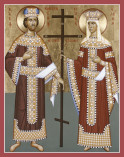 Constantine’s parents were the Emperor Constantius
Chlorus and the Empress Helena. Chlorus had further children by another wife, but by Helena he
had only the one, Constantine. Constantine fought two great battles when he came to the throne:
one against Maxentius, a tyrant in Rome, and the other against Licinius not far from Byzantium.
At the battle against Maxentius, when Constantine was in great anxiety and uncertainty about his
chances of success, a shining cross, surrounded by stars, appeared to him in the sky in full
daylight. On the cross were written the words: ‘In this sign, conquer!’ The wondering
emperor ordered that a great cross be put together, like the one that had appeared, and be
carried before the army. He also ordered all of his soldiers to paint crosses on their shields.
By the power of the Cross, he gained a glorious victory over enemies greatly superior in number.
Maxentius drowned himself in the Tiber. Immediately after this, Constantine issued the famous
Edict of Milan, in 313, to put an end to the persecution of Christians. Conquering Byzantium, he
built a beautiful capital city on the Bosphorus, which from that time was named
Constantinople.
Constantine’s parents were the Emperor Constantius
Chlorus and the Empress Helena. Chlorus had further children by another wife, but by Helena he
had only the one, Constantine. Constantine fought two great battles when he came to the throne:
one against Maxentius, a tyrant in Rome, and the other against Licinius not far from Byzantium.
At the battle against Maxentius, when Constantine was in great anxiety and uncertainty about his
chances of success, a shining cross, surrounded by stars, appeared to him in the sky in full
daylight. On the cross were written the words: ‘In this sign, conquer!’ The wondering
emperor ordered that a great cross be put together, like the one that had appeared, and be
carried before the army. He also ordered all of his soldiers to paint crosses on their shields.
By the power of the Cross, he gained a glorious victory over enemies greatly superior in number.
Maxentius drowned himself in the Tiber. Immediately after this, Constantine issued the famous
Edict of Milan, in 313, to put an end to the persecution of Christians. Conquering Byzantium, he
built a beautiful capital city on the Bosphorus, which from that time was named
Constantinople.
When there was discord in the Church about the troublesome heretic Arius, the emperor summoned the First Ecumenical Council in Nicaea, in 325, where the heresy was condemned and Orthodoxy confirmed. St. Helena, the emperor’s devout mother, was very zealous for the Christian Faith. She visited Jerusalem and found the Precious Cross of the Lord, and built the Church of the Resurrection over Golgotha and many other churches in the Holy Land. This holy woman went to the Lord in 327, at the age of eighty. The Emperor Constantine outlived his mother by ten years and entered into rest at the age of about sixty in 337, in the city of Nikomedia. His body was buried in the Church of the Holy Apostles in Constantinople.
2. Our Holy Father, the New-Martyr Pachomius.
Born in Little Russia, he was taken by the Tartars as a boy and sold to a Turkish tanner as a slave. He spent twenty-seven years in slavery in Usaki in Asia Minor, and was forced to embrace Islam. He went off to the Holy Mountain, became a monk and spent twelve years near the monastery of St. Paul. He resolved to suffer for Christ. His spiritual elder, Joseph, sent him off to Usaki, where he showed himself to his former owner as a Christian, wearing his monastic schema. The Turks gave him over to torture, then threw him into prison and finally beheaded him on May 8th, 1730, on Ascension Day. Many miracles were wrought by his blood and his relics. His body was buried on the island of Patmos in the Church of St. John the Theologian. Thus this villager from Little Russia became a martyr and wears the wreath in the kingdom of Christ.
FOR CONSIDERATION
We see that vice is something shameful and sinful, and that it always hides itself and always takes on the semblance of good works. St. John Chrysostom says most beautifully: ‘Vice has not got its own, personal face, but borrows the face of good deeds.’ The Savior also said: ‘(they) come to you in sheep’s clothing, but inwardly they are ravening wolves’ (Matt. 7:15). Call a liar a liar, and a thief a thief; a murderer a murderer, an immoral man an immoral man and a slanderer a slanderer, and you will anger them. Call any man honest, honorable, selfless, truthful, just, conscientious, and you’ll please and content him. Again I quote St. Chrysostom: ‘Good works are something natural to man, while vice is something unnatural and false.’ If a man is seized by some vice, he quickly justifies it by some good work, clothing it in the garment of good deeds. Truly, vice does not have its own, personal face, and neither has the devil, the father of vice.
Daily Scripture Readings taken from The Orthodox New Testament, translated and published by Holy Apostles Convent, Buena Vista, Colorado, copyright © 2000, used with permission, all rights reserved.
Daily Prologue Readings taken from The Prologue of Ochrid, by Bishop Nikolai Velimirovic, translated by Mother Maria, published by Lazarica Press, Birmingham, England, copyright © 1985, all rights reserved. Edited by Dormition Skete.