

Daily Devotional
Sunday, April 9, 2028 (NS), March 27, 2028 (OS)
Fast Day, but Fish, Wine and Olive Oil Allowed.
Holy Week
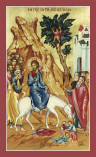
| Palm Sunday |
The commemoration of the holy Martyr Matrona of Thessalonica.
Scripture Readings
Paschalion — Movable Calendar
Palm Sunday
Epistle
The Reading is from the Epistle of Saint Paul to the Philippians [§ 247]. Brethren:
4 4Be rejoicing in the Lord always; again I will say, be rejoicing. 5Let your reasonableness be known to all men. The Lord is near: 6Cease being anxious about anything, but in everything by prayer and by entreaty, with giving of thanks, let your requests be made known to God. 7And the peace of God, which surpasseth all understanding, shall guard your hearts and your minds in Christ Jesus.
8For the rest, brethren, whatsoever things are true, whatsoever things are worthy of respect, whatsoever things are just, whatsoever things are pure, whatsoever things are pleasing, whatsoever things are of good report, if there is any virtue and if there is any praise, be considering these things. 9And what ye learned and received and heard and saw in me, these things be practising; and the God of peace shall be with you.
Gospel
In the Orthros
The Reading is from the Holy Gospel according to Saint Matthew [§ 83]. At that time:
21 1When Jesus drew near to Jerusalem, and came to Bethphage, toward the Mount of Olives, then Jesus sent forth two disciples, 2saying to them, “Go into the village, the one opposite you; and straightway ye shall find an ass which hath been tied, and a colt with her. Loose them and bring them to Me. 3“And if anyone should say anything to you, ye shall say, ‘The Lord hath need of them’; and straightway he will send them.” 4Now all this came to pass in order that it might be fulfilled that which was spoken by the prophet, saying, 5“Say to the daughter of Sion [Is. 62:11], ‘Behold thy King cometh to thee, meek, and mounted on an ass, and a colt, the foal of a beast of burden [cf. Zach. 9:9].’” 6And the disciples went and did even as Jesus commanded them, 7and brought the ass and the colt, and put their garments upon them, and He sat down upon them. 8And the greater part of the crowd spread their garments in the way; and others were cutting branches from the trees and were strewing them in the way. 9And the crowds, those going before and those following, were crying out, saying, “Hosanna, to the Son of David; blessed is He Who cometh in the name of the Lord [cf. Ps. 117(118):25(26)]; hosanna in the highest.” 10And after He entered into Jerusalem, all the city was shaken, saying, “Who is this?” 11And the crowds were saying, “This is Jesus the Prophet, the One from Nazareth of Galilee.”...
15But after the chief priests and the scribes saw the wonders which He did, and the children crying out in the temple and saying, “Hosanna, to the Son of David,” they were indignant, 16and said to Him, “Hearest Thou what these say?” And Jesus saith to them, “Yes; did ye never read, ‘Out of the mouth of babes and sucklings Thou hast perfected praise for Thyself [Ps. 8:2]’?” 17And He left them behind and went out of the city to Bethany, and He lodged there.
In the Liturgy
The Reading is from the Holy Gospel according to Saint John [§ 41].
12 1Six days before the passover, Jesus came to Bethany, where Lazarus was who had died, whom He raised from the dead. 2So they made a supper for Him there, and Martha was serving; but Lazarus was one of those reclining at table with Him. 3Then Mary, having taken a pound of very precious perfumed ointment of pure spikenard, anointed the feet of Jesus, and wiped His feet with her hair. And the house was filled with the odor of the perfumed ointment. 4Then one of His disciples, Judas Iscariote, Simon’s son, who was about to deliver Him up, saith, 5“Why was this perfumed ointment not sold for three hundred denarii and given to the poor?” 6But he said this, not that he was caring for the poor, but because he was a thief, and had the money box, and was taking away what was put in it. 7Then Jesus said, “Let her alone, for the day of My laying out for burial hath she kept it. 8“For ye have the poor among yourselves always, but Me ye have not always.” 9A great crowd of the Jews therefore knew that He was there, and they came not because of Jesus only, but also in order that they might see Lazarus, whom He raised from the dead. 10But the chief priests took counsel that they might put to death Lazarus also, 11because by reason of him many of the Jews were going away and were believing in Jesus.
12On the morrow a great crowd which came to the feast, after they heard that Jesus was coming into Jerusalem, 13took the palm branches of the palm trees, and went out to meet Him, and were crying, “Hosanna, blessed is He Who cometh in the name of the Lord, the King of Israel [cf. Ps. 117(118):25(26)].” 14And Jesus, having found a young ass, sat upon it, even as it is written: 15“Cease fearing, O daughter of Sion, behold, thy King cometh, sitting on a colt of an ass [cf. Zach. 9:9].” 16But the disciples knew not these things at the first; but when Jesus was glorified, then they remembered that these things were written in reference to Him, and that these things they did to Him. 17Then the crowd that was with Him when He called Lazarus out of the grave and raised him from the dead bore witness. 18On this account the crowd also went to meet Him, because it heard that He had done this sign.
Menaion — Fixed Calendar
The commemoration of the holy Martyr Matrona of Thessalonica.
No readings given.
Lives of the Saints (Prologue)
April 9th – Civil Calendar
March 27th – Church Calendar
1. The Holy Martyr Matrona.
She was an orphan, and a servant in the house of a Jew in Thessalonica. The wife of this Jew constantly derided Matrona for her faith in Christ, and urged her to cast Christ aside and go to the synagogue. But the humble Matrona went about her work conscientiously, not replying to her mistress and secretly praying to Christ our God. On one occasion the Jewess discovered that Matrona had gone to church unbeknown to her, and demanded, in a great rage, to know why she had gone to the church and not the synagogue. ‘Because God is alive in the Christian Church, but He has departed from the synagogues of the Jews,’ replied Matrona. Enraged by such a courageous answer, the Jewess thrashed her and locked her in a dark chamber, and in addition to that had her bound. But the next day she found her unbound by the power of God and kneeling in prayer, praising God. Then she locked her up again for the second time until she died of hunger. Then that wicked woman took the body of the holy maiden and threw it to the ground from the top of her house. Christians took the body of the martyr and buried it. The bishop, Alexander, when he had learned of the many miracles worked by the holy martyr, built a church over her grave. As for the evil Jewess, she soon received her just reward, when, standing on the same spot from which she had thrown Matrona’s body, she slipped and fell onto the cobbled pavement and was smashed to pieces.
2. Our Holy Father John the Clairvoyant.
He was a carpenter until the age of twenty-five, when, urged on by an unquenchable desire for constant prayer, he took himself off into the desert, where he lived until his death; that is, until the age of ninety. He lived in the body as one without a body. He could look into the heart of every person who came near him and could discover his name, and his thoughts and desires. He foretold the outcome of the Emperor Theodosios’ battles to him; prophesied to nobles, to monks, to anyone at all who was in need, to uncover what was hidden from them in the darkness of future days. A certain prince asked him to receive his wife, who wished to see him. The holy man was not willing to satisfy empty curiosity, so he appeared in a dream to the prince’s wife, and she saw him just as he was. And when the woman described her dream to her husband, he affirmed that such was the appearance of the holy man. He taught every visitor about humility, which is the basic virtue, and always drew his examples from life. He taught how pride makes war against a man of exalted character and brings him to dust and to terrible sins. He endured great assaults from evil spirits. Once Satan appeared to him with a great crowd of demons in the form of shining angels. They pressed him to bow down before Satan, lying to him and telling him that it was Christ. But he answered with great wisdom: ‘Every day I bow down to Jesus Christ my King; if it were He, it would not be necessary for me to bow down to Him at this particular moment.’ After these words, the evil forces disappeared like smoke. He died peacefully, kneeling in prayer, at the age of ninety.
3. Our Holy Father Paphnutios.
He was a disciple of St. Anthony the Great. The holiness of his life brought many sinners (for example, St. Thaïs, Oct 8th) back to the path of repentance, for he was more like a bodiless angel than a carnal man. He entered into rest towards the end of the fourth century.
FOR CONSIDERATION
‘He who thinks evil, in him is no cleanness,’ says St. Simeon the New Theologian, and adds: ‘For how can there be a clean heart in one who fouls it with unclean thoughts, as a mirror is darkened by dust?’ Do you see, then, the inaccessible height on which the Christian religion stands in relation to all other religions and worldly theories? He who contemplates evil has in some manner done evil, and is at fault before God and his own soul. It is an insult to God and a loss to self. To be Christian in the true sense means to make an enormous effort to cleanse our hearts and minds from evil thoughts. On what an effort it is, there is a vast amount of teaching (which in our day remains an almost entirely closed book, even to Christians) and a wealth of true experience on the part of holy men and women who have justified this teaching. To cleanse oneself from evil and impure thoughts, this root of all evil, was the goal of all the great ascetics, cave-dwellers and hesychasts.
Daily Scripture Readings taken from The Orthodox New Testament, translated and published by Holy Apostles Convent, Buena Vista, Colorado, copyright © 2000, used with permission, all rights reserved.
Daily Prologue Readings taken from The Prologue of Ochrid, by Bishop Nikolai Velimirovic, translated by Mother Maria, published by Lazarica Press, Birmingham, England, copyright © 1985, all rights reserved. Edited by Dormition Skete.