

Daily Devotional
Sunday, March 26, 2028 (NS), March 13, 2028 (OS)
Fast Day, but Shellfish, Wine and Olive Oil Allowed.
Holy & Great Fast
| The Fourth Sunday of the Great Fast, in which we Commemorate St. John Climacus (Of the Ladder). Grave Mode — Seventh Eothinon |
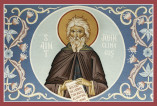
The commemoration of the translation of the relics of our holy father among the saints, Nikephoros, the Confessor and Patriarch of Constantinople.
Scripture Readings
Paschalion — Movable Calendar
The Fourth Sunday of the Great Fast, in which we Commemorate St. John Climacus (Of the Ladder).
Grave Mode — Seventh Eothinon
Epistle
The Reading is from the Epistle of Saint Paul to the Hebrews [§ 314]. Brethren:
6 13God, having made a promise to Abraham, since He had no one greater to swear by, swore by Himself, 14saying, “Surely blessing I will bless thee, and multiplying I will multiply thee [cf. Gen. 22:17].” 15And thus, after he patiently endured, he attained the promise. 16For men indeed swear by the greater, and the oath for confirmation is to them an end of all contradiction. 17Wherein God, willing more abundantly to show to the heirs of the promise the immutability of His counsel, mediated by an oath, 18that by two immutable things, in which it was impossible for God to lie, we may have a strong consolation, who have fled for refuge to lay hold of the hope set before us, 19which we have as an anchor of the soul, both sure and firm, and which entereth into “the inner space behind the veil [Lev. 16:2, 12, 15],” 20where Jesus entered as a forerunner on our behalf, having become a high priest forever according to the order of Melchisedek.
COMMEMORATION OF SAINT JOHN OF THE LADDER
The Reading is from the Epistle of Saint Paul to the Ephesians [§ 229]. Brethren:
5 8Be walking as children of light— 9for the fruit of the Spirit is in all goodness and righteousness and truth— 10proving what is well-pleasing to the Lord. 11And cease having fellowship with the unfruitful works of darkness, but rather even reprove them. 12For it is shameful even to speak of the things which are done by them in secret. 13But all things which are reproved are made manifest by the light; for all which is made manifest is light. 14Wherefore, He saith, “Rouse thyself, thou who sleepest, and arise from the dead, and the Christ shall shine on thee [cf. Is. 9:2, 26:19, 52:1, 60:1, 2].”
15Be taking heed then how exactly ye walk, not as unwise ones, but as wise ones, 16redeeming the time, because the days are evil. 17On this account cease becoming foolish, but become as ones understanding what the will of the Lord is. 18And cease being drunk with wine, in which is prodigality, but keep on being filled with the Spirit, 19speaking to one another in psalms and hymns and spiritual songs, singing and chanting in your heart to the Lord.
Gospel
The Reading is from the Holy Gospel according to Saint Mark [§ 40]. At that time:
9 17A certain man came to Jesus, falling on his knees before Him and saying, “Teacher, I brought to Thee my son who hath a dumb spirit. 18“And wheresoever it overtaketh him, it rendeth him; and he foameth and gnasheth his teeth, and is withering away. And I spoke to Thy disciples that they should cast it out, and they did not have the strength.” 19And He answereth and saith, “O unbelieving generation, until when shall I be with you? Until when shall I bear with you? Bring him to Me.” 20And they brought him to Him. And having seen Him, straightway the spirit convulsed him, and he fell on the ground and was rolling about foaming. 21And He asked his father, “How long a time is it since this hath happened to him?” And he said, “From childhood. 22“And ofttimes it casteth him both into fire and into water, in order that it might destroy him. But if Thou art able to do anything, have compassion upon us and help us.” 23And Jesus said to him, “As to the ‘if Thou art able,’ if thou art able to believe, all things can be to the one who believeth.” 24And straightway the father of the little child cried out with tears and was saying, “I believe, O Lord; help Thou mine unbelief.” 25And after Jesus saw that a crowd was running together, He rebuked the spirit, the unclean one, saying to it, “Thou dumb and deaf spirit, I command thee, come out of him, and enter no more into him.” 26And the spirit cried out and convulsed him much, and came out. And he became as if he were one dead, insomuch that many said, “He died.” 27But Jesus took hold of his hand and raised him up, and he arose. 28And after He entered into a house, His disciples were questioning Him privately, “Why were we not able to cast it out?” 29And He said to them, “This kind can come forth by nothing, except by prayer and fasting.”
30And having gone forth from that place, they were passing by through Galilee, and He was not willing that anyone should know it. 31For He was teaching His disciples and was saying to them, “The Son of Man is being delivered into the hands of men, and they shall kill Him; and having been killed, He shall raise Himself the third day.”
Commemoration of Saint John of the Ladder
The Reading is from the Holy Gospel according to Saint Matthew [§ 10]. At that time:
For Gk. usage, see Mt. 4:23-5:13; for Sl. usage, see Mt.4:25-5:13.
4 23Jesus was going around all Galilee, teaching in their synagogues, and proclaiming the Gospel of the kingdom, and curing every disease and every sickness among the people. 24And the report of Him went out into all Syria. And they brought to Him all those who were ill, constrained by various diseases and torments, and possessed by demons, and lunatics, and paralytics; and He cured them. 25And great crowds followed Him from Galilee, and Decapolis, and Jerusalem, and Judæa, and beyond the Jordan.
5 1And seeing the crowds, He went up into the
mountain; and after He sat down, His disciples came to Him. 2And He opened His mouth
and began to teach them, saying:
3“Blessed are the poor in spirit, for theirs is the
kingdom of the heavens.
4“Blessed are they who mourn, for they shall be
comforted.
5“Blessed are the meek, for they shall inherit the
earth.
6“Blessed are they who hunger and thirst after
righteousness, for they shall be filled.
7“Blessed are the merciful, for they shall find mercy.
8“Blessed are the pure in heart, for they shall see
God.
9“Blessed are the peacemakers, for they shall be
called sons of God.
10“Blessed are they who have been persecuted on
account of righteousness, for theirs is the kingdom of the heavens.
11“Blessed are ye whenever they reproach you and persecute
you, and say every evil word against you falsely on account of Me.
12“Be rejoicing and be exceedingly glad, for your reward
is great in the heavens. For so they persecuted the prophets who were before
you.
13“Ye are the salt of the earth; but if the salt should become insipid, with what shall it be salted? For it is no longer good for anything, except to be cast out and to be trampled underfoot by men.”
Menaion — Fixed Calendar
The commemoration of the translation of the relics of our holy father among the saints, Nikephoros, the Confessor and Patriarch of Constantinople.
No readings given.
Synaxarion Readings
The Fourth Sunday of Great Lent: St. John Climacus
On this day, the fourth Sunday of Great Lent, we commemorate our venerable father among the saints, St. John of Sinai, the author of The Ladder of Divine Ascent.
No one knows the birthplace or parentage of our venerable Father John of Sinai. In his youth, at the age of sixteen, he came to the wilderness of Sinai and dwelt under the guidance of Abba Martyrius. When Abba Martyrius tonsured our venerable Father John at the age of twenty, he took him and went to that pillar of the wilderness, Abba John the Sabbaite in the wilderness of Gouda where he had with him his disciple Stephen the Cappadocian. When the Sabbaite elder saw them, he arose and took water, poured it into a small basin, washed the feet of the disciple (the young John) and kissed his hand; but did not wash the feet of Abba Martyrius his superior. Abba Stephen was scandalized by the situation. After the departure of Abba Martyrius and his disciple, the Elder John noticed that his own disciple was greatly perplexed and said to him, “Why are you so troubled? Believe me, I do not know who the boy is, but today I received the abbot of Sinai and washed his feet.” And after forty years, he did indeed become the abbot according to the prophecy of the elder.
After the passing of his spiritual father, St. John continued alone in the wilderness in a cave in the Wadi Thola. He traveled from time to time, going at least once as far as Alexandria. He records in The Ladder his visit to a large monastic community there and marvels of repentance, obedience, and humility which he observed. In his humility, he counted our venerable father George the Wonderworker of Arselaou as his master. In all, he spent some forty years in solitude and stillness. He guided the monks who dwelt in that desert since he was a most excellent and nurturing spiritual father—for in those days there were innumerable ascetics living in cells all through the mountains and valleys of Sinai. From time to time, he received visitors from farther away. At one point, some other monks, prompted to jealously by the adversary who hates all good, complained of St. John’s fame and loquacious words of teaching. In response, he humbly kept strict silence for over a year, until the same fathers who had complained came, asking him to speak once again for the benefit of all.
After he had spent forty years in the wilderness, the monks of Sinai asked him to become abbot of the great monastery built by the emperor Justinian beside the Burning Bush of Moses, the holy Monastery of St. Catherine. In obedience to the fathers, he left his blessed solitude to take up the responsibilities of abbot. It is told that on the very day on which he assumed the office of abbot, there came a group of about six hundred pilgrims. When they were seated, our venerable Father John saw someone in the crowd with short hair and wearing a Jewish tunic. This person was going about like someone with authority, directing the cooks, the stewards, the storekeepers, and other workers. After the people left, when the servers all sat down to eat, they sought everywhere for the one who had been going about supervising but did not find him. Then the servant of God, our venerable Father John, said, “Do not marvel. The lord Moses did nothing strange in this same place where he served before and which belongs to him.” Behold the wonder! It had been the holy Prophet and Lawgiver Moses who had served the guests.
At the request of Abba John, abbot of Raitho near the shore of the Red Sea, our venerable father wrote his wonderful book, The Ladder of Divine Ascent, in which he sets out the whole of Christian life as a divine ascent of thirty rungs to Christ. This book has been a treasure, a pearl beyond price, to this day. It is useful not only to monastics but to all devout Christians.... St. John was true physician of souls and had great spiritual insight into men’s behavior. He made detailed observations of the symptoms of men’s sin-sick souls, diagnosed their spiritual diseases, and prescribed the appropriate medicine for their recovery and salvation. He showed how one can ascend the “ladder of the virtues” step by step and reach the Promised Land, fleeing the Egypt of the passions. Yet, his success was due only to his own life of constant watchfulness, fasting, vigil, and prayers.
The monastic community he shepherded continues to this day beside the Burning Bush, and his teachings guide and direct monastics throughout the world. During Great Lent, The Ladder is read aloud in monasteries during meals so the monastics may receive his edifying spiritual counsels for their soul’s sustenance, as they simultaneously receive physical nourishment for their bodies.
Today the cave in which he dwelt in the wilderness of Sinai can still be seen, but his resting place is unknown except to the angels. He fell asleep in the Lord in the seventh century. St. John is also commemorated on March 30, the day of his repose.
[From the “Synaxarion of the Lenten Triodion and Pentecostarion.”, HDM Press.]
Lives of the Saints (Prologue)
March 26th – Civil Calendar
March 13th – Church Calendar
1. St. Nikephoros, Patriarch of Constantinople. (c. 758-829).
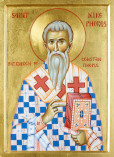 He governed the holy
Church with wisdom and zeal as the greatest arch-pastor of Constantinople. When Leo the Armenian
made his stand against icons, Nikephoros opposed the Emperor; first counselling him and then
denouncing him. For this the accursed emperor exiled him to the island of Prokonnesos. There was
a monastery on that island, which Nikephoros himself had built in honor of St. Theodore. And this
confessor of the Orthodox Faith spent thirteen years there, then died and went to the Lord in
827. Then all the iconoclast emperors perished, and Michael, with his mother Theodora, came to
the imperial throne in 842, and Methodius became patriarch. Then, in 846, the relics of St.
Nikephoros were translated from Prokonnesos to Constantinople and placed first in the Church of
Hagia Sophia, from which he had been driven in his lifetime, and then in the Church of the Holy
Apostles. The main commemoration of this great hierarch is on June 2nd, but on March 13th is
commemorated the finding and translation of his incorrupt relics. St. Nikephoros was driven from
Constantinople on March 13th, and on March 13th, nineteen years later, his relics were brought
back to his patriarchal seat.
He governed the holy
Church with wisdom and zeal as the greatest arch-pastor of Constantinople. When Leo the Armenian
made his stand against icons, Nikephoros opposed the Emperor; first counselling him and then
denouncing him. For this the accursed emperor exiled him to the island of Prokonnesos. There was
a monastery on that island, which Nikephoros himself had built in honor of St. Theodore. And this
confessor of the Orthodox Faith spent thirteen years there, then died and went to the Lord in
827. Then all the iconoclast emperors perished, and Michael, with his mother Theodora, came to
the imperial throne in 842, and Methodius became patriarch. Then, in 846, the relics of St.
Nikephoros were translated from Prokonnesos to Constantinople and placed first in the Church of
Hagia Sophia, from which he had been driven in his lifetime, and then in the Church of the Holy
Apostles. The main commemoration of this great hierarch is on June 2nd, but on March 13th is
commemorated the finding and translation of his incorrupt relics. St. Nikephoros was driven from
Constantinople on March 13th, and on March 13th, nineteen years later, his relics were brought
back to his patriarchal seat.
2. The Holy Martyr Christina of Persia.
She was harshly tortured in Persia in the 4th century for her unfaltering confession of the Christian Faith. The torturers whipped her so terribly that she died from exhaustion. Her soul parted from her martyred body and went to dwell in the eternal joy of Christ her King and Lord.
3. The Hieromartyr Publius.
This priest and martyr was successor in the episcopate in Athens to the famous Dionysius the Areopagite. As bishop, he was tortured by unbelievers and beheaded in the 2nd century. For a brief time of torture he inherited eternal life.
FOR CONSIDERATION
Great Christians are those who have great love for Christ. Oh, how truly great Christians our God-bearing fathers and the martyrs were! In our time, it is difficult for many to imagine this. Here is what one of those saints, St. Simeon the New Theologian, confessed in his monastery before all the monks. Speaking from his experience, how it bore out the truth of the Lord’s words: ‘My yoke is easy and My burden is light,’ he said: ‘Believe me, when I have fled to God my Savior, I have not encountered anything hard or unbearable.... I had a great and unbearable sadness only because I couldn’t find a sufficient means of dying for the love of Christ.’ Are not such souls like flames shut in earthen vessels? Flames are always upright and directed towards heaven. Just take off the lid, and the flame will leap up higher.
Daily Scripture Readings taken from The Orthodox New Testament, translated and published by Holy Apostles Convent, Buena Vista, Colorado, copyright © 2000, used with permission, all rights reserved.
Daily Prologue Readings taken from The Prologue of Ochrid, by Bishop Nikolai Velimirovic, translated by Mother Maria, published by Lazarica Press, Birmingham, England, copyright © 1985, all rights reserved. Edited by Dormition Skete.