

Daily Devotional
Saturday, March 25, 2028 (NS), March 12, 2028 (OS)
Fast Day, but Shellfish, Wine and Olive Oil Allowed.
Holy & Great Fast
The Saturday of the Fourth Week of the Great Fast
The commemoration of our holy Father Theophanes the Confessor of Sigriane, and our father among the saints, Gregory the Dialogist, Pope of Rome, and our venerable Father Symeon the New Theologian.
Scripture Readings
Paschalion — Movable Calendar
The Saturday of the Fourth Week of the Great Fast
Epistle
The Reading is from the Epistle of Saint Paul to the Hebrews [§ 313]. Beloved:
6 9We have been persuaded of the better things concerning you, even those things which hold on to salvation, though we speak thus. 10For God is not unjust, to be forgetful of your work and the labor of love which ye yourselves showed toward His name, in that ye have ministered to the saints and do minister. 11And we desire each of you to show the same earnestness to the full assurance of the hope until the end, 12in order that ye might not become sluggish, but imitators of those who through faith and long-suffering inherit the promises.
Another Reading for Saturday of the Fourth Week of the Great Fast in Commemoration of the Departed
The Reading is from the First Epistle of Saint Paul to the Corinthians [§ 163]. Brethren:
15 47The first man is of earth, earthy; the second Man is the Lord from heaven. 48As is the earthy, such are they also who are earthy; and as is the heavenly, such are they also who are heavenly. 49And even as we bore the image of the earthy, let us also bear the image of the heavenly. 50Now this I say, brethren, that flesh and blood is not able to inherit the kingdom of God; neither doth corruption inherit incorruption. 51Behold, I tell you a mystery: On the one hand we shall not all fall asleep, but on the other hand we shall all be changed— 52in a moment, in a wink of an eye, at the last trumpet. For a trumpet shall sound, and the dead shall be raised incorruptible, and we shall be changed. 53For it is needful for this corruptible to put on itself incorruption and this mortal to put on itself immortality. 54But whenever this corruption should put on itself incorruption, and this mortal should put on itself immortality, then the word which hath been written shall come to pass: “Death is swallowed up in victory [cf. Is. 25:8]. 55“O death, where is thy sting? O Hades, where is thy victory [cf. Hos. 13:14]?” 56Now the sting of death is sin, and the power of sin is the law. 57But thanks be to God Who giveth us the victory through our Lord Jesus Christ.
Gospel
The Reading is from the Holy Gospel according to Saint Mark [§ 31]. At that time:
7 31Jesus, having departed from the borders of Tyre and Sidon, came to the Sea of Galilee, in the midst of the borders of Decapolis. 32And they bring to Him a deaf man having an impediment in his speech; and they beseech Him that He might lay His hand on him. 33And He took him away, aside from the crowd, and put His fingers into his ears, and He spit and touched his tongue. 34And having looked up to the heaven, He sighed, and saith to him, “Ephphatha,” that is, “Be thou opened.” 35And straightway his ears were opened, and the band of his tongue was loosed, and he began to speak rightly. 36And He Himself gave them express orders that they should tell no one; but as much as He was giving them express orders, much more abundantly were they proclaiming it. 37And beyond all measure they were astonished, saying, “He hath done all things well. He maketh both the deaf to hear and the dumb to speak.”
Commemoration of the Departed
The Reading is from the Holy Gospel according to Saint John [§ 16]. The Lord said to the Jews who had come to Him:
5 24“Verily, verily, I say to you, that the one who heareth My word and believeth the One Who sent Me hath everlasting life, and cometh not into judgment, but hath passed over out of death into life. 25“Verily, verily, I say to you, that an hour cometh, and now is, when the dead shall hear the voice of the Son of God, and they who hear shall live. 26“For even as the Father hath life in Himself, so He also gave to the Son to have life in Himself, 27“and He also gave to Him authority to execute judgment. That He is Son of Man, 28“cease marvelling at this; for an hour is coming in which all those in the graves shall hear His voice, 29“and shall go forth—they who did good things to a resurrection of life, but they who practised bad things to a resurrection of condemnation. 30“I am not able to do anything of Myself. Even as I hear, I judge; and My judgment is just, because I seek not Mine own will, but the will of the One Who sent Me, the Father.”
Menaion — Fixed Calendar
The commemoration of our holy Father Theophanes the Confessor of Sigriane, and our father among the saints, Gregory the Dialogist, Pope of Rome, and our venerable Father Symeon the New Theologian.
Epistle
For the Hierarch:
The Reading is from the Epistle of Saint Paul to the Hebrews [§ 318]. Brethren:
7 26Such a High Priest was fitting for us: holy, guileless, undefiled, Who hath been separated from the sinners and hath become higher than the heavens, 27Who hath no need daily, even as the high priests, to offer up sacrifices, first for his own sins, then for those of the people; for this He did once for all after He offered up Himself. 28For the law appointeth men high priests who have weakness; but the word of the oath, which is after the law, appointeth the Son, Who hath been perfected forever.
8 1Now in reference to the things being spoken of, the chief point is: We have such a High Priest, Who sat down on the right of the throne of the majesty in the heavens, 2a Liturgist of the holies and of the tabernacle, the true one, which the Lord pitched, and not man.
Gospel
For the Hierarch:
The Reading is from the Holy Gospel according to Saint Luke [§ 24]. At that time:
6 17Jesus stood upon a level place. And there was a crowd of
His disciples, and a great multitude of the people from all of Judæa and Jerusalem and the
seacoast of Tyre and Sidon, who came to hear Him, and to be healed of their diseases—
18even those who were troubled by unclean spirits; and they were cured.
19And all the crowd was seeking to touch Him, for power was coming forth from Him and
healing all. 20And He lifted up His eyes to His disciples, and began to say:
“Blessed are the poor, for yours is the kingdom of God.
21“Blessed are ye who hunger now, for ye shall be
filled.
Blessed are ye who weep now, for ye shall laugh.
22“Blessed are ye whenever men hate you, and whenever they
separate you, and reproach you, and cast out your name as evil, on account of the Son of
Man.
23“Rejoice in that day and leap for joy, for behold, your
reward is great in the heavens.”
Lives of the Saints (Prologue)
March 25th – Civil Calendar
March 12th – Church Calendar
1. Our Holy Father Theophanes the Confessor.
Named ‘the Sygrian’ from his birthplace, Sygriane, he was a kinsman of the Emperor Leo the Isaurian (717-741) and his son Kopronymos (741-775). He had enormous wealth and lived in great splendor. But all this lost its value for Theophanes when he enthroned Christ the Lord in his soul. Then he was hindered by a marriage which he was obliged to make. He succeeded, though, in persuading his bride that they should live as brother and sister in chastity, and as soon as his parents died, his wife went to one monastery and he to another. His monastery was in the Syrian mountains in the Kyzikos region. The splendid and wealthy Theophanes lived for some time in the monastery as the poorest wretch, and all marvelled at the great change in him. Then, because he had become so known for his firm faith, abstinence and wisdom, he was invited to the Seventh Ecumenical Council at Nicaea in 787, at which the veneration of icons was upheld. Because of his great purity and chastity, God gave him the gift of wonder-working and he was able to heal all manner of illness, especially mania and madness. He prayed to God for all the sick and distressed and helped them by his prayers. Only when he himself fell ill and was sick for a long time did he refuse to pray for his own healing but endured it with thanksgiving. When another iconoclast period arose under the wicked Emperor Leo the Armenian, Theophanes was taken to Constantinople and thrown into prison, where he spent two years in discomfort, pain and humiliation. The emperor then sent him into exile on the island of Samothrace, an exile which he had foreseen in his spirit and foretold to the prison warders. When he arrived on Samothrace, he lived for only twenty-three days, then went to his Lord and Creator to receive the deserved wreath of glory.
2. Our Holy Father Simeon the New Theologian.
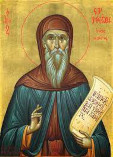 This
great and godly father of the Church was born in Galatia in Paphlagonia and educated in
Constantinople, where he entered the imperial service. He left all for Christ and took
himself off to a monastery, living in asceticism under the guidance of an elder, Simeon. He
then became abbot of the monastery of St. Mamas, and finally a hermit. He was the greatest
theologian since St. Gregory the Theologian. His writings, illumined with the grace he
carried in his heart, are a true theological revelation. He entered into rest in 1022,
leaving wonder-working relics. This
great and godly father of the Church was born in Galatia in Paphlagonia and educated in
Constantinople, where he entered the imperial service. He left all for Christ and took
himself off to a monastery, living in asceticism under the guidance of an elder, Simeon. He
then became abbot of the monastery of St. Mamas, and finally a hermit. He was the greatest
theologian since St. Gregory the Theologian. His writings, illumined with the grace he
carried in his heart, are a true theological revelation. He entered into rest in 1022,
leaving wonder-working relics.
|
3. St. Gregory the Dialogist, Pope of Rome.
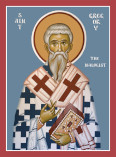 Son of the senator Gordianus, he himself became a senator and
governor of the city of Rome, but as soon as his father died, he gave himself to the spiritual
life. Out of his great wealth, he built six monasteries in Sicily and a seventh in Rome itself,
being tonsured in this last, which he dedicated to the Apostle Andrew. His mother, Sylvia, also
received the monastic schema in a women’s monastery. After the death of Pope Pelagius,
Gregory was chosen as pope. He fled from this honor and power and hid himself in the mountains
and ravines, but God showed people where to find him by making a fiery column, reaching from
earth to heaven, appear at the place where Gregory was hiding. He had a rare compassion, using
all his income for the housing of the poor and on hospitality. He frequently brought the poor in
and fed them from his own table. He occupied himself with the writing of instructive books.
‘The Dialogist,’ or ‘the one who converses’ was the name he was known by,
having written a book entitled ‘The Dialogues’ in which he brought to light the
virtues and miracles of the Italian saints. He also compiled the service of the Presanctified
Gifts that is used during the Great Fast. His archdeacon, Peter, often saw a dove hovering over
his head when he was writing. He went to the Lord in 604.
Son of the senator Gordianus, he himself became a senator and
governor of the city of Rome, but as soon as his father died, he gave himself to the spiritual
life. Out of his great wealth, he built six monasteries in Sicily and a seventh in Rome itself,
being tonsured in this last, which he dedicated to the Apostle Andrew. His mother, Sylvia, also
received the monastic schema in a women’s monastery. After the death of Pope Pelagius,
Gregory was chosen as pope. He fled from this honor and power and hid himself in the mountains
and ravines, but God showed people where to find him by making a fiery column, reaching from
earth to heaven, appear at the place where Gregory was hiding. He had a rare compassion, using
all his income for the housing of the poor and on hospitality. He frequently brought the poor in
and fed them from his own table. He occupied himself with the writing of instructive books.
‘The Dialogist,’ or ‘the one who converses’ was the name he was known by,
having written a book entitled ‘The Dialogues’ in which he brought to light the
virtues and miracles of the Italian saints. He also compiled the service of the Presanctified
Gifts that is used during the Great Fast. His archdeacon, Peter, often saw a dove hovering over
his head when he was writing. He went to the Lord in 604.
FOR CONSIDERATION
No one, not the Lord God Himself, takes pleasure in instructing the proud. No one cares for giving instruction to him who asserts that he knows everything. ‘Secrets will be revealed to the meek,’ says the wise Sirach (3:19). And David says that God ‘keeps the meek in truth and teaches the meek His ways’ (Ps. 24:9). The proud man wants to teach everyone and not be taught by anyone himself; but the meek man wants to teach no one but desires constantly to be instructed by someone, no matter whom. An empty ear of grain lifts its head high up over all the field, but a full ear has a drooping head!
O proud man, if only your guardian angel would some time pull back the curtain from your eyes and disclose to you the endless vista of all that you do not know! You would kneel before every man before whom you have vaunted your pride and whom you have despised, and would cry with tears: ‘Forgive me, forgive me! I know nothing!’ To the humble and devout it is often given to know the hour of their death, but death comes unexpectedly to the proud. St. Gregory the Dialogist tells of a humble bishop, Carpus, who celebrated the Liturgy every day, to whom One from the other world appeared and said: ‘Go on doing what you are doing, and serve Me while your legs will stand and your hands function. And on the day of the dormition of the Mother of God, come to Me, and I will give you your reward in My heavenly kingdom, together with all those who have prayed at these services.’ After a year, on the Feast of the Dormition, Bishop Carpus celebrated the divine Liturgy, bade farewell to his clergy and gave his spirit to God. And his face shone with the light of the sun.
Daily Scripture Readings taken from The Orthodox New Testament, translated and published by Holy Apostles Convent, Buena Vista, Colorado, copyright © 2000, used with permission, all rights reserved.
Daily Prologue Readings taken from The Prologue of Ochrid, by Bishop Nikolai Velimirovic, translated by Mother Maria, published by Lazarica Press, Birmingham, England, copyright © 1985, all rights reserved. Edited by Dormition Skete.