

Daily Devotional
Thursday, February 10, 2028 (NS), January 28, 2028 (OS)
No Fasting.
Thursday of the Thirty-Fourth Week
The commemoration of our holy and venerable Father Ephraim the Syrian.
Scripture Readings
Paschalion — Movable Calendar
Thursday of the Thirty-Fourth Week
Epistle
The Reading is from the First General Epistle of Saint John [§ 69]. Brethren:
1 8If we should say that we have no sin, we deceive ourselves, and the truth is not in us. 9If we be confessing our sins, faithful is He and righteous to forgive us our sins and cleanse us from all unrighteousness. 10If we should say that we have not sinned, we make Him a liar, and His word is not in us.
2 1My little children, these things I write to you, in order that ye might not sin. And if anyone should sin, we have a Paraclete with the Father, Jesus Christ the righteous. 2And He Himself is the expiation for our sins, and not for ours only, but also for the whole world. 3And in this we know that we have come to know Him, if we be keeping His commandments. 4The one who saith, “I have come to know Him,” and keepeth not His commandments, is a liar, and the truth is not in this one. 5But whosoever may keep His word, truly in this one the love of God hath been perfected. In this we know that we are in Him. 6The one who saith he abideth in Him ought himself also so to walk, even as that One walked.
Gospel
The Reading is from the Holy Gospel according to Saint Mark [§ 62]. The Lord said to His disciples:
13 31“The heaven and the earth shall pass away, but My words in no wise shall pass away.
32“But concerning that day or the hour, no one knoweth, not even the angels in heaven, nor the Son, except the Father. 33“Be taking heed, be vigilant, and be praying; for ye know not when the time is. 34“It is as a man who went abroad, and left his house, and gave authority to his slaves, and to each one his work, and he commanded the porter that he should watch. 35“Be watching then; for ye know not when the lord of the house cometh—at evening, or at midnight, or at cockcrowing, or in the morning— 36“lest coming suddenly he should find you sleeping. 37“Now what I say to you, I say to all: Be watching.”
14 1Now after two days it was the passover and the feast of unleavened bread. And the chief priests and the scribes were seeking how they might lay hold of Him by guile and put Him to death. 2But they were saying, “Not during the feast, lest there be an uproar of the people.”
Menaion — Fixed Calendar
The commemoration of our holy and venerable Father Ephraim the Syrian.
Epistle
The Reading is from the Epistle of Saint Paul to the Galatians [§ 213]. Brethren:
5 22The fruit of the Spirit is love, joy, peace, long-suffering, kindness, goodness, faith, 23meekness, self-control; against such things there is no law. 24But they who are of the Christ crucified the flesh with the passions and the lusts. 25If we live by the Spirit, let us also be walking by the Spirit. 26Let us not become vainglorious, provoking one another, envying one another.
6 1Brethren, even if a man should be overtaken in some transgression, ye, the spiritual ones, be restoring such a one in the spirit of meekness, looking out for thyself, lest thou also be tempted. 2Keep on bearing one another’s burdens, and thus fill up the law of the Christ.
Gospel
The Reading is from the Holy Gospel according to Saint Luke [§ 24]. At that time:
6 17Jesus stood upon a level place. And there was a crowd of
His disciples, and a great multitude of the people from all of Judæa and Jerusalem and the
seacoast of Tyre and Sidon, who came to hear Him, and to be healed of their diseases—
18even those who were troubled by unclean spirits; and they were cured.
19And all the crowd was seeking to touch Him, for power was coming forth from Him and
healing all. 20And He lifted up His eyes to His disciples, and began to say:
“Blessed are the poor, for yours is the kingdom of God.
21“Blessed are ye who hunger now, for ye shall be
filled.
Blessed are ye who weep now, for ye shall laugh.
22“Blessed are ye whenever men hate you, and whenever they
separate you, and reproach you, and cast out your name as evil, on account of the Son of
Man.
23“Rejoice in that day and leap for joy, for behold, your
reward is great in the heavens.”
for Sl. usage, see [Mt. 11:27-30].
Lives of the Saints (Prologue)
February 10th – Civil Calendar
January 28th – Church Calendar
1. Our Holy Father Ephraim the Syrian.
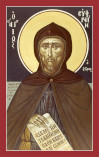 Born in Syria of poor parents in the reign of the
Emperor Constantine the Great, his early youth was spent somewhat tempestuously, but he suddenly
underwent a spiritual crisis and began to burn with love for the Lord Jesus. He was a disciple of
St. Jacob of Nisibis (Jan. 13th). By the great grace of God, wisdom flowed from his tongue like a
stream of honey and from his eyes tears flowed unceasingly; so much so, that his eyelashes fell
out. Loving work like a bee, Ephraim was constantly either writing books or teaching the monks in
the monastery or the people in the city of Edessa, or was giving himself to prayer and
contemplation. His books are numerous; his prayers are beautiful. The best-known of the latter is
the prayer in the Great Fast: ‘O Lord and Master of my life...’ When they wished to
take him by force and make him bishop, he feigned madness and began to run through the city of
Edessa, trailing his garments along behind him. Seeing him mad, they left him in peace. He was a
contemporary and friend of St. Basil the Great. St. Ephraim was especially the apostle of
repentance. Even today his writings soften many hearts, strengthen them against sin and turn them
back to Christ. He entered into rest at a great age in 373.
Born in Syria of poor parents in the reign of the
Emperor Constantine the Great, his early youth was spent somewhat tempestuously, but he suddenly
underwent a spiritual crisis and began to burn with love for the Lord Jesus. He was a disciple of
St. Jacob of Nisibis (Jan. 13th). By the great grace of God, wisdom flowed from his tongue like a
stream of honey and from his eyes tears flowed unceasingly; so much so, that his eyelashes fell
out. Loving work like a bee, Ephraim was constantly either writing books or teaching the monks in
the monastery or the people in the city of Edessa, or was giving himself to prayer and
contemplation. His books are numerous; his prayers are beautiful. The best-known of the latter is
the prayer in the Great Fast: ‘O Lord and Master of my life...’ When they wished to
take him by force and make him bishop, he feigned madness and began to run through the city of
Edessa, trailing his garments along behind him. Seeing him mad, they left him in peace. He was a
contemporary and friend of St. Basil the Great. St. Ephraim was especially the apostle of
repentance. Even today his writings soften many hearts, strengthen them against sin and turn them
back to Christ. He entered into rest at a great age in 373.
2. Our Holy Father Isaac the Syrian.
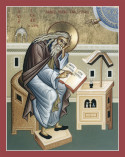 Born in Nineveh, he began at an early age to live
the ascetic life in the monastery of Mar-Matthew near Nineveh. When he became known for his
holy life and miracles, he was chosen as bishop of Nineveh and forced to accept this state.
But after only five months he left his episcopate and fled secretly to the desert monastery
of Rabban-Shapur. He was the author of many works, of which about a hundred homilies on the
spiritual life and asceticism, written mainly from his own experience, have come down to
us. He was without equal as a writer and guide in the spiritual life. He entered into rest
at a great age at the end of the seventh century. Born in Nineveh, he began at an early age to live
the ascetic life in the monastery of Mar-Matthew near Nineveh. When he became known for his
holy life and miracles, he was chosen as bishop of Nineveh and forced to accept this state.
But after only five months he left his episcopate and fled secretly to the desert monastery
of Rabban-Shapur. He was the author of many works, of which about a hundred homilies on the
spiritual life and asceticism, written mainly from his own experience, have come down to
us. He was without equal as a writer and guide in the spiritual life. He entered into rest
at a great age at the end of the seventh century.
|
3. Our Holy Father Palladios.
He was a Syrian hermit, a great ascetic and wonder-worker. One morning the corpse of a rich man whom brigands had killed and robbed was found lying outside his cell. Palladios was tried for this crime, and in order to clear up the difficulty, prayed to God and by his prayers raised up the dead man. He entered into rest during the fourth century.
4. Our Holy Father Ephraim of the Kiev Caves.
St. Ephraim instituted the Feast of the Translation of the Relics of St. Nicholas to Bari on May 9th. He departed this life in 1096.
FOR CONSIDERATION
The saints’ freedom from envy is a wonderful phenomenon. The saints not only did not allow envy to conquer their hearts, but exerted themselves greatly to ensure that their friends be exalted and they themselves debased. When St. Hilarion of Palestine once visited St. Anthony in Egypt, St. Anthony exclaimed: ‘Welcome, O morning star!’ To this, St. Hilarion replied: ‘And greetings to thee, thou pillar of light that supports the universe.’ When St. Makarios was praised as a monk, the saint replied: ‘Forgive me, my brethren! I am not a monk, but I have seen those who are.’ When some people told St. Sisoës that he was the equal of St. Anthony in perfection, he replied: ‘Were I to have but one single thought such as Anthony’s, I would be all of flame.’
Daily Scripture Readings taken from The Orthodox New Testament, translated and published by Holy Apostles Convent, Buena Vista, Colorado, copyright © 2000, used with permission, all rights reserved.
Daily Prologue Readings taken from The Prologue of Ochrid, by Bishop Nikolai Velimirovic, translated by Mother Maria, published by Lazarica Press, Birmingham, England, copyright © 1985, all rights reserved. Edited by Dormition Skete.