

Daily Devotional
Wednesday, February 9, 2028 (NS), January 27, 2028 (OS)
No Fasting.
Wednesday of the Thirty-Fourth Week
The commemoration of the translation of the relics of our father among the saints, John Chrysostom, Archbishop of Constantinople.
Scripture Readings
Paschalion — Movable Calendar
Wednesday of the Thirty-Fourth Week
Epistle
The Reading is from the Second General Epistle of Saint Peter [§ 68 A].
3 1Beloved, this second epistle, I now write to you, in which I stir up your sincere mind 2to be mindful of the words which were spoken before by the holy prophets, and of the commandment of us, the apostles of the Lord and Savior, 3knowing this first, that during the last days mockers shall come, walking according to their own desires, 4and saying, “Where is the promise of His coming? For since the fathers fell asleep, all things continue thus as they were from the beginning of creation.” 5For this escapeth their notice willingly: that by the word of God were there heavens of old, and an earth having stood together out of water and in water, 6by which the world of that time, having been deluged by water, perished. 7But the present heavens and the earth, which have been laid up in store by the same word, are being kept for fire until a day of judgment and perdition of ungodly men. 8But, beloved, let not this one thing escape you, that one day with the Lord is as a thousand years, and a thousand years as one day. 9The Lord is not slow as to the promise, as some deem slowness, but is long-suffering toward us, not willing to have any perish, but to have all come to repentance. 10But the day of the Lord shall come as a thief in the night, in which the heavens shall pass away with a rushing sound, and the elements, being burned with intense heat, shall be dissolved; and the earth and the works in it shall be burned completely. 11Therefore, because of all these things being dissolved, what manner of persons ought ye to be in holy modes of life and acts of piety, 12expecting and earnestly desiring the coming of the day of the Lord, by reason of which the heavens, being set on fire, shall be dissolved, and the elements, being burned with intense heat, shall be melted! 13But according to His promise, we look for new heavens and a new earth, wherein dwelleth righteousness.
14Wherefore, beloved, looking for these things, earnestly endeavor to be found by Him in peace, spotless and blameless; 15and be deeming that the long-suffering of the Lord is salvation, even as also our beloved brother Paul, according to the wisdom which was given to him, wrote to you, 16as also in all his epistles, speaking in them concerning these things, in which are some things hard to be understood, which the unlearned and unstable twist, as they do also the rest of Scriptures, to their own destruction.
17Ye therefore, beloved, since ye know these things beforehand, be on your guard lest, having been led away by the error of the lawless, ye should fall from your own steadfastness; 18but keep on increasing in grace and in knowledge of our Lord and Savior Jesus Christ. To Him be the glory, both now and to the day of eternity. Amen.
Gospel
The Reading is from the Holy Gospel according to Saint Mark [§ 61]. The Lord said to His disciples:
13 24“In those days, after that affliction, the sun shall be darkened, and the moon shall not give her light; 25“and the stars shall be falling from the heaven, and the powers which are in the heavens shall be shaken. 26“And then shall they see the Son of Man coming in clouds with great power and glory. 27“And then He shall send forth His angels, and shall gather together His elect from the four winds, from the uttermost part of the earth unto the uttermost part of the heaven. 28“Now learn the parable from the fig tree: Whenever its branch at once should become tender and put forth leaves, ye know that the summer is near; 29“thus also ye, whenever ye see these things coming to pass, know ye that it is near, even at the doors. 30“Verily I say to you that in no wise shall this generation pass away until all these things take place. 31“The heaven and the earth shall pass away, but My words in no wise shall pass away.”
Menaion — Fixed Calendar
The commemoration of the translation of the relics of our father among the saints, John Chrysostom, Archbishop of Constantinople.
Epistle
The Reading is from the Epistle of Saint Paul to the Hebrews [§ 318]. Brethren:
7 26Such a High Priest was fitting for us: holy, guileless, undefiled, Who hath been separated from the sinners and hath become higher than the heavens, 27Who hath no need daily, even as the high priests, to offer up sacrifices, first for his own sins, then for those of the people; for this He did once for all after He offered up Himself. 28For the law appointeth men high priests who have weakness; but the word of the oath, which is after the law, appointeth the Son, Who hath been perfected forever.
8 1Now in reference to the things being spoken of, the chief point is: We have such a High Priest, Who sat down on the right of the throne of the majesty in the heavens, 2a Liturgist of the holies and of the tabernacle, the true one, which the Lord pitched, and not man.
Gospel
The Reading is from the Holy Gospel according to Saint John [§ 36]. The Lord said to the Jews who had come to Him:
10 9“I am the door; by Me if anyone should enter, he shall be saved, and shall go in and go out and find pasture. 10“The thief cometh not, except that he might steal, and slay, and destroy. I came that they may have life, and may have it abundantly. 11“I am the good shepherd. The good shepherd layeth down his life for the sheep. 12“But the hireling, who indeed is not a shepherd, whose own the sheep are not, seeth the wolf coming, and leaveth the sheep and fleeth; and the wolf seizeth them and scattereth the sheep. 13“Now the hireling fleeth, because he is a hireling and careth not about the sheep. 14“I am the good shepherd; and I know those that are Mine, and am known of those that are Mine. 15“Even as the Father knoweth Me, I also know the Father; and I lay down My life for the sheep. 16“And I have other sheep which are not of this fold; them also it is needful for Me to bring, and they shall hear My voice; and there shall be one flock and one Shepherd.”
Lives of the Saints (Prologue)
February 9th – Civil Calendar
January 27th – Church Calendar
1. St. John Chrysostom, the Golden Mouth of Orthodoxy.
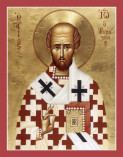 The Church celebrates the memory of this saint on November 13th and
January 30th, but on this day is celebrated the translation of his honored relics from the
Armenian village of Comana, where he died in exile in 407, to Constantinople where earlier, as
patriarch, he had governed the Church. Thirty years after his death, Patriarch Proklos made a
speech in memory of his spiritual father and mentor, and by this speech so roused the love of the
people and the emperor, Theodosios the Younger, towards the great saint that they all wanted the
relics of St. Chrysostom to be translated to Constantinople. It is related that the coffin
containing the relics could not be shifted from its place until the emperor had written a letter
to St. Chrysostom, begging his forgiveness (for Theodosios’ mother, Evdoxia, was guilty of
having persecuted the saint) and appealing to him to return to Constantinople, his former
residence. When this repentant letter was placed on the coffin, the latter became light in
weight. Before the translation, many of the sick, on touching the coffin, were healed. When the
relics arrived at the capital, the emperor again begged forgiveness over them in his
mother’s name, as though it were she herself speaking: ‘While I lived in this
temporal life, I acted in malice towards thee; but now that thou livest in eternal life, be thou
of help to my soul. My glory passes and there is nought to help me; help me, father, in thy
glory; help me before I come to be condemned before the judgment of Christ.’ When the saint
was carried into the Church of the Holy Apostles and placed on the patriarchal throne, the
assembled throng heard these words from his mouth: ‘Peace be unto all!’ The
translation of the relics of St. John Chrysostom was carried out in the year 438.
The Church celebrates the memory of this saint on November 13th and
January 30th, but on this day is celebrated the translation of his honored relics from the
Armenian village of Comana, where he died in exile in 407, to Constantinople where earlier, as
patriarch, he had governed the Church. Thirty years after his death, Patriarch Proklos made a
speech in memory of his spiritual father and mentor, and by this speech so roused the love of the
people and the emperor, Theodosios the Younger, towards the great saint that they all wanted the
relics of St. Chrysostom to be translated to Constantinople. It is related that the coffin
containing the relics could not be shifted from its place until the emperor had written a letter
to St. Chrysostom, begging his forgiveness (for Theodosios’ mother, Evdoxia, was guilty of
having persecuted the saint) and appealing to him to return to Constantinople, his former
residence. When this repentant letter was placed on the coffin, the latter became light in
weight. Before the translation, many of the sick, on touching the coffin, were healed. When the
relics arrived at the capital, the emperor again begged forgiveness over them in his
mother’s name, as though it were she herself speaking: ‘While I lived in this
temporal life, I acted in malice towards thee; but now that thou livest in eternal life, be thou
of help to my soul. My glory passes and there is nought to help me; help me, father, in thy
glory; help me before I come to be condemned before the judgment of Christ.’ When the saint
was carried into the Church of the Holy Apostles and placed on the patriarchal throne, the
assembled throng heard these words from his mouth: ‘Peace be unto all!’ The
translation of the relics of St. John Chrysostom was carried out in the year 438.
2. Our Holy Father Titus of the Kiev Caves.
He was at first a soldier, but receiving a wound in the head in battle, he retired from the world to the monastery of the Caves in Kiev, there to be healed and to receive the monastic schema. He spent his time in ceaseless mourning over his former sins. Before his death he was shown by a heavenly vision that all his sins had been forgiven. His relics lie in the caves of Theodosius.
FOR CONSIDERATION
Fasting is a great thing, but love is greater. If it is by fasting that devils are driven out, passions tamed, the body calmed, the spirit steadied, it is by love that God makes His abode with men. The Lord Himself emphasized fasting as necessary, but proclaimed love as the greatest commandment. In the first half of last century, Jeladin Bey, a Turk, ruled over Ochrid. He was a rebel against the sultan and an independent governor. At that time the Church was ruled by Metropolitan Kalinik. Jeladin and Kalinik, although of different faiths, were very good friends and often visited each other. It happened that Jeladin Bey condemned twenty-five Christians to death by hanging, and the execution was to take place on Great Friday. The metropolitan, deeply distressed by this event, went to Jeladin and besought him to mitigate the sentence. While they were talking, the hour of the midday meal arrived, and the bey invited the metropolitan to eat with him. A dish of lamb had been prepared for the meal. The metropolitan excused himself, as the fast (of the monastic rule, as well as of Holy Friday) prevented him from remaining to eat, and prepared to leave. The bey was angered and said to him: ‘Choose; either you eat with me and free twenty-five people from hanging, or you refrain and they hang.’ The metropolitan crossed himself and sat down to lunch, and Jeladin freed the people from the death sentence.
Daily Scripture Readings taken from The Orthodox New Testament, translated and published by Holy Apostles Convent, Buena Vista, Colorado, copyright © 2000, used with permission, all rights reserved.
Daily Prologue Readings taken from The Prologue of Ochrid, by Bishop Nikolai Velimirovic, translated by Mother Maria, published by Lazarica Press, Birmingham, England, copyright © 1985, all rights reserved. Edited by Dormition Skete.