

Daily Devotional
Monday, January 24, 2028 (NS), January 11, 2028 (OS)
No Fasting.
Monday of the Thirty-Second Week
The commemoration of the Afterfeast of Theophany, and our venerable Father Theodosios the Cœnobiarch.
Scripture Readings
Paschalion — Movable Calendar
Monday of the Thirty-Second Week
Epistle
The Reading is from the General Epistle of Saint Iakovos [§ 53].
2 14Brethren, what is the profit if one declare oneself to have faith but have not works? Is faith able to save him? 15Now if a brother or a sister be naked and wanting of daily food, 16and any of you should say to them, “Go in peace, warm yourselves and feed yourselves,” but ye give them not the necessities of the body, what is the profit? 17Even so faith, if it be not having works, is in itself dead. 18But someone will say, “Thou hast faith, and I have works”; show me thy faith without thy works, and I by my works will show thee my faith. 19Thou believest that God is one. Thou doest well. The demons also believe, and shudder. 20But dost thou wish to know, O vain man, that faith without works is dead? 21Was not Abraham our father justified by works, after he offered Isaac his son upon the altar? 22Thou seest that faith was working with his works, and by works faith was made perfect. 23And the Scripture was fulfilled which saith, “And Abraham believed God, and it was reckoned to him for righteousness [cf. Gen. 15:6]”; and he was called a “friend of God [cf. Ex. 33:11; Is. 41:8].” 24Ye see then that by works a man is justified, and not by faith only. 25But in like manner also was not Rahab the harlot justified by works, after she received the messengers and sent them out by another way? 26For even as the body without the spirit is dead, so also faith without works is dead.
Gospel
The Reading is from the Holy Gospel according to Saint Mark [§ 27]. At that time:
6 54After Jesus came out of the ship, straightway those of the country of Gennesaret recognized Him, 55and ran around that whole country round about, and began to carry about on the beds those who were ill to where they were hearing, “He is there.” 56And wheresoever He entered, into villages or cities or fields, in the marketplaces they kept on laying those who were sick, and beseeching Him that they might touch if just the fringe of His garment; and as many as would touch Him were made well.
7 1And the Pharisees and some of the scribes, who came from Jerusalem, gathered together to Him. 2And after they saw some of His disciples eating loaves with defiled hands, that is, unwashed hands, they found fault. 3For the Pharisees and all the Jews, unless they wash their hands, up to the elbow, eat not, holding the tradition of the elders. 4And on coming from the marketplace, unless they perform ablutions for themselves, they eat not. And there are many other things which they received and hold: dippings of cups and pitchers and copper vessels and couches. 5Then the Pharisees and the scribes questioned Him, “Why do Thy disciples not walk according to the tradition of the elders, but eat bread with unwashed hands?” 6And He answered and said to them, “Well did Esaias prophesy concerning you, the hypocrites, as it hath been written: ‘This people honoreth Me with their lips, but their heart is far away from Me [Is. 29:13]. 7“‘And in vain they revere Me, teaching as precepts the commandments of men [Is. 29:13].’ 8“For having left the commandment of God, ye keep on holding the tradition of men—dippings of pitchers and cups, and many other such like things ye do.”
Menaion — Fixed Calendar
The commemoration of the Afterfeast of Theophany, and our venerable Father Theodosios the Cœnobiarch.
Epistle
The Reading is from the Epistle of Saint Paul to the Hebrews [§ 334]. Brethren:
13 7Be remembering those who lead you, who spoke to you the word of God, whose faith keep on imitating, observing attentively the end of their conduct: 8Jesus Christ, the same yesterday and today and to the ages. 9Cease being carried about by various and strange teachings. For it is good for the heart to be confirmed by grace, not by foods, in which those walking therein were not profited. 10We have an altar from which those serving the tabernacle have no authority to eat; 11for the bodies of those animals, “whose blood is being brought into the holies for sins” by the high priest, “are being burned outside of the encampment [cf. Lev. 16:27].” 12Wherefore Jesus also, that He might sanctify the people by His own blood, suffered outside of the gate. 13Let us be going forth therefore to Him outside of the encampment, bearing His reproach; 14for we have no abiding city here, but we seek the coming one. 15Through Him, then, let us be offering up a “sacrifice of praise [Lev. 7:2(12)]” continually to God, that is, “the fruit of the lips [cf. Hos. 14:3(2); Is. 57:19],” giving thanks to His name. 16But cease being forgetful of doing good and of contributing; for God is well pleased with such sacrifices.
for Sl. usage, see [2 Cor. 4:6-15].
Gospel
The Reading is from the Holy Gospel according to Saint Matthew [§ 43]. The Lord said to His disciples:
11 27“All things were delivered to Me by My Father. And no one doth fully know the Son, except the Father; nor doth anyone fully know the Father, except the Son, and he to whomsoever the Son is willing to reveal Him. 28“Come to Me, all ye who labor and are burdened, and I will give you rest. 29“Take up My yoke upon you and learn from Me, for I am meek and humble in heart; and ye shall find rest to your souls. 30“For My yoke is good and My burden is light.”
Lives of the Saints (Prologue)
January 24th – Civil Calendar
January 11th – Church Calendar
1. Our Holy Father Theodosios the Great.
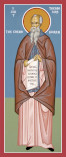 The first founder and organizer of cenobitic
monasticism, he was born of devout parents in Cappadocia, in the village of Mogarisses. As a
young man, he visited St. Simeon the Stylite, who blessed him and predicted for him great
spiritual glory. Theodosios set out in search of a place in which to found a monastery. He took
with him a censer containing cold charcoal and incense. At the place where the charcoal suddenly
ignited of itself, he stopped, settled down and began to lead a life of asceticism. There very
quickly gathered round him many monks of different nationalities and with different languages. He
therefore built a church for each language group, so that services were conducted and God praised
at the same moment in Greek, Armenian, Georgian and so forth. But on a day when they were to
receive holy Communion, all the brethren gathered in the great church, where the service was
conducted in Greek. The refectory was common to all; they held all possessions in common, labored
in common, endured in common and often hungered in common. Theodosios was a sublime example to
all the monks; an example in work, in prayer, in fasting, in vigils and in all the Christian
virtues. And God endowed him with the gifts of wonder-working, to heal the sick, to be present
and help from a distance, to tame wild beasts, to predict the future and to increase bread and
wheat. Prayer was on his lips day and night. He entered peacefully into rest in the Lord in the
year 529, at the age of 105.
The first founder and organizer of cenobitic
monasticism, he was born of devout parents in Cappadocia, in the village of Mogarisses. As a
young man, he visited St. Simeon the Stylite, who blessed him and predicted for him great
spiritual glory. Theodosios set out in search of a place in which to found a monastery. He took
with him a censer containing cold charcoal and incense. At the place where the charcoal suddenly
ignited of itself, he stopped, settled down and began to lead a life of asceticism. There very
quickly gathered round him many monks of different nationalities and with different languages. He
therefore built a church for each language group, so that services were conducted and God praised
at the same moment in Greek, Armenian, Georgian and so forth. But on a day when they were to
receive holy Communion, all the brethren gathered in the great church, where the service was
conducted in Greek. The refectory was common to all; they held all possessions in common, labored
in common, endured in common and often hungered in common. Theodosios was a sublime example to
all the monks; an example in work, in prayer, in fasting, in vigils and in all the Christian
virtues. And God endowed him with the gifts of wonder-working, to heal the sick, to be present
and help from a distance, to tame wild beasts, to predict the future and to increase bread and
wheat. Prayer was on his lips day and night. He entered peacefully into rest in the Lord in the
year 529, at the age of 105.
2. Blessed Michael of Klops.
A fool for Christ, a Russian of princely family, he made himself a fool in order to hide his virtues from the world and escape the praise of men, and he thus received praise from God. He died in the year 1453 in the monastery of Klops near Novgorod, where his relics are preserved.
FOR CONSIDERATION
A man who is open to a bribe cannot be a Christian. The Orthodox fathers of the Church were never open either to bribes or intimidation. Bribery in things of the Faith is equivalent to Judas’ betrayal of Christ for money; such bribery is a characteristic only of certain heretics. When the Emperor Anastasios (491-518) fell into the Eftychian heresy, he rebelled against the decisions of the Fourth Ecumenical Council and attempted to revoke them. In order to win the chief leaders of the Church to his side, he began sending them various gifts. St. Theodosios was the first in renown in Palestine, and to him the emperor sent thirty liters of gold, ostensibly for the needs of his monastery. Theodosios realized immediately that the emperor meant this as a bribe, and acted with very great wisdom. He would not keep the money for the monastery, although it was in great need, nor return it to the emperor for him to work more evil with it against Orthodoxy, so he instantly distributed all the gold to the poor in the emperor’s name, that this act of charity might strengthen his prayers for the emperor’s repentance and return to the true path.
Daily Scripture Readings taken from The Orthodox New Testament, translated and published by Holy Apostles Convent, Buena Vista, Colorado, copyright © 2000, used with permission, all rights reserved.
Daily Prologue Readings taken from The Prologue of Ochrid, by Bishop Nikolai Velimirovic, translated by Mother Maria, published by Lazarica Press, Birmingham, England, copyright © 1985, all rights reserved. Edited by Dormition Skete.