

Daily Devotional
Sunday, January 2, 2028 (NS), December 20, 2027 (OS)
Fast Day, but Shellfish, Wine and Olive Oil Allowed.
The Sunday Before the Nativity of Christ: The Commemoration of the Holy Fathers.
Sunday of the Twenty-Eighth Week
Mode Three — Sixth Eothinon
20.The commemoration of Hieromartyr Ignatios the God-bearer, and St. John of Kronstadt.
Scripture Readings
Special Commemorations
The Sunday Before the Nativity of Christ: The Commemoration of the Holy Fathers.
Epistle
The Reading is from the Epistle of Saint Paul to the Hebrews [§ 328]. Brethren:
For Gk. usage, read Heb. 11:9, 10, 32-40; for Sl. usage, read Heb. 11:9, 10, 17-23, 32-40.
11 9By faith Abraham sojourned in the land of the promise, as in a foreign land, having dwelt in tents with Isaac and Jacob, the joint-heirs of the same promise; 10for he was waiting for the city which hath the foundations of which the artificer and maker is God....
Sl. usage adds Heb. 11:17-23, and then verses 32-40, but Gk. usage skips to Heb. 11:32-40.
17By faith Abraham, when he was put to the test, offered up Isaac, and he who received the promises offered up his only-begotten son, 18as to whom it was said “for in Isaac thy seed shall be called [Gen. 21:12],” 19reckoning that God was able to raise even from the dead; from which also he received him for himself in a type. 20By faith Isaac blessed Jacob and Esau concerning coming things. 21By faith Jacob, when he was dying, blessed each of the sons of Joseph, and “did reverence upon the top of his staff [Gen. 47:31].” 22By faith Joseph, when he was dying, made mention concerning the exodus of the sons of Israel, and gave command concerning his bones. 23By faith Moses, after he was born, was hid three months by his parents, because “they saw the little child was fair [cf. Ex. 2:2],” and they were not afraid of the edict of the king....
Both Gk. and Sl. usages conclude with Heb. 11:32-40.
32And what more shall I say? For the time will fail me narrating about Gideon and Barak and also Samson and Jephthae, and about David and Samuel and the prophets, 33who through faith struggled against kingdoms, wrought righteousness, attained to promises, stopped mouths of lions, 34quenched the power of fire, escaped the edges of the sword, were empowered out of weakness, became strong in battle, turned back encampments of aliens. 35Women received their dead by resurrection. And others were tortured, not accepting release, that they might attain a better resurrection. 36And others received trial of mockings and of scourgings, and, moreover, of bonds and of imprisonment. 37They were stoned, they were sawn asunder, were tempted; they died, murdered by the sword. They went about in sheepskins, in goatskins, being in need, afflicted, ill-treated— 38of whom the world was not worthy. They were made to wander in deserts, and in mountains, and in caves, and in the holes of the earth. 39And these all, having been approved by testimony through faith, received not for themselves the promise, 40God having foreseen some better thing concerning us, that they should not be made perfect without us.
Gospel
The Reading is from the Holy Gospel according to Saint Matthew [§ 1].
1 1The book of the generation of Jesus Christ, the Son of David, the Son of Abraham.
2Abraham begat Isaac, and Isaac begat Jacob, and Jacob begat Judas and his brethren, 3and Judas begat Phares and Zara of Thamar, and Phares begat Esrom, and Esrom begat Aram, 4and Aram begat Aminadab, and Aminadab begat Naasson, and Naasson begat Salmon, 5and Salmon begat Booz of Rachab, and Booz begat Obed of Ruth, and Obed begat Jesse, 6and Jesse begat David the king. And David the king begat Solomon of her who had been the wife of Urias, 7and Solomon begat Roboam, and Roboam begat Abia, and Abia begat Asa, 8and Asa begat Josaphat, and Josaphat begat Joram, and Joram begat Ozias, 9and Ozias begat Joatham, and Joatham begat Achaz, and Achaz begat Ezekias, 10and Ezekias begat Manasses, and Manasses begat Amon, and Amon begat Josias, 11and Josias begat Jechonias and his brethren, in the time of the deportation to Babylon. 12And after the deportation to Babylon, Jechonias begat Salathiel, and Salathiel begat Zorobabel, 13and Zorobabel begat Abiud, and Abiud begat Eliakeim, and Eliakeim begat Azor, 14and Azor begat Sadok, and Sadok begat Acheim, and Acheim begat Eliud, 15and Eliud begat Eleazar, and Eleazar begat Matthan, and Matthan begat Jacob, 16and Jacob begat Joseph the husband of Mary, of whom was born Jesus Who is called Christ.
17Then all the generations from Abraham until David are fourteen generations, and from David until the deportation to Babylon are fourteen generations, and from the deportation to Babylon until the Christ are fourteen generations.
18Now the birth of Jesus Christ was thus: For His Mother, Mary, having been betrothed to Joseph, before they came together, was found to be with child of the Holy Spirit. 19But Joseph her husband, being just, and yet not willing to make her an example, wished to divorce her secretly. 20And after he pondered these things, behold, an angel of the Lord appeared to him in a dream, saying, “Joseph, son of David, do not become afraid to take to thee Mariam thy wife; for that which is in her was begotten of the Holy Spirit. 21“And she shall bring forth a Son and thou shalt call His name Jesus, for He shall save His people from their sins. 22“Now all this came to pass, in order that it might be fulfilled that which was spoken by the Lord through the prophet, saying, 23“‘Behold, the virgin shall be with child, and shall bring forth a son, and they shall call His name Emmanuel [cf. Is. 7:14],’” which is, being interpreted, “God with us.” 24And Joseph, having been awakened from sleep, did as the angel of the Lord commanded him, and took to him his wife, 25and was not knowing her until she brought forth her Son, the firstborn; and he called His name Jesus.
Paschalion — Movable Calendar
Sunday of the Twenty-Eighth Week
Mode Three — Sixth Eothinon
Epistle
The Reading is from the Epistle of Saint Paul to the Colossians [§ 250]. Brethren:
1 12Give thanks to the God and Father Who rendereth us sufficient for the portion of the lot of the saints in the light, 13Who delivered us from the power of the darkness and translated us into the kingdom of the Son of His love, 14in Whom we have the redemption through His blood, the forgiveness of sins, 15Who is the image of the invisible God, the firstborn of all creation. 16For in Him were all things created, the things in the heavens and the things upon the earth, the visible and the invisible, whether thrones, or dominions, or principalities, or authorities. All things through Him and to Him have been created. 17And He is before all things, and in Him all things have come into existence. 18And He is the head of the body, the Church, Who is the beginning, the firstborn from the dead, that in all things He might come to hold first place.
Gospel
The Reading is from the Holy Gospel according to Saint Luke [§ 91]. At that time:
18 18A certain ruler came to Jesus and questioned Him, saying, “Good Teacher, by doing what shall I inherit eternal life?” 19And Jesus said to him, “Why callest thou Me good? No one is good except One: God. 20“Thou knowest the commandments: ‘Do not commit adultery, do not murder, do not steal, do not bear false witness, be honoring thy father and thy mother [cf. Ex. 20:13, 15, 14, 16, 12].’” 21And he said, “All these I kept for myself from my youth.” 22And after Jesus heard these things, He said to him, “Yet one thing is wanting to thee: sell all, as much as thou hast, and distribute to the poor, and thou shalt have treasure in heaven; and come and keep on following Me.” 23And after he heard these things, he became deeply grieved, for he was exceedingly rich. 24And after Jesus saw him become deeply grieved, He said, “How with difficulty shall they who have riches enter into the kingdom of God! 25“For it is easier for a camel to enter through a needle’s eye than for a rich man to enter the kingdom of God.” 26And they who heard it said, “And who is able to be saved?” 27And He said, “The things impossible with men are possible with God.”
Menaion — Fixed Calendar
20.The commemoration of Hieromartyr Ignatios the God-bearer, and St. John of Kronstadt.
Epistle
For the God-bearer:
The Reading is from the Epistle of Saint Paul to the Hebrews [§ 325]. Brethren:
10 32Remind yourselves of the former days in which, after ye were illuminated, ye endured a great contest of sufferings: 33partly, being made a show of both by reproaches and affliction; and partly, having become partners of those who conducted themselves thus. 34For ye also sympathized with those in bonds and ye yourselves accepted the seizure of your possessions with joy, knowing in yourselves that ye have in the heavens a better and abiding possession. 35Do not begin therefore to cast away your boldness which hath great recompense. 36For ye have need of patience, that, after ye do the will of God, ye might receive for yourselves the promise. 37“For yet a very little while, the One Who cometh will come, and will not delay [cf. Hab. 2:3]. 38“Now the just shall live by faith; and if one should draw himself back, My soul hath no pleasure in him [cf. Hab. 2:4].”
for Sl. usage, see [Heb. 4:14-5:6].
For St. John:
The Reading is from the First General Epistle of Saint John [§ mid 73].
4 7Beloved, let us be loving one another, for love is of God, and everyone who loveth hath been born of God and knoweth God. 8The one who loveth not knoweth not God, for God is love. 9In this was manifest the love of God among us, because God hath sent forth His only-begotten Son into the world, in order that we might live through Him. 10In this is love, not that we loved God, but that He Himself loved us, and sent forth His Son to be an expiation for our sins. 11Beloved, if God so loved us, we ought also to love one another.
Gospel
For the God-bearer:
The Reading is from the Holy Gospel according to Saint Mark [§ 41]. At that time:
9 33Jesus and His disciples came to Capernaum. And when He was in the house, He was questioning them, “What were ye discussing among yourselves on the way?” 34But they were keeping silent; for on the way they discussed with one another who was greater. 35And He sat down and called the twelve, and saith to them, “If anyone doth wish to be first, he shall be last of all and servant of all.” 36And He took a little child and set him in their midst. And after He took him into His arms, He said to them, 37“Whosoever shall receive one of such little children in My name, receiveth Me; and whosoever shall receive Me, receiveth not Me, but the One Who sent Me forth.”
38And John answered Him, saying, “Teacher, we saw someone who doth not follow us casting out demons in Thy name, and we hindered him, because he doth not follow us.” 39But Jesus said, “Cease hindering him, for there is no one who shall do a work of power in My name, and be able quickly to speak evil of Me. 40“For he who is not against us is for us. 41“For whosoever shall give you a cup of water to drink in My name, because ye are of Christ, verily I say to you, in no wise shall he lose his reward.”
For St. John:
The Reading is from the Holy Gospel according to Saint Luke [§ 26]. The Lord said:
6 31“Even as ye wish that men be doing to you, also be ye doing to them in like manner. 32“And if ye should love those who love you, what kind of thanks is there to you? For even the sinners love those who love them. 33“And if ye should do good to those who do good to you, what kind of thanks is there to you? For even the sinners do the same. 34“And if ye should lend to those from whom ye hope to receive, what kind of thanks is there to you? For also the sinners lend to sinners, in order that they might receive the same. 35“But keep on loving your enemies and doing good, and lending, hoping to receive back nothing; and your reward shall be great, and ye shall be sons of the Highest; for He is kind to the unthankful and to the evil. 36“Therefore keep on becoming compassionate, even as your Father also is compassionate.”
Lives of the Saints (Prologue)
January 2nd – Civil Calendar
December 20th – Church Calendar
1. The Hieromartyr Ignatius the God-Bearer, Bishop of Antioch.
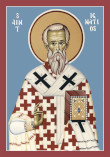 This holy man was named the
‘God-Bearer’ because he always carried the name of the living God in his heart and on
his lips. Also, by tradition, he was thus named because he was held in the arms of God incarnate,
Jesus Christ. On a day when the Lord was teaching His disciples humility, He took a child and set
it among them, saying: ‘Whosoever shall humble himself as this little child, the same is
greatest in the kingdom of heaven’ (Matt. 18:4). This child was Ignatius. He was later a
disciple of St. John the Theologian, together with Polycarp, the Bishop of Smyrna. As bishop in
Antioch, he governed the Church of God as a good shepherd, and was the first to introduce
antiphonal singing into the Church, in which two choirs alternate. This way of singing was
revealed to St. Ignatius from among the angels in heaven. When the Emperor Trajan passed through
Antioch on his way to battle with the Persians, he heard about Ignatius, summoned him and urged
him to offer sacrifice to idols, so that he could be made a senator. The emperor’s urgings
and threats being in vain, holy Ignatius was put in irons and sent to Rome, escorted by ten
bestial soldiers, to be thrown to the wild beasts. Ignatius rejoiced to be suffering for his
Lord, and prayed to God that the wild beasts should be the tomb for his body, and that none
should hinder his death. After a long and difficult journey from Asia through Thrace, Macedonia
and Epirus, Ignatius reached Rome, where he was thrown to the lions in the circus. They tore him
to pieces and devoured him, leaving only a few of the larger bones and his heart. This glorious
lover of the Lord Christ suffered in the year 106 in Rome, in the time of the Emperor Trajan. He
appeared many times from the other world and worked wonders, helping to this day all who call on
him for help.
This holy man was named the
‘God-Bearer’ because he always carried the name of the living God in his heart and on
his lips. Also, by tradition, he was thus named because he was held in the arms of God incarnate,
Jesus Christ. On a day when the Lord was teaching His disciples humility, He took a child and set
it among them, saying: ‘Whosoever shall humble himself as this little child, the same is
greatest in the kingdom of heaven’ (Matt. 18:4). This child was Ignatius. He was later a
disciple of St. John the Theologian, together with Polycarp, the Bishop of Smyrna. As bishop in
Antioch, he governed the Church of God as a good shepherd, and was the first to introduce
antiphonal singing into the Church, in which two choirs alternate. This way of singing was
revealed to St. Ignatius from among the angels in heaven. When the Emperor Trajan passed through
Antioch on his way to battle with the Persians, he heard about Ignatius, summoned him and urged
him to offer sacrifice to idols, so that he could be made a senator. The emperor’s urgings
and threats being in vain, holy Ignatius was put in irons and sent to Rome, escorted by ten
bestial soldiers, to be thrown to the wild beasts. Ignatius rejoiced to be suffering for his
Lord, and prayed to God that the wild beasts should be the tomb for his body, and that none
should hinder his death. After a long and difficult journey from Asia through Thrace, Macedonia
and Epirus, Ignatius reached Rome, where he was thrown to the lions in the circus. They tore him
to pieces and devoured him, leaving only a few of the larger bones and his heart. This glorious
lover of the Lord Christ suffered in the year 106 in Rome, in the time of the Emperor Trajan. He
appeared many times from the other world and worked wonders, helping to this day all who call on
him for help.
2. St. Danilo, Archbishop of Serbia.
The son of rich and God-loving parents, he was given a careful upbringing. King Milutin took him to his court, but from love of God, he fled and became a monk in the monastery of Konculsk near the Ibar. He was later abbot of Hilandar and suffered much at the hands of the plundering Latin crusaders. He was Bishop of Banja and then of Hum, and finally Archbishop of Serbia. He was from beginning to end a strict ascetic, with a special gift of tears. He made peace between Kings Dragutin and Milutin, and later between Milutin and Stefan of Dečani, and fought fiercely against the Latins and the Bogomils. Under his supervision, the monasteries of Banja and Dečani were built, and he restored and built many other churches. He also recorded the lives of the Serbian kings and saints. Untiring in the service of God to the end of his life, he entered peacefully into rest in the time of King Dušan, on the night of December 19/20th, 1338. He was a great hierarch, a great ascetic, a great worker and a great patriot.
FOR CONSIDERATION
The holy martyrs, consumed by love for Christ, were like unquenchable flames. This love eased their sufferings and made death sweet. St. John Chrysostom says of St. Ignatius: ‘He put off his body as easily as a man takes off his clothes.’ Travelling to Rome to his death, Ignatius had only one fear: that Christians would somehow impede his martyrdom for Christ, by their prayers or in some outward way. He therefore implored them constantly, in writing and in speech, not to do this. ‘Forgive me,’ he said, ‘I know what is useful to me. I but begin to be a disciple of Christ when I desire nothing, either visible or invisible, but to come to Christ. May every devilish torture come upon me: fire, crucifixion, wild beasts, the sword, tearing asunder, the breaking of my bones, the crushing of my whole body—only that I may receive Jesus Christ. It is better for me to die for Christ than to reign to the ends of the earth.... My love cleaves to the Cross, and there is no spark of love in me for any earthly thing.’ When he was taken to the circus, he spoke thus to the people: ‘Citizens of Rome, know that I am not being punished for any wrong-doing, neither have I been condemned to death for any transgressing, but for the sake of my God, by Whose love I am gripped and Whom I desire with an insatiable desire. I am His wheat; may I be ground by the teeth of beasts, that I may be His pure bread.’
Daily Scripture Readings taken from The Orthodox New Testament, translated and published by Holy Apostles Convent, Buena Vista, Colorado, copyright © 2000, used with permission, all rights reserved.
Daily Prologue Readings taken from The Prologue of Ochrid, by Bishop Nikolai Velimirovic, translated by Mother Maria, published by Lazarica Press, Birmingham, England, copyright © 1985, all rights reserved. Edited by Dormition Skete.