

Daily Devotional
Sunday, December 19, 2027 (NS), December 6, 2027 (OS)
Fast Day, but Fish, Wine and Olive Oil Allowed.
Fourth Period
Sunday of the Twenty-Sixth Week
Mode One — Fourth Eothinon
The commemoration of our father among the saints, Nicholas, Bishop of Myra of Lycia, the Wonder-worker.
Scripture Readings
Paschalion — Movable Calendar
Fourth Period
Sunday of the Twenty-Sixth Week
Mode One — Fourth Eothinon
Epistle
The Reading is from the Epistle of Saint Paul to the Ephesians [§ 229]. Brethren:
5 8Be walking as children of light— 9for the fruit of the Spirit is in all goodness and righteousness and truth— 10proving what is well-pleasing to the Lord. 11And cease having fellowship with the unfruitful works of darkness, but rather even reprove them. 12For it is shameful even to speak of the things which are done by them in secret. 13But all things which are reproved are made manifest by the light; for all which is made manifest is light. 14Wherefore, He saith, “Rouse thyself, thou who sleepest, and arise from the dead, and the Christ shall shine on thee [cf. Is. 9:2, 26:19, 52:1, 60:1, 2].”
15Be taking heed then how exactly ye walk, not as unwise ones, but as wise ones, 16redeeming the time, because the days are evil. 17On this account cease becoming foolish, but become as ones understanding what the will of the Lord is. 18And cease being drunk with wine, in which is prodigality, but keep on being filled with the Spirit, 19speaking to one another in psalms and hymns and spiritual songs, singing and chanting in your heart to the Lord.
Gospel
The Reading is from the Holy Gospel according to Saint Luke [§ 71]. At that time:
13 10Jesus was teaching in one of the synagogues on the sabbath days. 11And behold, there was a woman who had a spirit of infirmity eighteen years, and was bowed together, and was utterly unable to lift herself up. 12And having seen her, Jesus called to her and said to her, “Woman, thou hast been loosed from thine infirmity.” 13And He laid His hands upon her, and immediately she was set straight again, and was glorifying God. 14But the ruler of the synagogue, being indignant because Jesus cured on the sabbath, answered and was saying to the crowd, “There are six days in which is it fitting to work; within these therefore come and be cured, but not on the day of the sabbath.” 15The Lord then answered him and said, “Hypocrite, doth not each of you on the sabbath loose his ox or ass from the manger, and lead it away and give it drink? 16“And ought not this woman, being a daughter of Abraham, whom Satan bound, lo, eighteen years, to be loosed from this bond on the day of the sabbath?” 17And when He said these things, all those who opposed Him were put to shame; but the whole crowd was rejoicing over all the glorious things which were being done by Him.
Menaion — Fixed Calendar
The commemoration of our father among the saints, Nicholas, Bishop of Myra of Lycia, the Wonder-worker.
Epistle
The Reading is from the Epistle of Saint Paul to the Hebrews [§ 335]. Brethren:
13 17Be obedient to those who lead you, and keep on submitting, for they are watchful for your souls, as those about to render an account, that they may do this with joy, and not groaning; for this would be unprofitable for you. 18Keep on praying for us; for we trust that we have a good conscience, in all things wishing to conduct ourselves well. 19But I beseech you more abundantly to do this, that I might be restored more quickly to you.
20Now the God of peace Who brought up from the dead our Lord Jesus, the Shepherd of the sheep, the great One, in the blood of an everlasting covenant, 21may He render you perfect in every good work, in order to do His will, doing in you that which is well-pleasing before His face, through Jesus Christ, to Whom be glory to the ages of the ages. Amen.
Gospel
The Reading is from the Holy Gospel according to Saint Luke [§ 24]. At that time:
6 17Jesus stood upon a level place. And there was a crowd of
His disciples, and a great multitude of the people from all of Judæa and Jerusalem and the
seacoast of Tyre and Sidon, who came to hear Him, and to be healed of their diseases—
18even those who were troubled by unclean spirits; and they were cured.
19And all the crowd was seeking to touch Him, for power was coming forth from Him and
healing all. 20And He lifted up His eyes to His disciples, and began to say:
“Blessed are the poor, for yours is the kingdom of God.
21“Blessed are ye who hunger now, for ye shall be
filled.
Blessed are ye who weep now, for ye shall laugh.
22“Blessed are ye whenever men hate you, and whenever they
separate you, and reproach you, and cast out your name as evil, on account of the Son of
Man.
23“Rejoice in that day and leap for joy, for behold, your
reward is great in the heavens.”
Lives of the Saints (Prologue)
December 19th – Civil Calendar
December 6th – Church Calendar
1. St. Nicholas the Wonder-worker, Archbishop of Myra in Lycia.
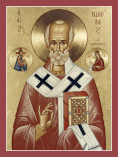 This saint, famed throughout the
entire world today, was the only son of his eminent and wealthy parents, Theophanes and Nona,
citizens of Patara in Lycia. They dedicated to God the only son He gave them. St. Nicholas was
instructed in the spiritual life by his uncle Nicholas, Bishop of Patara (see below), and became
a monk at ‘New Sion,’ a monastery founded by his uncle. On the death of his parents,
Nicholas distributed all the property he inherited to the poor and kept nothing back for himself.
As a priest in Patara, he was known for his charitable works, fulfilling the Lord’s words:
‘Let not thy left hand know what thy right hand doeth’ (Matt. 6:3). When he embraced
a life of solitude and silence, thinking to live in that way until his death, a voice from on
high came to him: ‘Nicholas, set about your work among the people if you desire to receive
a crown from Me.’ Immediately after that, by God’s wondrous providence, he was chosen
as archbishop of the city of Myra in Lycia. Merciful, wise and fearless, Nicholas was a true
shepherd to his flock. He was cast into prison during the persecutions of Diocletian and
Maximian, but even there continued to instruct the people in the law of God. He was present at
the First Ecumenical Council in Nicaea in 325, and in his zeal, struck Arius with his hand. For
this act, he was removed from the council and from his episcopal duties, until some of the chief
hierarchs had a vision of our Lord Christ and His most holy Mother showing their sympathy with
Nicholas.
This saint, famed throughout the
entire world today, was the only son of his eminent and wealthy parents, Theophanes and Nona,
citizens of Patara in Lycia. They dedicated to God the only son He gave them. St. Nicholas was
instructed in the spiritual life by his uncle Nicholas, Bishop of Patara (see below), and became
a monk at ‘New Sion,’ a monastery founded by his uncle. On the death of his parents,
Nicholas distributed all the property he inherited to the poor and kept nothing back for himself.
As a priest in Patara, he was known for his charitable works, fulfilling the Lord’s words:
‘Let not thy left hand know what thy right hand doeth’ (Matt. 6:3). When he embraced
a life of solitude and silence, thinking to live in that way until his death, a voice from on
high came to him: ‘Nicholas, set about your work among the people if you desire to receive
a crown from Me.’ Immediately after that, by God’s wondrous providence, he was chosen
as archbishop of the city of Myra in Lycia. Merciful, wise and fearless, Nicholas was a true
shepherd to his flock. He was cast into prison during the persecutions of Diocletian and
Maximian, but even there continued to instruct the people in the law of God. He was present at
the First Ecumenical Council in Nicaea in 325, and in his zeal, struck Arius with his hand. For
this act, he was removed from the council and from his episcopal duties, until some of the chief
hierarchs had a vision of our Lord Christ and His most holy Mother showing their sympathy with
Nicholas.
This wonderful saint was a defender of the truth of God, and was ever a spirited champion of justice among the people. On two occasions, he saved three men from undeserved sentences of death. Merciful, trustworthy and loving right, he walked among the people like an angel of God. People considered him a saint even during his lifetime, and invoked his aid when in torment or distress. He would appear both in dreams and in reality to those who called upon him for help, responding speedily to them, whether close at hand or far away. His face would shine with light as Moses’ did aforetime, and his mere presence among people would bring solace, peace and goodwill. In old age, he sickened of a slight illness, and went to his rest in the Lord after a life full of labor and fruitful toil. He now enjoys eternal happiness in the kingdom of heaven, continuing to help the faithful on earth by his miracles, and to spread the glory of God. He entered into rest on December 6th, 343.
2. St. Nicholas, Bishop of Patara.
The uncle of the great St. Nicholas, he set his nephew on the spiritual path and ordained him priest.
3. The Holy Martyr Nicholas of Karamanos.
He was harshly tortured by the Turks, and was hanged in Smyrna in 1657.
4. St. Theophilus, Bishop of Antioch.
A man well-versed in Hellenistic philosophy, he became a Christian through reading the holy Scriptures and became a great champion of the Christian Faith. His work ‘On the Faith’ is extant today. He governed the Church in Antioch for thirteen years, and went to his rest in the year 181.
FOR CONSIDERATION
On icons of St. Nicholas, our Lord and Savior will often be seen on one side with the Gospels in His hand, and the most holy Mother of God on the other with an episcopal omophorion in hers. This has a twofold historical significance: it denotes, firstly, Nicholas’ calling to the episcopal office, and secondly his vindication and reinstatement following the punishment for his clash with Arius. St. Methodius, Patriarch of Constantinople, writes: ‘One night, St. Nicholas saw our Savior in glory, standing by him and holding out to him the Gospels adorned with gold and pearls, and the Mother of God standing on his other side and placing an omophorion on his shoulders. Shortly after this vision, John, the then Archbishop of Myra, died, and Nicholas was installed as Archbishop of that city.’ That was the first occasion. The second occurred at the time of the First Ecumenical Council in Nicaea. Unable to put a stop by argument to the senseless blasphemy of Arius against the Son of God and His most pure Mother, St. Nicholas struck Arius in the face. The holy fathers at the council strongly disapproved of such behavior, and they banned Nicholas from the council and stripped him of all marks of his episcopal rank. That very night, several of the fathers had the selfsame vision: how the Lord stood on one side of Nicholas with the Gospels and the Mother of God on the other with an omophorion, offering to the saint those marks of rank that had been stripped from him. Seeing this, the fathers were amazed, and quickly returned to Nicholas that which they had taken from him. They began from that time to respect him as a great man, and to interpret his action against Arius not as some senseless rage but as the expression of great zeal for God’s truth.
Daily Scripture Readings taken from The Orthodox New Testament, translated and published by Holy Apostles Convent, Buena Vista, Colorado, copyright © 2000, used with permission, all rights reserved.
Daily Prologue Readings taken from The Prologue of Ochrid, by Bishop Nikolai Velimirovic, translated by Mother Maria, published by Lazarica Press, Birmingham, England, copyright © 1985, all rights reserved. Edited by Dormition Skete.