

Daily Devotional
Saturday, October 9, 2027 (NS), September 26, 2027 (OS)
No Fasting.
22. The commemoration of our venerable Fathers whose incorrupt relics rest in the Near Caves of Kiev.
If the 22nd of September should occur on a Saturday, we commemorate our venerable Fathers whose incorrupt relics rest in the Near Caves of Kiev. If the 22nd does not occur on a Saturday, this feast shall be commemorated on the Saturday following the 22nd of September.
Saturday of the Sixteenth Week
The commemoration of the translation of the holy Apostle and Evangelist John the Theologian.
Scripture Readings
Special Commemorations
22. The commemoration of our venerable Fathers whose incorrupt relics rest in the Near Caves of Kiev.
If the 22nd of September should occur on a Saturday, we commemorate our venerable Fathers whose incorrupt relics rest in the Near Caves of Kiev. If the 22nd does not occur on a Saturday, this feast shall be commemorated on the Saturday following the 22nd of September.
Epistle
The Reading is from the Second Epistle of Saint Paul to the Corinthians [§§ 176, 177]. Brethren:
4 6It is God Who said, “Let there be light [cf. Gen. 1:3]” to shine out of darkness, Who shined in our hearts, for the illumination of the knowledge of the glory of God in the face of Jesus Christ.
7But we have this treasure in earthen vessels, that the preeminence of the power may be of God, and not from us. 8In every way we are afflicted, but not straitened; we are at a loss, but not utterly at a loss; 9persecuted, but not abandoned; cast down, but not destroyed— 10always bearing about in the body the dying of the Lord Jesus, that the life also of Jesus might be made manifest in our body. 11For we, the living, are always being delivered to death on account of Jesus, that also the life of Jesus might be made manifest in our mortal flesh. 12So that indeed death energizeth itself in us, but life in you. 13But having the same spirit of faith, according to that which hath been written: “I believed, wherefore I spoke [Ps. 115(116):1(10)],” we also believe, and therefore speak, 14knowing that the One Who raised up the Lord Jesus shall raise up us also through Jesus, and shall present us with you. 15For all things are for your sakes, that the grace, which abounded through the majority, might cause the giving of thanks to abound more to the glory of God.
Gospel
The Reading is from the Holy Gospel according to Saint Matthew [§ 43]. The Lord said to His disciples:
11 27“All things were delivered to Me by My Father. And no one doth fully know the Son, except the Father; nor doth anyone fully know the Father, except the Son, and he to whomsoever the Son is willing to reveal Him. 28“Come to Me, all ye who labor and are burdened, and I will give you rest. 29“Take up My yoke upon you and learn from Me, for I am meek and humble in heart; and ye shall find rest to your souls. 30“For My yoke is good and My burden is light.”
Paschalion — Movable Calendar
Saturday of the Sixteenth Week
Epistle
The Reading is from the First Epistle of Saint Paul to the Corinthians [§ 146]. Brethren:
10 23All things are lawful to me, but not all things are expedient; all things are lawful to me, but not all things build up. 24Let no one seek that of his own, but each one that of the other. 25Keep on eating everything that is sold in a market, examining nothing for the sake of conscience: 26for “the earth is the Lord’s, and the fullness thereof [Ps. 23(24):1].” 27And if any of the unbelievers invite you, and ye wish to go, be eating everything set before you, examining nothing for the sake of conscience. 28If anyone should tell you, “This is a sacrifice to idols,” cease eating, on account of that one who informed, and for the sake of conscience; for “the earth is the Lord’s, and the fullness thereof [Ps. 23(24):1].”
Gospel
The Reading is from the Holy Gospel according to Saint Luke [§ 15]. At that time:
4 31Jesus went down to Capernaum, a city of Galilee, and was teaching them on the sabbath days. 32And they were astonished at His teaching, for His word was with authority. 33And in the synagogue there was a man who had an unclean demon; and he cried out with a loud voice, 34saying, “Ha! What is it to us and to Thee, Jesus, O Nazarene? Art Thou come to destroy us? I know Thee Who Thou art, the Holy One of God.” 35And Jesus rebuked him, saying, “Be thou muzzled, and come forth out of him.” And after the demon threw him in the midst, he came out from him, and by no means hurt him. 36And amazement came upon all, and they were talking together with one another saying, “What word is this, for with authority and power He commandeth the unclean spirits, and they come out?”
Menaion — Fixed Calendar
The commemoration of the translation of the holy Apostle and Evangelist John the Theologian.
Epistle
The Reading is from the First Epistle of Saint John [§ mid 73]. My beloved:
4 12No one hath beheld God at any time. If we be loving one another, God abideth in us, and His love is made perfect in us. 13In this we know that we abide in Him, and He in us, because He hath given us of His Spirit. 14And we have beheld and bear witness that the Father hath sent forth the Son as Savior of the world. 15Whosoever shall confess that Jesus is the Son of God, God abideth in him, and he in God. 16And we have come to know and have believed the love which God hath in us. God is love; and the one abiding in love, abideth in God, and God in him. 17In this hath love been made perfect with us, in order that we may have boldness in the day of judgment, that even as He is, we are also in this world. 18There is no fear in love; but perfect love casteth out fear, because fear hath punishment; and the one who feareth hath not been made perfect in love. 19We love Him, because He first loved us.
Gospel
The Reading is from the Holy Gospel according to Saint John [§§ 61, mid 67]. At that time:
19 25There had stood by the Cross of Jesus His Mother, and His Mother’s sister, Mary the wife of Cleopas, and Mary Magdalene. 26Then Jesus, having seen His Mother and the disciple whom He loved standing by, saith to His Mother, “Woman, behold thy son.” 27Then He saith to the disciple, “Behold, thy Mother.” And from that hour the disciple took her into his own home....
21 24This is the disciple who beareth testimony concerning these things, and wrote these things; and we know that his testimony is true. 25And there are also many other things, which if as much as Jesus did may be written one by one, I suppose even the world itself could not contain the books that would be written. Amen.
Lives of the Saints (Prologue)
Special Commemorations
The commemoration of our venerable Fathers whose incorrupt relics rest in the Near Caves of Kiev.
If the 22nd of September should occur on a Saturday, we commemorate our venerable Fathers whose incorrupt relics rest in the Near Caves of Kiev. If the 22nd does not occur on a Saturday, this feast shall be commemorated on the Saturday following the 22nd of September.
The Synaxis of all the Saints of the Kiev Near Caves.
The blessed work of asceticism begun by Anthony, the lover of labor and man of God, grew throughout the ages as a fruitful olive tree. The numerous saints, who shone like stars in these caves of Anthony’s, are each commemorated on his special day. Today, the whole assembly of them is commemorated and invoked by the faithful for aid.
Menaion — Fixed Calendar
October 9th – Civil Calendar
September 26th – Church Calendar
1. St. John the Theologian, Apostle and Evangelist.
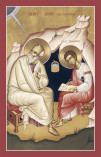 John was the son of Zebedee the fisherman
and Salome the daughter of Joseph, the betrothed of the holy Mother of God. Called by the Lord
Jesus, John immediately left his father and the fishing nets and followed Christ with his brother
Iakovos. From that time, he was not parted from his Lord until the end. With Peter and Iakovos,
he was present at the raising of Jairus’ daughter and at the Lord’s Transfiguration,
and laid his head on Jesus’ breast at the Mystical Supper. When all the others had forsaken
the crucified Lord, John stayed beneath the Cross with the holy Mother of God. In obedience to
the Lord’s wish, he was as a son to the holy Virgin Mary, caring for her and serving her,
looking after her right up to her falling-asleep. After her dormition, John went off with his
disciple Prochorus to preach the Gospel in Asia Minor, and mainly lived and worked in Ephesus. By
his inspired preaching and miracles, he brought many to Christianity and undermined the
foundations of paganism. The vexed pagans bound him and sent him to Rome to the Emperor Domitian.
He was tortured and flogged before the emperor, but when he was unharmed either by the strong
poison that he was given to drink or the boiling oil into which he was put, the emperor was
afraid, and thinking he was immortal, sent him into exile on the island of Patmos. On this
island, St. John brought many to Christianity by his words and miracles, and strengthened the
Church of God. He wrote his Gospel and the Revelation there. In the time of the Emperor Nerva,
who gave liberty to all the captives, John returned to Ephesus, where he lived for some time,
confirming the work that he had earlier begun. He was over a hundred years old when he went to
the Lord. When his disciples later opened his grave, they found that his body was not there.
Every year, on May 8th, a fine, fragrant dust, endowed with healing power rose from his grave.
After a long and fruitful life of labor upon earth, this beloved disciple of Christ and pillar of
the Church entered into the joy of his Lord, to peace and eternal rejoicing.
John was the son of Zebedee the fisherman
and Salome the daughter of Joseph, the betrothed of the holy Mother of God. Called by the Lord
Jesus, John immediately left his father and the fishing nets and followed Christ with his brother
Iakovos. From that time, he was not parted from his Lord until the end. With Peter and Iakovos,
he was present at the raising of Jairus’ daughter and at the Lord’s Transfiguration,
and laid his head on Jesus’ breast at the Mystical Supper. When all the others had forsaken
the crucified Lord, John stayed beneath the Cross with the holy Mother of God. In obedience to
the Lord’s wish, he was as a son to the holy Virgin Mary, caring for her and serving her,
looking after her right up to her falling-asleep. After her dormition, John went off with his
disciple Prochorus to preach the Gospel in Asia Minor, and mainly lived and worked in Ephesus. By
his inspired preaching and miracles, he brought many to Christianity and undermined the
foundations of paganism. The vexed pagans bound him and sent him to Rome to the Emperor Domitian.
He was tortured and flogged before the emperor, but when he was unharmed either by the strong
poison that he was given to drink or the boiling oil into which he was put, the emperor was
afraid, and thinking he was immortal, sent him into exile on the island of Patmos. On this
island, St. John brought many to Christianity by his words and miracles, and strengthened the
Church of God. He wrote his Gospel and the Revelation there. In the time of the Emperor Nerva,
who gave liberty to all the captives, John returned to Ephesus, where he lived for some time,
confirming the work that he had earlier begun. He was over a hundred years old when he went to
the Lord. When his disciples later opened his grave, they found that his body was not there.
Every year, on May 8th, a fine, fragrant dust, endowed with healing power rose from his grave.
After a long and fruitful life of labor upon earth, this beloved disciple of Christ and pillar of
the Church entered into the joy of his Lord, to peace and eternal rejoicing.
2. Our Holy Father Nilus of Calabria.
A great ascetic among the Greeks of Calabria, the founder of several monasteries, a wonder-worker and defender of the purity of Orthodoxy, he undertook long journeys simply in order to save another man trouble. He had a burning love for his neighbor, and entered into rest in 1005, leaving many disciples of real worth. The best-known among these is St. Bartholomew, the writer of several canons, who died in 1044.
FOR CONSIDERATION
‘The one who turneth a sinner from the error of his way shall save a soul from death and shall cover a multitude of sins’—thus writes the Apostle Iakovos (5:20). Christ’s apostles did not only speak in this way, but confirmed their words by their actions. Of St. John the Apostle, Clement of Alexandria relates that in some place in Asia Minor he baptized a pagan youth and confided him to the care of the local bishop, then went off to continue his work of preaching the Gospel. In St. John’s absence, the young man became corrupt and began to drink and steal, and finally joined a band of brigands that fell on men from the forest and robbed them. After a certain time, St. John returned and heard from the bishop what had happened to this young man. Then St. John, without losing a moment, found a horse and a guide and hurried off to the forest where the robber band had its lair. Searching through the forest, the saint found the robbers and came before their chief. The young man, as soon as he saw him, took to his heels. The aged John went after him, and despite his age, came up with him. Seeing that he had caught up with him, the young man fell at the apostle’s feet and could not, for shame, meet his eye. John embraced him and kissed him, as a shepherd does when he finds his lost sheep. St. John brought him back to the city and settled him afresh in a life of faith and good works, and being pleasing to God, the young man entered into rest in due time.
Daily Scripture Readings taken from The Orthodox New Testament, translated and published by Holy Apostles Convent, Buena Vista, Colorado, copyright © 2000, used with permission, all rights reserved.
Daily Prologue Readings taken from The Prologue of Ochrid, by Bishop Nikolai Velimirovic, translated by Mother Maria, published by Lazarica Press, Birmingham, England, copyright © 1985, all rights reserved. Edited by Dormition Skete.