

Daily Devotional
Monday, September 27, 2027 (NS), September 14, 2027 (OS)
Fast Day. No Meat, Fish, Dairy, Eggs, Alcohol or Olive Oil Allowed.
Monday of the Fifteenth Week
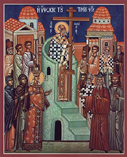
| The commemoration of the universal Exaltation of the precious and life-giving Cross. |
Scripture Readings
Paschalion — Movable Calendar
Monday of the Fifteenth Week
Epistle
The Reading is from the Epistle of Saint Paul to the Galatians [§ 202]. Brethren:
2 11When Peter came to Antioch, I withstood him to the face, because he stood condemned. 12For before the coming of certain ones from Iakovos, he was eating with the Gentiles; but when they came, he began to draw back and separate himself, being afraid of those of the circumcision. 13And also the rest of the Jews were dissembling with him, so that even Barnabas was carried away with their dissimulation. 14But when I saw that they were not walking uprightly according to the truth of the Gospel, I said to Peter in front of them all, “If thou, being a Jew, livest after the manner of Gentiles, and not after the manner of the Jews, why dost thou compel the Gentiles to live as Jews? 15“We—Jews by nature, and not sinners of the Gentiles— 16“knowing then that a man is not being justified by the works of the law, except through faith in Jesus Christ, even we believed in Christ Jesus, in order that we might be justified by faith in Christ and not by the works of the law; because by the works of the law shall no flesh be justified.”
Gospel
The Reading is from the Holy Gospel according to Saint Mark [§ 21]. At that time:
5 24A great crowd was following Jesus and pressing upon Him. 25And a certain woman who had a flow of blood for twelve years— 26and who suffered much under many physicians and spent all from her own means, and was not profited at all, but rather came to be the worse for it— 27after she heard about Jesus, came in the crowd behind, and touched His garment; 28for she was saying within herself, “If I might but touch His garments, I shall be made well.” 29And straightway the fountain of her blood was dried up; and she knew in her body that she had been healed from the scourge. 30And Jesus, straightway having fully known in Himself that the power from Him went forth, turned around in the crowd and was saying, “Who touched Me on My garments?” 31And His disciples were saying to Him, “Thou seest the crowd pressing on Thee, and sayest Thou, ‘Who touched Me?’” 32And He kept looking around Himself to see her who had done this. 33And the woman, fearing and trembling, knowing that which had been done for her, came and fell down before Him, and told Him all the truth. 34And He said to her, “Daughter, thy faith hath made thee well; go in peace, and be sound in body from thy scourge.”
Menaion — Fixed Calendar
The commemoration of the universal Exaltation of the precious and life-giving Cross.
Epistle
The Reading is from the First Epistle of Saint Paul to the Corinthians [§ 125]. Brethren:
1 18The word, that of the Cross, on the one hand, to those who are perishing is foolishness, but on the other hand, to us who are being saved, it is the power of God. 19For it hath been written: “I will destroy the wisdom of the wise, and will set at nought the comprehension of the intelligent [cf. Is. 29:14].” 20Where is the wise? Where is the scribe? Where is the disputer of this age? Did not God make foolish the wisdom of this world? 21For since, in the wisdom of God, the world knew not God through its wisdom, it pleased God through the foolishness of the preaching to save those who believe. 22For indeed, Jews ask for a sign, and Greeks seek wisdom; 23but we proclaim Christ Who hath been crucified, to Jews, on the one hand, a stumbling block, and to Greeks, on the other hand, foolishness, 24but to those who are called, both Jews and Greeks, Christ, God’s power and God’s wisdom.
Gospel
In the Orthros
The Reading is from the Holy Gospel according to Saint John [§ mid 42]. The Lord said:
12 28“Father, glorify Thy name.” Then a voice came out of heaven: “I both glorified it and will glorify it again.” 29The crowd then that stood by and heard it was saying that thunder had occurred; others were saying, “An angel hath spoken to Him.” 30Jesus answered and said, “This voice hath not occurred for My sake, but for your sakes. 31“Now is a judgment of this world; now the ruler of this world shall be cast out. 32“And I, if I be lifted up from the earth, will draw all to Myself.” 33But He was saying this, signifying by what manner of death He was about to die. 34The crowd answered Him, “We heard out of the law that the Christ abideth forever; and how sayest Thou, ‘The Son of Man must be lifted up’? Who is this Son of Man?” 35Then Jesus said to them, “Yet a little while is the light with you. Be walking while ye have the light, that darkness might not overtake you; and indeed the one who walketh in the darkness knoweth not where he goeth. 36“While ye have the light, keep on believing in the light, that ye might become sons of light.” Jesus spoke these things, and departed, and was hidden from them.
In the Liturgy
The Reading is from the Holy Gospel according to Saint John [§§ 60, 61]. At that time: The high priest and elders took counsel against Jesus to put Him to death. And they delivered Him to Pilate, saying, “Away with Him, away with Him, crucify Him.”
19 6Pilate saith to them, “Ye take Him and crucify Him, for I find no cause for accusation in Him.” 7The Jews answered him, “We have a law, and according to our law He ought to die, because He made Himself Son of God.” 8Therefore, when Pilate heard this saying, he was the more afraid. 9And he entered into the Prætorium again, and saith to Jesus, “From what place art Thou?” But Jesus did not give him an answer. 10Then Pilate saith to Him, “Speakest Thou not to me? Knowest Thou not that I have authority to crucify Thee, and authority to release Thee?” 11Jesus answered, “Thou wouldest have no authority at all against Me, except it were given to thee from above.”... 13Therefore Pilate, having heard this saying, brought out Jesus, and took his seat upon the tribunal in a place which is called Lithostrotos, but in Hebrew, Gabbatha. 14Now it was the preparation of the passover, and about the sixth hour. And he saith to the Jews, “Behold your King!” 15But they cried out, “Take Him away, take Him away, crucify Him.” Pilate saith to them, “Your King shall I crucify?” The chief priests answered, “We have no king except Cæsar.” 16Therefore he then delivered Him up to them, in order that He might be crucified.
And they took Jesus and led Him away. 17And bearing His Cross, He went out to the place called Place of a Skull, which is called in Hebrew, Golgotha, 18where they crucified Him, and two others with Him, on the one side and the other, and Jesus in the middle. 19And Pilate also wrote a title, and put it on the Cross. And it was written: “Jesus the Nazaræan, the King of the Jews.” 20Therefore many of the Jews read this title, for the place where Jesus was crucified was near the city; and it was written in Hebrew, in Greek, and in Latin....
25Now there had stood by the Cross of Jesus His Mother, and His Mother’s sister, Mary the wife of Cleopas, and Mary Magdalene. 26Then Jesus, having seen His Mother and the disciple whom He loved standing by, saith to His Mother, “Woman, behold thy son.” 27Then He saith to the disciple, “Behold, thy Mother.” And from that hour the disciple took her into his own home. 28After this, Jesus, knowing that all things now have been accomplished, that the Scripture might be fulfilled, saith, “I thirst.” 29A vessel therefore full of vinegar was set; and they filled a sponge with vinegar and put around it hyssop, and brought it to His mouth. 30Then, when Jesus took the vinegar, He said, “It hath been finished.” And having bowed His head, He delivered up the spirit.
Lives of the Saints (Prologue)
September 27th – Civil Calendar
September 14th – Church Calendar
1. The Universal Exaltation of the Holy Cross.
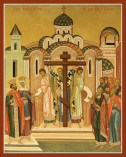 On this day are commemorated two events
connected with the Precious Cross of Christ: the first, the finding of the Cross on Golgotha and
the second the returning of the Cross to Jerusalem from Persia.
On this day are commemorated two events
connected with the Precious Cross of Christ: the first, the finding of the Cross on Golgotha and
the second the returning of the Cross to Jerusalem from Persia.
Staying in the holy land, the holy Empress Helena decided to look for the Precious Cross of the Lord. An old Jew called Judah was the only person who knew the whereabouts of the Cross, and under pressure from the empress, he revealed that the Cross was buried under the Temple of Venus that the Emperor Hadrian had built on Golgotha. The empress ordered that this idolatrous temple be pulled down, and then, digging deep below it, she found three crosses. While the empress was in uncertainty about how to recognize which cross was the Lord’s, a funeral procession passed by. Then Patriarch Makarios told them to place the crosses one by one on the dead man. When they placed the first and second on him, the dead man remained unchanged, but when they placed the third on him, he was restored to life. By this, they knew that this was the Precious and life-giving Cross of Christ. After that, they placed it on a sick woman, and she recovered. Then the patriarch raised the Cross aloft for all to see, and the people sang with tears: ‘Lord, have mercy!’ The Empress Helena had a silver casing made, and placed the precious Cross in it.
Later, King Chozroes conquered Jerusalem, took the people into slavery and carried the Lord’s Cross off to Persia, where it remained for fourteen years. In 628, the Greek Emperor Herakleios was victorious over Chozroes and brought the Cross back to Jerusalem with great ceremony. Entering the city, Herakleios was carrying the Cross on his back, but suddenly the aged emperor was unable to take another step. Patriarch Zacharias saw an angel directing the emperor to take off his imperial robes and walk beneath the Cross along the way that Christ had walked, barefoot and humiliated as He had been. He passed this vision on to the emperor, who stripped himself of his raiment, and in poor clothing and barefoot, took up the Cross, carried it to Golgotha and placed it in the Church of the Resurrection, to the joy and consolation of the whole Christian world.
2. St. Plakilla (Flaccilla) the Empress.
The wife of the Emperor Theodosios the Great, she was a true Christian in both thought and deed. She was especially distinguished by her help to the poor and the sick. When someone told her that this was not consistent with her imperial dignity, she replied: ‘It befits the imperial state to help with money; my personal endeavors (towards the poor) I give to Him Whose good will it was to give me this state.’ She entered peacefully into rest in about 400.
3. Our Holy Father, the Martyr Makarios of Thessalonica.
A disciple of Patriarch Niphon at the time that the latter was laboring in the asceticism of silence at Vatopedi, Makarios longed for martyrdom for the sake of Christ, and begged St. Niphon’s blessing to seek it. The discerning patriarch, perceiving that this was God’s will, blessed him for the way of martyrdom. Makarios went to Thessalonica, and in the midst of a crowd of Turks, began to speak of Christ as the one, true God. The Turks seized him and threw him into prison. When he was brought to trial, Makarios cried out to the Turks: ‘Oh, that you would come to know the truth and be baptized in the name of the Father, the Son and the Holy Spirit!’ The Turks beheaded him in 1527. At that moment, Niphon saw this in his spirit at Vatopedi, and told a monk of Makarios’ death by martyrdom, saying: ‘Know, my child, that your brother Makarios has today died a martyr, and is borne to heaven, triumphing and rejoicing in the Lord. May we be worthy of blessing by his prayers!’ (From the Athonite Patrology).
4. Our Holy Mother Maria of Tarsus.
She at first lived a life of harlotry. Two monks traveling through Tarsus stayed at the inn where Maria plied her trade. When she approached the monks, they rebuked her and pushed her away as unclean. She suddenly repented and vowed to sin no more from that moment. The monks took her with them to a women’s monastery, where Maria lived in asceticism till old age. She had the gift of wonder-working during her lifetime and after her death.
FOR CONSIDERATION
A nobleman decided to give a gold cross to a church, and found a young but experienced goldsmith, gave him a great measure of gold and told him to make whatever sort of cross he liked. The poor goldsmith, seeing such an offering made by the nobleman for the sake of his soul, was fired in his own heart with love for God, and decided to add ten gold pieces of his own to the nobleman’s heap of gold. When the cross was ready, the nobleman weighed it and found that it was heavier than the gold that he had given to the young man. He immediately began to abuse him as a thief, suspecting him of having abstracted some of the gold and substituted a heavier metal. When the young man saw the nobleman in such a rage, he confessed his deed. ‘I added,’ he said, ‘some gold of my own, as the widow gave her two mites, to receive Christ’s reward along with you.’ Hearing this, the nobleman’s heart was touched and he said to the young man: ‘From this day, you are my son and the inheritor of all my goods.’
Daily Scripture Readings taken from The Orthodox New Testament, translated and published by Holy Apostles Convent, Buena Vista, Colorado, copyright © 2000, used with permission, all rights reserved.
Daily Prologue Readings taken from The Prologue of Ochrid, by Bishop Nikolai Velimirovic, translated by Mother Maria, published by Lazarica Press, Birmingham, England, copyright © 1985, all rights reserved. Edited by Dormition Skete.