

Daily Devotional
Monday, June 7, 2027 (NS), May 25, 2027 (OS)
No Fasting.
Monday of the Sixth Week
The commemoration of the third finding of the precious head of the holy and glorious prophet, forerunner, and Baptist John.
Scripture Readings
Paschalion — Movable Calendar
Monday of the Sixth Week
Epistle
The Reading is from the Acts of the Apostles [§ 39]. In those days:
For Gk. usage, see Acts 17:1-9; for Sl. usage, Acts 17:1-15.
17 1After Paul and Silas traveled through Amphipolis and Apollonia, they came to Thessalonica, where there was a synagogue of the Jews. 2And according to what was customary to Paul, he went in to them, and for three sabbaths was discoursing with them from the Scriptures, 3laying open and setting forth that it was needful for the Christ to have suffered, and to have risen from the dead, and that “this Jesus Whom I proclaim to you is the Christ.” 4And some of them were persuaded and were allotted to Paul and Silas—both of the Greeks who were reverent, a great multitude, and of the chief women not a few. 5But those Jews who were not persuaded became jealous, and took to themselves certain evil men of the market-loungers, and formed a crowd, and made an uproar in the city; and having taken a stand against the house of Jason, they were seeking to bring them out to the people. 6But not having found them, they were dragging Jason and certain brethren before the rulers of the city, crying out, “These who have upset the inhabited world are present here also, 7“whom Jason hath received. And these all practise contrary to the decrees of Cæsar, saying there is another king—Jesus.” 8And they agitated the crowd and the rulers of the city when they heard these things. 9And after they took bail from Jason and the rest, they dismissed them. 10And the brethren straightway by night sent off to Verea both Paul and Silas, who, having arrived, went into the synagogue of the Jews. 11Now these, who received the word with all readiness and who daily examined the Scriptures if these things were so, were more noble than those in Thessalonica. 12Many indeed therefore from among them believed, and of the Greek women, those of noble rank, and of the men, not a few. 13But when the Jews of Thessalonica came to know that in Verea also the word of God was proclaimed by Paul, they came there also stirring up the crowds. 14And then straightway the brethren sent forth Paul to go as far as the sea; but both Silas and Timothy were staying behind there. 15And those who conducted Paul brought him as far as Athens; and having received a command for Silas and Timothy that they should come to him as quickly as possible, they went forth.
Gospel
The Reading is from the Holy Gospel according to Saint John [§ 40]. At that time:
11 47The chief priests and the Pharisees gathered together for a session of the sanhedrin, and were saying, “What are we doing? For this Man is doing many signs. 48“If we should let Him thus alone, all will believe in Him; and the Romans shall come and take away both our place and the nation.” 49But a certain one of them, Caiaphas, being high priest of that year, said to them, “Ye know nothing at all, 50“nor consider that it is expedient for us that one man should die for the people, and not that the whole nation should perish.” 51But he said this not of himself; but being high priest that year, he prophesied that Jesus was about to die for the nation; 52and not for the nation only, but that He also should gather together into one the children of God who have been scattered abroad. 53Then from that day they took counsel together among themselves, in order that they might put Him to death. 54Jesus therefore was no longer walking openly among the Jews, but went away from that place into the country near the wilderness, to a city called Ephraim, and there He stayed with His disciples.
Sl. usage adds Jn. 11:55-57.
55And the passover of the Jews was near, and many went up to Jerusalem out of the country before the passover, in order that they might purify themselves. 56Then were they seeking Jesus and were speaking with one another, as they stood in the temple, “What think ye, that He will come to the feast?” 57Now both the chief priests and the Pharisees had given a command, that if anyone should know where He is, he should make it known, in order that they might lay hold of Him.
Menaion — Fixed Calendar
The commemoration of the third finding of the precious head of the holy and glorious prophet, forerunner, and Baptist John.
Epistle
The Reading is from the Second Epistle of Saint Paul to the Corinthians [§§ 176, 177]. Brethren:
4 6It is God Who said, “Let there be light [cf. Gen. 1:3]” to shine out of darkness, Who shined in our hearts, for the illumination of the knowledge of the glory of God in the face of Jesus Christ.
7But we have this treasure in earthen vessels, that the preeminence of the power may be of God, and not from us. 8In every way we are afflicted, but not straitened; we are at a loss, but not utterly at a loss; 9persecuted, but not abandoned; cast down, but not destroyed— 10always bearing about in the body the dying of the Lord Jesus, that the life also of Jesus might be made manifest in our body. 11For we, the living, are always being delivered to death on account of Jesus, that also the life of Jesus might be made manifest in our mortal flesh. 12So that indeed death energizeth itself in us, but life in you. 13But having the same spirit of faith, according to that which hath been written: “I believed, wherefore I spoke [Ps. 115(116):1(10)],” we also believe, and therefore speak, 14knowing that the One Who raised up the Lord Jesus shall raise up us also through Jesus, and shall present us with you. 15For all things are for your sakes, that the grace, which abounded through the majority, might cause the giving of thanks to abound more to the glory of God.
Gospel
The Reading is from the Holy Gospel according to Saint Matthew [§ 40]. At that time:
11 2After John heard in the prison the works of the Christ, he sent two of his disciples, 3and said to Him, “Art Thou the coming One, or do we look for another?” 4And Jesus answered and said to them, “Go and report to John what ye are hearing and seeing: 5“the blind are recovering their sight and the lame are walking; the lepers are being cleansed and the deaf are hearing; the dead are being raised and the poor are being preached the Gospel. 6“And happy is he, whosoever shall not be offended in Me.” 7And as these went their way, Jesus began to say to the crowds concerning John, “What went ye out into the wilderness to behold? A reed being shaken by the wind? 8“But what went ye out to see? A man who hath been clothed in soft garments? Behold, those wearing soft garments are in the houses of kings. 9“But what went ye out to see? A prophet? Yea, I say to you, and much more than a prophet. 10“For this is he about whom it hath been written: ‘Behold, I send forth My messenger before Thy face, who shall prepare Thy way before Thee [cf. Mal. 3:1].’ 11“Verily I say to you, there hath not arisen among those born of women a greater than John the Baptist; but the least in the kingdom of the heavens is greater than he. 12“And from the days of John the Baptist until now the kingdom of the heavens is being taken by force, and the forceful seize it. 13“For all the prophets and the law prophesied until John. 14“And if ye are willing to receive it, he is Elias, who is about to come. 15“The one who hath ears to hear, let him hear.”
Lives of the Saints (Prologue)
June 7th – Civil Calendar
May 25th – Church Calendar
1. The Third Finding of the Head of St. John the Baptist.
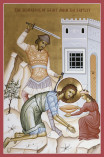 In the eighth century, during a period of
fierce iconoclasm, the head of St. John the Baptist was taken to Comana, the place of St.
John Chrysostom’s exile. When the iconoclast persecution ended in 850, in the time of
the Emperor Michael and Patriarch Ignatius, the honored head of St. John was taken to
Constantinople and placed in the church at the imperial court. In the eighth century, during a period of
fierce iconoclasm, the head of St. John the Baptist was taken to Comana, the place of St.
John Chrysostom’s exile. When the iconoclast persecution ended in 850, in the time of
the Emperor Michael and Patriarch Ignatius, the honored head of St. John was taken to
Constantinople and placed in the church at the imperial court.
|
2. The Hieromartyr Therapon, Bishop of Cyprus.
A monk and ascetic on the island of Cyprus, he was worthy of episcopal rank, and during a persecution of Christians, was found worthy of a yet higher crown: that of martyrdom. His body at first rested in a church in Cyprus, but during the reign of the Emperor Nikephoros, in 806, the Hagarenes fell upon Cyprus. Therapon appeared to the verger, told him that the infidel was about to attack Cyprus and ordered him to have his relics transferred to Constantinople. The verger saw to this at once. When the ship with the casket put to sea, a great storm arose, but the sea around the ship remained calm and a sweet perfume spread from the casket around the whole ship and the surrounding area. Then the verger opened it, and they saw that it was full of myrrh, which flowed from the saint’s relics. Many of the sick anointed themselves with this myrrh and were restored to health. A church was built in Constantinople over the relics of the wonder-working saint, which continued to give healing to all who gathered round them with faith. The gravest diseases were healed by St. Therapon’s relics: paralysis, cancer, hemorrhage, insanity, blindness, tuberculosis and other maladies.
3. The Holy Martyrs Pasikratees, Valention, Julius and others.
They were Roman soldiers, and suffered for Christ in about 302 in Macedonian Dorostolon (Silistra). When Pasikratees’ brother, Papianos (who had apostatised from Christ through fear), came to his brother and tried to persuade him to renounce Christ and stay alive, St. Pasikratees replied: ‘Get away from me; you are no brother of mine!’ Pasikratees and Valention (Valentine) were beheaded together. At his trial, Julius said: ‘I am a war veteran, and have served the emperor faithfully for twenty-six years. And, having been faithful till now in lesser things, how can I not be faithful in the things that are greater, to the heavenly kingdom and its King?’ Then Nikanor was brought before the prefect, Maximus. Nikanor’s wife encouraged her husband to die for the sake of Christ. ‘You stupid old woman,’ Maximus hurled at her, ‘Are you after a better husband?’ She replied: ‘If you think that of me, give the order to have me killed now, before my husband!’ Marcian also perished with Nikanor. His wife came to the place of execution, carrying their son in her arms. Marcian kissed his son and prayed: ‘O almighty God, do Thou take care of him!’ And they were all then slain and entered into the kingdom of Christ.
FOR CONSIDERATION
Some ignorant people think more about the end of the world than that of their own lives, although it is evident that, when a man comes to the end of his life, he reaches the end of the world also. A certain brother standing in the presence of St. Seraphim of Sarov was turning over in his mind how he would ask the saint about the end of the world. St. Seraphim perceived his thoughts and said to him: ‘My joy, you rate poor Seraphim too highly; how could I know when the end of the world will be, and that great day when the Lord shall judge the living and the dead, giving to each according to his works? No, no; it is impossible for me to know about it.’ And if the saints could not know, how could we poor sinners find out? And to what purpose would we know that which the Savior Himself did not find it needful for us to know? It is far better to consider that our death will come before the end of the world than to contemplate the possibility of the world’s ending before we die.
Daily Scripture Readings taken from The Orthodox New Testament, translated and published by Holy Apostles Convent, Buena Vista, Colorado, copyright © 2000, used with permission, all rights reserved.
Daily Prologue Readings taken from The Prologue of Ochrid, by Bishop Nikolai Velimirovic, translated by Mother Maria, published by Lazarica Press, Birmingham, England, copyright © 1985, all rights reserved. Edited by Dormition Skete.