

Daily Devotional
Sunday, May 30, 2027 (NS), May 17, 2027 (OS)
No Fasting.
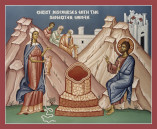
| Fifth Sunday of Pascha, or Sunday of the Samaritan Woman Mode Four — Seventh Eothinon |
The commemoration of the holy Apostles Andronikos and Junia.
Scripture Readings
Paschalion — Movable Calendar
Fifth Sunday of Pascha, or Sunday of the Samaritan Woman
Mode Four — Seventh Eothinon
Epistle
The Reading is from the Acts of the Apostles [§ 28]. In those days:
For Gk usage, see Acts 11:19-30; for Sl. usage. see Acts 11:19-26, 29, 30.
11 19The apostles, who were scattered because of the affliction that arose about Stephen, went abroad as far as Phœnicia and Cyprus and Antioch, speaking the word to no one except to Jews only. 20But some of them were men of Cyprus and Cyrene, who, after they came to Antioch, began speaking to the Hellenists, preaching as good tidings the Lord Jesus. 21And the hand of the Lord was with them, and a great number believed and turned to the Lord. 22Then the report concerning them was heard in the ears of the Church which was in Jerusalem. And they sent forth Barnabas to go through as far as Antioch, 23who, after he came and saw the grace of God, was glad and was exhorting all to keep on remaining near to the Lord with purpose of heart. 24For he was a good man, and full of the Holy Spirit and of faith; and a considerable crowd was added to the Lord. 25And Barnabas went forth to Tarsus to search for Saul. 26And having found him, he brought him to Antioch. And it came to pass that they were gathered together with the Church for a whole year, and taught a considerable crowd. And the disciples were called Christians first in Antioch.
27And in these days prophets came down from Jerusalem to Antioch. 28And one of them, by name Agavos, rose up, and signified by the Spirit that there was about to be a great famine over all the inhabited world, which also came to pass in the time of Claudius Cæsar. 29And according as any one of the disciples was prospered, each of them determined to send relief toward ministering to the brethren who dwelt in Judæa, 30which also they did, sending it off to the presbyters by the hand of Barnabas and Saul.
Gospel
The Reading is from the Holy Gospel according to Saint John [§ 12]. At that time:
4 5Jesus came to a city of Samaria called Sychar, near the place which Jacob gave to his son Joseph. 6And Jacob’s well was there. Jesus then, having grown weary from the journey, was sitting thus on the well. It was about the sixth hour. 7There cometh a woman of Samaria to draw water. Jesus saith to her, “Give Me to drink.” 8For His disciples had gone away into the city in order that they might buy provisions. 9Then the Samaritan woman saith to Him, “How is it that Thou, being a Jew, askest to drink from me, who am a Samaritan woman? For the Jews have no dealings with Samaritans.” 10Jesus answered and said to her, “If thou knewest the gift of God, and Who is the One Who saith to thee, ‘Give Me to drink,’ thou wouldest have asked Him, and He would have given to thee living water.” 11The woman saith to Him, “Lord, Thou hast no bucket for drawing water, and the well is deep. From what place then hast Thou the water, the living one? 12“Thou art not greater than our father Jacob, who gave us the well, and drank from it himself, and his sons, and his animals, art Thou?” 13Jesus answered and said to her, “Everyone who drinketh of this water shall thirst again; 14“but whosoever drinketh of the water which I shall give him in no wise shall ever thirst. But the water which I shall give him shall become in him a fountain of water springing into eternal life.” 15The woman saith to Him, “Lord, give me this water, that I may not be thirsting, nor keep on coming here to draw.” 16Jesus said to her, “Go, call thy husband, and come here.” 17The woman answered and said, “I have no husband.” Jesus said to her, “Well didst thou say, ‘I have no husband,’ 18“for thou hast had five husbands, and now he whom thou hast is not thy husband; this truly thou hast spoken.” 19The woman saith to Him, “Lord, I perceive that Thou art a prophet. 20“Our fathers do reverence in this mountain, and ye say that in Jerusalem is the place where it is needful to do reverence.” 21Jesus saith to her, “Woman, believe Me, that there is coming an hour when neither in this mountain, nor in Jerusalem, shall ye do reverence to the Father. 22“Ye do reverence what ye know not; we do reverence what we know, for salvation is of the Jews. 23“But there is coming an hour, and now is, when the true worshippers shall do reverence to the Father in spirit and truth; for also the Father seeketh such as those who revere Him. 24“God is Spirit, and it is needful for those who revere Him to do reverence in spirit and truth.” 25The woman said to Him, “I know that Messiah is coming, the One Who is called Christ. Whenever that One should come, He will announce to us all things.” 26Jesus saith to her, “I am, the One Who speaketh to thee.” 27And upon this came His disciples, and they wondered that He was speaking with a woman; nevertheless no one said, “What seekest Thou?” or “Why speakest Thou with her?” 28The woman then left her waterpot, and went away into the city, and saith to the people, 29“Come, see a Man Who told me all things whatsoever I did. This One is not the Christ, is He?” 30Then they went forth out of the city and were going toward Him.
31But in the meantime the disciples were entreating Him, saying, “Rabbi, eat.” 32But He said to them, “I have food to eat which ye know not.” 33Therefore the disciples were saying to one another, “No one brought Him anything to eat, did he?” 34Jesus saith to them, “My food is that I be doing the will of Him Who sent Me, and that I should finish His work. 35“Do ye not say, ‘It is yet a space of four months, and the harvest cometh’? Behold, I say to you, lift up your eyes and see the fields, for they are white already to harvest. 36“And the one who reapeth receiveth a reward, and gathereth fruit to life eternal, that both the one who soweth and the one who reapeth may rejoice together. 37“For in this the saying is true, ‘There is one who soweth and another who reapeth.’ 38“I sent you forth to reap on what ye have not labored; others have labored, and ye have entered into their labor.” 39And many of the Samaritans of that city believed in Him, because of the utterance of the woman testifying, “He told me all things whatsoever I did.” 40Therefore, when the Samaritans came to Him, they were asking Him to stay with them; and He stayed there two days. 41And many more believed because of His word. 42And to the woman they were saying, “We no longer believe because of thy talk; for we ourselves have heard, and we know that this One is truly the Savior of the world, the Christ.”
Menaion — Fixed Calendar
The commemoration of the holy Apostles Andronikos and Junia.
No readings given.
Lives of the Saints (Prologue)
May 30th – Civil Calendar
May 17th – Church Calendar
1. The Holy Apostle Andronicus.
One of the Seventy, he was a kinsman of the Apostle Paul, as Paul wrote (Rom. 16:17), remembering also St. Junia, Andronicus’ helper. Andronicus was made Bishop of Pannonia, and did not stay in one place, but preached the Gospel throughout the whole of Pannonia. With St. Junia, he was successful in bringing many to Christ and in demolishing many temples of idolatry. Both of them had the grace of wonder-working, by which they drove out demons and healed every sort of sickness and disease. They both suffered for Christ, and thus received a twofold crown: of apostleship and of martyrdom. Their holy relics were found in the excavations in Evgenios (see Feb. 2nd).
2. The Holy Martyr Solochon.
He was an Egyptian by birth, and a Roman soldier under the commander Campanus, in the reign of the wicked Emperor Maximian. When the imperial command that all soldiers offer sacrifice to idols arrived, Solochon revealed that he was a Christian. Two of his friends, Pamphamir and Pamphylon, also did the same. The commander ordered that they be beaten and tortured with great harshness, under which St. Pamphamir and St. Pamphylon breathed their last. Solochon remained alive, and was put to new torture: the commander ordered the soldiers to force his teeth open with a sword and stuff his mouth with food sacrificed to idols. The martyr broke the iron with his teeth and did not receive the foul, idolatrous sacrifice. Finally, they stabbed him with a quill through both ears and left him thus to die. Christians took the martyr and carried him to the home of a widow, where he gained a little strength with food and drink, and continued to give counsel to the faithful to be steadfast in their faith and in torture for it. After this, he breathed a thanksgiving to God, finished his earthly course and went to the kingdom of heaven, to the Lord Whom he had served so faithfully, in the year 298.
FOR CONSIDERATION
After a terrible earthquake in Antioch, St. John Chrysostom said to the people: ‘Great are the fruits of the earthquake. Behold, the Lord, Who loves mankind, Who shakes the city but confirms the souls; Who makes the foundations tremble but strengthens the thoughts; Who demonstrates the weakness of the city but makes the will strong! Behold His love for men: He makes to sway for a little, and makes strong forever. The earthquake lasts for two days, but the devotion will remain for all time; sorrow endures for a season, but strength is forever. A mother who wants to wean her child from frequent crying rocks the cradle strongly, not in order to kill it but to frighten it. Precisely thus, the Lord, Who holds His universe in His hand, shakes it—not in order to destroy it, but to bring those who love lawlessness back to salvation.’ This is how the holy fathers, the pillars of the universal Church, knew how to explain by God’s love for man both assaults and blessings, both misfortunes and pleasures. Let us be ashamed of our slowness in thanking God when He gives, and of our quickness in grumbling at Him when He takes away.
Daily Scripture Readings taken from The Orthodox New Testament, translated and published by Holy Apostles Convent, Buena Vista, Colorado, copyright © 2000, used with permission, all rights reserved.
Daily Prologue Readings taken from The Prologue of Ochrid, by Bishop Nikolai Velimirovic, translated by Mother Maria, published by Lazarica Press, Birmingham, England, copyright © 1985, all rights reserved. Edited by Dormition Skete.