

Daily Devotional
Saturday, May 29, 2027 (NS), May 16, 2027 (OS)
No Fasting.
Saturday of the Fourth Week
The commemoration of our venerable Father Theodore the Sanctified, disciple of St. Pachomios the Great.
Scripture Readings
Paschalion — Movable Calendar
Saturday of the Fourth Week
Epistle
The Reading is from the Acts of the Apostles [§ 29].
12 1At that time, Herod the king put forth his hands to maltreat some of those from the Church. 2And he killed Iakovos the brother of John with a sword. 3And because he saw that it pleased the Jews, he in addition went on to seize Peter also—and they were the days of unleavened bread— 4whom after he laid hold of, he also put in prison, and delivered him up to four sets of four soldiers to guard him, purposing after the passover to bring him forth to the people. 5Peter, therefore, on the one hand, was being guarded in the prison, but on the other hand, earnest prayer was being made by the Church to God on his behalf. 6And when Herod was about to bring him forth, on that very night Peter was sleeping, bound with two chains between two soldiers; and guards also were before the door keeping the prison. 7And behold, an angel of the Lord stood by him, and a light shone in the chamber; and he struck the side of Peter, and woke him up, saying, “Rise up quickly.” And the chains from his hands fell off of him. 8And the angel said to him, “Gird thyself about, and bind on thy sandals.” And so he did. And he saith to him, “Cast about thee thine outer garment, and follow thou me.” 9And he went out and kept on following him, and did not know that it was real that which was happening by means of the angel, but he kept on thinking he saw a vision. 10And after they passed a first guard and a second, they came up to the gate, the iron one, which leadeth into the city, which was opened to them of itself; and having gone out, they advanced one street, and straightway the angel departed from him. 11And after Peter came to himself, he said, “Now I know of a truth, that the Lord sent forth His angel, and took me out of the hand of Herod and all the expectation of the people of the Jews.”
Gospel
The Reading is from the Holy Gospel according to Saint John [§ 31].
8 31The Lord Jesus was saying to the Jews who had believed Him, “If ye abide in My word, truly ye are My disciples; 32“and ye shall know the truth, and the truth shall set you free.” 33They answered Him, “We are Abraham’s seed, and have never yet been enslaved to anyone; how sayest Thou, ‘Ye shall become free?’” 34Jesus answered them, “Verily, verily, I say to you, that everyone who doeth sin is a slave of sin. 35“And the slave abideth not in the house forever; the Son abideth forever. 36“If therefore the Son should set you free, verily ye shall be free. 37“I know that ye are Abraham’s seed; but ye seek to kill Me, because My word findeth no room in you. 38“I am speaking that which I have seen by the side of My Father; and ye therefore are doing that which ye have seen from the side of your father.” 39They answered and said to Him, “Abraham is our father.” Jesus said to them, “If ye were children of Abraham, ye would do the works of Abraham. 40“But now ye seek to kill Me, a Man Who hath spoken the truth to you, which I heard from God; this Abraham did not do. 41“Ye are doing the works of your father.” Then they said to Him, “We have not been born of fornication; we have one Father, God.” 42Then Jesus said to them, “If God were your Father, ye would love Me; for I came forth out of God and am come; for neither have I come of Myself, but that One sent Me forth.”
Menaion — Fixed Calendar
The commemoration of our venerable Father Theodore the Sanctified, disciple of St. Pachomios the Great.
No readings given.
Lives of the Saints (Prologue)
May 29th – Civil Calendar
May 16th – Church Calendar
1. Our Holy Father Theodore the Sanctified.
He was a disciple of St. Pachomios, being born and growing up an unbeliever. Coming to the true Faith as a young man, he was baptized, and having heard of St. Pachomios, fled to him in his monastery, unknown to his parents. St. Pachomios made him a monk and came to love him for his rare zeal and his obedience. When his mother came to fetch him back home, he would not let her see him, but prayed to God to enlighten her with the truth. And indeed, his mother not only did not take her son back home, but herself did not return. Seeing a women’s monastery close by, ruled by Pachomios’ sister, she entered it and was tonsured. After a certain time, Paphnutios, Theodore’s brother, also came to the monastery and was tonsured. It once happened that the Bishop of Panopolis invited Pachomios to build a monastery for the many people who were desirous of the monastic life. Pachomios took Theodore with him, and entrusted to him the duty of building the monastery. Upon Pachomios’ death, Theodore became abbot of all Pachomios’ monasteries and lived until great old age, guiding a multitude of monks on the way of salvation. He entered peacefully into rest and went to the kingdom of eternal light in the year 368.
2. The Blessed Maiden Musa.
St. Gregory the Dialogist relates of her that she was a mere nine years old when the most holy Mother of God appeared to her on two occasions, surrounded by virgins bathed in light. When Musa expressed her desire to be included in the resplendent company of the Queen of heaven, the Mother of God told her that she would come for her and take her within a month, outlining for her how she should spend those thirty days. On the twenty-fifth day, Musa took to her bed and on the thirtieth day the most pure and holy Mother again appeared to her, calling to her in a quiet voice, to which Musa replied: ‘Here I am waiting, my Lady! I’m ready!’ and she breathed forth her spirit. She passed from this life to life eternal in the fifth century.
3. St. Nicholas Mystikos, Patriarch of Constantinople.
‘Mystikos’ signifies the senior member of the imperial council. This saint was such at first, then a high-ranking courtier, but after this he forsook the vanity of the world and was tonsured. He was renowned for the rare austerity of his life. The Emperor Leo VI had married four times, and the patriarch therefore forbade him entry to the church, and the priests who had married him were defrocked. The emperor cast the patriarch out and drove him into a monastery. The delegates of the Roman Pontiff, Sergius III, gave their approval to the emperor’s fourth marriage, but when the emperor died, Nicholas was restored to the patriarchal throne and called a council in 925, at which fourth marriages were in general forbidden to Christians. He died peacefully in 930.
4. The Holy New-Martyr Nicholas.
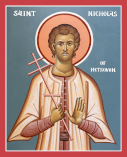 He was born in Metsovon of Epirus,
of pious parents. He left home while quite young and traveled to Trikala, where he found
employment with a Turkish baker. There he denied the Faith and embraced Islam. He then returned
home and repented. A neighbor of his former employer came upon Nicholas one day and discovered
his return to Christianity. He blackmailed Nicholas for several years. Finally, Nicholas decided
that his succumbing to this blackmail was tantamount to further denying Christ, and he became
determined to become a martyr to correct his denial of Christ. He confessed his intentions to his
parish priest, who advised him not to proceed with his plan, lest he be unable to endure their
tortures and fall a second time. Nicholas was determined, however, and his priest blessed and
strengthened him for his ordeal. Nicholas then traveled back to Trikala, where he refused to pay
his blackmailer any further. He was brought before the Turkish judge for having embraced and then
renounced Islam. He was beaten with rods, and finally burned alive in Trikala on May 16, 1617. He
was twenty-six years old. A pious Christian secretly recovered his skull from the ashes, and hid
it in the wall of a house he was building at the time. Later, a man named Melandros bought the
house. Every year, for several years, on the day of Nicholas’ martyrdom, Melandros beheld a
strange light emanating from the wall of the house. He received a divine revelation in his sleep,
disclosing that at the place the light appeared was hidden the holy skull of Nicholas the Martyr.
Melandros dug into the wall where he had beheld the light, and found the martyr’s relics. Feeling
himself unworthy to possess such a treasure, he turned it over to his brother, a monk at a
monastery of Meteora. The martyr’s head is preserved to this day in one of the monasteries
of the Meteora in Thessaly, and performs many miracles, heals the gravest sicknesses and is
particularly renowned for driving locusts from crops.
He was born in Metsovon of Epirus,
of pious parents. He left home while quite young and traveled to Trikala, where he found
employment with a Turkish baker. There he denied the Faith and embraced Islam. He then returned
home and repented. A neighbor of his former employer came upon Nicholas one day and discovered
his return to Christianity. He blackmailed Nicholas for several years. Finally, Nicholas decided
that his succumbing to this blackmail was tantamount to further denying Christ, and he became
determined to become a martyr to correct his denial of Christ. He confessed his intentions to his
parish priest, who advised him not to proceed with his plan, lest he be unable to endure their
tortures and fall a second time. Nicholas was determined, however, and his priest blessed and
strengthened him for his ordeal. Nicholas then traveled back to Trikala, where he refused to pay
his blackmailer any further. He was brought before the Turkish judge for having embraced and then
renounced Islam. He was beaten with rods, and finally burned alive in Trikala on May 16, 1617. He
was twenty-six years old. A pious Christian secretly recovered his skull from the ashes, and hid
it in the wall of a house he was building at the time. Later, a man named Melandros bought the
house. Every year, for several years, on the day of Nicholas’ martyrdom, Melandros beheld a
strange light emanating from the wall of the house. He received a divine revelation in his sleep,
disclosing that at the place the light appeared was hidden the holy skull of Nicholas the Martyr.
Melandros dug into the wall where he had beheld the light, and found the martyr’s relics. Feeling
himself unworthy to possess such a treasure, he turned it over to his brother, a monk at a
monastery of Meteora. The martyr’s head is preserved to this day in one of the monasteries
of the Meteora in Thessaly, and performs many miracles, heals the gravest sicknesses and is
particularly renowned for driving locusts from crops.
5. Our Holy Fathers, the Martyrs of St. Sava’s.
In the time of the Emperor Herakleios, in about 610, forty-four monks of the community of St. Sava the Sanctified suffered for the Christian Faith. Their heroism and sufferings were recorded by St. Antiochus (Dec. 24th).
FOR CONSIDERATION
When Theodore the Sanctified was in Panopolis with his spiritual father, St. Pachomios, a philosopher came to him and sought to dispute with him about faith. The philosopher posed these three questions to Theodore: ‘Who was not born, but died? Who was born, but did not die? And who died, but did not decay?’ To those questions, St. Theodore made answer: ‘Adam was not born, but died. Enoch was born, but did not die. Lot’s wife died, but did not decay.’ The saint added this advice to the philosopher: ‘Take note of this sound advice of ours: shun vain questionings and scholastic syllogisms; draw near to Christ, Whom we serve, and you will receive the forgiveness of your sins.’ The philosopher was rendered speechless by such a shrewd answer, and went away ashamed. From this, one sees clearly the difference between a pagan philosopher and a Christian saint. The one loses himself in abstractions, in skilful juggling with words, in contests of logic and mental gymnastics, while the other centers his whole mind on the living God and on the salvation of his soul. The one is abstract and dead; the other is practical and alive.
Daily Scripture Readings taken from The Orthodox New Testament, translated and published by Holy Apostles Convent, Buena Vista, Colorado, copyright © 2000, used with permission, all rights reserved.
Daily Prologue Readings taken from The Prologue of Ochrid, by Bishop Nikolai Velimirovic, translated by Mother Maria, published by Lazarica Press, Birmingham, England, copyright © 1985, all rights reserved. Edited by Dormition Skete.