

Daily Devotional
Saturday, May 15, 2027 (NS), May 2, 2027 (OS)
No Fasting.
Saturday of the Second Week
The commemoration of the translation of the relics of our father among the saints, Athanasios the Great, Patriarch of Alexandria, and the holy and right-believing King Boris, Equal-to-the-apostles, Enlightener of the Bulgarians, who was given the name Michael in holy Baptism.
Scripture Readings
Paschalion — Movable Calendar
Saturday of the Second Week
Epistle
The Reading is from the Acts of the Apostles [§ 15]. In those days:
5 21The apostles, having heard that, entered into the temple during the early morning and began teaching. But the high priest came and those with him, and they called together the sanhedrin and all the council of elders of the sons of Israel, and sent off to the prison to have them brought. 22But after the officers came and found them not in the prison, they returned and reported, 23saying, “Indeed we found the prison shut with all security, and the guards standing outside before the doors; but after we opened them, we found no one inside.” 24Now when the priest and the captain of the temple-guard and the chief priests heard these words, they were quite at a loss concerning them and what this would become. 25But a certain one came and reported to them, saying, “Behold, the men whom ye yourselves put in the prison are standing in the temple and teaching the people.” 26Then the captain went with the officers and brought them without violence, for they were fearing the people, lest they should be stoned. 27And after they brought them, they stood them in the sanhedrin. And the high priest questioned them, 28saying, “We did charge you by a command not to teach on this name, did we not? And behold, ye have made Jerusalem full of your teaching, and intend to bring the blood of this Man upon us.” 29But Peter and the apostles answered and said, “It is needful to obey God rather than men. 30“The God of our fathers raised up Jesus, Whom ye yourselves laid hands upon and hanged on a tree. 31“This One did God exalt with His right hand to be a Prince and Savior, to give repentance to Israel and forgiveness of sins. 32“And we are His witnesses of these words, and also the Holy Spirit Whom God gave to those who obey Him.” 33Now after they heard that, their hearts were sawn asunder, and they were taking counsel to kill him.
Gospel
The Reading is from the Holy Gospel according to Saint John [§ 19]. At that time:
6 14The people, having seen what sign Jesus did, began to say, “This is truly the Prophet Who cometh into the world.” 15Then Jesus, having known that they were about to come and seize Him in order that they might make Him king, withdrew again to the mountain Himself alone.
16And when it became evening, His disciples went down to the sea; 17and having embarked into the ship, they were going across the sea to Capernaum. And already it had become dark, and Jesus had not come to them. 18And the sea was stirred up by a great wind blowing. 19Then after they had rowed about twenty-five or thirty stadia, they see Jesus walking on the sea and drawing near to the ship; and they became afraid. 20But He saith to them, “I am; cease being afraid.” 21Then they were willing to receive Him into the ship; and straightway the ship came to be at the land to which they were going.
22On the morrow, the crowd which stood on the other side of the sea saw that there was no other boat there, except that one into which His disciples entered, and that Jesus did not enter together with His disciples into the little boat, but that His disciples went away alone— 23but there came little boats from Tiberias, near the place where they ate the bread after the Lord gave thanks. 24When the crowd therefore saw that Jesus was not there, nor His disciples, they themselves also embarked into the ships and came to Capernaum, seeking Jesus. 25And after they found Him on the other side of the sea, they said to Him, “Rabbi, when didst Thou arrive here?” 26Jesus answered them and said, “Verily, verily, I say to you, ye seek Me, not because ye saw signs, but because ye ate of the loaves and were filled. 27“Cease working for the meat which perisheth, but for the food which abideth to everlasting life, which the Son of Man shall give to you; for this One did God the Father seal.”
Menaion — Fixed Calendar
The commemoration of the translation of the relics of our father among the saints, Athanasios the Great, Patriarch of Alexandria, and the holy and right-believing King Boris, Equal-to-the-apostles, Enlightener of the Bulgarians, who was given the name Michael in holy Baptism.
Epistle
For the Hierarch:
The Reading is from the Epistle of Saint Paul to the Hebrews [§ 334]. Brethren:
13 7Be remembering those who lead you, who spoke to you the word of God, whose faith keep on imitating, observing attentively the end of their conduct: 8Jesus Christ, the same yesterday and today and to the ages. 9Cease being carried about by various and strange teachings. For it is good for the heart to be confirmed by grace, not by foods, in which those walking therein were not profited. 10We have an altar from which those serving the tabernacle have no authority to eat; 11for the bodies of those animals, “whose blood is being brought into the holies for sins” by the high priest, “are being burned outside of the encampment [cf. Lev. 16:27].” 12Wherefore Jesus also, that He might sanctify the people by His own blood, suffered outside of the gate. 13Let us be going forth therefore to Him outside of the encampment, bearing His reproach; 14for we have no abiding city here, but we seek the coming one. 15Through Him, then, let us be offering up a “sacrifice of praise [Lev. 7:2(12)]” continually to God, that is, “the fruit of the lips [cf. Hos. 14:3(2); Is. 57:19],” giving thanks to His name. 16But cease being forgetful of doing good and of contributing; for God is well pleased with such sacrifices.
for Sl. usage, see [Heb. 7:26-8:2].
For the King and Equal-to-the-apostles:
The Reading is from the Acts of the Apostles [§ 49]. In those days:
26 1Agrippa said to Paul, “It is permitted thee to speak for thyself.” Then Paul, stretching forth his hand, began to defend himself:
For Gk. usage, skip to Acts 26:12-20; for Sl. usage, read Acts 26:2-5, 12-20.
2“Concerning all the things of which I am being accused by the Jews, king Agrippa, I deem myself happy, because I am about to defend myself before thee today, 3“especially because thou art one acquainted with all of the customs and also the subjects of dispute among the Jews. Wherefore I entreat thee to hear me with forbearance. 4“So then, my way of life from my youth which was from the beginning among mine own nation in Jerusalem, all the Jews know, 5“who knew me before, from the beginning—if they would be willing to testify—that according to the strictest sect of our religion, I lived a Pharisee.... 12“And during these things,...
Gk. and Sl. usages continue the Reading from here, Acts 26:12-20.
12“As I went to Damascus with authority and a commission from the chief priests, 13“at midday, in the way, I saw, O king, a light from heaven, above the brightness of the sun, shining round about me and those traveling with me. 14“And after all of us fell down to the ground, I heard a voice speaking to me and saying in the Hebrew language, ‘Saul, Saul, why persecutest thou Me? It is hard for thee to kick against the goads.’ 15“And I said, ‘Who art Thou, Lord?’ And He said, ‘I am Jesus Whom thou persecutest. 16“‘But rise up and stand on thy feet; for I appeared to thee for this purpose, to appoint thee a servant and a witness both of what thou didst see and of what I shall appear to thee in visions, 17“‘taking thee out for Myself from the people and the nations, to whom now I send thee forth, 18“‘to open their eyes, in order to turn them about from darkness to light and from the power of Satan to God, in order to receive forgiveness of sins and an inheritance among those who have been sanctified by faith that is in Me.’ 19“Whereupon, O king Agrippa, I did not become disobedient to the heavenly vision; 20“but I was bringing tidings to those in Damascus first and in Jerusalem, and in all the land of Judæa, and to the nations, to repent and turn to God, practising works worthy of repentance.”
Gospel
For the Hierarch:
The Reading is from the Holy Gospel according to Saint Matthew [§ 11]. The Lord said to His disciples:
5 14“Ye are the light of the world. A city situated on the top of a mountain cannot be hid. 15“Nor do they light a lamp and put it under the bushel, but upon the lampstand, and it giveth light to all those in the house. 16“Thus, let your light shine before men, that they might see your good works, and might glorify your Father Who is in the heavens.
17“Do not begin to think that I came to abolish the law or the prophets; I came not to abolish, but to fulfill. 18“For verily I say to you, until the heaven and the earth shall have passed away, one iota or one tittle in no wise shall pass away from the law, until all shall have taken place. 19“Whosoever then shall break one of the least of these commandments, and shall teach men so, he shall be called least in the kingdom of the heavens; but whosoever shall do and teach them, this one shall be called great in the kingdom of the heavens.”
For the King:
The Reading is from the Holy Gospel according to Saint John [§ mid 35]. The Lord said to those Jews who had come to Him:
10 1“Verily, verily, I say to you, the one who entereth not by the door into the fold of the sheep, but goeth up from another place, that one is a thief and a robber. 2“But the one who entereth by the door is a shepherd of the sheep. 3“To this one the doorkeeper openeth, and the sheep hear his voice; and he calleth his own sheep by name and leadeth them out. 4“And whenever he should put forth his own sheep, he goeth before them; and the sheep follow him, because they know his voice. 5“But a stranger in no wise will they follow, but will flee from him, because they know not the voice of strangers.” 6This parable Jesus spoke to them; but they understood not what it was which He spoke to them. 7Then said Jesus to them again, “Verily, verily, I say to you that I am the door of the sheep. 8“All, as many as came before Me, are thieves and robbers; but the sheep heard them not. 9“I am the door; by Me if anyone should enter, he shall be saved, and shall go in and go out and find pasture.”
Lives of the Saints (Prologue)
May 15th – Civil Calendar
May 2nd – Church Calendar
1. The Holy Martyrs Esperos, Zoë, Kyriakos and Theodulos.
In the time of the Emperor Hadrian (117-138), a pagan called Catallus bought Esperos, his wife Zoë and their sons Kyriakos and Theodulos as slaves. Being convinced Christians, they refused to eat anything that had been sacrificed to idols, but threw all that had been thus offered to the dogs, and themselves went hungry. Catallus, discovering this, became very angry and began to torture his slaves cruelly. He first tortured the children, but they remained unfaltering in the Faith and sought yet harsher tortures. At last all four of them were cast into a burning furnace where, after prayers of thanksgiving, they gave their spirits into the Lord’s hands. Their bodies remained whole and untouched by the fire.
2. St. Athanasius the Great, Archbishop of Alexandria.
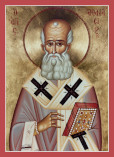 On this day are commemorated the
translation of his relics and their miracles. The life and work of this great saint are
written on January 18th. On this day are commemorated the
translation of his relics and their miracles. The life and work of this great saint are
written on January 18th.
|
3. The Holy Martyrs Boris and Gleb.
They were sons of the great Prince Vladimir, Baptizer of the Russian people. Until his Baptism, Vladimir had many wives, and children by them. Boris and Gleb were brothers of one mother. Before his death in 1015, Vladimir divided the kingdom among all his sons. But Svyatopolk, his eldest son and Prince of Kiev, desired to take the parts that were set aside for Boris and Gleb, so he sent men to kill Boris in one place and Gleb in another. Both brothers were deeply devout and pleasing to God in all things, and they met death with prayer and the lifting up of their hearts to Him. Their bodies remained incorrupt and fragrant, and were buried in the town of Vishgorod, where to this day blessed strength flows forth from them to heal men of diverse ills and sufferings.
4. St. Michael (Boris), King of Bulgaria.
Born and brought up as a pagan, Boris was baptized under the guidance of his uncle, Boyan, and his own sister. At his Baptism, he received the name Michael (Mikhail). Patriarch Photius sent him priests, who little by little baptized the whole Bulgarian people. Many of the nobles opposed this new Faith, but it was victorious, and the Cross glittered on many churches built by the devout King Michael. The Faith among the Bulgarians, as among the Serbs, was especially strengthened by the Five Followers of Ochrid, disciples of Saints Kyril and Methodius, who preached the knowledge of Christ to the people in the vernacular Slavonic language.
Michael became a monk in old age, and withdrew to a monastery. But when his son Vladimir began to ruin his father’s work and exterminate the Christians, Michael again put on his military uniform, took his sword, threw Vladimir down from the throne and replaced him with his younger son Simeon. He then put on his monastic schema again and withdrew to tranquillity, where, in asceticism and prayer, he finished his earthly course peacefully, ‘in good faith and a true confession of our Lord Jesus Christ, great and honored,’ and went to the heavenly world on May 2nd, 906.
FOR CONSIDERATION
Blessed Maximus the Fool for Christ walked naked in winter through the streets of Moscow. To the advice of some to put on some clothes and protect himself from the cold, he replied: ‘The winter is hard, but Paradise is sweet!’ He also said: ‘God crowns endurance with salvation.’ If Christ the Lord did not regret giving Himself to torture and death for our sakes, why should we regret giving ourselves for our own sakes? He bequeathed us a prescription, a diet, for our spiritual health, and this He named His easy yoke. The yoke with which we load ourselves is much heavier, for that yoke topples us into still greater and greater spiritual sickness. The earth demands of us many great sacrifices, promising us no reward after death. The earth demands that we sacrifice God to her, and our soul and conscience, our mind and human and divine dignity, and shows us a dark and stinking grave as the end of everything and the payment for everything. Christ seeks that we sacrifice only the earth and our animal nature, and sin and vice and everything that is worthless, and He then promises us resurrection and immortal life in Paradise. Yes, the winter is hard, but Paradise is sweet!
Daily Scripture Readings taken from The Orthodox New Testament, translated and published by Holy Apostles Convent, Buena Vista, Colorado, copyright © 2000, used with permission, all rights reserved.
Daily Prologue Readings taken from The Prologue of Ochrid, by Bishop Nikolai Velimirovic, translated by Mother Maria, published by Lazarica Press, Birmingham, England, copyright © 1985, all rights reserved. Edited by Dormition Skete.