

Daily Devotional
Thursday, May 13, 2027 (NS), April 30, 2027 (OS)
No Fasting.
Thursday of the Second Week
The commemoration of the holy Apostle Iakovos, son of Zebedee.
Scripture Readings
Paschalion — Movable Calendar
Thursday of the Second Week
Epistle
The Reading is from the Acts of the Apostles [§ 12]. In those days:
4 23The apostles, having been set free, came to their own company and reported as much as the chief priests and the elders said to them. 24And after they heard that, with one accord they lifted up their voice to God and said, “Master, Thou art the God Who made the heaven and the earth and the sea, and all things that are in them, 25“Who by the mouth of Thy servant David said, ‘Why did the nations act arrogantly and the peoples meditate empty things [Ps. 2:1]? 26“‘The kings of the earth stood by, and the rulers were gathered together against the Lord and against His Christ [Ps. 2:2].’ 27“For of a truth, both Herod and Pontius Pilate, with the Gentiles and the peoples of Israel, were gathered together against Thy holy Servant Jesus, Whom Thou didst anoint, 28“to do whatsoever Thy hand and Thy counsel foreordained to be done. 29“And now, Lord, look upon their threats, and grant to Thy slaves to speak Thy word with all boldness, 30“as Thou stretchest forth Thy hand for healing and signs and wonders to be done through the name of Thy holy Servant Jesus.” 31And having made entreaty, the place was shaken in which they were gathered together; and they were all filled with the Holy Spirit, and were speaking the word of God with boldness.
Gospel
The Reading is from the Holy Gospel according to Saint John [§ 16]. The Lord said to the Jews who had come to Him:
5 24“Verily, verily, I say to you, that the one who heareth My word and believeth the One Who sent Me hath everlasting life, and cometh not into judgment, but hath passed over out of death into life. 25“Verily, verily, I say to you, that an hour cometh, and now is, when the dead shall hear the voice of the Son of God, and they who hear shall live. 26“For even as the Father hath life in Himself, so He also gave to the Son to have life in Himself, 27“and He also gave to Him authority to execute judgment. That He is Son of Man, 28“cease marvelling at this; for an hour is coming in which all those in the graves shall hear His voice, 29“and shall go forth—they who did good things to a resurrection of life, but they who practised bad things to a resurrection of condemnation. 30“I am not able to do anything of Myself. Even as I hear, I judge; and My judgment is just, because I seek not Mine own will, but the will of the One Who sent Me, the Father.”
Menaion — Fixed Calendar
The commemoration of the holy Apostle Iakovos, son of Zebedee.
Epistle
The Reading is from the Acts of the Apostles [§ 29].
12 1At that time, Herod the king put forth his hands to maltreat some of those from the Church. 2And he killed Iakovos the brother of John with a sword. 3And because he saw that it pleased the Jews, he in addition went on to seize Peter also—and they were the days of unleavened bread— 4whom after he laid hold of, he also put in prison, and delivered him up to four sets of four soldiers to guard him, purposing after the passover to bring him forth to the people. 5Peter, therefore, on the one hand, was being guarded in the prison, but on the other hand, earnest prayer was being made by the Church to God on his behalf. 6And when Herod was about to bring him forth, on that very night Peter was sleeping, bound with two chains between two soldiers; and guards also were before the door keeping the prison. 7And behold, an angel of the Lord stood by him, and a light shone in the chamber; and he struck the side of Peter, and woke him up, saying, “Rise up quickly.” And the chains from his hands fell off of him. 8And the angel said to him, “Gird thyself about, and bind on thy sandals.” And so he did. And he saith to him, “Cast about thee thine outer garment, and follow thou me.” 9And he went out and kept on following him, and did not know that it was real that which was happening by means of the angel, but he kept on thinking he saw a vision. 10And after they passed a first guard and a second, they came up to the gate, the iron one, which leadeth into the city, which was opened to them of itself; and having gone out, they advanced one street, and straightway the angel departed from him. 11And after Peter came to himself, he said, “Now I know of a truth, that the Lord sent forth His angel, and took me out of the hand of Herod and all the expectation of the people of the Jews.”
Gospel
The Reading is from the Holy Gospel according to Saint Luke [§ 40]. At that time:
9 1After Jesus called together to Himself His twelve disciples, He gave them power and authority over all the demons, and to cure diseases. 2And He sent them forth to proclaim the kingdom of God and to heal those who were sick. 3And He said to them, “Cease taking anything for the way, neither staves, nor leathern pouch, nor bread, nor money, nor having two tunics apiece. 4“And into whatsoever house ye enter, be lodging there, and from that place be going forth. 5“And as many as will not receive you, when ye go forth from the city, shake off even the dust from your feet for a testimony against them.” 6And as they went forth, they were passing through village by village, preaching the Gospel, and curing everywhere.
for Sl. usage, see [Lk. 5:1-11].
Lives of the Saints (Prologue)
May 13th – Civil Calendar
April 30th – Church Calendar
1. The Holy Apostle Iakovos (James).
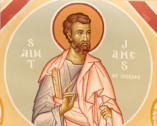 He was the son of Zebedee and brother of John, and was
one of the Twelve Holy Apostles. At the call of the Lord Jesus, he left his fishing nets and his
father, and together with John, immediately followed Christ. He was one of the three apostles to
whom the Lord revealed the greatest mysteries: before whom He was transfigured on Tabor and
before whom He was in agony in the Garden of Gethsemane before His Passion. After receiving the
Holy Spirit, he preached the Gospel in various places, going as far as Spain. On his return from
Spain, a violent quarrel broke out between the Jews and himself on the holy Scriptures, and being
unable to withstand him, they hired a magician, Hermogenes. But Hermogenes and Philip, his pupil,
were overcome by the power and truth that Iakovos preached, and were baptized. Then the Jews
denounced him to Herod, and persuaded one Josias to slander the apostle. This Josias, seeing
Iakovos’ manly bearing and hearing his clear preaching of the truth, repented and came to
faith in Christ. When Iakovos was condemned to death, this Josias was also condemned. Mounting
the scaffold, Josias begged Iakovos’ forgiveness for the sin of slander, and Iakovos
embraced him, kissing him and saying: ‘Peace be to thee, and forgiveness.’ And they
both laid their heads under the sword and were beheaded for the sake of the Lord Whom they had
loved and served. St. Iakovos suffered in Jerusalem in the year 45. His body was taken to Spain,
where to this day miracles of healing are performed at his tomb.
He was the son of Zebedee and brother of John, and was
one of the Twelve Holy Apostles. At the call of the Lord Jesus, he left his fishing nets and his
father, and together with John, immediately followed Christ. He was one of the three apostles to
whom the Lord revealed the greatest mysteries: before whom He was transfigured on Tabor and
before whom He was in agony in the Garden of Gethsemane before His Passion. After receiving the
Holy Spirit, he preached the Gospel in various places, going as far as Spain. On his return from
Spain, a violent quarrel broke out between the Jews and himself on the holy Scriptures, and being
unable to withstand him, they hired a magician, Hermogenes. But Hermogenes and Philip, his pupil,
were overcome by the power and truth that Iakovos preached, and were baptized. Then the Jews
denounced him to Herod, and persuaded one Josias to slander the apostle. This Josias, seeing
Iakovos’ manly bearing and hearing his clear preaching of the truth, repented and came to
faith in Christ. When Iakovos was condemned to death, this Josias was also condemned. Mounting
the scaffold, Josias begged Iakovos’ forgiveness for the sin of slander, and Iakovos
embraced him, kissing him and saying: ‘Peace be to thee, and forgiveness.’ And they
both laid their heads under the sword and were beheaded for the sake of the Lord Whom they had
loved and served. St. Iakovos suffered in Jerusalem in the year 45. His body was taken to Spain,
where to this day miracles of healing are performed at his tomb.
2. St. Donatus.
Bishop of Evria in Albania, he was endowed by God with great gifts of wonder-working, and performed many miracles for the sake of the people. He turned brackish water into sweet, brought rain in a drought, healed the king’s daughter of insanity and raised a dead man. This dead man had paid off a debt to some creditor, but the unscrupulous creditor wanted the debt paid a second time, so he used the death of his debtor to come to the widow and demand that the debt be paid immediately. The widow wept and complained to the bishop. St. Donatus told the creditor to wait until the man had been buried, then they would talk about the debt. But the creditor angrily demanded his own. Then Donatus went up to the corpse, took hold of it and cried: ‘Get up, brother, and see what’s up with this creditor of yours!’ The corpse got up, and with a terrible gaze, looked at its creditor, telling him when and where it had paid the debt. It also demanded a written receipt from him. The terrified creditor gave the receipt into its hands. The corpse tore it up, then lay down again and died. St. Donatus entered peacefully into rest in great old age, and went to the Lord in 387. His relics are still preserved for the help of the faithful in Evria in Albania.
3. The Holy Martyr Argyre.
This new-martyr was born in Prousa (Bursa) of devout parents. As soon as she was married to a Christian man, a Turk from the neighborhood looked on her and invited her to live with him. The Christ-loving Argyre rejected the Turk’s foul suggestion, and he was enraged and accused her to the judge of having intended to become a Moslem and afterwards retracted. From trial to trial, from prison to prison, St. Argyre spent fifteen whole years suffering for Christ, for she loved Him more than anything in the world. She finally died in prison in Constantinople in 1725.
FOR CONSIDERATION
A devout elder was lying on his deathbed. His friends were gathered round him, weeping for him. The elder sighed three times. The monks asked him why he had sighed. The elder replied: ‘I sighed the first time because you are afraid of death; the second time because you are not ready for death; and the third time because I am going from toil to rest.’ You see how a righteous man enters into rest? He does not fear death; he is ready for death, and he sees that, through death, he passes from a life of toil to eternal rest. When human nature is conceived in its natural state in Paradise, then death is unnatural, as sin is unnatural. Death comes from sin. Repentant and cleansed from sin, a man does not regard death as annihilation but as the gate of immortal life. And if the righteous prayed for their earthly life to be prolonged, this was not from love of this life, nor from fear of death, but only that they might be given more time for repentance and cleansing from sin, so that they might be purer and more sinless to go before God. And if they sometimes showed fear in the face of death, this was not fear of death but of God’s judgement. What sort of fear must unrepentant sinners have in the face of death?
Daily Scripture Readings taken from The Orthodox New Testament, translated and published by Holy Apostles Convent, Buena Vista, Colorado, copyright © 2000, used with permission, all rights reserved.
Daily Prologue Readings taken from The Prologue of Ochrid, by Bishop Nikolai Velimirovic, translated by Mother Maria, published by Lazarica Press, Birmingham, England, copyright © 1985, all rights reserved. Edited by Dormition Skete.