

Daily Devotional
Wednesday, May 12, 2027 (NS), April 29, 2027 (OS)
Fast Day, but Wine and Olive Oil Allowed.
Wednesday of the Second Week
The commemoration of the holy Apostles of the Seventy, Jason and Sosipater, and their companions (commemorated on Sl. calendar on the 28th of April). The commemoration of the holy Nine Martyrs of Kyzicus, Theognis, Rufus, Antipater, Theostichos, Artemas, Magnos, Theodotos, Thavmasios, and Philemon (commemorated on Gk. calendar on the 28th of April).
Scripture Readings
Paschalion — Movable Calendar
Wednesday of the Second Week
Epistle
The Reading is from the Acts of the Apostles [§ 11]. In those days:
4 13When the Jews saw the boldness of Peter and John, and comprehended for themselves that they were unlettered and laymen, they kept on wondering and began to recognize them that they were with Jesus. 14And seeing the man who was healed standing with them, they kept on having nothing to gainsay. 15But after they commanded them to go outside the council, they were conferring with one another, 16saying, “What shall we do to these men? For, indeed, that a notable sign hath come to pass through them is manifest to all those inhabiting Jerusalem, and we are not able to deny it. 17“But in order that it might not spread further among the people, let us forbid them with a threat to no longer speak in this name to any man.” 18And they called them, and commanded them not to speak at all nor teach in the name of Jesus. 19But Peter and John answered and said to them, “Whether it is right before the face of God to hearken to you rather than God, judge ye. 20“For we cannot but speak the things which we saw and heard.” 21Now after they further threatened them, they released them, finding nothing how they might punish them, because of the people; for all were glorifying God for that which had taken place. 22For the man upon whom this sign of healing had taken place was more than forty years old.
Gospel
The Reading is from the Holy Gospel according to Saint John [§ 15]. The Lord said to the Jews who had come to Him:
5 17“My Father worketh until now, and I work.” 18On this account therefore the Jews were seeking the more to kill Him, because He not only was breaking the sabbath, but was also calling God His own Father, making Himself equal to God. 19Then Jesus answered and said to them, “Verily, verily, I say to you, the Son is not able to do anything of Himself, unless He see the Father doing anything; for whatsoever that One may do, these things also the Son is doing in like manner. 20“For the Father loveth the Son, and showeth Him all things which He Himself doeth; and He will show Him greater works than these, that ye may wonder. 21“For even as the Father raiseth up the dead and maketh alive, thus also the Son maketh alive whom He will. 22“For the Father judgeth no one, but hath given all judgment to the Son, 23“in order that all may honor the Son, even as they are honoring the Father. The one who honoreth not the Son honoreth not the Father Who sent Him. 24“Verily, verily, I say to you, that the one who heareth My word and believeth the One Who sent Me hath everlasting life, and cometh not into judgment, but hath passed over out of death into life.”
Menaion — Fixed Calendar
The commemoration of the holy Apostles of the Seventy, Jason and Sosipater, and their companions (commemorated on Sl. calendar on the 28th of April). The commemoration of the holy Nine Martyrs of Kyzicus, Theognis, Rufus, Antipater, Theostichos, Artemas, Magnos, Theodotos, Thavmasios, and Philemon (commemorated on Gk. calendar on the 28th of April).
No readings given.
Lives of the Saints (Prologue)
May 12th – Civil Calendar
April 29th – Church Calendar
1. St. Basil of Ostrog.
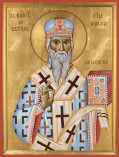 Basil was born in Popovo Selo in Herzegovina,
of simple and devout parents. From his youth he was filled with love for the Church of God, and
when he grew up he went to the monastery of the Dormition of the Mother of God at Trebinje, and
became a monk. As such, he quickly became known for his serious and rare ascetic life, for he
loaded himself with ascetic practices, each harder than the last. He was later chosen and
consecrated as Bishop of Zahum and Skenderia, much against his will. As a bishop, he first lived
in the monastery at Tvrdoš, whence, as a good pastor, he confirmed his flock in the
Orthodox Faith, keeping it from the cruelty of the Turks and the guile of the Latins. But when he
was too pressed-upon by his enemies, and when Tvrdoš* was destroyed by the Turks, Basil
moved to Ostrog, where he lived in strict asceticism, protecting his flock by his unceasing and
loving prayers. He went peacefully to the Lord in the 16th century, leaving his whole and healing
body, incorrupt and wonder-working, to the present day. The miracles at the grave of St. Basil
are without number. Both Christians and Moslems hasten to his relics and find healing of the
gravest sicknesses and sufferings. A great national gathering takes place there every year at
Pentecost.
Basil was born in Popovo Selo in Herzegovina,
of simple and devout parents. From his youth he was filled with love for the Church of God, and
when he grew up he went to the monastery of the Dormition of the Mother of God at Trebinje, and
became a monk. As such, he quickly became known for his serious and rare ascetic life, for he
loaded himself with ascetic practices, each harder than the last. He was later chosen and
consecrated as Bishop of Zahum and Skenderia, much against his will. As a bishop, he first lived
in the monastery at Tvrdoš, whence, as a good pastor, he confirmed his flock in the
Orthodox Faith, keeping it from the cruelty of the Turks and the guile of the Latins. But when he
was too pressed-upon by his enemies, and when Tvrdoš* was destroyed by the Turks, Basil
moved to Ostrog, where he lived in strict asceticism, protecting his flock by his unceasing and
loving prayers. He went peacefully to the Lord in the 16th century, leaving his whole and healing
body, incorrupt and wonder-working, to the present day. The miracles at the grave of St. Basil
are without number. Both Christians and Moslems hasten to his relics and find healing of the
gravest sicknesses and sufferings. A great national gathering takes place there every year at
Pentecost.
* Author’s Note: A new church, on the ruins of the old Tvrdoš, has been built in our day by Nikolai Runjevac, from the village of Poljica near Trebinje—a wonderful foundation in the sight of God and His people.
2. The Nine Holy Martyrs of Kyzikos.
These nine courageous martyrs, burning with love for Christ, refused to offer sacrifice to idols or to deny Christ the Lord, for which they were harshly tortured and finally beheaded. In the time of the Emperor Constantine, a church was built in Kyzikos in honor of these martyrs, and their incorrupt relics were laid there. Their names were: Theognes, Roufos, Antipater, Theostichos, Artemas, Magnos, Theodotos, Thaumasios and Philemon. They all scorned the temporal for the sake of the eternal, and the corruptible for the incorruptible. Therefore the Lord brought them into His eternal family and crowned them with wreaths of unfading glory. They suffered with honor and were glorified in the 3rd century.
3. Our Holy Father Memnon the Wonder-worker.
From his youth, Memnon gave himself to fasting and prayer, and purified himself so greatly that he became a dwelling-place of the Holy Spirit. He cured incurable illnesses and worked many other miracles. He appeared during storms at sea and saved boats from destruction. He entered peacefully into rest in the Lord in the second century, and went to His heavenly courts.
FOR CONSIDERATION
Nothing can be hidden from the omniscient God. To Him is known at every moment what is being done on earth, both in the external and in the internal, spiritual world. Not a single intention, not a single wish, not a single thought of his can a man hide from God. How can that which cannot be hidden from holy men be hidden from God? The great Tsar Ivan the Formidable came one day to church. In the church, Blessed Basil the Fool for Christ was at prayer. The tsar was indeed physically present in the church, but his mind was on Sparrow Hill, not far from Moscow, on which a palace had been begun. Throughout the service, Ivan was thinking of how to continue and complete his palace on that hill. After the service, the tsar saw Basil, and asked him where he had been. ‘In church,’ replied Basil, and immediately asked the tsar: ‘And where were you, my tsar?’ ‘I, too, have been in church,’ replied the tsar. But to this, the discerning saint made answer: ‘You are not speaking the truth, my little Ivan, for I saw you in thought walking on Sparrow Hill and building a palace there!’
Daily Scripture Readings taken from The Orthodox New Testament, translated and published by Holy Apostles Convent, Buena Vista, Colorado, copyright © 2000, used with permission, all rights reserved.
Daily Prologue Readings taken from The Prologue of Ochrid, by Bishop Nikolai Velimirovic, translated by Mother Maria, published by Lazarica Press, Birmingham, England, copyright © 1985, all rights reserved. Edited by Dormition Skete.