

Daily Devotional
Sunday, April 25, 2027 (NS), April 12, 2027 (OS)
Fast Day, but Fish, Wine and Olive Oil Allowed.
Holy Week
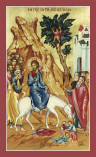
| Palm Sunday |
The commemoration of our holy father among the saints, Basil the Confessor, Bishop of Parium.
Scripture Readings
Paschalion — Movable Calendar
Palm Sunday
Epistle
The Reading is from the Epistle of Saint Paul to the Philippians [§ 247]. Brethren:
4 4Be rejoicing in the Lord always; again I will say, be rejoicing. 5Let your reasonableness be known to all men. The Lord is near: 6Cease being anxious about anything, but in everything by prayer and by entreaty, with giving of thanks, let your requests be made known to God. 7And the peace of God, which surpasseth all understanding, shall guard your hearts and your minds in Christ Jesus.
8For the rest, brethren, whatsoever things are true, whatsoever things are worthy of respect, whatsoever things are just, whatsoever things are pure, whatsoever things are pleasing, whatsoever things are of good report, if there is any virtue and if there is any praise, be considering these things. 9And what ye learned and received and heard and saw in me, these things be practising; and the God of peace shall be with you.
Gospel
In the Orthros
The Reading is from the Holy Gospel according to Saint Matthew [§ 83]. At that time:
21 1When Jesus drew near to Jerusalem, and came to Bethphage, toward the Mount of Olives, then Jesus sent forth two disciples, 2saying to them, “Go into the village, the one opposite you; and straightway ye shall find an ass which hath been tied, and a colt with her. Loose them and bring them to Me. 3“And if anyone should say anything to you, ye shall say, ‘The Lord hath need of them’; and straightway he will send them.” 4Now all this came to pass in order that it might be fulfilled that which was spoken by the prophet, saying, 5“Say to the daughter of Sion [Is. 62:11], ‘Behold thy King cometh to thee, meek, and mounted on an ass, and a colt, the foal of a beast of burden [cf. Zach. 9:9].’” 6And the disciples went and did even as Jesus commanded them, 7and brought the ass and the colt, and put their garments upon them, and He sat down upon them. 8And the greater part of the crowd spread their garments in the way; and others were cutting branches from the trees and were strewing them in the way. 9And the crowds, those going before and those following, were crying out, saying, “Hosanna, to the Son of David; blessed is He Who cometh in the name of the Lord [cf. Ps. 117(118):25(26)]; hosanna in the highest.” 10And after He entered into Jerusalem, all the city was shaken, saying, “Who is this?” 11And the crowds were saying, “This is Jesus the Prophet, the One from Nazareth of Galilee.”...
15But after the chief priests and the scribes saw the wonders which He did, and the children crying out in the temple and saying, “Hosanna, to the Son of David,” they were indignant, 16and said to Him, “Hearest Thou what these say?” And Jesus saith to them, “Yes; did ye never read, ‘Out of the mouth of babes and sucklings Thou hast perfected praise for Thyself [Ps. 8:2]’?” 17And He left them behind and went out of the city to Bethany, and He lodged there.
In the Liturgy
The Reading is from the Holy Gospel according to Saint John [§ 41].
12 1Six days before the passover, Jesus came to Bethany, where Lazarus was who had died, whom He raised from the dead. 2So they made a supper for Him there, and Martha was serving; but Lazarus was one of those reclining at table with Him. 3Then Mary, having taken a pound of very precious perfumed ointment of pure spikenard, anointed the feet of Jesus, and wiped His feet with her hair. And the house was filled with the odor of the perfumed ointment. 4Then one of His disciples, Judas Iscariote, Simon’s son, who was about to deliver Him up, saith, 5“Why was this perfumed ointment not sold for three hundred denarii and given to the poor?” 6But he said this, not that he was caring for the poor, but because he was a thief, and had the money box, and was taking away what was put in it. 7Then Jesus said, “Let her alone, for the day of My laying out for burial hath she kept it. 8“For ye have the poor among yourselves always, but Me ye have not always.” 9A great crowd of the Jews therefore knew that He was there, and they came not because of Jesus only, but also in order that they might see Lazarus, whom He raised from the dead. 10But the chief priests took counsel that they might put to death Lazarus also, 11because by reason of him many of the Jews were going away and were believing in Jesus.
12On the morrow a great crowd which came to the feast, after they heard that Jesus was coming into Jerusalem, 13took the palm branches of the palm trees, and went out to meet Him, and were crying, “Hosanna, blessed is He Who cometh in the name of the Lord, the King of Israel [cf. Ps. 117(118):25(26)].” 14And Jesus, having found a young ass, sat upon it, even as it is written: 15“Cease fearing, O daughter of Sion, behold, thy King cometh, sitting on a colt of an ass [cf. Zach. 9:9].” 16But the disciples knew not these things at the first; but when Jesus was glorified, then they remembered that these things were written in reference to Him, and that these things they did to Him. 17Then the crowd that was with Him when He called Lazarus out of the grave and raised him from the dead bore witness. 18On this account the crowd also went to meet Him, because it heard that He had done this sign.
Menaion — Fixed Calendar
The commemoration of our holy father among the saints, Basil the Confessor, Bishop of Parium.
No readings given.
Lives of the Saints (Prologue)
April 25th – Civil Calendar
April 12th – Church Calendar
1. Our Holy Father Isaac II of Syria (St. Isaac the Syrian is commemorated on Jan. 28th).
St. Gregory the Dialogist writes about this Isaac. He went to Italy in the time of the Goths and went into the church in the town of Spoleto to pray. He asked the verger to leave him locked in the church all night, and thus spent the night in prayer without moving from that place. He spent the next day and night in the same way. The verger called him a hypocrite and struck him a blow—and lost his reason at that same moment. Seeing how the verger was so fiercely tormented, Isaac bent over him and the evil spirit fled from him, leaving him whole. People came to hear of this happening, and the whole town thronged around this wonderful elder. They offered him money and goods, but he refused them all and would accept nothing. Instead, he withdrew to a forest, where he built himself a cell, which quickly became transformed into a large monastery. Isaac became famous for his miracles, especially for his discernment. One evening he told the brethren to take all the hoes out to the vineyard and leave them there. The next day, the brethren set out for the vineyard, taking their lunch, as they had no workers. When they got there, they found as many people working as there were hoes to work with. It transpired that these people had come as thieves to steal the hoes, but by the power of God, they were constrained to work all night.
On another occasion, a couple of almost-naked men came seeking clothing from Isaac. He sent a monk to a hollow tree at the end of the road, to bring what he found there. The monk went off, found some clothing and brought it back to the monastery. The abbot took the clothing and gave it to the beggars. They were profoundly ashamed as they recognized their own clothing, which they had concealed in that tree.
A man once sent two beehives to the monastery. A monk hid one of them on the way, and brought the other to the abbot. The saint said to him: ‘Be careful when you go back to that beehive you hid on the way. It’s been taken over by poisonous snakes. Take care they don’t bite you!’
St. Isaac reposed in peace in 550.
2. St. Basil the Confessor.
In a time of iconoclasm, this virtuous man was bishop in the city of Parius in Asia Minor. He refused to sign the imperial order against the veneration of icons, for which he was greatly persecuted and tortured. But he remained firm as diamond in his Orthodoxy. He died in the first half of the 8th century, and went to the Lord.
3. Our Holy Father Akakios.
From the village of Gollitsa in Epirus, he was a great Athonite ascetic, spiritual guide and clairvoyant, and had many heavenly visions. He gave his blessing to several monks to seek martyrdom. He entered into rest at the age of 98, in 1730.
4. Our Holy Mother Athanasia.
Born on the island of Aegina of rich and eminent parents, she gave her goods to the poor and went off to a monastery, where she heaped greater and greater asceticism on herself. She took food only once a day, and that only bread and water, and in the Great Fast only once every two days. Only at Nativity and Pascha did she taste fish and oil. Although she was abbess of the monastery, she was the servant of all the other sisters and was ashamed that any should wait on her. She was made worthy of the great gift of wonder-working, both during her lifetime and after her death. She entered into rest in the Lord in 860.
FOR CONSIDERATION
The wicked Emperor Constantine Kopronymos had a virtuous daughter, the maiden Anthusa, ‘a beauteous branch of an evil stem’. She remained set against all her father’s urgings that she marry, for she was firmly bound in whole-hearted love to Christ the Lord. When her father died, Anthusa gave her goods away to the poor and became a nun in a monastery. It is a cause of wonder that many men of gentle birth have left the vanity of the world and set off on the narrow way after Christ; and it is twice as great a cause of wonder that women scorn youth and wealth and all the transient attraction of the world for the love of Christ. The Lord Himself said that it is hard for a rich man to enter the kingdom of heaven. Hard, yes: but not impossible. To those who scorn their own selves, it is easy to scorn riches and the whole world.
Daily Scripture Readings taken from The Orthodox New Testament, translated and published by Holy Apostles Convent, Buena Vista, Colorado, copyright © 2000, used with permission, all rights reserved.
Daily Prologue Readings taken from The Prologue of Ochrid, by Bishop Nikolai Velimirovic, translated by Mother Maria, published by Lazarica Press, Birmingham, England, copyright © 1985, all rights reserved. Edited by Dormition Skete.