

Daily Devotional
Friday, December 18, 2026 (NS), December 5, 2026 (OS)
Fast Day, but Wine and Olive Oil Allowed.
Friday of the Twenty-Ninth Week
The commemoration of our holy and God-bearing father, Savvas the Sanctified.
Scripture Readings
Paschalion — Movable Calendar
Friday of the Twenty-Ninth Week
Epistle
The Reading is from the Epistle of Saint Paul to the Hebrews [§ 317]. Brethren:
7 18On the one hand there is an annulling of the foregoing commandment because of its weakness and unprofitableness, 19for the law made nothing perfect; but on the other hand there is the bringing in of a better hope, by which we draw near to God. 20And inasmuch as not without taking an oath He was made priest (for they indeed have become priests without taking an oath, 21but He with the taking of an oath, by Him saying to Him, “The Lord swore and will not regret, ‘Thou art a priest forever according to the order of Melchisedek [Ps. 109(110):4]’”), 22by so much Jesus hath become a surety of a better covenant. 23And they on the one hand who have become priests are many, being hindered from continuing by reason of death; 24but He on the other hand, because He abideth forever, hath the intransitive priesthood. 25Wherefore He is also able to save to the uttermost those who come to God through Him, since He ever liveth to intercede on their behalf.
Gospel
The Reading is from the Holy Gospel according to Saint Luke [§ 101]. At that time:
20 19The chief priests and the scribes sought to lay hands upon Jesus in the same hour, but they were afraid of the people; for they knew that He was speaking this parable against them.
20And having watched carefully for an opportunity, they sent forth suborned men, which feigned themselves to be righteous, in order that they might take hold of a word of His, so as to deliver Him up to the rule and the authority of the governor. 21And they questioned Him, saying, “Teacher, we know that Thou sayest and teachest rightly, and acceptest not the person of any, but teachest the way of God in truth. 22“Is it lawful for us to give tribute to Cæsar or not?” 23But He perceived their knavery, and said to them, “Why are ye trying to tempt Me? 24“Show Me a denarius. Whose image and inscription hath it?” And they answered and said, “Cæsar’s.” 25And He said to them, “Render therefore the things of Cæsar to Cæsar, and the things of God to God.” 26And they were not able to take hold of His saying in the presence of the people; and having marvelled at His answer, they kept silent.
Menaion — Fixed Calendar
The commemoration of our holy and God-bearing father, Savvas the Sanctified.
Epistle
The Reading is from the Epistle of Saint Paul to the Galatians [§ 213]. Brethren:
5 22The fruit of the Spirit is love, joy, peace, long-suffering, kindness, goodness, faith, 23meekness, self-control; against such things there is no law. 24But they who are of the Christ crucified the flesh with the passions and the lusts. 25If we live by the Spirit, let us also be walking by the Spirit. 26Let us not become vainglorious, provoking one another, envying one another.
6 1Brethren, even if a man should be overtaken in some transgression, ye, the spiritual ones, be restoring such a one in the spirit of meekness, looking out for thyself, lest thou also be tempted. 2Keep on bearing one another’s burdens, and thus fill up the law of the Christ.
Gospel
The Reading is from the Holy Gospel according to Saint Matthew [§ 43]. The Lord said to His disciples:
11 27“All things were delivered to Me by My Father. And no one doth fully know the Son, except the Father; nor doth anyone fully know the Father, except the Son, and he to whomsoever the Son is willing to reveal Him. 28“Come to Me, all ye who labor and are burdened, and I will give you rest. 29“Take up My yoke upon you and learn from Me, for I am meek and humble in heart; and ye shall find rest to your souls. 30“For My yoke is good and My burden is light.”
Lives of the Saints (Prologue)
December 18th – Civil Calendar
December 5th – Church Calendar
1. Our Holy Father Sava the Sanctified.
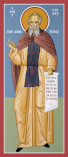 The unknown village of Mutalaska, in the province of
Cappadocia, became famous through this great light of the Orthodox Church, for St. Sava was born
there. He left the home of his parents, John and Sophia, at the age of eight and became a monk in
a nearby monastery called ‘Flavian’s’. After ten years, he moved to the
monasteries of Palestine, staying longest in the monastery of St. Efthymios the Great (Jan. 20th)
and Theoktistos. Efthymios, who had the gift of discernment, foretold that he would be a famous
monk and leader of monks, and that he would found a monastery that would be greater than any
other of that day. After St. Efthymios’ death, Sava went into the desert, where he lived
for five years as a hermit in a cave which an angel of God showed him. After that, when he had
become a perfected monk, he began by divine providence to gather round him many desirous of the
spiritual life. They very quickly grew in number, so that Sava had to build both a church and
many cells. Some Armenians also came to him, and he set aside a cave for them, and they
celebrated the services there in their own language. When his father died, his aged mother Sophia
came to him and he made her a nun and gave her a cell away from the monastery, where she lived in
asceticism till her death. This holy father endured many attacks from those close to him, from
heretics, and from demons. But he overcame them all in these ways: those close to him he won over
by his goodness and forbearance, the heretics by an unshakable confession of the Orthodox Faith,
and the demons with the sign of the Cross and the invocation of God’s aid. He had a
particularly severe battle with the demons on the mountain of Castellium, where he founded the
second of his seven monasteries. He and his neighbor, Theodosios the Great, are considered to be
the greatest lights and pillars of Orthodoxy in the East. Kings and patriarchs were brought to
the right Faith by them, and these holy and wonderful men, strong in the power of God, served
each and every man as an example of humility. St. Sava entered into rest in 532 at the age of
ninety-four, after a life of great labor and great reward.
The unknown village of Mutalaska, in the province of
Cappadocia, became famous through this great light of the Orthodox Church, for St. Sava was born
there. He left the home of his parents, John and Sophia, at the age of eight and became a monk in
a nearby monastery called ‘Flavian’s’. After ten years, he moved to the
monasteries of Palestine, staying longest in the monastery of St. Efthymios the Great (Jan. 20th)
and Theoktistos. Efthymios, who had the gift of discernment, foretold that he would be a famous
monk and leader of monks, and that he would found a monastery that would be greater than any
other of that day. After St. Efthymios’ death, Sava went into the desert, where he lived
for five years as a hermit in a cave which an angel of God showed him. After that, when he had
become a perfected monk, he began by divine providence to gather round him many desirous of the
spiritual life. They very quickly grew in number, so that Sava had to build both a church and
many cells. Some Armenians also came to him, and he set aside a cave for them, and they
celebrated the services there in their own language. When his father died, his aged mother Sophia
came to him and he made her a nun and gave her a cell away from the monastery, where she lived in
asceticism till her death. This holy father endured many attacks from those close to him, from
heretics, and from demons. But he overcame them all in these ways: those close to him he won over
by his goodness and forbearance, the heretics by an unshakable confession of the Orthodox Faith,
and the demons with the sign of the Cross and the invocation of God’s aid. He had a
particularly severe battle with the demons on the mountain of Castellium, where he founded the
second of his seven monasteries. He and his neighbor, Theodosios the Great, are considered to be
the greatest lights and pillars of Orthodoxy in the East. Kings and patriarchs were brought to
the right Faith by them, and these holy and wonderful men, strong in the power of God, served
each and every man as an example of humility. St. Sava entered into rest in 532 at the age of
ninety-four, after a life of great labor and great reward.
Among all his other great and good works, let this be remembered above all: that he compiled the first Order of Services for use in monasteries, now known as the Jerusalem Typikon.
2. Our Holy Fathers, the Martyrs of Karyes.
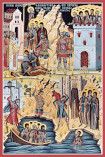 They suffered at the time of the Union of
Lyons, at the hands of the Papists. The Union was the work of the pope and the Emperor
Michael Palaiologos (1260-81). The Protos of the Holy Mountain was hanged, and the others
were beheaded with the sword. For details of this, see October 10th. They suffered at the time of the Union of
Lyons, at the hands of the Papists. The Union was the work of the pope and the Emperor
Michael Palaiologos (1260-81). The Protos of the Holy Mountain was hanged, and the others
were beheaded with the sword. For details of this, see October 10th.
|
3. Our Holy Father Nectarios of Bitola.
Born in Bitola, he lived in asceticism in the monastery of the Holy Physicians Kosmas and Damian, together with his father who was also a monk. He later went to Karyes, where he continued his asceticism in the cell of the Holy Archangels, under the direction of the elders of Philotheou and Dionysiou. After conquering human envy, demonic attacks and painful illnesses, he entered into the kingdom of Christ on December 5th, 1500. His incorrupt and fragrant relics are preserved in his cell.
4. Our Holy Fathers Karion and Zachariah.
Father and son, they were great Egyptian ascetics. Karion left his wife and their two children and went off to become a monk. The young Zachariah was taken into the monastery as a child, and he outstripped in asceticism both his father and many other notable ascetics. When they asked Zachariah: ‘Who is truly a monk?’ he replied: ‘He who constantly exercises himself in the fulfilling of God’s commandments.’
FOR CONSIDERATION
A man may be great in some skill, as a statesman or a military leader, but no one amongst men is greater than the man great in faith, hope and love. The greatness of the faith and hope in God held by St. Sava the Sanctified is best shown by the following incident: One day the monastery treasurer came to Sava and said he would not be able to sound the semantron* the following Saturday and Sunday to summon the brethren for the common service and meal, because there was not a trace of flour in the monastery, nor anything at all to eat or drink. For the same reason, even the divine Liturgy was impossible. The saint replied without hesitation: ‘I shall not cancel the Liturgy because of a lack of flour. He Who commanded us not to be concerned for bodily things is faithful to His word, and is able to sustain us in a time of hunger.’ And he placed all his trust in God. In this extremity, he was prepared to send some of the church vessels and vestments to be sold in the city, so that the divine services might not be foregone, nor the brothers a customary meal. But, before Saturday dawned, some men, moved by divine providence, brought thirty mules laden with wheat, wine and oil to the monastery. ‘What do you say now, my brother?’ Sava asked the treasurer. ‘Shall we not strike the semantron and gather the fathers?’ The treasurer was ashamed of his lack of faith, and begged the abbot’s forgiveness. Sava’s biographer called him ‘severe with demons, but mild with men’. Some monks rebelled against St. Sava, and were driven from the monastery by order of Patriarch Elias. They built themselves huts on the bed of the Tekoa River, and lived there in dire straits without the bare necessities of life. Hearing that they were starving, St. Sava loaded mules with flour and took them to them himself. Seeing that they had no church, he built them one. At first the monks received him with hatred, but afterwards they returned his love with love, and repented of their former evil towards him.
* Semantron (in Serbian, klepalo)—a long piece of wood, shaped for resonance, which is struck rapidly with a mallet. It became widely used in place of a bell under Turkish rule, when Christians were forbidden to ring bells because the Turks held the superstition that bells call demons.—Translator.
Daily Scripture Readings taken from The Orthodox New Testament, translated and published by Holy Apostles Convent, Buena Vista, Colorado, copyright © 2000, used with permission, all rights reserved.
Daily Prologue Readings taken from The Prologue of Ochrid, by Bishop Nikolai Velimirovic, translated by Mother Maria, published by Lazarica Press, Birmingham, England, copyright © 1985, all rights reserved. Edited by Dormition Skete.