

Daily Devotional
Tuesday, November 3, 2026 (NS), October 21, 2026 (OS)
No Fasting.
Tuesday of the Twenty-Third Week
The commemoration of our venerable Father Hilarion the Great.
Scripture Readings
Paschalion — Movable Calendar
Tuesday of the Twenty-Third Week
Epistle
The Reading is from the First Epistle of Saint Paul to the Thessalonians [§ 263]. Brethren:
1 6Ye became imitators of us and of the Lord, having received the word in much affliction with joy of the Holy Spirit, 7so that ye became examples to all those who believe in Macedonia and Achaia. 8For from you the word of the Lord hath been sounded forth, not only in Macedonia and Achaia, but also in every place your faith, which is toward God, hath gone forth, so that there is no need for us to have to speak anything. 9For they themselves keep on reporting concerning us, what sort of entrance we had with you, and how ye turned toward God from the idols, to serve a living and true God, 10and to wait for His Son from the heavens, Whom He raised from the dead, Jesus, Who delivereth us from the wrath which is coming.
Gospel
The Reading is from the Holy Gospel according to Saint Luke [§ 44]. The Lord said to His disciples:
9 23“If anyone is willing to come after Me, let him deny himself, and take up his cross daily, and keep on following Me. 24“For whosoever will save his life shall lose it; but whosoever will lose His life on account of Me, this same one shall save it. 25“For what is a man profited, if he gaineth the whole world, but destroyeth or loseth himself? 26“For whosoever is ashamed of Me and My words, of this one the Son of Man shall be ashamed, whenever He should come in His glory, and that of the Father, and of the holy angels. 27“But of a truth I say to you, there are some of those standing here who in no wise shall taste of death, until they see the kingdom of God.”
Menaion — Fixed Calendar
The commemoration of our venerable Father Hilarion the Great.
Epistle
The Reading is from the Second Epistle of Saint Paul to the Corinthians [§ 188]. Brethren:
9 6The one who soweth sparingly shall also reap sparingly; and the one who soweth with blessing shall also reap with blessing. 7Let each give even as he purposeth in his heart, not out of sorrow or out of necessity; for God loveth a cheerful giver. 8And God is able to make all grace abound toward you, that ye, always having all self-sufficiency in everything, may abound to every good work, 9even as it hath been written: “He dispersed, he gave to the poor; his righteousness abideth forever [Ps. 111(112):9].” 10Now the One Who supplieth seed to the sower and bread for eating, may He provide and multiply your seed for sowing, and increase the fruits of your righteousness, 11being enriched in everything to all open-handedness, which worketh out through us giving of thanks to God.
Gospel
The Reading is from the Holy Gospel according to Saint Luke [§ 24]. At that time:
6 17Jesus stood upon a level place. And there was a crowd of
His disciples, and a great multitude of the people from all of Judæa and Jerusalem and the
seacoast of Tyre and Sidon, who came to hear Him, and to be healed of their diseases—
18even those who were troubled by unclean spirits; and they were cured.
19And all the crowd was seeking to touch Him, for power was coming forth from Him and
healing all. 20And He lifted up His eyes to His disciples, and began to say:
“Blessed are the poor, for yours is the kingdom of God.
21“Blessed are ye who hunger now, for ye shall be
filled.
Blessed are ye who weep now, for ye shall laugh.
22“Blessed are ye whenever men hate you, and whenever they
separate you, and reproach you, and cast out your name as evil, on account of the Son of
Man.
23“Rejoice in that day and leap for joy, for behold, your
reward is great in the heavens.”
Lives of the Saints (Prologue)
November 3rd – Civil Calendar
October 21st – Church Calendar
1. Our Holy Father Hilarion the Great.
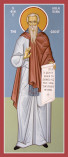 As a rose growing among thorns, so was this great
saint born of pagan parents in the village of Tabatha near Gaza in Palestine. His parents sent
him to study in Alexandria, where the gifted youngster quickly assimilated both secular learning
and spiritual wisdom. Coming to know Christ the Lord and receiving Baptism, he desired to serve
the Lord with his whole heart. With this desire, Hilarion visited St. Anthony the Great in the
desert and became his disciple. He then returned to his homeland and lived in asceticism near
Maiuma, not far from Gaza. Demons tried to frighten him with various terrors, but he, with prayer
to God and the sign of the Cross, overcame them all and drove them away. A great many who were
desirous of the spiritual life gathered around him, and St. Hilarion became for Palestine what
St. Anthony was for Egypt. A divine teacher, a strict ascetic, a marvellous wonder-worker,
Hilarion was revered not only by Christians but also by pagans. He, though, fearing the praise of
men and crying out through his tears: ‘Woe is me, for I am getting my reward in this
life!’ fled from place to place simply to hide from men and remain alone with his soul and
God. He therefore settled and lived for a time in Egypt, Sicily, Dalmatia and finally in Cyprus,
where his life of great toil came to an end in about 372, when he had reached the age of eighty.
Hilarion’s wonder-working relics were taken by Ezekiel, one of his disciples, to Palestine
and laid in the monastery that he had founded.
As a rose growing among thorns, so was this great
saint born of pagan parents in the village of Tabatha near Gaza in Palestine. His parents sent
him to study in Alexandria, where the gifted youngster quickly assimilated both secular learning
and spiritual wisdom. Coming to know Christ the Lord and receiving Baptism, he desired to serve
the Lord with his whole heart. With this desire, Hilarion visited St. Anthony the Great in the
desert and became his disciple. He then returned to his homeland and lived in asceticism near
Maiuma, not far from Gaza. Demons tried to frighten him with various terrors, but he, with prayer
to God and the sign of the Cross, overcame them all and drove them away. A great many who were
desirous of the spiritual life gathered around him, and St. Hilarion became for Palestine what
St. Anthony was for Egypt. A divine teacher, a strict ascetic, a marvellous wonder-worker,
Hilarion was revered not only by Christians but also by pagans. He, though, fearing the praise of
men and crying out through his tears: ‘Woe is me, for I am getting my reward in this
life!’ fled from place to place simply to hide from men and remain alone with his soul and
God. He therefore settled and lived for a time in Egypt, Sicily, Dalmatia and finally in Cyprus,
where his life of great toil came to an end in about 372, when he had reached the age of eighty.
Hilarion’s wonder-working relics were taken by Ezekiel, one of his disciples, to Palestine
and laid in the monastery that he had founded.
2. St. Hilarion, Bishop of Meglin.
He was born of eminent and devout parents. His childless mother had long prayed to God to give her a child, and when she was at prayer, the most holy Mother of God appeared to her and comforted her with the words: ‘Don’t cry; you will have a son, and he will bring many to the light of truth.’ When Hilarion was only three years old, the hymn: ‘Holy, holy, holy Lord God of Sabaoth’ was constantly heard on his lips. Well-educated, he became a monk at the age of eighteen and founded a monastery based on the rule of St. Pachomios. In 1134, he was consecrated Bishop of Meglin by Efstathius, Archbishop of Trnovo. St. Hilarion had an almost lifelong struggle against the Bogomils and the Armenian heretics, but by his spiritual learning and unequalled holiness, he put them all to shame and brought many of them to Orthodoxy. He entered peacefully into rest and went to the kingdom of his Lord in 1164.
3. Our Holy Father Philotheus.
Born in Chrysopolis in Macedonia, he was taken from his mother, a widow, by the Turks and thrown into prison along with one of his brothers. They were miraculously delivered from prison by the most holy Mother of God and taken to a monastery in Neapolis in Asia Minor. Their mother later found her sons as monks, and herself became a nun. Philotheus went to the Holy Mountain, where he lived first in the monastery of Dionysiou and then in the wilds. A wonderful ascetic and a great conqueror of demonic powers, he entered peacefully into rest at the age of eighty-four. He left instructions that he was not to be buried, but that his body was to be thrown into the forest for the birds and wild beasts. Later, a fisherman saw a great light in the forest at night, and being frozen, went to warm himself at it, thinking it was a fire. The light was, however, coming from the wonder-working relics of St. Philotheus.
FOR CONSIDERATION
The all-seeing eye of God looks on all men, and in a wonderful way, guides the faithful to salvation. That which may seem to the faithful at first to be a great loss shows itself in time to be a great gain. The case of St. Philotheus and his brother, who were lost to their mother, is similar to that of St. Xenophon (January 26th), and to that of St. Efstathios Placidus and his wife and sons (Sept. 20th). When St. Philotheus and his brother were sitting in the Turkish prison in Macedonia, the most holy Mother of God appeared to them, in the form of their mother, and said to them: ‘Get up, my dear children, and follow me,’ and the young men suddenly found themselves in a monastery in the city of Neapolis in Asia Minor. When the young men told the abbot what had happened to them, he understood that this was of God, and he received them and made them monks. A long time passed, and their mother was in bitter grief. She finally decided to enter a women’s monastery and consecrate herself to God. The providence of God led her to the neighborhood of the monastery where her sons were. Once, when the monastery was keeping its festival, she came with some of the other nuns for the feast. She saw her sons in church, but did not recognize them. Then one of the brothers called the other by his secular name. The mother was touched to the heart by that beloved name, and looked carefully into his face. Then their mother recognized her sons and they her, and their joy was very great, and they thanked God with overflowing hearts. Believing Christians must not despair at even the greatest apparent loss.
Daily Scripture Readings taken from The Orthodox New Testament, translated and published by Holy Apostles Convent, Buena Vista, Colorado, copyright © 2000, used with permission, all rights reserved.
Daily Prologue Readings taken from The Prologue of Ochrid, by Bishop Nikolai Velimirovic, translated by Mother Maria, published by Lazarica Press, Birmingham, England, copyright © 1985, all rights reserved. Edited by Dormition Skete.