

Daily Devotional
Monday, November 2, 2026 (NS), October 20, 2026 (OS)
No Fasting.
Monday of the Twenty-Third Week
20. The commemoration of the holy Great-martyr Artemios, and our venerable Father Gerasimos the New of Kephallonia.
Scripture Readings
Paschalion — Movable Calendar
Monday of the Twenty-Third Week
Epistle
The Reading is from the First Epistle of Saint Paul to the Thessalonians [§ 262].
1 1Paul, and Silouanos, and Timothy, to the Church of the Thessalonians in God the Father and the Lord Jesus Christ: Grace to you and peace from God our Father and the Lord Jesus Christ.
2We give thanks to God always concerning you all, making remembrance of you in the time of our prayers, 3remembering unceasingly your work of faith, and labor of love, and patience of hope in our Lord Jesus Christ before our God and Father, 4knowing, brethren, beloved by God, your election. 5For our Gospel did not come to be to you in word only, but also in power, and in the Holy Spirit, and in much fullness of assurance, even as ye know of what sort we were among you for your sake.
Gospel
The Reading is from the Holy Gospel according to Saint Luke [§ 43]. At that time:
9 18It came to pass, as Jesus was praying alone, the disciples were with Him, and He questioned them, saying, “Whom do the crowds say that I am?” 19And they answered and said, “John the Baptist, but others say Elias; and others say that some prophet of the ancients hath risen.” 20And He said to them, “But ye, whom do ye say that I am?” And Peter answered and said, “The Christ of God.” 21And He strictly warned them and commanded them to tell this to no one, 22saying, “It is necessary for the Son of Man to suffer many things, and to be rejected by the elders and chief priests and scribes, and be killed, and be raised the third day.”
Menaion — Fixed Calendar
20. The commemoration of the holy Great-martyr Artemios, and our venerable Father Gerasimos the New of Kephallonia.
Epistle
For the Great-martyr:
The Reading is from the Second Epistle of Saint Paul to Saint Timothy [§ 292]. Child Timothy:
2 1Be thou empowered in the grace that is in Christ Jesus; 2and the things which thou heardest from me in the midst of many witnesses, commit thou these things to faithful men who shall be competent also to teach others. 3Thou therefore suffer hardship as a good soldier of Jesus Christ. 4No one serving as a soldier is entangled with the affairs of life, in order that he might please the one who enlisted him. 5And if anyone also contend as an athlete in the games, he is not crowned unless he contend lawfully. 6The farmer who laboreth must be first to partake of the fruits. 7Be considering what I say; O may the Lord give thee understanding in all things! 8Be remembering Jesus Christ, of the seed of David, Who hath been raised from the dead, according to my Gospel, 9in which I suffer hardship even to bonds as a malefactor, but the word of God hath not been bound. 10On this account I endure all things for the sake of the elect, that they might also attain salvation that is in Christ Jesus with eternal glory.
For the venerable Father:
The Reading is from the Epistle of Saint Paul to the Galatians [§ 213]. Brethren:
5 22The fruit of the Spirit is love, joy, peace, long-suffering, kindness, goodness, faith, 23meekness, self-control; against such things there is no law. 24But they who are of the Christ crucified the flesh with the passions and the lusts. 25If we live by the Spirit, let us also be walking by the Spirit. 26Let us not become vainglorious, provoking one another, envying one another.
6 1Brethren, even if a man should be overtaken in some transgression, ye, the spiritual ones, be restoring such a one in the spirit of meekness, looking out for thyself, lest thou also be tempted. 2Keep on bearing one another’s burdens, and thus fill up the law of the Christ.
Gospel
For the Great-martyr:
The Reading is from the Holy Gospel according to Saint John [§ 52]. The Lord said to His disciples:
15 17“These things I command you, that ye be loving one another.
18“If the world hate you, ye know that it hath hated Me before it hath hated you. 19“If ye were of the world, the world would love its own; but because ye are not of the world—but I chose you for Myself out of the world—therefore the world hateth you. 20“Keep on remembering the word which I said to you, ‘A slave is not greater than his lord.’ If they persecuted Me, they will also persecute you; if they kept My word, they will keep yours also. 21“But all these things they will do to you for My name’s sake, because they know not the One Who sent Me. 22“If I had not come and spoken to them, they would not have sin, but now they have no pretext for their sin. 23“The one who hateth Me hateth My Father also. 24“If I did not do the works among them which no other one hath done, they would not have sin; but now they have both seen and hated both Me and My Father. 25“But this cometh to pass that the word might be fulfilled which hath been written in their law: ‘They hated Me without a cause [cf. Ps. 34(35):22, 68(69):5(4)].’ 26“But whenever the Paraclete should come, Whom I shall send to you from the Father, the Spirit of the truth Who proceedeth from the Father, that One shall bear witness concerning Me. 27“And ye also are bearing witness, because ye have been with Me from the beginning.
16 1“These things I have spoken to you, in order that ye should not be made to stumble. 2“They shall put you out of the synagogues; yea moreover, there cometh an hour that everyone who killeth you should think that he offereth God a service.”
For the venerable Father:
The Reading is from the Holy Gospel according to Saint Matthew [§ 43]. The Lord said to His disciples:
11 27“All things were delivered to Me by My Father. And no one doth fully know the Son, except the Father; nor doth anyone fully know the Father, except the Son, and he to whomsoever the Son is willing to reveal Him. 28“Come to Me, all ye who labor and are burdened, and I will give you rest. 29“Take up My yoke upon you and learn from Me, for I am meek and humble in heart; and ye shall find rest to your souls. 30“For My yoke is good and My burden is light.”
Lives of the Saints (Prologue)
November 2nd – Civil Calendar
October 20th – Church Calendar
1. The Holy and Great Martyr Artemios.
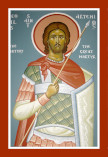 This glorious saint was Egyptian by birth,
and the commander-in-chief of the army of the Emperor Constantine the Great. When the victorious
Cross, encircled by stars, appeared to the emperor, Artemios also saw it, came to faith in Christ
the Lord and was baptized. Later, in the time of the Emperor Constantius, Constantine’s
son, he was sent to Greece to take the relics of St. Andrew and St. Luke from Patras and Thebes
respectively to Constantinople, which charge Artemios carried out with joy. After that, he was
appointed governor and imperial representative in Egypt, in which appointment he remained
throughout the reign of Constantius and for a certain time under Julian the Apostate. When this
renegade emperor went to war against the Persians, he stopped for a time in Antioch and summoned
Artemios and his army to join him there. Artemios went. At that time, the emperor gave two
Christian priests, Evgenios and Makarios, over to torture. Seeing this, St. Artemios was
profoundly alarmed, went to the emperor and said to him: ‘Why are you so inhumanly
torturing these innocent and dedicated men, and why are you putting pressure on them to turn back
from the Orthodox Faith?’ He also prophesied to the emperor that his end was near. The
furious emperor sent the two priests into exile in Arabia, where they soon died, and stripped
Artemios of his military rank, ordering that he be flogged and whipped. All wounded and covered
with blood, Artemios was thrown into prison, where the Lord Christ Himself appeared to him,
healing and comforting him. After that, the emperor ordered that he be laid on a flat stone and
that another stone be put on him, so crushing his body like a board. Finally, he was beheaded, in
362. The Emperor Julian then went out against the Persians and perished in a dishonorable way, as
St. Artemios had foretold.
This glorious saint was Egyptian by birth,
and the commander-in-chief of the army of the Emperor Constantine the Great. When the victorious
Cross, encircled by stars, appeared to the emperor, Artemios also saw it, came to faith in Christ
the Lord and was baptized. Later, in the time of the Emperor Constantius, Constantine’s
son, he was sent to Greece to take the relics of St. Andrew and St. Luke from Patras and Thebes
respectively to Constantinople, which charge Artemios carried out with joy. After that, he was
appointed governor and imperial representative in Egypt, in which appointment he remained
throughout the reign of Constantius and for a certain time under Julian the Apostate. When this
renegade emperor went to war against the Persians, he stopped for a time in Antioch and summoned
Artemios and his army to join him there. Artemios went. At that time, the emperor gave two
Christian priests, Evgenios and Makarios, over to torture. Seeing this, St. Artemios was
profoundly alarmed, went to the emperor and said to him: ‘Why are you so inhumanly
torturing these innocent and dedicated men, and why are you putting pressure on them to turn back
from the Orthodox Faith?’ He also prophesied to the emperor that his end was near. The
furious emperor sent the two priests into exile in Arabia, where they soon died, and stripped
Artemios of his military rank, ordering that he be flogged and whipped. All wounded and covered
with blood, Artemios was thrown into prison, where the Lord Christ Himself appeared to him,
healing and comforting him. After that, the emperor ordered that he be laid on a flat stone and
that another stone be put on him, so crushing his body like a board. Finally, he was beheaded, in
362. The Emperor Julian then went out against the Persians and perished in a dishonorable way, as
St. Artemios had foretold.
2. Holy and Righteous Artemius (Artemy).
Born in 1532, he was the son of Russian peasants, Kosmas and Apollinaria, from the village of Verkol near Dvinsk. Even at the age of five he was different from other children in his rare piety and meekness. When he was thirteen years old he went with his father through a great forest, and died there of exposure. His grieving father, unable to dig a grave, covered the body with branches and went on his way. Twenty-eight years later, a man saw a strange light in the forest, went over to it and found the body of Artemius, whole and incorrupt. It gave healing to many of the sick when they touched it. His holy relics are preserved in a monastery near Pinega, not far from Arkhangelsk.
3. Our Holy Father Gerasimos the New.
From Trikala in the Peloponnese, of the Notaras family, he was born in 1509. He lived in asceticism on Athos and then in Palestine, where he once fasted for forty days. He then settled on the island of Kephalonia, where he founded a monastery for women. He brought rain by his prayers, healed the sick and had insight into the future. He entered into rest in the Lord on August 15th, 1579, being a wonder-worker both during his lifetime and after his death.
4. Our Holy Father, the New-Martyr Ignatius.
 From Zagora in
Bulgaria, that famous Zagora that has given the Church so many holy ascetics and martyrs,
he lived in asceticism in the skete of St. John the Forerunner on Athos. He voluntarily put
himself into the hands of the Turks to be tortured for Christ, and was hanged in
Constantinople on October 8th, 1814. His relics have wonder-working power, and his head is
preserved in the monastery of St. Panteleimon. From Zagora in
Bulgaria, that famous Zagora that has given the Church so many holy ascetics and martyrs,
he lived in asceticism in the skete of St. John the Forerunner on Athos. He voluntarily put
himself into the hands of the Turks to be tortured for Christ, and was hanged in
Constantinople on October 8th, 1814. His relics have wonder-working power, and his head is
preserved in the monastery of St. Panteleimon.
|
FOR CONSIDERATION
God guides with a marvelous compassion those who give themselves over to His holy will and His care. As a candle-maker uses the soft wax to make whatever sort of candle he wishes, so God in His wisdom makes from His consecrated servants immortal lights in His heavenly kingdom. St. Ignatius the New-martyr was utterly given to God even as a boy, and yearned to become a monk and be a martyr for the Faith. In the time of the Karageorge uprising, the Turkish army assembled all over Bulgaria against Serbia, and came to the house of Ignatius’ father, George, to see if there was anyone there that they could take for the army. George was a strong man and well-grown, and they wanted to take him, but he said to them firmly: ‘I cannot go to war against my fellow-Christians.’ The furious Turks killed him on the spot. Young Ignatius hid in a neighboring house and then fled to Romania, but his desire for monasticism took him onto the Holy Mountain. He wanted something still more than monasticism—he wanted martyrdom. Praying one night with tears before an icon of the most holy Mother of God, begging her to open the path of martyrdom to him, he heard a sound in front of him, and looked up to see the golden halo detach itself from the icon and fall onto his head. Very soon after that, he suffered martyrdom at the hands of the Turks, and received the wreath of eternal glory.
Daily Scripture Readings taken from The Orthodox New Testament, translated and published by Holy Apostles Convent, Buena Vista, Colorado, copyright © 2000, used with permission, all rights reserved.
Daily Prologue Readings taken from The Prologue of Ochrid, by Bishop Nikolai Velimirovic, translated by Mother Maria, published by Lazarica Press, Birmingham, England, copyright © 1985, all rights reserved. Edited by Dormition Skete.