

Daily Devotional
Thursday, October 22, 2026 (NS), October 9, 2026 (OS)
No Fasting.
Thursday of the Twenty-First Week
The commemoration of the holy Apostle Iakovos, the son of Alphæos.
Scripture Readings
Paschalion — Movable Calendar
Thursday of the Twenty-First Week
Epistle
The Reading is from the Epistle of Saint Paul to the Colossians [§ 252]. Brethren:
For Gk. usage, see Col. 1:24-29, 2:1; for Sl. usage, see Col. 1:24-29.
1 24Now I rejoice in my sufferings on behalf of you, and fill up the things lacking of the afflictions of the Christ in my flesh, on behalf of His body, which is the Church, 25of which I became a minister, according to the dispensation of God which is given to me for you, to fulfill the word of God, 26the mystery which hath been hidden from the ages and from the generations, but now is made manifest to His saints, 27to whom God willed to make known what is the wealth of the glory of this mystery among the nations, which is Christ in you, the hope of the glory, 28Whom we announce, admonishing every man and teaching every man in all wisdom, in order that we might present every man perfect in Christ Jesus; 29for which I also labor, struggling according to the energy of Him Who Himself energizeth in me in power.
2 1For I wish you to know how great a struggle I have for you, and for those in Laodicea, and for as many as have not seen my face in the flesh.
Gospel
The Reading is from the Holy Gospel according to Saint Luke [§ 31]. At that time:
7 17The report concerning Jesus went forth in all Judæa and in all the country round about.
18And His disciples brought tidings to John concerning all these things. 19And John called to himself a certain two of his disciples, and sent them to Jesus, saying, “Art Thou the coming One, or do we look for another?” 20And after the men came to Him, they said, “John the Baptist hath sent us to Thee, saying, ‘Art Thou the coming One, or do we look for another?’” 21And in the same hour He cured many of diseases and plagues, and of evil spirits; and to many blind He graciously gave the power of sight. 22And Jesus answered and said to them, “Go and report to John what ye saw and heard: the blind are recovering their sight, the lame are walking, the lepers are being cleansed, the deaf are hearing, the dead are being raised, the poor are being preached the Gospel; 23“and happy is he, whosoever shall not be offended in Me.” 24And after the messengers of John departed, He began to speak to the crowds concerning John: “What have ye gone out into the wilderness to behold? A reed being shaken by the wind? 25“But what have ye gone out to see? A man who hath been clothed in soft garments? Behold, those in glorious garments and in luxury are in the palaces. 26“But what have ye gone out to see? A prophet? Yea, I say to you, and much more than a prophet. 27“This is he concerning whom it hath been written: ‘Behold, I send forth My messenger before Thy face, who shall prepare Thy way before Thee [cf. Mal. 3:1].’ 28“For I say to you, among those born of women, no one is a greater prophet than John the Baptist; but the least in the kingdom of God is greater than he.” 29And all the people who heard Him—even the tax collectors—justified God and were baptized with the baptism of John. 30But the Pharisees and the doctors of the law, who were not baptized by him, set aside the counsel of God in regard to themselves.
Menaion — Fixed Calendar
The commemoration of the holy Apostle Iakovos, the son of Alphæos.
Epistle
The Reading is from the First Epistle of Saint Paul to the Corinthians [§ 131]. Brethren:
4 9I think that God showed forth us the apostles last, as condemned to death; for we became a spectacle to the world, both to angels and to men. 10We are fools for Christ’s sake, but ye are wise in Christ. We are weak, but ye are strong. Ye are held in honor, but we are dishonored. 11Until the present hour, we both hunger and thirst, and are naked, and are being buffeted, and never at rest. 12And we toil working with our own hands. Being reviled, we bless; being persecuted, we bear up; 13being evilly spoken of, we beseech. We became as the filth of the world, the off-scouring of all until now. 14I do not write these things shaming you, but admonishing you as my beloved children. 15For if ye have myriads of tutors in Christ, yet ye have not many fathers; for in Christ Jesus I begot you through the Gospel. 16Therefore, I beseech you, keep on becoming imitators of me.
Gospel
The Reading is from the Holy Gospel according to Saint Matthew [§ 34]. At that time:
9 36 Jesus, having seen the crowds, was moved with compassion for them, because they were wearied and cast down, as sheep not having a shepherd. 37Then He saith to His disciples, “The harvest indeed is great, but the workers are few. 38“Entreat therefore the Lord of the harvest that He would send forth workers into His harvest.”
10 1And after He called to Himself His twelve disciples, He gave to them authority over unclean spirits, so as to cast them out, and to cure every disease and every weakness. 2Now the names of the twelve apostles are these: first, Simon, who is called Peter, and Andrew his brother; Iakovos the son of Zebedee, and John his brother; 3Philip and Bartholomew; Thomas and Matthew the tax collector; Iakovos the son of Alphæos, and Lebbæos, who was surnamed Thaddæos; 4Simon the Cananite, and Judas the Iscariote, who also delivered Him up. 5These twelve Jesus sent forth, and commanded them, saying, “Do not begin to go into the way of the nations, and do not begin to enter into a city of the Samaritans. 6“But go rather to the sheep, the lost of the house of Israel. 7“And as ye go, be preaching, saying, ‘The kingdom of the heavens hath drawn near.’ 8“Be healing the sick, cleansing lepers, raising the dead, casting out demons; freely ye received, freely give.”
for Sl. usage, see [Lk. 10:16-21].
Lives of the Saints (Prologue)
October 22nd – Civil Calendar
October 9th – Church Calendar
1. The Holy Apostle Iakovos.
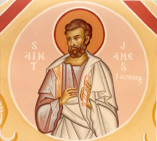 The son of Alphaeus and one of the twelve
great apostles, he was the brother of the Apostle and Evangelist Matthew. He was a witness of the
true words and miracles of our Lord and Savior Jesus Christ and a witness of His Passion,
Resurrection and Ascension. After the descent of the Holy Spirit at Pentecost, it fell to the lot
of the Apostle Iakovos to preach Christ’s Gospel in Eleftheropolis and the surrounding
area, and then in Egypt, where he suffered for his Savior. With great power both in word and act,
Iakovos spread abroad the saving news of the incarnate Logos of God, rooting out idol worship,
driving demons out of men, healing all manner of sickness and disease in the name of the Lord
Jesus Christ. His labors and his zeal were crowned with great success. Many pagans came to belief
in Christ the Lord, churches were founded and set in order and priests and bishops were made. He
suffered in Egypt in the town of Ostracina, being crucified by the pagans. Thus this great and
wonderful apostle of Christ went to the heavenly kingdom, to reign forever with the King of
glory.
The son of Alphaeus and one of the twelve
great apostles, he was the brother of the Apostle and Evangelist Matthew. He was a witness of the
true words and miracles of our Lord and Savior Jesus Christ and a witness of His Passion,
Resurrection and Ascension. After the descent of the Holy Spirit at Pentecost, it fell to the lot
of the Apostle Iakovos to preach Christ’s Gospel in Eleftheropolis and the surrounding
area, and then in Egypt, where he suffered for his Savior. With great power both in word and act,
Iakovos spread abroad the saving news of the incarnate Logos of God, rooting out idol worship,
driving demons out of men, healing all manner of sickness and disease in the name of the Lord
Jesus Christ. His labors and his zeal were crowned with great success. Many pagans came to belief
in Christ the Lord, churches were founded and set in order and priests and bishops were made. He
suffered in Egypt in the town of Ostracina, being crucified by the pagans. Thus this great and
wonderful apostle of Christ went to the heavenly kingdom, to reign forever with the King of
glory.
2. Our Holy Father Andronikos and his wife Athanasia.
A citizen of Antioch in the time of Theodosios the Great (379-95), Andronikos was a goldsmith by profession. Both he and his wife were very devout, striving without ceasing to walk in the ways of the Lord. They gave a third of what they earned to the poor, another third to the Church and kept the last for their own use. When they had had two children, they agreed to live in the future as brother and sister. Then, by God’s unfathomable providence, both their children died on the same day. They grieved deeply until the martyr Julian appeared to Athanasia by their grave and comforted her with the tidings that their children were in the kingdom of God, and that they were better off there than with their parents on earth. After this, they left everything and went to Egypt, there receiving the monastic schema: Andronikos with the elder, Daniel, at Sketis and Athanasia in a women’s monastery in Tabennisi. Being pleasing to God by many years of asceticism, they entered into the eternal kingdom of Christ: first Athanasia and then, eight days later, Andronikos.
3. Holy and Righteous Abraham and Lot.
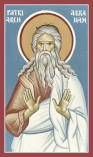 Read about them in the Book of Genesis. Read about them in the Book of Genesis.
|
4. St. Demetrius, Patriarch of Alexandria.
The eleventh Bishop of Alexandria after St. Mark the Evangelist, he governed his flock long and wisely from 189 to 231. During his time, at the request of the Indians, he sent St. Pantaenus, the director of a famous catechetical school in Alexandria, to preach the Gospel in India. Pantaenus found in India the Gospel that St. Matthew wrote in Aramaic.
5. St. Stefan, Despot of Serbia.
Son of the Despot George and Queen Irene, he lived for a time with his sister Mara at the court of Sultan Murat II and was blinded at Jedrene together with his brother Gregory (Grgur). He began to reign over the Serbs in 1458, but was forced almost at once to flee to Albania, where he married Angelina, the daughter of Skenderbeg. Blind and unhappy, but utterly given to God, he died in Italy in 1468. His relics are preserved in the monastery of Krušedol, the foundation of his son Maxim.
FOR CONSIDERATION
How God both punishes and has mercy is clearly shown to us in the last despots of Serbia, in the time of the Turkish conquest of the Serbian lands. It was not of their own power and will that the Turks came into the Balkans and subjugated the Christian peoples—Greeks, Bulgars and Serbs—but by God’s permission; in the same way that Nebuchadnezzar, not by his own power but by God’s permission, conquered Jerusalem and took the Jews off into captivity. The Serbian people suffered greatly for the sins of the princes and nobles, and these latter themselves suffered even more greatly. Despot George died an exile; his sons, Gregory and Stefan, were blinded by the Turks; his daughter was forced into marriage with the sultan; his middle son rose up against his mother Irene and brother Gregory, and by force took the insecure throne at Smederevo, but died suddenly. Blind Stefan had barely become despot when he had to flee to Albania, and then to Italy, where he died, in that foreign place, as an exile and a refugee. This was all God’s punishment. Where, then, does mercy come in? God glorified with eternal glory both this Stefan and his wife Angelina, and their children Maxim and John. After lying eight years in the grave, Stefan’s body was dug up and found to be intact and filled with a fragrant scent, and many miracles were wrought over his holy relics. So also, by the grace of God, both his wife and his sons were glorified and sanctified.
Daily Scripture Readings taken from The Orthodox New Testament, translated and published by Holy Apostles Convent, Buena Vista, Colorado, copyright © 2000, used with permission, all rights reserved.
Daily Prologue Readings taken from The Prologue of Ochrid, by Bishop Nikolai Velimirovic, translated by Mother Maria, published by Lazarica Press, Birmingham, England, copyright © 1985, all rights reserved. Edited by Dormition Skete.