

Daily Devotional
Wednesday, October 21, 2026 (NS), October 8, 2026 (OS)
Fast Day. No Meat, Fish, Dairy, Eggs, Alcohol or Olive Oil Allowed.
Wednesday of the Twenty-First Week
The commemoration of our holy Mother Pelagia.
Scripture Readings
Paschalion — Movable Calendar
Wednesday of the Twenty-First Week
Epistle
The Reading is from the Epistle of Saint Paul to the Colossians [§ 251]. Brethren:
1 18Christ is the head of the body, the Church, Who is the beginning, the firstborn from the dead, that in all things He might come to hold first place. 19For all the fullness was pleased to dwell in Him; 20and through Him to reconcile all things to Him, having made peace through the blood of His Cross, through Him, whether the things on the earth or the things in the heavens. 21And you, being once alienated and enemies in your mind, in wicked works, yet now did He reconcile 22in the body of His flesh through death, to present you holy and blameless and without reproach before Him— 23if indeed ye continue abiding in the faith, firmly founded and steadfast, and are not moved away from the hope of the Gospel which ye heard, and which was proclaimed in all the creation which is under the heaven, of which I, Paul, became a minister.
Gospel
The Reading is from the Holy Gospel according to Saint Luke [§ 28]. The Lord said:
6 46“Why do ye call Me, ‘Lord, Lord,’ and do not what I say? 47“Everyone who cometh to Me, and heareth My words, and doeth them, I will show you to whom he is like: 48“He is like a man building a house, who dug and went deep and laid a foundation on the rock. And after a flood arose, the river beat against that house; and yet it did not have enough strength to shake it, for it had been founded upon the rock. 49“But the one who heard, and did not, is like a man who built a house on the earth without a foundation, on which the river beat against, and straightway it fell; and the breakage of that house was great.”
7 1Now when He completed all His words in the ears of the people, He entered into Capernaum.
Menaion — Fixed Calendar
The commemoration of our holy Mother Pelagia.
Epistle
The Reading is from the Epistle of Saint Paul to the Ephesians [§ 229]. Brethren:
5 8Be walking as children of light— 9for the fruit of the Spirit is in all goodness and righteousness and truth— 10proving what is well-pleasing to the Lord. 11And cease having fellowship with the unfruitful works of darkness, but rather even reprove them. 12For it is shameful even to speak of the things which are done by them in secret. 13But all things which are reproved are made manifest by the light; for all which is made manifest is light. 14Wherefore, He saith, “Rouse thyself, thou who sleepest, and arise from the dead, and the Christ shall shine on thee [cf. Is. 9:2, 26:19, 52:1, 60:1, 2].”
15Be taking heed then how exactly ye walk, not as unwise ones, but as wise ones, 16redeeming the time, because the days are evil. 17On this account cease becoming foolish, but become as ones understanding what the will of the Lord is. 18And cease being drunk with wine, in which is prodigality, but keep on being filled with the Spirit, 19speaking to one another in psalms and hymns and spiritual songs, singing and chanting in your heart to the Lord.
Gospel
No reading given.
Lives of the Saints (Prologue)
October 21st – Civil Calendar
October 8th – Church Calendar
1. Our Holy Mother Pelagia.
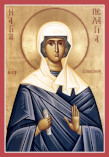 A repentant sinner, she was born a pagan in Antioch and endowed
by God with great physical beauty, but she used this beauty to destroy her own soul and those of
others, acquiring great wealth from her prostitution. One day, walking past the church of the
holy martyr Julian, where Bishop Nonnus was preaching, she turned into the church and listened to
the sermon, which was about the Dreadful Judgement and the punishment of sinners. These words so
shook her, and wrought so great a change in her, that she was of a sudden filled with
self-loathing and fear of God, and repenting of all her filthy sins, fell down before St. Nonnus,
begging him to baptize her: ‘Holy father, be merciful to me, a sinner; baptize me, and
teach me repentance. I am a sea of iniquity, an abyss of destruction, a net and weapon of the
devil.’ Thus this penitent implored Christ’s hierarch with tears. And he baptized
her. Blessed Romana, a deaconess of that church, stood sponsor to her at her Baptism, and after
that, as her spiritual mother, grounded her well in the Christian Faith. But Pelagia was not
content just to be baptized. Feeling the weight of her many sins and the pricking of her
conscience, she decided on a great ascesis. She gave away to the poor the enormous wealth she had
amassed by her immorality and went secretly to Jerusalem, where, under a man’s name as the
monk Pelagios, she shut herself in a cell on the Mount of Olives and there began a strict ascesis
of fasting, prayer and vigils. Three years later. St. Nonnus’ deacon, Iakovos, visited her
and found her still alive, but when he went to her again a few days later, he found her dead body
and gave it burial. St. Pelagia entered into rest in about 461. Thus that sometime great sinner,
by repentance and striving, received the mercy of God, the forgiveness of her sins and
sanctification, and her purified and sanctified soul was made worthy of the kingdom of God.
A repentant sinner, she was born a pagan in Antioch and endowed
by God with great physical beauty, but she used this beauty to destroy her own soul and those of
others, acquiring great wealth from her prostitution. One day, walking past the church of the
holy martyr Julian, where Bishop Nonnus was preaching, she turned into the church and listened to
the sermon, which was about the Dreadful Judgement and the punishment of sinners. These words so
shook her, and wrought so great a change in her, that she was of a sudden filled with
self-loathing and fear of God, and repenting of all her filthy sins, fell down before St. Nonnus,
begging him to baptize her: ‘Holy father, be merciful to me, a sinner; baptize me, and
teach me repentance. I am a sea of iniquity, an abyss of destruction, a net and weapon of the
devil.’ Thus this penitent implored Christ’s hierarch with tears. And he baptized
her. Blessed Romana, a deaconess of that church, stood sponsor to her at her Baptism, and after
that, as her spiritual mother, grounded her well in the Christian Faith. But Pelagia was not
content just to be baptized. Feeling the weight of her many sins and the pricking of her
conscience, she decided on a great ascesis. She gave away to the poor the enormous wealth she had
amassed by her immorality and went secretly to Jerusalem, where, under a man’s name as the
monk Pelagios, she shut herself in a cell on the Mount of Olives and there began a strict ascesis
of fasting, prayer and vigils. Three years later. St. Nonnus’ deacon, Iakovos, visited her
and found her still alive, but when he went to her again a few days later, he found her dead body
and gave it burial. St. Pelagia entered into rest in about 461. Thus that sometime great sinner,
by repentance and striving, received the mercy of God, the forgiveness of her sins and
sanctification, and her purified and sanctified soul was made worthy of the kingdom of God.
2. Our Holy Mother Thaïs.
A repentant sinner, she was an Egyptian by birth. Like St. Pelagia, Thaïs (Taisia) spent her youth in prostitution, being set on the way of evil living by her shameless mother. But God the merciful, Who desires not that sinners should perish but that they should be saved, found a way in His wonderful providence to save the sinful Thaïs. One of the disciples of St. Anthony the Great, Paphnutios the Sindonite, heard of Thaïs, of her sinful life and the spiritual poison with which she was poisoning the souls of many, and he decided, with God’s help, to save her. Holy Paphnutios, therefore, dressed himself in ordinary clothes, took a gold piece and went to the town. He found Thaïs and gave her the coin. Thaïs, thinking that the man had given her the gold piece with evil intent, took Paphnutios off to her room. Then Paphnutios opened his blessed lips and denounced Thaïs’ sin, calling her to repentance. Thaïs’ soul and conscience were roused, and she gave herself to tears of heartfelt repentance. Giving away all her goods to the needy, she went to a monastery of virgins, near to Paphnutios’ hermitage, and stayed there for about three years, shut in a cell and living only on bread and water. Just before her death, St. Paphnutios visited her, and made her leave her cell against her will. She quickly fell ill, and after a short illness, gave her purified and sanctified soul to God. St. Paul the Simple, another disciple of St. Anthony, saw in a vision in Paradise a most beautiful dwelling prepared for the penitent Thaïs. This holy soul entered into rest in about 340.
3. The Holy Martyr Pelagia.
She was a virgin of an eminent family in Antioch. In the time of the Emperor Numerian, the governor of Antioch sent soldiers to bring Pelagia to trial as a known Christian. The soldiers surrounded the house and called the holy maiden to the door. She appeared, and when she heard that they had come to take her for trial, she pretended delight and asked the soldiers to wait a moment or two while she got herself ready. She then climbed up onto the roof of the house, raised her hands to heaven and prayed for a long time, begging God to receive her soul and not let her virginity be fouled. God did so, and her dead body fell in front of the soldiers. ‘Her death,’ writes St. Chrysostom, ‘came about not as a natural occurrence but by the command of God,’ and he continues: ‘And thus this virginal body, purer than any gold, lay on the earth: angels surrounded it, archangels paid it honor and Christ Himself was with her.’
In the Slavonic Prologue, there is recorded the following occurrence with an unrepentant sinner: A deacon, Raphael, was sick unto death. This was told to St. Epiphanius, who loved Raphael, and the elder came to him at once. Recognising his spiritual father, Raphael began to weep and wail bitterly. Epiphanius also wept, then asked the deacon why he was in such grief. The deacon replied: ‘Woe is me, devils have snatched away my works, and the angels of God have withdrawn themselves from me!’ After that, he began to bleat like a goat, and then bark like a dog. And at that he gave up his soul. St. Epiphanius said that this was because of some great sin, unconfessed and unrepented.
FOR CONSIDERATION
Oh, when shall we get to the point of making as much effort over our souls as we do over our bodies? When shall we come to the desire to bedeck ourselves with virtues before God and His glorious angels as much as we bedeck ourselves with vain and transitory outward gauds? Pelagia and Thaïs were, in the beginning, only aware of their bodies, while their souls were like slaves lying bound in the prison of their flesh. They were both bedecked with vanity, clothed in vanity, adorned with vanity, surrounded by vanity and flattered by vanity. But what a sudden change! What a divine step in their lives! Stranger than if a wild apple tree were to change its nature and begin to bear sweet apples, or if some turgid and stinking pool somehow cleared itself and became pure drinking water. When Bishop Nonnus, with the other bishops, first saw Pelagia the sinner in her external resplendence, clad in the costliest garments, ornamented, adorned, bedecked with rings, necklaces and baubles, perfumed, surrounded by slaves—when the bishop saw her, he burst into tears and said to his companions: ‘I have indeed learned much from this woman. God will bring her before His Dreadful Judgement and will rebuke us through her. For think: how many hours does this woman spend in her room washing herself, dressing herself, titivating herself, preening herself in the mirror—and what for? Only to appear lovelier in men’s eyes. And we, who have an immortal Bridegroom in heaven—we do not exert ourselves to bedeck our souls with repentance, we do not hasten to bathe them in tears of repentance or to clothe them in the beauty of the virtues, that they may appear lovelier in God’s eyes.’
Daily Scripture Readings taken from The Orthodox New Testament, translated and published by Holy Apostles Convent, Buena Vista, Colorado, copyright © 2000, used with permission, all rights reserved.
Daily Prologue Readings taken from The Prologue of Ochrid, by Bishop Nikolai Velimirovic, translated by Mother Maria, published by Lazarica Press, Birmingham, England, copyright © 1985, all rights reserved. Edited by Dormition Skete.