

Daily Devotional
Saturday, August 29, 2026 (NS), August 16, 2026 (OS)
No Fasting.
Saturday of the Thirteenth Week
The commemoration of the Afterfeast of the Dormition, and the translation of the holy Napkin from Edessa to Constantinople, and the Martyr Diomedes.
Scripture Readings
Paschalion — Movable Calendar
Saturday of the Thirteenth Week
Epistle
The Reading is from the First Epistle of Saint Paul to the Corinthians [§ 126]. Brethren:
2 6We speak wisdom among the perfect, but a wisdom not of this age, nor of the rulers of this age, who are coming to nought. 7But we speak God’s wisdom in a mystery, which hath been hidden and which God foreordained before the ages to our glory, 8which not one of the rulers of this age hath known; for if they had known, they would not have crucified the Lord of the glory. 9But even as it hath been written: “Eye hath not seen, and ear hath not heard, and neither hath it entered into the heart of man the things which God prepared for those who love Him [cf. Is. 64:4].”
Gospel
The Reading is from the Holy Gospel according to Saint Matthew [§ 90]. At that time:
22 15The Pharisees took counsel against Jesus how they might ensnare Him in a word. 16And they sent forth to Him their disciples with the Herodians, saying, “Teacher, we know that Thou art true, and teachest the way of God in truth, and there is a care to Thee for no one; for Thou lookest not on the person of men. 17“Tell us then, what thinkest Thou? Is it lawful to give a poll-tax to Cæsar, or not?” 18But Jesus knew their wickedness, and said, “Why are ye trying to tempt Me, ye hypocrites? 19“Show Me the coin of the tribute.” And they brought a denarius to Him. 20And He saith to them, “Whose is this image and the inscription?” 21They say to Him, “Cæsar’s.” Then He saith to them, “Render therefore the things of Cæsar to Cæsar, and the things of God to God.” 22And after they heard these words, they marvelled, and they left Him and went away.
Menaion — Fixed Calendar
The commemoration of the Afterfeast of the Dormition, and the translation of the holy Napkin from Edessa to Constantinople, and the Martyr Diomedes.
Epistle
The Reading is from the First Epistle of Saint Paul to Saint Timothy [§ 284]. Child Timothy:
3 13They who have served well as deacons acquire a good degree for themselves and much boldness in faith which is in Christ Jesus.
14These things I write to thee, hoping to come to thee more quickly. 15But if I delay, I write in order that thou mayest know how one ought to be conducting oneself in the house of God, which is the Church of the living God, pillar and stay of the truth. 16And confessedly, great is the mystery of piety: God was manifested in the flesh, justified in the Spirit, seen by angels, proclaimed among the nations, believed on in the world, taken up in glory.
4 1Now the Spirit speaketh expressly that in latter times some shall apostatize from the faith, giving heed to deceiving spirits and teachings of demons, 2speaking lies in hypocrisy, having been branded as to their own conscience, 3forbidding to marry, bidding to abstain from foods, which God created for partaking with giving of thanks by the faithful and those who have fully known the truth. 4For every creature of God is good, and nothing is to be cast away, if it is received with giving of thanks; 5for it is sanctified by the word of God and intercessory prayer.
for Sl. usage, see [Col. 1:12-18], or see [2 Cor. 3:4-11].
Gospel
For Gk. usage, see [Lk. 9:51-57, 10:22-24, 13:22] herein below;
for Sl. usage, see [Lk. 9:51-56, 10:22-24].
The Reading is from the Holy Gospel according to Saint Luke [§§ 48, 52, 72]. At that time:
9 51When the days were being fulfilled of the taking up of Jesus, He indeed set His face to go to Jerusalem; 52and He sent forth messengers before His face. And they went and entered into a village of Samaritans, so as to make ready for Him. 53And they did not receive Him, because His face was toward Jerusalem. 54And after His disciples Iakovos and John saw this, they said, “Lord, dost Thou wish that we should command fire to come down from heaven, and consume them, even as Elias did?” 55But He turned about and rebuked them, and said, “Ye know not of what manner of spirit ye are; 56“the Son of Man came not to destroy men’s lives, but to save.” And they went to another village.
57And it came to pass, as they went in the way,...
10 22He turned to the disciples and said, “All things were delivered to Me by My Father. And no one doth fully know Who the Son is, except the Father, and Who the Father is, except the Son, and he to whomsoever the Son is willing to reveal Him.” 23And He turned around to the disciples, and said privately, “Blessed are the eyes which see what ye see. 24“For I say to you, that many prophets and kings wished to see what ye see, but saw not, and to hear what ye hear, but heard not.”...
13 22And He was going through, by cities and villages, teaching, and making His way toward Jerusalem.
Lives of the Saints (Prologue)
August 29th – Civil Calendar
August 16th – Church Calendar
1. The Icon of our Lord Jesus Christ Not-made-with-hands.
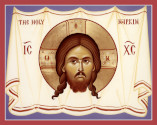 In the time that our Lord was preaching the Gospel and healing every
disease and every infirmity among the people, there was in the city of Edessa, on the banks of
the Euphrates, a certain Prince Avgar, who was riddled with leprosy. He heard of Christ, the
Healer of every pain and sickness, and sent a portrait-painter, Ananias, to Palestine with a
letter to Christ, in which he begged the Lord to come to Edessa and heal him of his leprosy. In
the event of the Lord’s not being able to come, the prince commanded Ananias to paint His
likeness and bring it, believing that the portrait would heal him. The Lord replied that He could
not come, as the time of His Passion was at hand, and He took a napkin and wiped His face,
leaving a perfect reproduction of His most pure face on the napkin. The Lord gave this napkin to
Ananias, with a message to say that the prince would be healed by it, but not entirely, and He
would therefore send him later an envoy who would rid him of the remainder of the disease.
Receiving the napkin, Avgar kissed it and the leprosy fell from his body, with just a little
remaining on his face. Later, the Apostle Thaddaeus, preaching the Gospel, came to Avgar, healed
him secretly and baptized him. Then the prince smashed the idols that stood at the city’s
gateway and placed the napkin with the face of Christ above the entrance, stuck onto wood,
surrounded with a gold frame and ornamented with pearls. The prince also wrote above the icon on
the gateway: ‘O Christ our God, no one who hopes in Thee will be put to shame’.
Later, one of Avgar’s great-grandsons restored idolatry, and the Bishop of Edessa came by
night and walled-in the icon above the gateway. Centuries passed. In the time of the Emperor
Justinian, the Persian King, Chozroes, attacked Edessa, and the city was in great affliction. The
Bishop of Edessa, Evlavios, had a vision of the most holy Mother of God, who revealed to him the
secret of the icon, walled in and forgotten. The icon was found, and by its power the Persian
army was defeated. It was taken to Constantinople in 950 to heal the emperor, and was kept there
for the veneration of countless multitudes of Christians. It was lost in the Fourth Crusade to
undisciplined crusaders.
In the time that our Lord was preaching the Gospel and healing every
disease and every infirmity among the people, there was in the city of Edessa, on the banks of
the Euphrates, a certain Prince Avgar, who was riddled with leprosy. He heard of Christ, the
Healer of every pain and sickness, and sent a portrait-painter, Ananias, to Palestine with a
letter to Christ, in which he begged the Lord to come to Edessa and heal him of his leprosy. In
the event of the Lord’s not being able to come, the prince commanded Ananias to paint His
likeness and bring it, believing that the portrait would heal him. The Lord replied that He could
not come, as the time of His Passion was at hand, and He took a napkin and wiped His face,
leaving a perfect reproduction of His most pure face on the napkin. The Lord gave this napkin to
Ananias, with a message to say that the prince would be healed by it, but not entirely, and He
would therefore send him later an envoy who would rid him of the remainder of the disease.
Receiving the napkin, Avgar kissed it and the leprosy fell from his body, with just a little
remaining on his face. Later, the Apostle Thaddaeus, preaching the Gospel, came to Avgar, healed
him secretly and baptized him. Then the prince smashed the idols that stood at the city’s
gateway and placed the napkin with the face of Christ above the entrance, stuck onto wood,
surrounded with a gold frame and ornamented with pearls. The prince also wrote above the icon on
the gateway: ‘O Christ our God, no one who hopes in Thee will be put to shame’.
Later, one of Avgar’s great-grandsons restored idolatry, and the Bishop of Edessa came by
night and walled-in the icon above the gateway. Centuries passed. In the time of the Emperor
Justinian, the Persian King, Chozroes, attacked Edessa, and the city was in great affliction. The
Bishop of Edessa, Evlavios, had a vision of the most holy Mother of God, who revealed to him the
secret of the icon, walled in and forgotten. The icon was found, and by its power the Persian
army was defeated. It was taken to Constantinople in 950 to heal the emperor, and was kept there
for the veneration of countless multitudes of Christians. It was lost in the Fourth Crusade to
undisciplined crusaders.
2. The Holy Martyr Diomedes.
A doctor from Tarsus of eminent parents, he taught the people the Christian Faith as he healed them. The Emperor Diocletian ordered that he be beheaded in Nicaea in 298. Those who beheaded him and took his head to the emperor were blinded, and when they restored the head to his body, with prayer, they were healed.
3. Our Holy Father Joachim of Osogovsk.
He lived the ascetic life in the second half of the eleventh century on the mountain of Osogovsk, in a cave in a place called Sarandopor. In that place another ascetic, Theodore of the Sheepfield, to whom St. Joachim appeared in a dream, built a church. Many miracles have been performed throughout the centuries over the relics of St. Joachim, and are being performed even to this day.
4. The Holy Martyr Stamatios.
He was a villager, born in Volos in Thessaly. When some inhuman agha collected the imperial tax from the people and left them in a terrible plight, Stamatios went to Constantinople with several companions, to complain to the vizier. The sultan’s nobles bore Stamatios a grudge for his stern accusation, and they arrested him. They first tried to convert him to Islam by flattery, promising him riches, glory and honor. Then the Turks tortured him and finally beheaded him in front of Hagia Sophia, in 1680. Thus this soldier of Christ was crowned with the wreath of martyrdom.
FOR CONSIDERATION
The Orthodox Church surpasses all other so-called “Christian” groups in the richness of her Tradition. Protestants look only to the holy Scriptures, but the Scriptures can only be interpreted within the Tradition. The Apostle Paul himself commands: ‘Brethren, stand fast, and hold the traditions which ye have been taught, whether by word or our epistle’ (II Thess. 2:15). The tradition concerning Prince Avgar is doubtless an apostolic tradition, although it is not referred to by any of them in their epistles. The Apostle Thaddaeus wrote nothing, and therefore, according to Protestant thinking, he said nothing, and gave nothing to the faithful. Why was he then an apostle of Christ? The tradition about Prince Avgar is mentioned by St. John Damascene in his defence of the veneration of icons.
How marvellous and touching is Avgar’s letter to Christ! Having been inspired to write to Him, telling Him that he had heard of His miraculous power to heal the sick, and having begged Him to come and heal him, he continues: ‘I hear this also, that the Jews hate You and prepare some sort of wickedness against You. I have a city; it’s small but beautiful, and abounds in every good thing. Come to me here and live with me in my city, which will provide for all the needs of us both.’ Thus wrote a pagan prince, at the time that the princes of Jerusalem were preparing death for the Lord, the Lover of mankind.
Daily Scripture Readings taken from The Orthodox New Testament, translated and published by Holy Apostles Convent, Buena Vista, Colorado, copyright © 2000, used with permission, all rights reserved.
Daily Prologue Readings taken from The Prologue of Ochrid, by Bishop Nikolai Velimirovic, translated by Mother Maria, published by Lazarica Press, Birmingham, England, copyright © 1985, all rights reserved. Edited by Dormition Skete.