

Daily Devotional
Sunday, April 5, 2026 (NS), March 23, 2026 (OS)
Fast Day, but Fish, Wine and Olive Oil Allowed.
Holy Week
| Palm Sunday |
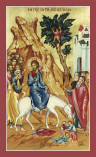
The commemoration of our venerable Father Nikon and his 199 Disciples in Sicily.
Scripture Readings
Paschalion — Movable Calendar
Palm Sunday
Epistle
The Reading is from the Epistle of Saint Paul to the Philippians [§ 247]. Brethren:
4 4Be rejoicing in the Lord always; again I will say, be rejoicing. 5Let your reasonableness be known to all men. The Lord is near: 6Cease being anxious about anything, but in everything by prayer and by entreaty, with giving of thanks, let your requests be made known to God. 7And the peace of God, which surpasseth all understanding, shall guard your hearts and your minds in Christ Jesus.
8For the rest, brethren, whatsoever things are true, whatsoever things are worthy of respect, whatsoever things are just, whatsoever things are pure, whatsoever things are pleasing, whatsoever things are of good report, if there is any virtue and if there is any praise, be considering these things. 9And what ye learned and received and heard and saw in me, these things be practising; and the God of peace shall be with you.
Gospel
In the Orthros
The Reading is from the Holy Gospel according to Saint Matthew [§ 83]. At that time:
21 1When Jesus drew near to Jerusalem, and came to Bethphage, toward the Mount of Olives, then Jesus sent forth two disciples, 2saying to them, “Go into the village, the one opposite you; and straightway ye shall find an ass which hath been tied, and a colt with her. Loose them and bring them to Me. 3“And if anyone should say anything to you, ye shall say, ‘The Lord hath need of them’; and straightway he will send them.” 4Now all this came to pass in order that it might be fulfilled that which was spoken by the prophet, saying, 5“Say to the daughter of Sion [Is. 62:11], ‘Behold thy King cometh to thee, meek, and mounted on an ass, and a colt, the foal of a beast of burden [cf. Zach. 9:9].’” 6And the disciples went and did even as Jesus commanded them, 7and brought the ass and the colt, and put their garments upon them, and He sat down upon them. 8And the greater part of the crowd spread their garments in the way; and others were cutting branches from the trees and were strewing them in the way. 9And the crowds, those going before and those following, were crying out, saying, “Hosanna, to the Son of David; blessed is He Who cometh in the name of the Lord [cf. Ps. 117(118):25(26)]; hosanna in the highest.” 10And after He entered into Jerusalem, all the city was shaken, saying, “Who is this?” 11And the crowds were saying, “This is Jesus the Prophet, the One from Nazareth of Galilee.”...
15But after the chief priests and the scribes saw the wonders which He did, and the children crying out in the temple and saying, “Hosanna, to the Son of David,” they were indignant, 16and said to Him, “Hearest Thou what these say?” And Jesus saith to them, “Yes; did ye never read, ‘Out of the mouth of babes and sucklings Thou hast perfected praise for Thyself [Ps. 8:2]’?” 17And He left them behind and went out of the city to Bethany, and He lodged there.
In the Liturgy
The Reading is from the Holy Gospel according to Saint John [§ 41].
12 1Six days before the passover, Jesus came to Bethany, where Lazarus was who had died, whom He raised from the dead. 2So they made a supper for Him there, and Martha was serving; but Lazarus was one of those reclining at table with Him. 3Then Mary, having taken a pound of very precious perfumed ointment of pure spikenard, anointed the feet of Jesus, and wiped His feet with her hair. And the house was filled with the odor of the perfumed ointment. 4Then one of His disciples, Judas Iscariote, Simon’s son, who was about to deliver Him up, saith, 5“Why was this perfumed ointment not sold for three hundred denarii and given to the poor?” 6But he said this, not that he was caring for the poor, but because he was a thief, and had the money box, and was taking away what was put in it. 7Then Jesus said, “Let her alone, for the day of My laying out for burial hath she kept it. 8“For ye have the poor among yourselves always, but Me ye have not always.” 9A great crowd of the Jews therefore knew that He was there, and they came not because of Jesus only, but also in order that they might see Lazarus, whom He raised from the dead. 10But the chief priests took counsel that they might put to death Lazarus also, 11because by reason of him many of the Jews were going away and were believing in Jesus.
12On the morrow a great crowd which came to the feast, after they heard that Jesus was coming into Jerusalem, 13took the palm branches of the palm trees, and went out to meet Him, and were crying, “Hosanna, blessed is He Who cometh in the name of the Lord, the King of Israel [cf. Ps. 117(118):25(26)].” 14And Jesus, having found a young ass, sat upon it, even as it is written: 15“Cease fearing, O daughter of Sion, behold, thy King cometh, sitting on a colt of an ass [cf. Zach. 9:9].” 16But the disciples knew not these things at the first; but when Jesus was glorified, then they remembered that these things were written in reference to Him, and that these things they did to Him. 17Then the crowd that was with Him when He called Lazarus out of the grave and raised him from the dead bore witness. 18On this account the crowd also went to meet Him, because it heard that He had done this sign.
Menaion — Fixed Calendar
The commemoration of our venerable Father Nikon and his 199 Disciples in Sicily.
No readings given.
Lives of the Saints (Prologue)
April 5th – Civil Calendar
March 23rd – Church Calendar
1. The Hieromartyr Nikon.
Born in Naples of a pagan father and a Christian mother, he was an officer in the Roman army in Naples. He was not baptized, although his mother, unbeknown to his father, had instructed him in the Christian Faith. Once, when he was setting off with his company to war, his mother advised him that if he were in trouble, to make the sign of the Cross and call on Christ to help him. And so, when Nikon’s company was surrounded during the battle and close to final extermination, Nikon made the sign of the Cross and began to call upon Christ. At that moment he was filled with exceptional strength and rushed upon his opponents, killing some and putting the others to flight. Returning home, Nikon could not stop exclaiming in wonder: ‘Great is the God of the Christians!’ After he had brought joy to his mother with his report of the victory by the aid of Christ’s Cross, he set sail in secret for Asia, where the Bishop of Kyzikos, Theodosios, baptized him. After his Baptism, he shut himself up in a monastery and devoted himself to study and to asceticism. However, Bishop Theodosios had a vision before his death, in which he was told to consecrate Nikon as his successor. The aged Theodosios summoned Nikon immediately and ordained him deacon, and then priest and bishop. By divine providence Nikon came soon after this to Neapolis, where he found his mother still alive. On her death, he went to Sicily with nine disciples, one-time comrades in battle, and there devoted himself to preaching the Gospel. There was a terrible persecution of Christians at that time, and Prince Quintianus seized Nikon and his companions and gave them over to great torture. One hundred and ninety of his disciples and friends were slain. The torturer tied Nikon to the tails of horses, threw him from a high cliff into a ravine, beat him and flayed him, yet Nikon survived all these tortures. He was finally slain with the sword and his body was abandoned in a field for the birds to eat, but a shepherd boy, possessed by a raging evil spirit, fell on the dead body of Christ’s martyr, took hold of it, and was immediately healed. He spread the news about Nikon’s body, and Christians came and buried it. St. Nikon suffered and went to the Lord in the reign of the Emperor Decius.
2. Our Holy Father Nikhon of the Kiev Caves.
Nikhon was a friend of St. Anthony of the Caves and the spiritual father of our holy father Theodosius. After the tonsuring of the Boyar Varlaam and the eunuch Ephraim he was threatened by Prince Izyaslav, but the princess turned the prince’s anger to godly fear and holy Nikhon was left in peace. Desiring to beautify the Church with icons, Nikhon prayed for assistance, and through his prayers some Greek iconographers suddenly arrived in Kiev from Constantinople. St. Anthony and St. Theodosius had appeared to them in a vision and sent them to Nikhon in Kiev. He was glorified for his daring asceticism and his spiritual wisdom. He became abbot of the Monastery of the Caves against his will in old age, and went to the Lord in 1066. His incorrupt relics are preserved in the Kiev Caves.
3. The Holy Virgin-martyr Basil of Mangazeya, Protector Against Homosexuality.
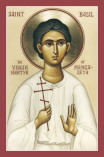 St. Basil was born in 1587 in Yaroslavl,
and as a very small boy, he used to go to the church every time he could. He loved God’s
house and he wanted to be there more than any other place. Because his father, Theodore, was a
poor merchant and his family often had very little food, Basil agreed to become an apprentice for
a merchant in the faraway Siberian town of Mangazeya. The young Basil was a very good and careful
worker, and soon he was given a more responsible job in the company. Siberia was a very dangerous
place, full of wild animals, warlike native tribes, and lawless men. There were almost no women
in Siberia. Thus, some perverse men used to commit homosexual acts with young men and boys. Soon
after the saint had arrived in Mangazeya, his boss tried to entice the youth into homosexual
relations, first with flattery and bribes and finally with threats and punishments. Basil,
however, rejected the depraved man and continued to fast and pray and ask God to help him remain
pure. The boss hated Basil for his meek and humble personality and for his devout religious life.
Yet no matter how much he persecuted and mistreated the innocent lad, Basil continued to perform
all his duties faithfully and honestly.
St. Basil was born in 1587 in Yaroslavl,
and as a very small boy, he used to go to the church every time he could. He loved God’s
house and he wanted to be there more than any other place. Because his father, Theodore, was a
poor merchant and his family often had very little food, Basil agreed to become an apprentice for
a merchant in the faraway Siberian town of Mangazeya. The young Basil was a very good and careful
worker, and soon he was given a more responsible job in the company. Siberia was a very dangerous
place, full of wild animals, warlike native tribes, and lawless men. There were almost no women
in Siberia. Thus, some perverse men used to commit homosexual acts with young men and boys. Soon
after the saint had arrived in Mangazeya, his boss tried to entice the youth into homosexual
relations, first with flattery and bribes and finally with threats and punishments. Basil,
however, rejected the depraved man and continued to fast and pray and ask God to help him remain
pure. The boss hated Basil for his meek and humble personality and for his devout religious life.
Yet no matter how much he persecuted and mistreated the innocent lad, Basil continued to perform
all his duties faithfully and honestly.
During the Paschal Matins, thieves robbed the merchandise house in which Basil worked. Discovering the theft, the boss went to the governor and reported the theft, accusing Basil of the crime. Thus, on the day of Christ’s Bright Pascha, when the holy Church calls all people to peace and love, this innocent, God-fearing boy was betrayed by a false witness, just as Christ had been betrayed by false witnesses. The governor did not even investigate the charges but immediately sent officers to arrest St. Basil and drag him out of the church. The governor and Basil’s boss began to torture the boy in order to force a confession from him. In spite of all the fierce tortures, the blessed one would only reply meekly, “I am innocent.” The pain from the tortures became so unbearable that the youth fainted for a while. His meekness and patient endurance enraged the evil merchant even more, so he finally, in a demonic frenzy, struck the innocent virgin on the head with a heavy chain of keys. The righteous Basil fell to the floor, sighed heavily, and gave up his pure soul into the hands of the Lord, on the day of Christ’s radiant Pascha, 1600. He was thirteen years old.
In order to hide their foul crime, the governor and the passion-crazed merchant placed the body of the holy martyr into a rough coffin and lowered it into a nearby marsh, weighted down with stones. Fifty-two years later, God willed to reveal the glory of His holy virgin-martyr, and many wondrous events began to occur in the area around Mangazeya. Several pious people had dreams in which a beardless youth appeared to them, and many ill people were healed by this holy boy. A strange light was seen over the marsh and unseen voices were heard chanting nearby. Then, the coffin of this saint rose slowly to the top of the mud. A pious archer, Steven Shiryaev, noticed the coffin but did not approach it until St. Basil appeared to him in a dream and told him to open the coffin. Then the whole story of St. Basil’s martyrdom became known, and his relics, whole and incorrupt, were retrieved from the swamp. A chapel was built for the relics, and many people received healings through the prayers of the young martyr.
Author’s note: In the Greek Synaxarion and the Athonite Patrology, the New-Martyr Luke from Jedrene is commemorated on this day. He was taken to Constantinople by the Turks as a child and circumcised. He was greatly troubled in his conscience because of this, regarding his circumcision as the devil’s seal upon him, which he could destroy only by suffering martyrdom for Christ. He became a monk on the Holy Mountain and went with his elder, Vissarion, to Mytilene. There he was murdered by the Turks on March 23rd, 1802. Hanging in the air, the martyr’s body gave forth a fragrant myrrh.
FOR CONSIDERATION
St. Paphnutios prayed to God to reveal to him whom he (Paphnutios) resembled, and he heard a voice that said to him: ‘You are like a merchant seeking goodly pearls: get up, and don’t be lazy!’ But God could not say to all of us that we are like merchants seeking goodly pearls. For many of us do not seek pearls but bury ourselves under thicker and thicker layers of worthless dust. It is not only pearls that a fishing-net brings up from the bottom of the sea, but also mud and sand. An ignoramus grabs at the mud and sand as at the pearl. Only a merchant who can recognize a true pearl throws the net into the sea innumerable times, sifting out the mud and sand until he finds one seed pearl. Why did God compare Paphnutios to a merchant? Because Paphnutios had given all his goods and devoted all his efforts and his time in order somehow to find that one, true seed-pearl. That one pearl is a heart purified from passions and evil thoughts, and inflamed with love for God. Get up, man, and don’t be lazy! The day of your marketing is nearing its twilight.
Daily Scripture Readings taken from The Orthodox New Testament, translated and published by Holy Apostles Convent, Buena Vista, Colorado, copyright © 2000, used with permission, all rights reserved.
Daily Prologue Readings taken from The Prologue of Ochrid, by Bishop Nikolai Velimirovic, translated by Mother Maria, published by Lazarica Press, Birmingham, England, copyright © 1985, all rights reserved. Edited by Dormition Skete.