

Daily Devotional
Saturday, April 4, 2026 (NS), March 22, 2026 (OS)
Fast Day, but Shellfish, Wine and Olive Oil Allowed.
Holy & Great Fast
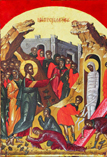
| Saturday of the Holy and Righteous Lazarus |
The commemoration of the holy Martyr Basil the presbyter of Ankyra.
Scripture Readings
Paschalion — Movable Calendar
Saturday of the Holy and Righteous Lazarus
Epistle
The Reading is from the Epistle of Saint Paul to the Hebrews [§ mid 333]. Brethren:
12 28Since we are receiving an unshakable kingdom, let us be having gratitude by which we may worship God well pleasingly with reverence and piety. 29For also, “Our God is a consuming fire [cf. Deut. 4:24].”
13 1Let brotherly love abide. 2Cease being forgetful of hospitality, for by this some entertained angels unawares. 3Be mindful of those in bonds as bound with them, of those being ill-treated as being yourselves also in the body. 4Marriage is honorable in all, and the bed undefiled; but fornicators and adulterers God will judge. 5Let your manner of life be without covetousness, being satisfied with things at hand; for He hath said, “In no wise will I leave thee, nor in any wise will I abandon thee [cf. Deut. 31:6].” 6So that being of good courage we may say, “The Lord is a helper to me, and I will not be afraid; what shall man do to me [cf. Ps. 117(118):6]?”
7Be remembering those who lead you, who spoke to you the word of God, whose faith keep on imitating, observing attentively the end of their conduct: 8Jesus Christ, the same yesterday and today and to the ages.
Gospel
The Reading is from the Holy Gospel according to Saint John [§ 39]. At that time:
11 1There was a certain sick man, Lazarus of Bethany, of the village of Mary and her sister Martha. 2And it was that Mary who anointed the Lord with perfumed ointment and wiped His feet with her hair, whose brother Lazarus was sick. 3Therefore the sisters sent to Him, saying, “Lord, behold, he whom Thou lovest is sick.” 4And after Jesus heard that, He said, “This sickness is not to death, but for the glory of God, in order that the Son of God might be glorified by it.” 5Now Jesus loved Martha and her sister and Lazarus. 6When He heard therefore that “he is sick,” then indeed He remained in the place which He was for two days. 7Then after this He saith to His disciples, “Let us go into Judæa again.” 8The disciples say to Him, “Rabbi, just now the Jews were seeking to stone Thee, and goest Thou there again?” 9Jesus answered, “There are twelve hours in the day, are there not? If anyone walk about in the day, he stumbleth not, because he seeth the light of this world; 10“but if anyone walk about in the night, he stumbleth, because the light is not in him.” 11These things He said, and after this He saith to them, “Our friend Lazarus hath fallen asleep; but I go that I might awaken him.” 12Then said His disciples, “Lord, if he hath fallen asleep, he shall recover.” 13But Jesus had spoken about his death; but they thought that He spoke about taking rest in sleep. 14Therefore Jesus then said to them openly, “Lazarus died. 15“And I rejoice on your account that I was not there, in order that ye might believe; but let us go to him.” 16Then Thomas, the one who was called Didymos, said to his fellow disciples, “Let us also go, that we might die with Him.”
17Then after Jesus came, He found that he already had been in the sepulcher four days. 18Now Bethany was nigh to Jerusalem, about fifteen stadia away, 19and many of the Jews had come to join the women around Martha and Mary, in order that they might console them concerning their brother. 20Then Martha, when she heard that “Jesus is coming,” went to meet Him; but Mary was sitting in the house. 21Then Martha said to Jesus, “Lord, if Thou wert here, my brother would not have died. 22“But even now I know that whatsoever Thou Thyself shalt ask of God, God will give it to Thee.” 23Jesus saith to her, “Thy brother shall rise up.” 24Martha saith to Him, “I know that he shall rise up in the resurrection in the last day.” 25Jesus said to her, “I am the resurrection and the life. The one who believeth in Me, though he die, he shall live; 26“and everyone who liveth and believeth in Me, in no wise shall ever die. Believest thou this?” 27She saith to Him, “Yea, Lord, I have believed that Thou art the Christ, the Son of God, Who cometh into the world.” 28And after she said these things, she went away and called Mary her sister secretly, and saith, “The Teacher is present and calleth thee.” 29And the latter, when she heard, rose up quickly and came to Him. 30Now Jesus had not yet come into the village, but was in the place where Martha went to meet Him. 31The Jews then who were with her in the house, and consoling her, after they saw that Mary quickly rose up and went out, followed her, saying, “She is going to the sepulcher that she might weep there.” 32Then when Mary came where Jesus was, and saw Him, she fell at His feet, saying to Him, “Lord, if Thou wert here, my brother would not have died.” 33When Jesus therefore saw her weeping, and the Jews who came down with her weeping, He rebuked His deep feelings in the spirit and troubled Himself, 34and said, “Where have ye laid him?” They said to Him, “Lord, come and see.” 35Jesus wept. 36Then the Jews were saying, “Behold, how He was loving him.” 37But some of them said, “Was not this One able, Who opened the eyes of the blind, to have caused that this one should not die?” 38Then Jesus, again rebuking His deep feelings in Himself, cometh to the sepulcher. Now it was a cave, and a stone was lying upon it. 39Jesus saith, “Take away the stone.” Martha, the sister of the one who was dead, saith to Him, “Lord, already he stinketh, for it is the fourth day.” 40Jesus saith to her, “I said to thee that if thou wouldest believe, thou shouldest see the glory of God, did I not?” 41Then they took away the stone where the dead one was laid. And Jesus lifted His eyes upwards, and said, “Father, I give thanks to Thee that Thou heardest Me. 42“But I know that Thou hearest Me always; but on account of the crowd which stood around I said it, that they might believe that Thou didst send Me forth.” 43And after He said these things, He cried with a loud voice, “Lazarus, come forth.” 44And the one who was dead came forth, his feet and hands having been bound with graveclothes; and his face had been bound about with a napkin. Jesus saith to them, “Loose him, and let him go.”
45Then many of the Jews who came to Mary, and saw what Jesus did, believed in Him.
Menaion — Fixed Calendar
The commemoration of the holy Martyr Basil the presbyter of Ankyra.
No readings given.
Lives of the Saints (Prologue)
April 4th – Civil Calendar
March 22nd – Church Calendar
1. The Hieromartyr Basil, Priest of Ankyra.
Under the Emperor Constantius there was much suffering at the hands of the Arians. At that time, Basil became known as a staunch defender of Orthodoxy and a true shepherd of his flock in Ankyra. When, after Constantius, Julian the Apostate came to the throne and began to persecute the Christians, Basil openly denounced this new wickedness and encouraged his people in the Faith. For this he was thrown into prison. When the Emperor Julian came to Ankyra, Basil was brought before him and he began to urge Basil to abandon the Christian Faith, promising him honors and wealth. Then Basil answered him: ‘I believe in my Christ, Whom you have denied and Who gave you this earthly kingdom, but He will shortly take this from you. How can you have no shame before the altar under which you were saved from death as an eight-year-old child when they sought to kill you? Therefore He will soon take this earthly kingdom from you, and your body shall not be buried when you have spewed forth your soul in bitter torments.’ Julian was furious and ordered that a strip of skin be torn from his body every day. And his torturers carried this out for seven days. When Basil was brought out again before the emperor, he tore a strip of his own flesh off and threw it into Julian’s face, shouting: ‘Take this and eat it, Julian, if such food is sweet to you, but Christ is life for me!’ This occurrence was noised in the town, and the emperor left Ankyra in secret out of shame and went to Antioch. And they continued to torture Basil with red-hot irons until he surrendered his soul to his Lord for Whom he had suffered so much. This was in the year 363.
2. St. Drosida.
The daughter of the Emperor Trajan, she was seized with five other women when they were gathering the bodies of the martyrs who had suffered for Christ by night, and was for this cruelly mutilated by the emperor. The five women were terribly tortured and at last thrown into molten copper, where they surrendered their souls to their Lord. But Drosida remained under strict imperial guard. However, she escaped from the court and after eight days she gave her soul into God’s hands.
3. Our Holy Father, the Martyr Efthymios (Euthymius).
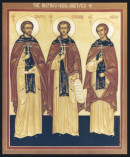 He was born in the
village of Dimitsana in the Peloponnese. As a boy, he lived as a Christian, but later he went to
Romania and there gave himself over to great debauchery. In this debasement, the evil spirit led
him to embrace Islam. No sooner had he done so than he began to repent bitterly. He returned to
the Christian Faith and became a monk on the Holy Mountain. After several years spent in strict
fasting and prayer, he made up his mind to die for Christ. With the blessing of his spiritual
father, he went to Constantinople, where he somehow succeeded in gaining access to the grand
vizier. He began to make the sign of the Cross in front of him, to praise Christ and to denounce
Mohammed. After long-drawn-out torture, he was condemned to death and was slain on March 22nd,
1814, on Palm Sunday. Many miraculous healings of the sick were wrought through his relics. His
precious head is in the Russian monastery of St. Panteleimon on the Holy Mountain. Thus this
twenty-year-old youth first died to Christ and then died for Christ.
He was born in the
village of Dimitsana in the Peloponnese. As a boy, he lived as a Christian, but later he went to
Romania and there gave himself over to great debauchery. In this debasement, the evil spirit led
him to embrace Islam. No sooner had he done so than he began to repent bitterly. He returned to
the Christian Faith and became a monk on the Holy Mountain. After several years spent in strict
fasting and prayer, he made up his mind to die for Christ. With the blessing of his spiritual
father, he went to Constantinople, where he somehow succeeded in gaining access to the grand
vizier. He began to make the sign of the Cross in front of him, to praise Christ and to denounce
Mohammed. After long-drawn-out torture, he was condemned to death and was slain on March 22nd,
1814, on Palm Sunday. Many miraculous healings of the sick were wrought through his relics. His
precious head is in the Russian monastery of St. Panteleimon on the Holy Mountain. Thus this
twenty-year-old youth first died to Christ and then died for Christ.
FOR CONSIDERATION
Even in His agony on the Cross, the Lord Jesus did not condemn sinners, but held up before His Father forgiveness for their sins, saying: ‘they know not what they do!’ Let us judge no man, that we be not condemned. For no one is certain that he will not, before his death, commit that very sin for which he has condemned his brother. St. Anastasios of Sinai teaches: ‘If you see someone sinning, do not condemn him, for you do not know how he will finish his life. That thief crucified with Christ was a murderer, and Judas was an apostle of Christ’s, but the thief entered Paradise and Judas went to perdition. If you see someone sin, you do not know his good works. For many sin in public and repent in private, and we see their sin but do not know of their repentance. Therefore, my brethren, let us condemn no man, that we be not condemned.’
Daily Scripture Readings taken from The Orthodox New Testament, translated and published by Holy Apostles Convent, Buena Vista, Colorado, copyright © 2000, used with permission, all rights reserved.
Daily Prologue Readings taken from The Prologue of Ochrid, by Bishop Nikolai Velimirovic, translated by Mother Maria, published by Lazarica Press, Birmingham, England, copyright © 1985, all rights reserved. Edited by Dormition Skete.