

Daily Devotional
Monday, April 6, 2026 (NS), March 24, 2026 (OS)
Fast Day. No Meat, Fish, Dairy, Eggs, Alcohol or Olive Oil Allowed.
Holy Week
| Holy and Great Monday |
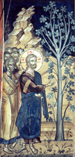
The commemoration of the Forefeast of the Annunciation, and our holy father among the saints, Artemon, Bishop of Seleucia of Pisidia, and our venerable Father Zacharias the Recluse.
Scripture Readings
Paschalion — Movable Calendar
Holy and Great Monday
Epistle
There is no Epistle Reading this day because of Holy Week.
Gospel
In the Orthros
The Reading is from the Holy Gospel according to Saint Matthew [§ 84]. At that time:
21 18As Jesus returned into the city, He hungered. 19And having seen a single fig tree in the way, He came to it and found nothing on it, except leaves only, and said to it, “Let there be no more fruit from thee forever.” And forthwith the tree was withered. 20And after the disciples saw it, they wondered, saying, “How was the fig tree withered forthwith?” 21And Jesus answered and said to them, “Verily I say to you, if ye have faith and doubt not, ye shall not only do that which was done to the fig tree, but even if ye should say to this mountain, ‘Be thou taken away, and be thou cast into the sea,’ it shall come to pass. 22“And all things, whatsoever ye ask in prayer, believing, ye shall receive.”
23And after He came into the temple, the chief priests and the elders of the people came to Him as He taught, saying, “By what authority doest Thou these things? And who gave Thee this authority?” 24And Jesus answered and said to them, “I also will question you for one word, which if ye tell Me, I also will tell you by what authority I am doing these things. 25“The baptism of John—from what place was it? From heaven or from men?” And they were reasoning with themselves, saying, “If we should say, ‘From heaven,’ He will say to us, ‘Why then did ye not believe him?’ 26“But if we should say, ‘From men,’ we fear the multitude; for all hold John as a prophet.” 27And they answered and said to Jesus, “We know not.” And He said to them, “Neither do I tell you by what authority I am doing these things. 28“But what think ye? A certain man had two children, and he came to the first and said, ‘Child, go today and work in my vineyard.’ 29“And he answered and said, ‘I will not’; but afterward he felt regret and went forth. 30“And he came to the second and spoke in like manner. And he answered and said, ‘I go, sir’; and he went not forth. 31“Which of the two did the will of the father?” They say to Him, “The first.” Jesus saith to them, “Verily I say to you that the tax collectors and the harlots go into the kingdom of God before you. 32“For John came to you in the way of righteousness, and ye believed him not; but the tax collectors and the harlots believed him; and ye, having seen, felt no regret afterward in order to believe him.
33“Hear another parable: There was a certain man, a master of a house, who planted a vineyard, and put a hedge around it, and dug a wine-vat in it in which to press grapes, and built a tower. And he let it out to vinedressers, and went abroad. 34“And when the season of the fruits drew near, he sent forth his slaves to the vinedressers to receive his fruits. 35“And the vinedressers took his slaves, and indeed beat one, and killed another, and stoned another. 36“Again he sent forth other slaves, more than the first; and they did to them in like manner. 37“But afterwards he sent his son to them, saying, ‘They will respect my son.’ 38“But after the vinedressers saw the son, they said among themselves, ‘This is the heir. Come, let us kill him, and let us gain possession of his inheritance.’ 39“And they took him, and cast him out of the vineyard, and slew him. 40“Whenever the lord, therefore, of the vineyard should come, what shall he do to those vinedressers?” 41They say to Him, “He will evilly destroy those evil men, and will let out the vineyard to other vinedressers who shall render to him the fruits in their seasons.” 42Jesus saith to them, “Did ye never read in the Scriptures, ‘The stone which the builders rejected, this became the head of the corner; this came to be from the Lord, and it is marvellous in our eyes [Ps. 117(118):22, 23; cf. Is. 28:16]’? 43“On this account I say to you that the kingdom of God shall be taken away from you, and it shall be given to a nation producing the fruits of it.”
In the Liturgy of the Presanctified Gifts
The Reading is from the Holy Gospel according to Saint Matthew [§ 98]. At that time:
24 3As Jesus sat upon the Mount of Olives, His disciples came to Him privately, saying, “Tell us, when shall these things be, and what shall be the sign of Thy coming, and of the completion of the age?” 4And Jesus answered and said to them, “Be taking heed, lest anyone lead you astray. 5“For many shall come in My name, saying, ‘I am the Christ’; and they shall lead astray many. 6“But ye are going to hear of wars and rumors of wars; keep on looking out and cease being clamorous; for all these things must come to pass, but the end is not yet. 7“For nation shall be stirred up against nation, and kingdom against kingdom. And there shall be famines, and plagues, and earthquakes, in place after place. 8“But all these are a beginning of birth pangs. 9“Then they shall deliver you up to affliction, and shall kill you; and ye shall be hated by all the nations for My name’s sake. 10“And then many shall be made to stumble, and shall deliver up one another, and shall hate one another. 11“And many false prophets shall be raised up, and shall lead astray many. 12“And because lawlessness shall have been multiplied, the love of the multitude shall grow cold. 13“But the one who endureth to the end, this one shall be saved. 14“And this Gospel of the kingdom shall be proclaimed in all the inhabited world, for a testimony to all the nations; and then shall the end come. 15“Whenever ye therefore see ‘the abomination of the desolation [cf. Dan. 9:27, 12:11],’ which was spoken of by Daniel the prophet, standing in the holy place”—the one who readeth, let him understand— 16“then let those in Judæa flee to the mountains. 17“The one on the housetop, let him not come down to take away anything out of his house. 18“And the one in the field, let him not return back to take up his clothes. 19“And woe to those who are with child and to those who give suck in those days. 20“But be praying that your flight might not take place in winter, neither on a sabbath. 21“For then there shall be great affliction, such as hath not been from the beginning of the world until the present, no, nor ever shall be. 22“And if those days were not shortened, no flesh would be saved; but for the elect’s sake those days shall be shortened. 23“Then if anyone should say to you, ‘Behold, here is the Christ,’ or ‘Here,’ do not begin to believe it. 24“For false christs and false prophets shall be raised up, and they shall produce great signs and wonders, so as to lead astray, if possible, even the elect. 25“Behold, I have told you beforehand. 26“If then they should say to you, ‘Behold, He is in the desert,’ do not begin to go forth; ‘Behold, He is in the secret chambers,’ do not begin to believe it. 27“For even as the lightning cometh forth from the east and appeareth as far as the west, so also shall be the coming of the Son of Man. 28“For wheresoever the corpse may be, there will the eagles be gathered together.
29“And straightway after the affliction of those days shall the sun be darkened, and the moon shall not give her light, and the stars shall fall from the heaven, and the powers of the heavens shall be shaken. 30“And then shall the sign of the Son of Man appear in the heaven, and then the tribes of the earth shall mourn, and they shall see the Son of Man coming on the clouds of the heaven with power and great glory. 31“And He shall send forth His angels with a great sound of a trumpet, and they shall gather together His elect from the four winds, from the uttermost parts of the heavens unto their extremities. 32“Now learn the parable from the fig tree: Whenever its branch at once should become tender and put forth leaves, ye know that the summer is near. 33“Thus also ye, whenever ye see all these things, know ye that it is near, even at the doors. 34“Verily I say to you, in no wise shall this generation pass away until all these things shall have taken place. 35“The heaven and the earth shall pass away, but My words in no wise shall pass away.”
Menaion — Fixed Calendar
The commemoration of the Forefeast of the Annunciation, and our holy father among the saints, Artemon, Bishop of Seleucia of Pisidia, and our venerable Father Zacharias the Recluse.
No readings given.
Lives of the Saints (Prologue)
April 6th – Civil Calendar
March 24th – Church Calendar
1. St. Artemon, Bishop of Seleukeia.
He was born and educated in Seleukeia. When the Apostle Paul came to that city, he saw Artemon, confirmed him yet more strongly in the Christian Faith and made him bishop of the city. Artemon guided Christ’s flock with love and zeal as a physician to the souls and bodies of his people, and entered into eternity in great old age.
2. Our Holy Father Iakovos the Confessor.
He suffered for the sake of the holy icons under the Emperor Leo the Armenian (813-820). He was a monk and a brother of the Studite monastery. When the great Theodore of the Studion was sent into exile, Iakovos was given over to great tortures to force him to renounce the veneration of icons. But he remained steadfast and faithful to Orthodoxy to the end. They returned him to his monastery, beaten and tortured, when the evil Emperor Leo had made a bad end. He died of his grievous injuries there in the monastery, and entered into the company of the citizens of heaven.
3. The Hieromartyr Parthenios, Patriarch of Constantinople.
Born on the island of Mytilene, he was Bishop of Chios for a long time, and was later chosen as patriarch. But because of false allegations that he was working against the state, the Turks at first tried to force him to embrace Islam, and when he refused decisively, hanged him in 1657.
4. Commemoration of the Miracle at the Monastery of the Caves in Kiev.
Two friends, John and Sergius, swore brotherhood before the icon of the holy Mother of God in this monastery. John was a rich man with a five-year-old son, Zachariah. John fell ill, and at his death commended his son to the care of Sergius, and left in Sergius’ keeping a large sum of silver and gold for him to hand over to Zachariah when he had grown up. When Zachariah came of age, however, Sergius denied receiving anything from the deceased John. Then Zachariah said: ‘Let him swear before the same icon of the most holy Mother of God, in front of which he accepted brotherhood with my late father, that he received nothing from John, and then I will seek nothing more from him.’ Sergius agreed, but when he had sworn this and went up to kiss the icon, some force held him back and would not allow him to come near. Then, tormented all at once by a demon, he began to cry out: ‘Holy fathers Anthony and Theodosius, do not let this merciless angel destroy me!’ The demon had attacked him by God’s permission. He then told them of all the money which John had left. But when they opened the box, they found double the amount. Taking it, Zachariah gave it to the monastery and was himself tonsured as a monk. He lived a long time and was worthy of God’s great gifts, entering peacefully into eternity.
5. Our Holy Father Zacharias.
He was the son of Carion the Egyptian, who left wife and children to become a monk. The father took Zacharias with him, since his mother was unable to provide for him. Although younger than many of the elders in Sketis, he received greater gifts of grace than many of them. He felt as if his whole interior was aflame with the grace of God. Zacharias replied to the question of St. Makarios, ‘Who is a true monk?’ saying: ‘He who constantly restrains himself in order to fulfill God’s commandments.’ And to the question of Abba Moses: ‘What does it mean to be a monk?’ Zacharias took off his hat and trod it underfoot, saying: ‘If a man be not so broken, he cannot be a monk.’ He was a great light among the monks in the desert, and went to his peace in the Lord at an early age.
FOR CONSIDERATION
One time, Abba Daniel and Abba Ammon were journeying together. Abba Ammon asked: ‘When shall we come to a cell, father?’ (i.e. to be able to pray to God). Abba Daniel replied: ‘Who is depriving us of God right at this moment? God is in the cell and outside the cell—the same God.’ By this we are taught the uninterruptedness of prayer, meditation on God and pondering on His works in us and around us. A church building facilitates and strengthens prayer, as also withdrawal and solitude, in their way, facilitate and strengthen it. But he who does not want to pray will not be tied by either church or cell. Nor will he who has tasted the sweetness of prayer be able to separate either his nature or his journeyings from prayer.
Daily Scripture Readings taken from The Orthodox New Testament, translated and published by Holy Apostles Convent, Buena Vista, Colorado, copyright © 2000, used with permission, all rights reserved.
Daily Prologue Readings taken from The Prologue of Ochrid, by Bishop Nikolai Velimirovic, translated by Mother Maria, published by Lazarica Press, Birmingham, England, copyright © 1985, all rights reserved. Edited by Dormition Skete.