

Daily Devotional
Saturday, November 1, 2025 (NS), October 19, 2025 (OS)
No Fasting.
Saturday of the Twenty-First Week
The commemoration of the holy Prophet Joel, and our holy and venerable Father John of Rila, and St. John of Kronstadt.
Scripture Readings
Paschalion — Movable Calendar
Saturday of the Twenty-First Week
Epistle
The Reading is from the Second Epistle of Saint Paul to the Corinthians [§ 174]. Brethren:
3 12Since we have such hope, we use much boldness; 13and not as Moses who used to put a veil over his face, in order that the sons of Israel should not look intently at the end of that being abolished. 14But their minds were hardened: For until this day, the same veil remaineth upon the reading of the old testament, it not being revealed that in Christ the veil is being abolished. 15But until today, when Moses is being read, a veil lieth upon their heart. 16But whenever it shall turn to the Lord, the veil is taken away. 17Now the Lord is the Spirit; and where the Spirit of the Lord is, there is freedom. 18But we all, with unveiled face, reflecting as a mirror the glory of the Lord, are being transformed into the same image from glory to glory, even as from the Lord, the Spirit.
Gospel
The Reading is from the Holy Gospel according to Saint Luke [§ 29]. At that time:
7 1Jesus entered into Capernaum. 2And a certain slave of a centurion, who was highly valued by him, being ill, was about to die. 3And after he heard about Jesus, he sent out elders of the Jews to Him, asking Him to come and cause his slave to recover. 4And they, having gone to Jesus, were beseeching Him earnestly, saying that he is worthy to whom He shall grant this. 5“For he loveth our nation, and he himself built the synagogue for us.” 6Now Jesus began going with them; but, already, when He was not far away from the house, the centurion sent friends to them, saying to them, “Lord, cease troubling Thyself; for I am not fit that Thou shouldest enter under my roof. 7“Wherefore, I deemed myself not even worthy to come to Thee; but speak a word, and my servant shall be healed. 8“For I also am a man who is placed under authority, having soldiers under me. And I say to this one, ‘Go,’ and he goeth; and to another, ‘Come,’ and he cometh; and to my slave, ‘Do this,’ and he doeth it.” 9And after Jesus heard these things, He marvelled at him. And having turned around to the crowd following Him, He said, “I say to you, not even in Israel did I find so great faith.” 10And after those who were sent returned to the house, they found the slave well who had been sick.
Menaion — Fixed Calendar
The commemoration of the holy Prophet Joel, and our holy and venerable Father John of Rila, and St. John of Kronstadt.
Epistle
For the Prophet:
The Reading is from the Acts of the Apostles [§ 4]. In those days:
2 14Peter, having taken his stand with the eleven, lifted up his voice and spoke out to them, “Men, Jews, and all those who inhabit Jerusalem, let this be known to you, and hearken to my words. 15“For these are not drunk, as ye suppose, for it is the third hour of the day. 16“But this is that which hath been spoken by the Prophet Joel, 17“‘And it shall be in the last days,’ saith God, ‘I will pour out of My Spirit upon all flesh; and your sons and your daughters shall prophesy, and your young men shall see visions, and your old men shall dream dreams [cf. Joel 2:28]; 18“‘and even upon My bondmen and upon My bondwomen in those days I will pour out of My Spirit [cf. Joel 2:29],’ and they shall prophesy. 19“‘And I will show wonders in the heaven above, and signs on the earth below, blood and fire and vapor of smoke [cf. Joel 2:30]. 20“‘The sun shall be turned into darkness, and the moon into blood, before that great and notable day of the Lord come [Joel 2:31]. 21“‘And it shall be that everyone, whosoever shall call upon the name of the Lord, shall be saved [Joel 2:32].’”
For the venerable Father:
The Reading is from the Epistle of Saint Paul to the Galatians [§ 213]. Brethren:
5 22The fruit of the Spirit is love, joy, peace, long-suffering, kindness, goodness, faith, 23meekness, self-control; against such things there is no law. 24But they who are of the Christ crucified the flesh with the passions and the lusts. 25If we live by the Spirit, let us also be walking by the Spirit. 26Let us not become vainglorious, provoking one another, envying one another.
6 1Brethren, even if a man should be overtaken in some transgression, ye, the spiritual ones, be restoring such a one in the spirit of meekness, looking out for thyself, lest thou also be tempted. 2Keep on bearing one another’s burdens, and thus fill up the law of the Christ.
For St. John of Kronstadt:
The Reading is from the First General Epistle of Saint John [§ mid 73].
4 7Beloved, let us be loving one another, for love is of God, and everyone who loveth hath been born of God and knoweth God. 8The one who loveth not knoweth not God, for God is love. 9In this was manifest the love of God among us, because God hath sent forth His only-begotten Son into the world, in order that we might live through Him. 10In this is love, not that we loved God, but that He Himself loved us, and sent forth His Son to be an expiation for our sins. 11Beloved, if God so loved us, we ought also to love one another.
Gospel
For the venerable Father:
The Reading is from the Holy Gospel according to Saint Luke [§ 24]. At that time:
6 17Jesus stood upon a level place. And there was a crowd of
His disciples, and a great multitude of the people from all of Judæa and Jerusalem and the
seacoast of Tyre and Sidon, who came to hear Him, and to be healed of their diseases—
18even those who were troubled by unclean spirits; and they were cured.
19And all the crowd was seeking to touch Him, for power was coming forth from Him and
healing all. 20And He lifted up His eyes to His disciples, and began to say:
“Blessed are the poor, for yours is the kingdom of God.
21“Blessed are ye who hunger now, for ye shall be
filled.
Blessed are ye who weep now, for ye shall laugh.
22“Blessed are ye whenever men hate you, and whenever they
separate you, and reproach you, and cast out your name as evil, on account of the Son of
Man.
23“Rejoice in that day and leap for joy, for behold, your
reward is great in the heavens.”
For St. John of Kronstadt:
The Reading is from the Holy Gospel according to Saint Luke [§ 26]. The Lord said:
6 31“Even as ye wish that men be doing to you, also be ye doing to them in like manner. 32“And if ye should love those who love you, what kind of thanks is there to you? For even the sinners love those who love them. 33“And if ye should do good to those who do good to you, what kind of thanks is there to you? For even the sinners do the same. 34“And if ye should lend to those from whom ye hope to receive, what kind of thanks is there to you? For also the sinners lend to sinners, in order that they might receive the same. 35“But keep on loving your enemies and doing good, and lending, hoping to receive back nothing; and your reward shall be great, and ye shall be sons of the Highest; for He is kind to the unthankful and to the evil. 36“Therefore keep on becoming compassionate, even as your Father also is compassionate.”
Lives of the Saints (Prologue)
November 1st – Civil Calendar
October 19th – Church Calendar
1. The Holy Prophet Joel.
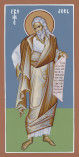 The second in order of the Minor Prophets, Joel was the son
of Phanuel, of the tribe of Reuben. He lived eight hundred years before Christ, and
foretold the misfortunes of the Israelites and their captivity in Babylon for the sins that
they had committed against God. He called the people to fasting and the priests to penitent
and tearful prayer that God would have mercy on them: ‘Sanctify ye a fast and cry
unto the Lord’ (l:14); ‘Let the priests weep between the porch and the
altar’ (2:17). Joel also prophesied the descent of the Holy Spirit upon the apostles,
and the outpouring of His grace on all the faithful (2:28). He foretold and described the
Dreadful Judgement of God, and also the glory of God’s holy Church. The second in order of the Minor Prophets, Joel was the son
of Phanuel, of the tribe of Reuben. He lived eight hundred years before Christ, and
foretold the misfortunes of the Israelites and their captivity in Babylon for the sins that
they had committed against God. He called the people to fasting and the priests to penitent
and tearful prayer that God would have mercy on them: ‘Sanctify ye a fast and cry
unto the Lord’ (l:14); ‘Let the priests weep between the porch and the
altar’ (2:17). Joel also prophesied the descent of the Holy Spirit upon the apostles,
and the outpouring of His grace on all the faithful (2:28). He foretold and described the
Dreadful Judgement of God, and also the glory of God’s holy Church.
|
2. The Holy Martyr Varus.
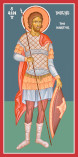 He was a Roman officer in Egypt and a secret Christian. When seven
Christian teachers were thrown into prison, Varus kept visiting them there, supplying their needs
and serving them with great devotion. He marveled at the martyrs, and grieved that fear would not
let him stand up as a martyr for Christ. These men of God gave him courage, and Varus made up his
mind to go and be tortured with them. One of these godly men died in prison, and when the wicked
governor had the martyrs brought before him and saw that there were only six of them, he asked
where the seventh was. ‘I am the seventh!’ cried Varus. The furious governor had him
tortured first. He ordered that he be flogged with dry thongs, then that he be tied to a tree and
hacked to pieces bit by bit with knives until he gave his holy soul to God. His body was then
thrown onto a dung-heap. A woman of Palestinian birth, Cleopatra, the widow of an officer, was
there with her son John. She secretly took the relics of the holy martyr off the dung-heap and
buried them in her house. She then asked the governor’s permission to take the body of her
dead husband back from Egypt to Palestine. As she was an officer’s widow, the governor at
once gave her permission. This blessed Christian woman, Cleopatra, however, took the body, not of
her husband but of the holy martyr Varus, taking it to her village of Edra, near Tabor, and
burying it there. She then built a church dedicated to St. Varus, and he appeared to her often
from the other world, resplendent as an angel of God.
He was a Roman officer in Egypt and a secret Christian. When seven
Christian teachers were thrown into prison, Varus kept visiting them there, supplying their needs
and serving them with great devotion. He marveled at the martyrs, and grieved that fear would not
let him stand up as a martyr for Christ. These men of God gave him courage, and Varus made up his
mind to go and be tortured with them. One of these godly men died in prison, and when the wicked
governor had the martyrs brought before him and saw that there were only six of them, he asked
where the seventh was. ‘I am the seventh!’ cried Varus. The furious governor had him
tortured first. He ordered that he be flogged with dry thongs, then that he be tied to a tree and
hacked to pieces bit by bit with knives until he gave his holy soul to God. His body was then
thrown onto a dung-heap. A woman of Palestinian birth, Cleopatra, the widow of an officer, was
there with her son John. She secretly took the relics of the holy martyr off the dung-heap and
buried them in her house. She then asked the governor’s permission to take the body of her
dead husband back from Egypt to Palestine. As she was an officer’s widow, the governor at
once gave her permission. This blessed Christian woman, Cleopatra, however, took the body, not of
her husband but of the holy martyr Varus, taking it to her village of Edra, near Tabor, and
burying it there. She then built a church dedicated to St. Varus, and he appeared to her often
from the other world, resplendent as an angel of God.
3. Our Holy Father John of Rila.
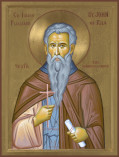 The main feast of St. John is on August 18th. Today we
celebrate the first translation of his relics, in 1238, from Sophia to Trnovo. The main feast of St. John is on August 18th. Today we
celebrate the first translation of his relics, in 1238, from Sophia to Trnovo.
|
4. Our Holy Father Prochorus of Pchinja.
He was a contemporary and friend of St. John of Rila and St. Gabriel of Lesnov. In response to his prayers, God showed him the place where he was to live in asceticism—a wooded area near the River Pchinja. There St. Prochorus lived till old age, and there he died. Only the one, all-seeing God can know all the labors and temptations that he endured throughout his asceticism, but one can judge from his relics, from which myrrh flows forth, and the miracles of healing wrought by him to this day, both the greatness of his asceticism and the greatness of God’s grace given to him as a reward for his great labors. St. Prochorus entered into rest and went to the heavenly kingdom in the eleventh century.
FOR CONSIDERATION
An appearing of the holy martyr Varus: When the devout widow Cleopatra had built a church to St. Varus, she invited the bishop and clergy to consecrate it. A great many Christians gathered for the festivities, for St. Varus was venerated in the whole neighborhood as a great healer and wonder-worker. After the service, the devout benefactress went up to the relics of St. Varus in the church and prayed to him thus: ‘I beg you, you who endured such suffering for Christ, ask of God that which is pleasing to Him and of help to me and my only son.’ Cleopatra had a son, John, who had just gone into the army. As soon as she had left the church, her son, who had been in good health till then, fell ill. He was seized with a burning fever and his state became worse and worse, until he died at about midnight. The angry and grief-stricken mother came to St. Varus’ grave and spoke sharply to him: ‘O man of God, do you call this helping me?’ and she said much more in her bitter grief, then, being greatly exhausted, fell into a light sleep. Suddenly St. Varus appeared to her, accompanied by her son John. They both shone like the sun, clad in raiment whiter than snow, girded with golden girdles and wearing splendid wreaths on their heads. The saint said to her: ‘Didn’t you yourself pray to me to beg of God whatever was pleasing to Him and of help to you and your son? I prayed to God and He, of His unspeakable goodness, has taken your son into His heavenly army. If you want him, here he is; take him and put him in the army of some earthly king.’ Hearing these words, the young John embraced St. Varus and said to him: ‘My lord, don’t listen to my mother, and don’t send me back into the world, that sink of unrighteousness and iniquity, from which you have taken me.’ Rousing from the dream, Cleopatra felt a great joy in her heart, and went joyfully out of the church. She lived for seven years near the church, and St. Varus, together with John, appeared to her often.
Daily Scripture Readings taken from The Orthodox New Testament, translated and published by Holy Apostles Convent, Buena Vista, Colorado, copyright © 2000, used with permission, all rights reserved.
Daily Prologue Readings taken from The Prologue of Ochrid, by Bishop Nikolai Velimirovic, translated by Mother Maria, published by Lazarica Press, Birmingham, England, copyright © 1985, all rights reserved. Edited by Dormition Skete.