

Daily Devotional
Friday, October 31, 2025 (NS), October 18, 2025 (OS)
Fast Day, but Wine and Olive Oil Allowed.
Friday of the Twenty-First Week
The commemoration of the holy Apostle and Evangelist Luke.
Scripture Readings
Paschalion — Movable Calendar
Friday of the Twenty-First Week
Epistle
The Reading is from the Epistle of Saint Paul to the Colossians [§ 253]. Brethren:
2 1I wish you to know how great a struggle I have for you, and for those in Laodicea, and for as many as have not seen my face in the flesh, 2that their hearts might be comforted, having been knit together in love and unto all wealth of the full assurance of understanding, to a full knowledge of the mystery of the God and Father, and of the Christ, 3in Whom are hid all the treasures of wisdom and knowledge. 4And this I say, in order that no one may be beguiling you by persuasive speech; 5for even though I am absent in the flesh, yet I am with you in spirit, rejoicing and seeing your order, and the steadfastness of your faith in Christ.
6As ye therefore received the Christ, Jesus the Lord, be walking in Him, 7rooted and built up in Him, and confirmed in the faith, even as ye were taught, abounding in it in giving of thanks.
Gospel
The Reading is from the Holy Gospel according to Saint Luke [§ 50]. At that time:
10 1The Lord appointed seventy others also, and sent them forth two by two before His face into every city and place where He Himself was about to go. 2Therefore He was saying to them, “The harvest indeed is great, but the workers are few. Entreat therefore the Lord of the harvest that He would send out workers into His harvest. 3“Go; behold, I send you forth as lambs in the midst of wolves. 4“Cease carrying a purse, neither a leathern pouch, nor sandals; and do not begin to greet anyone along the way. 5“And into whatsoever house ye enter, first say, ‘Peace be to this house.’ 6“And if, indeed, there be there a son of peace, your peace shall come to rest upon it; but if not so, it shall return to you. 7“And in that very house keep on remaining, eating and drinking the things given by them, for the worker is worthy of his hire. Do not have the habit of moving from house to house. 8“And into whatsoever city ye enter, and they receive you, go on eating the things which are set before you; 9“and keep on curing the sick in it, and saying to them, ‘The kingdom of God hath drawn near to you.’ 10“But into whatsoever city ye enter, and they receive you not, go out into its broad streets, and say, 11“‘Even the dust of your city, which cleaveth to us, we wipe off ourselves against you; but know this, that the kingdom of God hath drawn near to you.’ 12“But I say to you that it shall be more tolerable in that day for Sodom than for that city. 13“Woe to thee, Chorazin! Woe to thee, Bethsaida! For if the works of power which took place in you took place in Tyre and Sidon, they would have repented long ago, sitting in sackcloth and ashes. 14“But it shall be more tolerable for Tyre and Sidon in the judgment than for you. 15“And thou, Capernaum, which hath been lifted high unto the heaven, shall be brought down as far as Hades.”
Menaion — Fixed Calendar
The commemoration of the holy Apostle and Evangelist Luke.
Epistle
The Reading is from the Epistle of Saint Paul to the Colossians [§ mid 260]. Brethren:
For Gk. usage, see Col. 4:5-11, 14-18; for Sl. usage, see Col. 4:5-11, 14, 18.
4 5Be walking in wisdom toward those who are outside, redeeming the time. 6Let your speech always be with grace, which hath been seasoned with salt, to know how ye ought to answer each one.
7Tychikos, the beloved brother and faithful minister and fellow slave in the Lord, shall make known to you all the things concerning me, 8whom I am sending to you for this very thing, in order that he might know the things concerning you and comfort your hearts, 9with Onesimos, the faithful and beloved brother, who is one of you. They shall make known to you all the things here.
10Aristarchos, my fellow prisoner, greeteth you, and Mark, the cousin of Barnabas—concerning whom ye received orders; if he should come to you, receive him— 11and Jesus, the one who is called Justos, who are of the circumcision. These are the only fellow workers for the kingdom of God who became a consolation to me.... 14Luke the physician, the beloved one, greeteth you, and Demas. 15Greet the brethren in Laodicea, and Nymphas, and the church in his house. 16And whenever the epistle should be read before you, cause that it also be read in the Laodicean Church, and that the epistle from Laodicea should also be read. 17And say to Archippos, “Be taking heed to the ministry which thou didst receive in the Lord, that thou be fulfilling it.” 18The greeting of Paul by mine own hand. Be remembering my bonds. Grace be with you. Amen.
Gospel
The Reading is from the Holy Gospel according to Saint Luke [§ 51]. The Lord said to His disciples:
10 16“The one who heareth you heareth Me, and the one who rejecteth you rejecteth Me, and the one who rejecteth Me rejecteth the One Who sent Me forth.”
17And the seventy returned with joy, saying, “Lord, even the demons are being made subject to us in Thy name.” 18And He said to them, “I was beholding Satan as lightning having fallen out of the heaven. 19“Behold, I give you the authority to tread upon serpents and scorpions, and upon all the power of the enemy; and nothing in anywise shall injure you. 20“However cease rejoicing in this, that the spirits are being made subject to you; but be rejoicing that your names were written in the heavens.” 21In the same hour Jesus rejoiced in the Spirit, and said, “I give thanks to Thee, O Father, Lord of the heaven and of the earth, that Thou didst hide these things from the wise and intelligent, and didst reveal them to babes. Yea, Father, for thus it was well-pleasing before Thee.”
Lives of the Saints (Prologue)
October 31st – Civil Calendar
October 18th – Church Calendar
1. The Holy Apostle and Evangelist Luke.
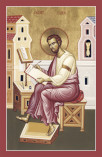 Born in Antioch, he applied himself in his youth to
the study of Greek philosophy, medicine and art. At the time that the Lord Jesus was at work upon
earth, Luke came to Jerusalem, where he saw the Savior face to face, heard His saving teaching
and was a witness of His wonderful works. Coming to belief in the Lord, St. Luke was included
among the Seventy and sent forth to preach the Gospel. Together with Cleopas, he saw the risen
Lord on the road to Emmaus (Lk. 24). After the descent of the Holy Spirit upon the apostles, Luke
returned to Antioch and there became a fellow-worker with the Apostle Paul, with whom he traveled
to Rome, bringing Jews and pagans to the Christian Faith. ‘Luke the beloved physician
salutes you,’ writes the Apostle Paul to the Colossians (4:14). At the request of the
Christians, he wrote his Gospel in about the year 60. After the death by martyrdom of the great
apostle, Luke preached the Gospel all over Italy, Dalmatia, Macedonia and elsewhere. He painted
forty icons of the most holy Mother of God and also icons of the Apostles Peter and Paul, and is
regarded as the founder of Christian iconography. In old age, he visited Libya and Upper Egypt,
and thence returned to Greece, where he set himself with great zeal to preach the Gospel and
bring men to Christ, disregarding his great age. St. Luke wrote both his Gospel and the Acts of
the Apostles, and dedicated them both to Theophilus, governor of Achaia. He was eighty-four years
old when wicked idol-worshippers put him to torture for the sake of Christ and hanged him from an
olive tree in the town of Thebes in Greece. The wonder-working relics of this wonderful saint
were taken to Constantinople in the time of the Emperor Constantius, son of St. Constantine.
Born in Antioch, he applied himself in his youth to
the study of Greek philosophy, medicine and art. At the time that the Lord Jesus was at work upon
earth, Luke came to Jerusalem, where he saw the Savior face to face, heard His saving teaching
and was a witness of His wonderful works. Coming to belief in the Lord, St. Luke was included
among the Seventy and sent forth to preach the Gospel. Together with Cleopas, he saw the risen
Lord on the road to Emmaus (Lk. 24). After the descent of the Holy Spirit upon the apostles, Luke
returned to Antioch and there became a fellow-worker with the Apostle Paul, with whom he traveled
to Rome, bringing Jews and pagans to the Christian Faith. ‘Luke the beloved physician
salutes you,’ writes the Apostle Paul to the Colossians (4:14). At the request of the
Christians, he wrote his Gospel in about the year 60. After the death by martyrdom of the great
apostle, Luke preached the Gospel all over Italy, Dalmatia, Macedonia and elsewhere. He painted
forty icons of the most holy Mother of God and also icons of the Apostles Peter and Paul, and is
regarded as the founder of Christian iconography. In old age, he visited Libya and Upper Egypt,
and thence returned to Greece, where he set himself with great zeal to preach the Gospel and
bring men to Christ, disregarding his great age. St. Luke wrote both his Gospel and the Acts of
the Apostles, and dedicated them both to Theophilus, governor of Achaia. He was eighty-four years
old when wicked idol-worshippers put him to torture for the sake of Christ and hanged him from an
olive tree in the town of Thebes in Greece. The wonder-working relics of this wonderful saint
were taken to Constantinople in the time of the Emperor Constantius, son of St. Constantine.
2. St. Peter of Cetinje, Metropolitan of Montenegro.
Born on April 1st, 1749, in the village of Njegusi, he became a monk at the age of twelve. After the death of Metropolitan Sava in 1782, Peter became Metropolitan and Governor of Montenegro. This holy man devoted his whole life to his people. Within Montenegro, he worked with his whole strength to pacify the warring tribes, and externally he defended the land and the people against plundering onslaughts, succeeding in both the one and the other. He is especially famed for his victory over Napoleon’s army in Dalmatia. He was strict with himself, and just and humble towards others. He lived in one tiny cell as a simple monk, although he was governor of a people. He entered into rest on October 18th, 1830, and his wonder-working relics are preserved incorrupt in the monastery of Cetinje. The Lord glorified him in heaven and on earth as His true and patient servant.
3. St. Julian Savvas of Mesopotamia.
St. Julian, called ‘the Hermit,’ was a Persian, an unlettered peasant, and was in the purity of his heart a vessel of the Holy Spirit. He lived in asceticism near the Euphrates in Mesopotamia, and had the gift of insight. At the moment at which Julian the Apostate perished, St. Julian saw him in spirit and told his disciples. St. Julian, the wonderful servant of God, entered into rest in the year 367.
FOR CONSIDERATION
Can a sinner, in the space of ten days, make full repentance of his sin? By the immeasurable grace of God, he can. In the time of the Emperor Maurice, there was a well-known bandit in the region around Constantinople. Both in the countryside and in the capital itself, he inspired fear and trembling. Then the emperor himself sent him a Cross, as a pledge that he would not punish him if he gave himself up. The bandit took the Cross, and did indeed give himself up. Arriving in Constantinople, he fell at the emperor’s feet and begged his forgiveness. The emperor kept his word, had mercy on him and let him go free. Immediately after that, the bandit fell gravely ill and sensed that death was near. He began to repent bitterly of all his sins, and implored God with tears to forgive him as the emperor had. He shed many tears in his prayer, so that the handkerchief with which he wiped them became soaked, and he died after ten days of prayerful weeping. The night of his death, the doctor who had been attending him had a strange vision in a dream: when the bandit on the bed breathed his last, a number of little black men gathered round him, flourishing bits of paper on which his sins were written, and two glorious angels also appeared. A pair of scales was placed in the middle, and the little black men gleefully put all the bits of paper on it, and their side of the scales was loaded while the other was empty. ‘What can we put in?’ the angels asked each other. ‘Let’s look for something good in his life.’ Then there appeared in the hand of one of the angels the handkerchief soaked with tears of repentance. The angels quickly placed it on their side of the scales, and it at once outweighed the other with all its papers. Then the little black men fled, howling in anguish, but the angels took the man’s soul and carried it to Paradise, glorifying God’s love for mankind.
Daily Scripture Readings taken from The Orthodox New Testament, translated and published by Holy Apostles Convent, Buena Vista, Colorado, copyright © 2000, used with permission, all rights reserved.
Daily Prologue Readings taken from The Prologue of Ochrid, by Bishop Nikolai Velimirovic, translated by Mother Maria, published by Lazarica Press, Birmingham, England, copyright © 1985, all rights reserved. Edited by Dormition Skete.